4101 results for "Novel"

How to Hold a Grudge From Resentment to Contentment—The Power of Grudges to Transform Your Life

Sophie Hannah
NAMED ONE OF THE 100 MUST-READ BOOKS OF THE YEAR BY TIME MAGAZINE “A cheerful, mischievous rebuke to all that spiritual sincerity and floaty nonattachment and sugary loving kindness” ( The Wall Street Journal ), this first and only comprehensive examination of the universal, but widely misunderstood, practice of grudge-holding will show you how to use grudges to be your happiest, most optimistic, and most forgiving self. Secretly, we all hold grudges, but most of us probably think we shouldn’t, and many of us deny that we do. To bear a grudge is too negative, right? Shouldn’t we just forgive and move on? Wrong, says prolific crime novelist and self-appointed grudge guru Sophie Hannah, in her groundbreaking and irreverent self-help guide. Yes, it’s essential to think positively if we want to live happy lives, but even more crucial is how we get to the positive. Denying our negative emotions and experiences is likely to lead only to more pain, conflict, and stress. What if our grudges are good for us? What if we could embrace them, and use them to help ourselves and others, instead of feeling ashamed of our inability to banish negative emotions and memories from our lives? With contributions from expert psychotherapists as well as extracts from her own extensive catalog of grudges, Sophie Hannah investigates the psychological origins of grudges and also offers not-so-obvious insights into how we should acknowledge—and embrace—them in order to improve the quality of our interpersonal relationships and senses of self. Grudges do not have to fill us with hate or make us toxic, bitter, and miserable. If we approach the practice of grudge-holding in an enlightened way, it will do the opposite—we will become more forgiving. For fans of Sophie Hannah’s bestselling crime novels who have ever wondered what is going on in her unusual, brilliant mind, How to Hold a Grudge is “a perfect document” ( The New York Times ) that also reveals everything we need to know about the many different forms of grudge, the difference between a grudge and not-a-grudge (not as obvious as it seems), when we should let a grudge go, and how to honor a grudge and distill lessons from it. Hannah’s practical, compassionate, and downright funny guide can turn us into better, happier people.
Simon and Schuster 2020-01-07 272 pages

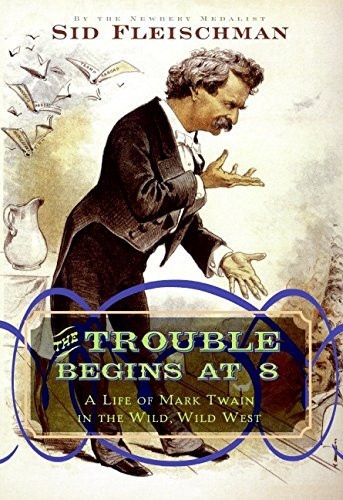
The trouble begins at 8: a life of Mark Twain in the wild, wild West

Fleischman, Sid
"Mark Twain was born fully grown, with a cheap cigar clamped between his teeth." So begins Sid Fleischman's ramble-scramble biography of the great American author and wit, who started life in a Missouri village as a barefoot boy named Samuel Clemens. Abandoning a career as a young steamboat pilot on the Mississippi River, Sam took a bumpy stagecoach to the Far West. In the gold and silver fields, he expected to get rich quick. Instead, he got poor fast, digging in the wrong places. His stint as a sagebrush newspaperman led to a duel with pistols. Had he not survived, the world would never have heard of Tom Sawyer or Huckleberry Finn—or red-headed Mark Twain. Samuel Clemens adopted his pen name in a hotel room in San Francisco and promptly made a jumping frog (and himself) famous. His celebrated novels followed at a leisurely pace; his quips at jet speed. "Don't let schooling interfere with your education," he wrote. Here, in high style, is the story of a wisecracking adventurer who came of age in the untamed West; an ink-stained rebel who surprised himself by becoming the most famous American of his time. Bountifully illustrated.
Greenwillow Books 2008 224 pages

The optical unconscious

Krauss, Rosalind E.
The Optical Unconscious is a pointed protest against the official story of modernism and against the critical tradition that attempted to define modern art according to certain sacred commandments and self-fulfilling truths. The account of modernism presented here challenges the vaunted principle of "vision itself." And it is a very different story than we have ever read, not only because its insurgent plot and characters rise from below the calm surface of the known and law-like field of modernist painting, but because the voice is unlike anything we have heard before. Just as the artists of the optical unconscious assaulted the idea of autonomy and visual mastery, Rosalind Krauss abandons the historian's voice of objective detachment and forges a new style of writing in this book: art history that insinuates diary and art theory, and that has the gait and tone of fiction. The Optical Unconscious will be deeply vexing to modernism's standard-bearers, and to readers who have accepted the foundational principles on which their aesthetic is based. Krauss also gives us the story that Alfred Barr, Meyer Shapiro, and Clement Greenberg repressed, the story of a small, disparate group of artists who defied modernism's most cherished self-descriptions, giving rise to an unruly, disruptive force that persistently haunted the field of modernism from the 1920s to the 1950s and continues to disrupt it today. In order to understand why modernism had to repress the optical unconscious, Krauss eavesdrops on Roger Fry in the salons of Bloomsbury, and spies on the toddler John Ruskin as he amuses himself with the patterns of a rug; we find her in the living room of Clement Greenberg as he complains about "smart Jewish girls with their typewriters" in the 1960s, and in colloquy with Michael Fried about Frank Stella's love of baseball. Along the way, there are also narrative encounters with Freud, Jacques Lacan, Georges Bataille, Roger Caillois, Gilles Deleuze, and Jean-Francois Lyotard. To embody this optical unconscious, Krauss turns to the pages of Max Ernst's collage novels, to Marcel Duchamp's hypnotic Rotoreliefs, to Eva Hesse's luminous sculptures, and to Cy Twombly's, Andy Warhol's, and Robert Morris's scandalous decoding of Jackson Pollock's drip pictures as "Anti-Form." These artists introduced a new set of values into the field of twentieth-century art, offering ready-made images of obsessional fantasy in place of modernism's intentionality and unexamined compulsions. Rosalind Krauss is Professor of Art History at Columbia University and an editor of the journal October.
MIT Press 1993 353 pages

The golden age of the American essay: 1945-1970

Phillip Lopate
"The three decades that followed World War II were an exceptionally fertile period for American essays. The explosion of journals and magazines, the rise of public intellectuals, and breakthroughs in the arts inspired a flowering of literary culture. At the same time, the many problems that confronted mid-century America--racism, sexism, nuclear threat, war, poverty, and environmental degradation among them--proved fruitful topics for America's best minds. In The Golden Age of the American Essay, Phillip Lopate assembles a dazzling array of famous writers, critics, sociologists, theologians, historians, activists, theorists, humorists, poets, and novelists. Here are writers like James Agee, E. B. White, A. J. Liebling, Randall Jarrell, and Mary McCarthy, pivoting from the comic indignities of daily life to world peace, consumerism, and restaurants in Paris. Here is Norman Mailer on Jackie Kennedy, Vladimir Nabokov on Lolita, Martin Luther King, Jr.'s "Letter from Birmingham Jail," and Richard Hofstadter's "The Paranoid Style in American Politics." Here are Gore Vidal, Rachel Carson, James Baldwin, Susan Sontag, John Updike, Joan Didion, and many more, in a treasury of brilliant writing that has stood the test of time." -Amazon.
Anchor Books, a division of Penguin Random House LLC 2021-04-06 519 pages

Day/Night: Travels in the Scriptorium and Man in the Dark

Auster, Paul
"Day/Night brings together two metaphysical novels that mirror each other and are meant to be read in tandem: two men, each confined to a room, one suddenly alert to his existence, the other desperate to escape into sleep. In Travels in the Scriptorium (2007), elderly Mr. Blank wakes in an unfamiliar cell, with no memory of who he is or how he got there. He must use the few objects he finds and the information imparted by the day's string of visitors to cobble together an idea of his identity. In Man in the Dark (2008), another old man, August Brill, suffering from insomnia, struggles to push away thoughts of painful personal losses by imagining what might have been. Who are we? What is real and not real? How does the political intersect with the personal? After great loss, why are some of us unable to go on? "One of America's greats"* and a descendant of Kafka and Borges,** Auster explores in these two small masterpieces some of our most pressing philosophical concerns. *Time Out Chicago/**Booklist"--
Picador/Henry Holt and Company 2013-11-05 320 pages

The Saturday wife

Ragen, Naomi
With more than half a million copies of her novels sold, Naomi Ragen has connected with the hearts of readers as well as reviewers who have met her work with unanimous praise. In The Saturday Wife , Ragen utilizes her fluid writing style--rich with charm and detail--to break new ground as she harnesses satire to expose a world filled with contradiction.Beautiful, blonde, materialistc Delilah Levy steps into a life she could have never imagined when in a moment of panic she decides to marry a sincere Rabbinical student. But the reality of becoming a paragon of virtue for a demanding and hypocritical congregation leads sexy Delilah into a vortex of shocking choices which spiral out of comtrol into a catastrophe which is as sadly believeable as it is wildly amusing.Told with immense warmth, fascinating insight, and wicked humor, The Saturday Wife depicts the pitched and often losing battle of all of us as we struggle to hold on to our faith and our values amid the often delicious temptations of the modern world.
St. Martin's Press 2007-08-07 292 pages

A night to remember: the Haggadah of contemporary voices

Zion, Mishael,Zion, Noam
A full traditional haggadah with a contemporary and Israeli accent. Commentaries from scholars and rabbis, mostly late 20th century, but also from novelists, poets, political leaders, and others. This book is for the family that wants to enhance their seder by bringing in ideas that will make the evening rich, thought-provoking, and fun for all. Many items for younger and older children are sprinkled throughout the book.
Zion Holiday Publications 2007 149 pages

Why? what makes us curious

Livio, Mario
Astrophysicist and author Mario Livio investigates perhaps the most human of all our characteristics—curiosity—in this “lively, expert, and definitely not dumbed-down account” ( Kirkus Reviews ) as he explores our innate desire to know why . Experiments demonstrate that people are more distracted when they overhear a phone conversation—where they can know only one side of the dialogue—than when they overhear two people talking and know both sides. Why does half a conversation make us more curious than a whole conversation? “Have you ever wondered why we wonder why? Mario Livio has, and he takes you on a fascinating quest to understand the origin and mechanisms of our curiosity. I thoroughly recommend it.” (Adam Riess, Nobel Prize Winner in Physics, 2011). Curiosity is not only at the heart of mystery and suspense novels, it is also essential to other creative endeavors, from painting to sculpture to music. It is the principal driver of basic scientific research. Even so, there is still no definitive scientific consensus about why we humans are so curious, or about the mechanisms in our brain that are responsible for curiosity. In the ever-fascinating Why? Livio interviewed scientists in several fields to explore the nature of curiosity. He examined the lives of two of history’s most curious geniuses, Leonardo da Vinci and Richard Feynman. He also talked to people with boundless curiosity: a superstar rock guitarist who is also an astrophysicist; an astronaut with degrees in computer science, biology, literature, and medicine. What drives these people to be curious about so many subjects? An astrophysicist who has written about mathematics, biology, and now psychology and neuroscience, Livio has firsthand knowledge of his subject which he explores in a lucid, entertaining way that will captivate anyone who is curious about curiosity.
Simon & Schuster 2017 252 pages

Deposition, 1940-1944: a secret diary of life in Vichy France

Werth, Léon
Historians agree: the diary of Léon Werth (1878-1955) is one of the most precious--and readable--pieces of testimony ever written about life in France under Nazi occupation and the Vichy regime. Werth was a free-spirited and unclassifiable writer. He is the author of eleven novels, art and dance criticism, acerbic political reporting, and memorable personal essays. He was Jewish, and left Paris in June 1940 to hide out in his wife's country house in Saint-Amour, a small village in the Jura Mountains. His short memoir 33 Days recounts his struggle to get there. Deposition tells of daily life in the village, on nearby farms and towns, and finally back in Paris, where he draws the portrait of a Resistance network in his apartment and writes an eyewitness report of the insurrection that freed the city in August 1966. From Saint-Amour, we see both the Resistance in the countryside--derailing troop trains, punishing notorious collaborators--and growing repression: arrests, torture, deportation, and executions. Above all, we see how Vichy and the Occupation affect the lives of farmers and villagers and how their often contradictory attitudes evolve from 1940 to 1944. Werth's ear for dialogue and novelist's gift for creating characters animate the diary: in the markets and in town, we meet real French peasants and shopkeepers, railroad men and the patronne of the café at the station, schoolteachers and gendarmes. They come off the page alive, and the countryside and villages come alive with them. With biting irony, Werth records, almost daily, what Vichy-German propaganda was saying on the radio and in the press. We follow the progress of the war as people did then, day by day. These entries make interesting, often amusing reading, a stark contrast with his entries on the persecution and deportation of the Jews. Deposition is a varied and complex piece of living history, and a pleasure to read. --
Oxford University Press 2021-07-28 325 pages

The James Bond Films 1962-1989 Interviews with the Actors, Writers and Producers

Lee Goldberg
In the 1980s, long before Lee Goldberg became a #1 New York Times bestselling author and successful TV writer/producer, he paid his UCLA tuition and rent by working as a freelance journalist covering the entertainment industry. His first, big interviews was with one of his idols, screenwriter Richard Maibaum, who wrote most of the James Bond movies. That lengthy, controversial, and award-winning interview, first published in the UCLA Daily Bruin and later reprinted in Starlog Magazine, was the beginning of Lee's extensive 007 coverage. Over the next few years, his Bond-related interviews for Starlog and other publications included actors Barry Nelson (the first man to play James Bond in TV's Casino Royale ), George Lazenby (the one-time Bond in On Her Majesty's Secret Service ), Roger Moore and Timothy Dalton, screenwriters Tom Mankiewicz, Michael Wilson and Lorenzo Semple Jr., and directors John Glen and Peter Hunt. Those interviews and more, quoted for decades in reference books about the Bond films, are now collected for the first time, in their original form, in this entertaining, and unique volume. This book, the first in a series of Goldberg's collected Hollywood journalism, isn't an exhaustive, detailed examination of the Bond films. Instead it's an intriguing snapshot of filmmaking in the 1980s, a revealing look at the creation of the Bond films...and perhaps also offers a glimpse into Goldberg's formative years as a writer, and how the lessons learned from his interviews may have shaped his own career as an acclaimed novelist and screenwriter.
Brash Books LLC 2022-02-28 122 pages

Book of Numbers

Joshua Cohen
When the enigmatic billionare founder and CEO of Tetration, the world's most powerful tech company, is diagnosed with terminal pancreatic cancer, he hires a failed novelist, Josh Cohen, to ghostwrite his memoirs. This tech mogul, known only as 'Principal', takes Josh deep into his own mind, and outlines the history of Tetration, which started by revolutionising the search engine and later ventured into smartphones, computer manufacturing and the surveillance of American citizens. Accompanying Josh on a mind-bending world tour of local Tetration offices, from Palo Alto to Dubai, Principal soon initiates Josh into the secret pretext of the autobiography project, and the life-or-death stakes that surround its publication.
Penguin Random House 2015-06-04 608 pages

They live

Lethem, Jonathan
“One of the cleverest, most accessibly in-depth film books released this year . . . a smart-ass novelist exploring a cheesy-cheeky ‘80s sci-fi flick.”— Hartford Advocate Deep Focus is a series of film books with a fresh approach. Take the smartest, liveliest writers in contemporary letters and let them loose on the most vital and popular corners of cinema history: midnight movies, the New Hollywood of the sixties and seventies, film noir, screwball comedies, international cult classics, and more . . . Kicking off the series is Jonathan Lethem’s take on They Live , John Carpenter’s 1988 classic amalgam of deliberate B-movie, sci-fi, horror, anti-Yuppie agitprop. Lethem exfoliates Carpenter’s paranoid satire in a series of penetrating, free-associational forays into the context of a story that peels the human masks off the ghoulish overlords of capitalism. Taking into consideration classic Hollywood cinema and science fiction—as well as popular music and contemporary art and theory— They Live provides a wholly original perspective on Carpenter’s subversive classic.
Soft Skull Press 2010-11-01 163 pages

Tuscany: inside the light

Meyerowitz, Joel
Joel Meyrowitz is one of the world's best-known and best-selling photographers; his Cape Light has become a color photography classic with 100,000 copies sold. The Tuscan countryside is among the most well-loved on earth, for its beauty, its natural bounty, its magnificent light. Award-winning photographer Joel Meyerowitz and novelist/playwright Maggie Barrett have combined talents to create a loving and personal portrait of Tuscany through the seasons. Meyerowitz provides the breathtaking images; Maggie Barrett offers poetic, evocative commentary that pays loving tribute to this alluring rural world. They take you inside everyday Tuscan life and landscape, and also capture the warmth of the people who live there and their profound connection to the land. Joel Meyerowitz, who has published 14 books, is a Guggenheim fellow and an NEA and an NEH award-winner. His photographs have shown in major museums, including the Museum of Modern Art. He was the only photographer granted access to Ground Zero, where he persistently captured both the devastation and the dedication of the many workers who toiled at the World Trade Center site. Maggie Barrett is the author of three novels and a collection of short stories. Her play, Give it Up, was performed off Broadway.
Sterling 2003 160 pages

Spellbound

Green, Jane
Jane Green, author the best-sellers The Beach House and Second Chance , follows happily married Alice who moves from London to the USA only to discover that her life is not as fairy-tale as it seems in Spellbound . Alice has everything. So why isn't she happy? After all, she has a handsome husband, a gorgeous home and membership of London's most exclusive clubs. Okay, Joe can't keep his hands to himself - but she got what she wanted, didn't she? When Joe's indiscretions force a transfer to New York, Alice hopes it'll be a fresh start. And when they find a beautiful old house in Connecticut she is overjoyed. For a while Alice and Joe are as happy as newlyweds. But then the late nights and unexplained absences start. Alice is desperate to give her marriage a fairy tale ending. What should she do? Stay and fight for Joe? Or try to break the spell he's cast over her? 'Will have you hungrily turning page after page' Heat 'Green whips up a sparkling morality tale that points the finger at bad boys and low-rent romance' Independent 'Her books are just damn readable' Glamour Jane Green's novels, including The Other Woman , Jemima J. , Babyville , The Love Verb (published as Promises to Keep in the USA), Girl Friday ( Dune Road ), Life Swap ( Swapping Lives ), Straight Talking , The Patchwork Marriage ( Another Piece of My Heart ), Mr. Maybe , and Bookends , are as moving as they are funny and have achieved best-seller status internationally. Spellbound is published in the USA as To Have and to Hold .
Penguin 2003-12-04 448 pages

Aurora Dawn

Herman Wouk
The publication of 'Aurora Dawn' in 1947 immediately established Herman Wouk as a novelist of exceptional literary and historical significance. Today, Aurora Dawn's themes have grown still more relevant and, in the manner of all great fiction, its characters and ironies have only been sharpened by the passage of time. Wouk's raucous satire of Manhattan's high-power elite recounts the adventures of one Andrew Reale as he struggles toward fame and fortune in the early days of radio. On the quest for wealth and prestige, ambitious young Andrew finds himself face-to-face with his own devil's bargain: forced to choose between soul and salary, true love and a strategic romance, Wouk's riotous, endearing hero learns a timeless lesson about the high cost of success in America's most extravagant metropolis.
Pocket Books 1983 224 pages

One blade of grass: a zen memoir

Shukman, Henry
**A TLS BOOK OF THE YEAR SELECTION** As heard on The Tim Ferriss Show! 'Captivating' TIMES LITERARY SUPPLEMENT 'The book Shukman was born to write' NATALIE GOLDBERG, author of WRITING DOWN THE BONES 'A wonderful and generous book' DAVID HINTON, author of THE WILDS OF POETRY *** One Blade of Grass is award-winning novelist and poet Henry Shukman's account of his journey through the world of Zen Buddhism. Raised in a rationalist household in Oxford during the spiritual heyday of the Sixties and Seventies, an unexpected spiritual awakening would prompt a lifelong quest to integrate the experience into his life, leading him eventually to Zen Buddhism. As Shukman gets to grips with meditative practice and struggles with anxiety, depression and the chronic eczema he had had since childhoods, he discovers in surprising ways the emotional, spiritual and even physical healing that he has been searching for all along. By turns humorous and moving, this beautifully written memoir demystifies Zen training, casting its profound insights in simple, lucid language, and takes the reader on a journey of their own, into the hidden treasures of life that contemplative practice can reveal to any of us.
Yellow Kite 2021-05-27 339 pages

Comedy in a Minor Key

Hans Keilson
A penetrating study of ordinary people resisting the Nazi occupation - and, true to its title, a dark comedy of wartime manners - Comedy in a Minor Key tells the story of Wim and Marie, a Dutch couple who first hide a Jew they know as Nico, then must dispose of his body when he dies of pneumonia. This novella, first published in 1947 and now translated into English for the first time, shows Hans Keilson at his best- deeply ironic, penetrating, sympathetic, and brilliantly modern, an heir to Joseph Roth and Franz Kafka. In 2008, when Keilson received Germany's prestigious Welt Literature Prize, the citation praised his work for exploring 'the destructive impulse at work in the twentieth century, down to its deepest psychological and spiritual ramifications.' Published to celebrate Keilson's hundredth birthday, Comedy in a Minor Key - and The Death of the Adversary , reissued in paperback - will introduce American readers to a forgotten classic author, a witness to World War II and a sophisticated storyteller whose books remain as fresh as when they first came to light.
Scribe Publications 2011 104 pages