4260 results for "World History"

The four little dragons: the spread of industrialization in East Asia

Vogel, Ezra Felvel
"Japan and the four little dragons—Taiwan, South Korea, Hong Kong, and Singapore—constitute less than 1 percent of the world’s land mass and less than 4 percent of the world’s population. Yet in the last four decades they have become, with Europe and North America, one of the three great pillars of the modern industrial world order. How did they achieve such a rapid industrial transformation? Why did the four little dragons, dots on the East Asian periphery, gain such Promethean energy at this particular time in history? Ezra F. Vogel, one of the most widely read scholars on Asian affairs, provides a comprehensive explanation of East Asia’s industrial breakthrough. While others have attributed this success to tradition or to national economic policy, Vogel’s penetrating analysis illuminates how cultural background interacted with politics, strategy, and situational factors to ignite the greatest burst of sustained economic growth the world has yet seen. Vogel describes how each of the four little dragons acquired the political stability needed to take advantage of the special opportunities available to would-be industrializers after World War II. He traces how each little dragon devised a structure and a strategy to hasten industrialization and how firms acquired the entrepreneurial skill, capital, and technology to produce internationally competitive goods. Vogel brings masterly insight to the underlying question of why Japan and the little dragons have been so extraordinarily successful in industrializing while other developing countries have not. No other work has pinpointed with such clarity how institutions and cultural practices rooted in the Confucian tradition were adapted to the needs of an industrial society, enabling East Asia to use its special situational advantages to respond to global opportunities."
Harvard University Press 1991 138 pages

Electric city: a novel

Rosner, Elizabeth
Upstate New York, at the confluence of the great Hudson River and its mighty tributary the Mohawk —from this stunning landscape came the creation of a new world of science. In 1887, Thomas Edison moved his Edison Machine Works here and in 1892, it became the headquarters of a major manufacturing company, giving the town its nickname: Electric City. The peak of Autumn, 1919: The pull of scientific discovery brings Charles Proteus Steimetz, a brilliant mathematician and recent arrival from Ellis Island, to town. His ability to capture lightning in a bottle earns him the title "Wizard of Electric City." Barely four feet tall with a deeply curving spine, Steinmetz's physical deformity belies his great intellect. Allied with his Mohawk friend Joseph Longboat and his adopted eleven–year–old granddaughter Midget, the advancements he makes in Electric City will, quite simply, change the world. The peak of Autumn, 1965: Sophie Levine, the daughter of a company man, one of the many scientists working at The Company, whose electric logo can be seen from everywhere in town. Her family escaped Europe just before World War II, leaving behind a wake of annihilation and persecution. Ensconced in Electric City, Sophie is coming of age just as the town is gasping its last breaths. The town, and America as a whole, is on the cusp of great instability: blackouts, social unrest over Vietnam, and soon the advent of the seventies. Into her orbit drifts Henry Van Curler, the favored son of one of Electric City's founding Dutch families, as well as Martin Longboat, grandson of Joseph Longboat. This new generation of Electric City will face both the history of their town and their own uncertain future, struggling to bridge the gap between the old world and the new. Electric City is a vital, pulsing, epic novel of America, of its great scientific ingenuity and its emotional ambition; one that frames the birth and evolution of its towns against the struggles of its indigenous tribes, the immigrant experience, a country divided, and the technological advancements that ushered in the modern world.
Counterpoint 2015-10-13 336 pages

Edge of order

Libeskind, Daniel
A stunning tour of the work of internationally known architect Daniel Libeskind and an investigation of a master artist's creative process. Daniel Libeskind is one of the foremost architects of our time, a self-proclaimed rebel celebrated for innovative, site-conscious designs, including the Jewish Museum Berlin and New York's World Trade Center Redevelopment. He has also emerged as one of architecture's most visible public ambassadors. In Edge of Order , Libeskind opens the door to his unique creative process, guiding us through a selection of his projects never before collected--both built and unrealized, major commissions and unexpected favorites--and revealing how he arrived at their designs through text and a rich array of visuals, including drawings, plans, and photographs. With a voracious appetite for culture and history, and an encyclopedic memory, Libeskind draws on everything from Greek mythology to Emily Dickinson to the Marx Brothers to explain the way he thinks about buildings and cities. Far more than a monograph, Edge of Order is both an essential document of Libeskind's remarkable career and an intimate portrait of an artist that will encourage creative people in any field to discover new points of inspiration.
Clarkson Potter/Publishers 2018-11-27 319 pages

The future of finance: how private equity and venture capital will shape the global economy

Schwartz, Dan
Dan Schwartz has done a masterful job of synthesizing the thoughts of some of the best minds in the private equity business along with his own to create a superb discussion of the industry, past, present, and most importantly where it is going. This is a must read for anyone in the private equity world and for those considering the field. Leonard Harlan Chairman, Executive Committee, Castle Harlan Dan Schwartz was a first-hand witness to the birth of private equity in Asia and has chronicled its explosive growth over the past two decades. In The Future of Finance he uses an insider’s perspective to full effect, pulling together the views of many practitioners to illuminate both the roots of the 2008 global crisis and private equity’s potential role in rebuilding our financial system. Schwartz’ fast-paced, conversational style makes for a welcome contrast to dry economic analysis—well worth reading for both business leaders and students of finance. Dan Carroll Managing Partner, TPG Dan Schwartz’s The Future of Finance offers an insightful and compelling window into the world of private equity and venture capital. Schwartz has leveraged his more than 20 years of industry experience to produce a well researched and nuanced work that will prove invaluable to anyone interested in these fields. Joe Bae Managing Partner, Kohlberg Kravis Roberts & Co. Asia For anyone concerned about the future economic impact of global innovation, job creation, and finance, Dan Schwartz’s comprehensive new treatise is a must read. Replete with in-depth perspectives of dozens of the most senior global venture capital and private equity leaders and numerous case study examples, this gem artfully explains the dramatic changes happening in these vital industries and how government leaders, policy makers, entrepreneurs and investors must adapt for continuing success in the second decade of the 21st century. Dixon R. Doll Cofounder and General Partner, DCM Chairman, U.S. National Venture Capital Assoc. (2008-09) From cottage industry to multi-billion asset class, Asian private equity has transformed the region’s financial and corporate landscape in two short decades. Dan Schwartz was present at the beginning of this fascinating era as iconic spokesman and entrepreneurial founder of AVCJ . His contribution as chief convener to the industry helped shape an asset class. The Future of Finance is forward looking while drawing upon the rich past of an industry’s development amid volatile cycles, financial crises, pandemics, capital excess, capital drought and Darwinian struggles. Many of the prime movers, who paved the way to the future, have shared privileged views with Dan over the years and now on these insightful pages. Philip Bilden Managing Director, HarbourVest Partners (Asia) Dan Schwartz’s extensive and experienced network has enabled him to tap the key issues and insights of today’s leading private equity and venture capital practitioners around the world. This enlivens Dan’s stroll through Europe, North America and Asia as he examines the development of these private capital markets…and these insights shape the prism through which he views a future for private equity in the coming decades. Bill Ferris Executive Chairman, Champ Private Equity Dan Schwartz is the person best placed to write about the history of the private equity industry in Asia—he was there right from the beginning. In nearly two decades, he has been a keen observer of the industry’s developments and market trends. He was the cheerleader when the industry was down and he has been a friend to most of the leading practitioners, a position that provides him with unique insights into the actual workings of the industry as described in the book. The “New Corporate Theory” introduced in the last section of the book is an interesting thesis. If it comes to fruition, it will transform the shareholder-driven corporate governance model as we know it today. Tang Kok Yew Chairman and Managing Partner, Affinity Equity Partners (HK) It would be hard to find a better guide to the private equity world. Dan Schwartz has been central to providing thought leadership in the Asian private equity markets and a leading commentator worldwide for over 20 years, he also has had impeccable timing as an entrepreneur. Jeremy Coller CEO and CIO, Coller Capital
Wiley 2010-03-29 222 pages

Dirty blonde: the diaries of Courtney Love

Love, Courtney
A multi-textual memoir chronicling the life of one of our most potent pop iconsGroundbreaking rock musician. Award-winning actress. Perceptive songwriter and author. Mother. Wife of a rock god. Fashionista and trendsetter. Provocateur. In each and every one of these roles Courtney Love has demonstrated a wholehearted commitment to her art, and an intense drive and a lust for life that have made her a star and a celebrity icon—but have also led her into some unwise, uncharted, and even dangerous territory. Simultaneously candid and enigmatic, Love has a mordant wit and vivid intelligence matched in intensity only by the extraordinary life she has led, from a bleak early childhood through great fame and terrible heartbreak to the present day. By turns exhilarating and unsettling, this is a story told for the first time in Dirty Blonde . Composed of an astonishing and eclectic collection of deeply personal artifacts including personal letters, childhood records, poetry, diary entries, song lyrics, fanzines, show flyers, other original writings, and never-before-seen photographs, Dirty Blonde leads us through the unimaginable highs and the despairing lows of one of the most compelling and creative figures in the world of popular culture. Through these diaries we see Love’s accomplishments, her mistakes, her history, and her bright future in a whole new light. From her upbringing in Oregon through her years living in Japan, New Zealand, and London, from her career highs with Hole and as a Hollywood leading lady to her personal heartbreak and struggle, Dirty Blonde is Love laid bare—a wholly fascinating portrait of a fierce and insightful woman with an unblinking worldview and a determination to express herself no matter the cost.
Faber and Faber 2006-10-31 292 pages

Getting to the heart of the matter: my 36 years in the Senate

Levin, Carl
"Representing Michigan for thirty-six years in the U.S. Senate, Carl Levin, the longest-serving senator in Michigan history, was known for his dogged pursuit of the truth, his commitment to holding government accountable, and his basic decency. Getting to the Heart of the Matter: My 36 Years in the Senate is his story - from his early days in Detroit as the son of a respected lawyer to the capstone of his career as chair of both the Senate Armed Services Committee and the Senate Permanent Subcommittee on Investigations. Levin's career placed him at the center of some of our nation's most critical points in modern times: from the aftermath of the 1967 Detroit riots, to the Clinton impeachment, through 9/11 and the wars in Iraq and Afghanistan, and the 2008 financial crisis. He met with numerous world leaders, including Egypt's Anwar Sadat and China's Jiang Zemin. Getting to the Heart of the Matter recounts Levin's experiences, thoughts, and actions during these historic moments. Consisting of seventeen chapters, the book takes the reader through Levin's early life in Detroit of the 1940s, 50s, and 60s where he met his wife, started a family, practiced law and served as the first General Counsel for the newly created Michigan Civil Rights Commission and the chief appellate defender for Detroit's Legal Aid Office. Elected to the Detroit City Council in 1969, where Levin served for eight years including four as Council president, the book describes how his fight against the Department of Housing and Urban Development's devastating housing practices in the neighborhoods of Detroit led him to run for the U.S. Senate with a pledge to make government work more effectively. Winning election six times, Levin had an illustrious career in the Senate where he challenged leaders in government and the private sector for the greater good of the nation. Levin describes how, as a Democrat, throughout his time in the Senate, he worked with Republican senators who often held different policy positions in order to find common ground to achieve national goals, and how he and his Senate staff searched for creative solutions to trade issues, support for the auto industry and manufacturing sector, U.S. military action in Iraq and Afghanistan, and efforts to protect the Great Lakes and the environment, among many other issues. Levin's hope in writing this memoir is that by sharing his deeply held beliefs about the responsibility of elected officials, the book will serve as a resource for people beginning a career in, or contemplating running for, public office. Readers with an interest in politics, history, facts, and perseverance will find kinship in this book" -- provided by the publisher
Wayne State University Press 2021 338 pages

The Persistence of the Old Regime

Mayer, Arno
Historians of the left and right and of all methodological persuasions have agreed, if on nothing else, that World War I followed the ascendancy of the bourgeoisie in Western Europe. It has become a historical truism that the aristocratic old regime, on the verge of its demise in Russia, Germany, and Austria-Hungary, had long ceased playing a significant role in the advanced sectors of Europe. Newly triumphant capitalists, the consensus has it, led Europe and the rest of the world into the Great War of 1914—a conflict initiated by large industrialists and financiers in order to expand their influence and power. Now, in this startling book the noted historian Arno J. Mayer challenges the validity of every one of these assertions His brilliant analysis of Europe from the late nineteenth century until 1914 exposes the continuing domination of the old regime rather than folding its tent after 1789, the "feudal element" remained in control in Western as well as Eastern Europe. Mayer's provocative thesis is supported by his masterful survey of Europe from England to Russia. In a clear, persuasive style, he demonstrates with wonderful examples that in the Europe of 1914, the economics and politics, the society and culture, and the social philosophies and attitudes al derived from and reinforced the power of the old regime. The implications of this book for the understanding of our own recent history are vast. Not merely does Mayer allege that the old regime was responsible for World War I, but he asserts that it took two world wars and the Holocaust—Europe's second "Thirty Years' War"—to finally dislodge it. The Persistence of the Old Regime is certain to stir the passions of historians and the public for a long time to come.
Random House 1981-03

Midnight Predator

Amelia Atwater-Rhodes
Though she was once a happy teenager with a wonderful family and a full life, Turquoise Draka is now a hunter. In a deadly world of vampires, shapeshifters, and mercenaries, she’ll track any prey if the price is right. Her current assignment: to assassinate Jeshikah, one of the cruelest vampires in history. Her employer: an unknown contact who wants the job done fast. Her major obstacle: she’ll have to hide her strength and enter Midnight, a fabled vampire realm, as a human slave. . . .
Random House Children's Books 2003-12-09 256 pages

The last crusader: a novel about Don Juan of Austria

De Wohl, Louis
Don Juan of Austria, one of history's most triumphant and inspiring heroes, is reborn in this opulent novel by Louis de Wohl. Because of the circumstances of his birth, this last son of Emperor Charles the Fifth spent his childhood in a Spanish peasant's hut. Acknowledged by King Philip as his half-brother, the attractive youth quickly became a central figure in a Court where intrigues and romances abounded. Don Juan's intelligence, kindness and devout attachment to the Church enabled him to live unscathed in an environment of luxury, violence and treachery. De Wohl paints in brilliant color the vivid scenes and characters at the Court of King Philip, Juan's campaign against rebel Moriscos in Andalusia, and the amazing climactic victory at Lepanto where he saved the Christian world from Islamic dominance. Here is a novel of high adventure which brings to life the turbulence of the sixteenth century with its conflicts of wickedness and piety, its sins of pride and conquest, its seething heresies and its great faith.
Ignatius Press 2010-01-01 495 pages

My gaze is turned inward: letters, 1934-1943

Kolmar, Gertrud
"Event of the time are a bit like Impressionist paintings . . . which combine into a recognizable whole only when observed from a distance." —Gertrude Kolmar in a letter to her sister, October 22, 1939 So a picture of Gertrud Kolmar, a gifted Jewish writer struggling to sustain her art and family, emerges from these eloquent and allusive letters. Written in the stolen moments before her day as a forced laborer in a munitions factory began, the letters tell of Kolmar's move from the family home in Finkenkrug to a three-room flat in Berlin, which she and her father must soon share with other displaced Jews. They describe her factory work as a learning experience and assert, in the face of ever worsening conditions, that true art, never dependent on comfort or peace, is "capable of triumphing over . . . time and place." These letters are a triumph of art, proclaiming the freedom of the human will amidst oppression. Though prevented by Nazi censorship from saying too much too directly, Kolmar still conveys the intensity and determination of her inner world, as well as the relentlessness of the outer world bent on crushing her. For its insight into the mind and soul of a poet submitting to and denying fate, and for its interior vision of one of history's darkest moments, My Gaze Is Turned Inward is a unique document of literary, historical, and spiritual power.
Northwestern University Press 2004-08-26 214 pages

One, Two, Three Absolutely Elementary Mathematics

David Berlinski
The acclaimed author of A Tour of the Calculus and The Infinite Ascent offers an enlightening and enthralling tour of the basics of mathematics, and reveals a world of fascination in fundamental mathematical ideas. One, Two, Three is David Berlinski’s captivating exploration of the foundation of mathematics, its fundamental ideas, and why they matter. By unraveling the complex answers to these most elementary questions—What is a number? How do addition, subtraction, and other functions actually work? What are geometry and logic?—Berlinski reveals the intricacy behind their seemingly simple exteriors. Peppered with enlightening historical anecdotes and asides on some of history’s most fascinating mathematicians, One, Two, Three, revels in the beauty of numbers as Berlinski shows us how and why these often slippery concepts are as essential to the field of mathematics as to who we are.
Knopf Doubleday Publishing Group 2012-05-01 224 pages

Prague in danger: the years of German occupation, 1939-45 : memories and history, terror and resistance, theater and jazz, film and poetry, politics and war

Demetz, Peter
A dramatic account of life in Czechoslovakia's great capital during the Nazi Protectorate With this successor book to Prague in Black and Gold, his account of more than a thousand years of Central European history, the great scholar Peter Demetz focuses on just six short years--a tormented, tragic, and unforgettable time. He was living in Prague then--a "first-degree half-Jew," according to the Nazis' terrible categories--and here he joins his objective chronicle of the city under German occupation with his personal memories of that period: from the bitter morning of March 15, 1939, when Hitler arrived from Berlin to set his seal on the Nazi takeover of the Czechoslovak government, until the liberation of Bohemia in April 1945, after long seasons of unimaginable suffering and pain. Demetz expertly interweaves a superb account of the German authorities' diplomatic, financial, and military machinations with a brilliant description of Prague's evolving resistance and underground opposition. Along with his private experiences, he offers the heretofore untold history of an effervescent, unstoppable Prague whose urbane heart went on beating despite the deportations, murders, cruelties, and violence: a Prague that kept its German- and Czech-language theaters open, its fabled film studios functioning, its young people in school and at work, and its newspapers on press. This complex, continually surprising book is filled with rare human detail and warmth, the gripping story of a great city meeting the dual challenge of occupation and of war.
Farrar, Straus and Giroux 2008-04-15 274 pages

GI Jews: how World War II changed a generation

Moore, Deborah Dash
Whether they came from Sioux Falls or the Bronx, over half a million Jews entered the U.S. armed forces during the Second World War. Uprooted from their working- and middle-class neighborhoods, they joined every branch of the military and saw action on all fronts. Deborah Dash Moore offers an unprecedented view of the struggles these GI Jews faced, having to battle not only the enemy but also the prejudices of their fellow soldiers. Through memoirs, oral histories, and letters, Moore charts the lives of fifteen young Jewish men as they faced military service and tried to make sense of its demands. From confronting pork chops to enduring front-line combat, from the temporary solace of Jewish worship to harrowing encounters with death camp survivors, we come to understand how these soldiers wrestled with what it meant to be an American and a Jew. Moore shows how military service in World War II transformed this generation of Jews, reshaping Jewish life in America and abroad. These men challenged perceptions of Jews as simply victims of the war, and encouraged Jews throughout the diaspora to fight for what was right. At the same time, service strengthened Jews' identification with American democratic ideals, even as it confirmed the importance of their Jewish identity. GI Jews is a powerful, intimate portrayal of the costs of a conflict that was at once physical, emotional, and spiritual, as well as its profound consequences for these hitherto overlooked members of the "greatest generation."
Belknap 2006-04 368 pages

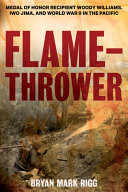
Flamethrower: Medal of Honor recipient Woody Williams, Iwo Jima, and World War II in the Pacific

Rigg, Bryan Mark
"Imagine strapping on a highly flammable 70-pound pack and entering combat as a surefire walking target-and you'd only begin to understand the job, and the horror, of Marine Corps flamethrower man. That's precisely what Hershel "Woody" Williams did in World War II, most importantly in February 1945 on Iwo Jima, one of the Pacific War's toughest battles. A few days into the battle, Marines were fighting hard for an airfield, and his captain asked Woody if he could do anything. He responded, "I'll try"-and for the next four hours, he virtually singlehandedly took on and ultimately destroyed seven enemy pillboxes and helped secure the airfield. Accomplished military historian Bryan Mark Rigg reconstructs Williams' remarkable story, from his youth in West Virginia to his experiences on Guadalcanal, Saipan, Guam, and most significantly Iwo Jima. In Rigg's telling, Williams's Medal of Honor action is not "just" a brave deed, but one of only a few strategically significant brave deeds-one that secured a strategic objective during a major campaign. Rigg tells Williams' story vividly, and objectively, and places it in the context of the broader Pacific theater of World War II."--
Stackpole Books 2020 544 pages

Imperfect justice: looted assets, slave labor, and the unfinished business of World War II

Eizenstat, Stuart
A personal memoir by Eizenstat, who served under President Carter in several capacities, including secretary of state on Holocaust issues, relating his experiences in negotiations with governments of and/or business representatives from Switzerland, Austria, France, and Germany to pay compensation to Holocaust victims or their heirs for looted property and for suffering (slave labor) under the Nazis. Swiss gold, stolen art, and other stolen property of individuals and communities were finally repaid through agreements reached or encouraged by U.S. class-action suits. In addition to the "imperfect justice" of financial recompense, notes the moral success of furthering the truth and inspiring international efforts at Holocaust education. also discusses the author's role in helping establish the U.S. Holocaust Memorial Museum.
Public Affairs 2003 401 pages

Hitler's spies: German military intelligence in World War II

Kahn, David
A German patrol wiggles through Russian lines to return with details of Soviet defenses. An expert Luftwaffe interrogator teases secret information from downed Allied airmen. Two spies steal ashore in Maine and make their way into New York City. Filled with episodes of intrigue and adventure, Hitler's Spies reveals the workings of German intelligence-the famed Abwehr, the dreaded SD, the codebreakers, the spies, and the intelligence gatherers of the Foreign Office-and explains its failure to best the Allies. Draws on original documents and extensive interviews.
Macmillan 1978 671 pages

Jewish reactions to the Holocaust

Bauer, Yehuda
A revised version of two courses of lectures delivered as part of the Broadcast University series of Israel Army Radio. Discusses the struggle of Jews for survival under Nazi rule, and attempts at aid and rescue by Jews in the Western democracies and Palestine, by foreign governments, and by "Righteous Gentiles". Emphasizes that the Nazis decided to murder all the Jews only in autumn 1940; until then no one could have foreseen the Holocaust to come. When the first reports of mass murder were received, they met with disbelief on the part of most Jews as well as non-Jews. This lack of awareness explains why the potential victims were slow to escape or resist; and, in conjunction with the prevalence of antisemitism and the political impotence of world and Palestinian Jewry, it also explains the failure of the outside world to come to their rescue. Among the topics covered are the search for countries of asylum; the Transfer Agreement; illegal immigration to Palestine; the ghettos and the Judenräte; the resistance groups and armed uprisings in the ghettos; Jewish partisans; underground rescue groups; negotiations with SS functionaries for Jewish lives; and the British Foreign Office's blocking of rescue proposals.
MOD Books 1989 226 pages

Mirrors of destruction: war, genocide, and modern identity

Bartov, Omer
Reflects on the interrelationship between war, genocide, and identity in the 20th century. Contends that World War I provided a pattern for the industrial killing that reached its apex in the Nazi Holocaust. Comparing France and Germany, both of which looked for an "elusive enemy" to help them cope with the trauma of World War I, notes that Germany found it in the Jews. This perception allowed the Germans to see themselves as victims and their actions against the Jews as self-defense. The search for "elusive enemies" (to blame for perpetrating the genocide) and "elusive victims" (e.g. the French or German people) continued after the war. Compares the French, German, and Jewish postwar discourses of the Holocaust. Presenting themselves as the main victims of Nazism, the French and Germans have tended to neglect Jews as the main victims. Criticizes writings by Hannah Arendt, Ka-Tzetnik, and some other postwar writers on the Holocaust and its roots.
Oxford University Press 2000 302 pages

Maimonides: life and thought

Halbertal, Moshe
Maimonides was the greatest Jewish philosopher and legal scholar of the medieval period, a towering figure who has had a profound and lasting influence on Jewish law, philosophy, and religious consciousness. This book provides a comprehensive and accessible introduction to his life and work, revealing how his philosophical sensibility and outlook informed his interpretation of Jewish tradition. Moshe Halbertal vividly describes Maimonides's childhood in Muslim Spain, his family's flight to North Africa to escape persecution, and their eventual resettling in Egypt. He draws on Maimonides's letters and the testimonies of his contemporaries, both Muslims and Jews, to offer new insights into his personality and the circumstances that shaped his thinking. Halbertal then turns to Maimonides's legal and philosophical work, analyzing his three great books - Commentary on the Mishnah, the Mishneh Torah, and the Guide of the Perplexed. He discusses Maimonides's battle against all attempts to personify God, his conviction that God's presence in the world is mediated through the natural order rather than through miracles, and his locating of philosophy and science at the summit of the religious life of Torah. Halbertal examines Maimonides's philosophical positions on fundamental questions such as the nature and limits of religious language, creation and nature, prophecy, providence, the problem of evil, and the meaning of the commandments. A stunning achievement, Maimonides offers an unparalleled look at the life and thought of this important Jewish philosopher, scholar, and theologian.
Princeton University Press 2015-06-02 385 pages