7908 results for "Science"

A new literary history of America

Greil Marcus,Werner Sollors,Henry B and Anne M Cabot Professor of English Literature and Professor of African and African American Studies Werner Sollors
America is a nation making itself up as it goes along--a story of discovery and invention unfolding in speeches and images, letters and poetry, unprecedented feats of scholarship and imagination. In these myriad, multiform, endlessly changing expressions of the American experience, the authors and editors of this volume find a new American history. In more than two hundred original essays, this book brings together the nation's many voices. From the first conception of a New World in the sixteenth century to the latest re-envisioning of that world in cartoons, television, science fiction, and hip hop, the book gives us a new, kaleidoscopic view of what "Made in America" means. Literature, music, film, art, history, science, philosophy, political rhetoric--cultural creations of every kind appear in relation to each other, and to the time and place that give them shape.--From publisher description.
Belknap Press of Harvard University Press 2009 1095 pages

Social psychology

Aronson, Elliot
Research made relevant through a storytelling approach. This renowned text maintains its acclaimed storytelling approach, teaching the science of psychology through an engaging narrative that makes research relevant to students. Drawing upon their extensive experience as researchers and teachers, Elliot Aronson, Tim Wilson, and Robin Akert present the classic research that has driven the field and introduce cutting-edge research that is the future of social psychology. Significantly updated to reflect advances in the discipline, the 8th edition provides a firm foundation for students to build their understanding of this rigorous science in a way that engages and fascinates. A better teaching and learning experience This program will provide a better teaching and learning experience-- for you and your students. Here's how: Personalize Learning -- The new MyPsychLab delivers proven results in helping students succeed, provides engaging experiences that personalize learning, and comes from a trusted partner with educational expertise and a deep commitment to helping students and instructors achieve their goals. Improve Critical Thinking -- The authors emphasize this rigorous science through research examples that encourage students to think twice about their preconceived notions of what social psychology is - and isn't. Engage Students -- Through real-life vignettes, which open each story chapter, and "mini-stories" throughout each chapter, the eighth edition provokes student interest by focusing on real-life examples. Explore Research -- The authors present a balance between the latest findings in the field with classic research in social psychology. Noting that some older studies deserve their status as classics and are important cornerstones to the discipline, this text encourages students to experience the continuity and depth of the field versus regarding it as a collection of studies published in the past few years. Support Instructors -- This program provides instructors with unbeatable resources, including state-of-the-art PowerPoints embedded with videos, the NEW MyPsychLab with ABC's What Would You Do videos, an easy to use Instructor's Manual, a robust test bank, and an online test generator (MyTest). All of these materials may be packaged with the text upon request. Note: MyPsychLab does not come automatically packaged with this text. To purchase MyPsychLab, please visit www.mypsychlab.com or you can purchase a ValuePack of the text + MyPsychLab (at no additional cost). ValuePack ISBN-10: 020591201X / ValuePack ISBN-13: 9780205912018.
Pearson 2013 538 pages

A guide for the perplexed: a novel

Horn, Dara
The incomparable Dara Horn returns with a spellbinding novel of how technology changes memory and how memory shapes the soul.Software prodigy Josie Ashkenazi has invented an application that records everything its users do. When an Egyptian library invites her to visit as a consultant, her jealous sister Judith persuades her to go. But in Egypt’s postrevolutionary chaos, Josie is abducted—leaving Judith free to take over Josie’s life at home, including her husband and daughter, while Josie’s talent for preserving memories becomes a surprising test of her empathy and her only means of escape.A century earlier, another traveler arrives in Egypt: Solomon Schechter, a Cambridge professor hunting for a medieval archive hidden in a Cairo synagogue. Both he and Josie are haunted by the work of the medieval philosopher Moses Maimonides, a doctor and rationalist who sought to reconcile faith and science, destiny and free will. But what Schechter finds, as he tracks down the remnants of a thousand-year-old community’s once-vibrant life, will reveal the power and perils of what Josie’s ingenious work brings into being: a world where nothing is ever forgotten.An engrossing adventure that intertwines stories from Genesis, medieval philosophy, and the digital frontier, A Guide for the Perplexed is a novel of profound inner meaning and astonishing imagination. --
W. W. Norton & Company 2013 342 pages

Well-being: the foundations of hedonic psychology

Kahneman, Daniel
The nature of well-being is one of the most enduring and elusive subjects of human inquiry. Well-Being draws upon the latest scientific research to transform our understanding of this ancient question. With contributions from leading authorities in psychology, social psychology, and neuroscience, this volume presents the definitive account of current scientific efforts to understand human pleasure and pain, contentment and despair. The distinguished contributors to this volume combine a rigorous analysis of human sensations, emotions, and moods with a broad assessment of the many factors, from heredity to nationality, that bear on our well-being. Using the tools of experimental science, the contributors confront the puzzles of human likes and dislikes. Why do we grow accustomed and desensitized to changes in our lives, both good and bad? Does our happiness reflect the circumstances of our lives or is it determined by our temperament and personality? Why do humans acquire tastes for sensations that are initially painful or unpleasant? By examining the roots of our everyday likes and dislikes, the book also sheds light on some of the more extreme examples of attraction and aversion, such as addiction and depression. Among its wide ranging inquiries, Well-Being examines systematic differences in moods and behaviors between genders, explaining why women suffer higher rates of depression and anxiety than men, but are also more inclined to express positive emotions. The book also makes international comparisons, finding that some countries' populations report higher levels of happiness than others. The contributors deploy an array of methods, from the surveys and questionnaires of social science to psychological and physiological experiments, to develop a comprehensive new approach to the study of well-being. They show how the sensory pleasures of the body can tells us something about the higher pleasures of the mind and even how the effectiveness of our immune system can depend upon the health of our social relationships.
Russell Sage Foundation 1999-07-08 593 pages

On freedom

Sunstein, Cass R.
"In this pathbreaking book, New York Times bestselling author Cass Sunstein asks us to rethink freedom. He shows that freedom of choice isn't nearly enough. To be free, we must also be able to navigate life. People often need something like a GPS device to help them get where they want to go--whether the issue involves health, money, jobs, children, or relationships. In both rich and poor countries, citizens often have no idea how to get to their desired destination. That is why they are unfree. People also face serious problems of self-control, as many of them make decisions today that can make their lives worse tomorrow. And in some cases, we would be just as happy with other choices, whether a different partner, career, or place to live--which raises the difficult question of which outcome best promotes our well-being. Accessible and lively, and drawing on perspectives from the humanities, religion, and the arts, as well as social science and the law, On Freedom explores a crucial dimension of the human condition that philosophers and economists have long missed--and shows what it would take to make freedom real."--Page [2] of cover.
Princeton University Press 2019-02-26 127 pages

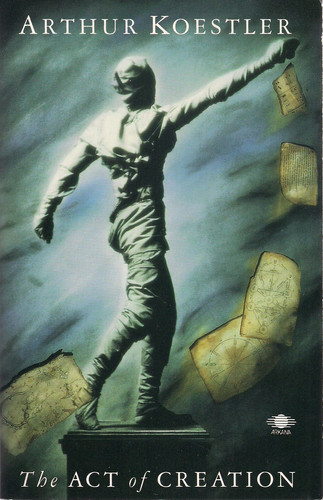
The act of creation

Koestler, Arthur
Astudy of the processes of discovery, invention, imagination and creativity in humor, science, and the arts. It lays out Koestler's attempt to develop an elaborate general theory of human creativity. From describing and comparing many different examples of invention and discovery, Koestler concludes that they all share a common pattern which he terms "bisociation"--A blending of elements drawn from of two previously unrelated matrices of thought into a new matrix of meaning by way of a process involving comparison, abstraction and categorization, analogies and metaphors. He regards many different mental phenomena based on comparison (such as analogies, metaphors, parables, allegories, jokes, identification, role-playing, acting, personification, anthropomorphism etc.), as special cases of "bisociation".
Arkana 1989 751 pages

The Mass Psychology of Fascism

Reich, Wilhelm
New for 2026 — Authorized Fourth Edition. This newly typeset edition restores the original Theodore P. Wolfe 1946 translation, overseen and approved by Reich and out of print for decades, together with new supporting material: a foreword by Professor Håvard Friis Nilsen, a bibliographic introduction by Dr. Philip W. Bennett, and Reich's 1933 Foreword and 1934 Afterword appearing in English for the first time. Wilhelm Reich, M.D. (1897–1957), first published this landmark study of the psychological roots of fascism in Nazi Germany in 1933, at the beginning of Hitler’s regime. It was banned almost immediately. Drawing on his work as a psychoanalyst and sexologist, Reich examines why the fascist message appealed to broad masses of voters in a time of economic uncertainty. At the time of publication, this was the first analysis of Nazism from one of Freud’s pupils, and for many years, it remained the only one. In a new foreword, Professor Håvard Friis Nilsen situates the book in its historical context.
Orgonon Press 2026-06-01 383 pages

Critical models: interventions and catchwords

Adorno, Theodor W.
"Critical Models combines into a single volume two of Adorno's most important postwar works — Interventions: Nine Critical Models (1963) and Catchwords: Critical Models II (1969). Written after his return to Germany in 1949, the articles, essays, and radio talks included in this volume speak to the pressing political, cultural, and philosophical concerns of the postwar era. The pieces in Critical Models reflect the intellectually provocative as well as the practical Adorno as he addresses such issues as the dangers of ideological conformity, the fragility of democracy, educational reform, the influence of television and radio, and the aftermath of fascism. This new edition includes an introduction by Lydia Goehr, a renowned scholar in philosophy, aesthetic theory, and musicology. Goehr illuminates Adorno's ideas as well as the intellectual, historical, and critical contexts that shaped his postwar thinking"
Columbia University Press 2005 410 pages

Why War? A Correspondence Between Albert Einstein and Sigmund Freud

Albert Einstein,Sigmund Freud
In 1932 the greatest genius of the Twentieth Century wrote an urgent letter to the century’s most influential psychologist. In that letter, Albert Einstein asked Sigmund Freud, “Is there any way of delivering mankind from the menace of war?” It was the same year that the German electorate made the Nazis the strongest political party in Germany, only one year before Adolf Hitler’s remarkable rise to power. Freud’s long and elaborate reply was greeted by Einstein with unrestrained enthusiasm. He called Freud’s letter “truly classic… something altogether magnificent.
Cat Pub Co 1991 21 pages

Supercapitalism: the transformation of business, democracy, and everyday life

Reich, Robert B.
From one of America's foremost economic and political thinkers comes a vital analysis of our new hypercompetitive and turbo-charged global economy and the effect it is having on American democracy. With his customary wit and insight, Reich shows how widening inequality of income and wealth, heightened job insecurity, and corporate corruption are merely the logical results of a system in which politicians are more beholden to the influence of business lobbyists than to the voters who elected them. Powerful and thought-provoking, Supercapitalism argues that a clear separation of politics and capitalism will foster an enviroment in which both business and government thrive, by putting capitalism in the service of democracy, and not the other way around.
Alfred A. Knopf 2007 272 pages

The physics of Star Trek

Krauss, Lawrence Maxwell
What warps when you’re traveling at warp speed? What is the difference between a wormhole and a black hole? Are time loops really possible, and can I kill my grandmother before I am born? Anyone who has ever wondered “could this really happen?” will gain useful insights into the Star Trek universe (and, incidentally, the real world of physics) in this charming and accessible guide. Lawrence M. Krauss boldly goes where Star Trek has gone-and beyond. From Newton to Hawking, from Einstein to Feynman, from Kirk to Picard, Krauss leads readers on a voyage to the world of physics as we now know it and as it might one day be.
Basic Books 2007-07-10 251 pages

Motherland: a feminist history of modern Russia, from revolution to autocracy

Ioffe, Julia
"Award-winning journalist Julia Ioffe tells the story of modern Russia through the history of its women, from revolution to utopia to autocracy. In 1990, seven-year-old Julia Ioffe and her family fled the Soviet Union. Nearly twenty years later, Ioffe returned to Moscow-only to discover just how much Russian society had changed while she had been living in America. The Soviet women she had known growing up-doctors, engineers, scientists-had seemingly been replaced with women desperate to marry rich and become stay-at-home moms. How had Russia gone from portraying itself as the vanguard of world feminism to the last bastion of conservative Christian values? In Motherland, Ioffe turns modern Russian history on its head, telling it exclusively through the stories of its women. From her own physician great-grandmothers to Lenin's lover, a feminist revolutionary; from the hundreds of thousands of Soviet girls who fought in World War II to the millions of single mothers who rebuilt and repopulated a devastated country; from the members of Pussy Riot to Yulia Navalnaya, wife of opposition leader Alexei Navalny, she chronicles one of the most audacious social experiments in history and how it failed the very women it was meant to liberate-and documents how that failure paved the way to the revanche of Vladimir Putin. Part memoir, part journalistic exploration, part history, Motherland paints a portrait of modern Russia through the women who shaped it. With deep emotion, Ioffe shows what it means to live through the cataclysms of revolution, war, idealism, and heartbreak-and reveals how the story of Russia today is inextricably tied to the history of its women"-- Provided by publisher.
Ecco, an imprint of Harper Collins Publishers 2025-10 489 pages

The Road to Freedom Economics and the Good Society

Joseph E. Stiglitz
We are a nation born from the conviction that people must be free. But since the middle of the last century, that idea has been co-opted. Forces on the political Right have justified exploitation by cloaking it in the rhetoric of freedom, leading to pharmaceutical companies freely overcharging for medication, a Big Tech free from oversight, politicians free to incite rebellion, corporations free to pollute, and more. How did we get here? Whose freedom are we--and should we--be thinking about? In The Road to Freedom, Nobel prize winner Joseph E. Stiglitz dissects America's current economic system and the political ideology that created it, laying bare their twinned failure. "Free" and unfettered markets have only succeeded in delivering a series of crises: the financial crisis, the opioid crisis, and the crisis of inequality. While a small portion of the population has amassed considerable wealth, wages for most people have stagnated. Free and unfettered markets have exploited consumers, workers, and the environment alike. Such failures have fed populist movements that believe being free means abandoning any obligations citizens have to one another. As they grow in strength, these movements now pose a real threat to true economic and political freedom. As an economic advisor to presidents and as chief economist at the World Bank, Stiglitz has witnessed these profound changes firsthand. As he argues, the failures follow from the elites' unshakeable dedication to "the neoliberal experiment." Explicitly taking on giants such as Friedrich Hayek and Milton Friedman, Stiglitz exposes accepted ideas about our political and economic life for what they are: twisted visions that tear at the social fabric while they enrich the very few. The Road to Freedom breaks new ground, showing how economics--including recent advances in which Stiglitz has played such an important role--reframes how to think about freedom and the role of the state in a twenty-first century society. Drawing on the work of contemporary philosophers, Stiglitz explains a deeper, more humane way to assess freedoms--one that considers with care what to do when one person's freedom conflicts with another's. We must reimagine our existing economic and legal systems and embrace forms of collective action, including regulation and investment, if we are to create an innovative society in which everyone can flourish. The task could not be more urgent, and Stiglitz's latest book is essential reading for those committed to the American ideal of an economic and political system that delivers well-being, opportunity, and meaningful freedoms for all.
W. W. Norton, Incorporated 2026-02-24 384 pages