

58,196 results in 0.12 seconds

Shiloh
This essential title provides practical examples for companies following IFRS, UK Company Legislation and FSA listing rules, As of 30 September 2010. The easy-to-use format presents model financial statements and expert commentary, making this an essential guide for those working with the accounts of UK Listed Groups.

Shiloh

Evocative objects: things we think with
In Evocative Objects, the author collects writings by scientists, humanists, artists, and designers that trace the power of everyday things. These essays reveal objects as emotional and intellectual companions that anchor memory, sustain relationships, and provoke new ideas

Medicine: the art of healing
Paintings, manuscript illuminations, prints, and other works of art reveal the history of medicine, the development of anatomical and scientific illustration, and the work of physicians and surgeons through the ages

The Passover Haggadah: with a traditional and contemporary commentary = [Hagadah shel Pesaḥ]
Hebrew and English.

Kosher Jesus
Kosher Jesus is a project of more than six years research and writing. The book seeks to offer to Jews and Christians the real story of Jesus, a wholly observant, Pharisaic Rabbi who fought Roman paganism and oppression and was killed for it. While many Christians will be confused by its assertion that Jesus never claimed divinity and not only did not abrogate the Torah but observed every letter of the Law, they will find comfort in my tracing most of Jesus' principal teachings back to Jewish sources, this before he was stripped of his Jewishness by later writers who sought to portray him as an enemy of his people. This is especially true of Jesus' most famous oration, the Sermon on the Mount, which is a reformulation of the Torah he studied and to which he was committed. A small sampling: Jesus: (Matt 5:5) Blessed are the meek, for they shall inherit the earth. Hebrew Bible: (Psalms 37) The meek shall inherit the earth, and delight themselves in the abundance of peace. Jesus: (Matt 5:8) Blessed are the pure in heart, for they shall see G-d. Hebrew Bible: (Psalms 24) Who shall ascend the mount of the Lord - the pure-hearted. Jesus: (Matt 5:39) But if anyone strikes you on the right cheek, turn to him the other also. Hebrew Bible: (Lamentations 3:30) Let him offer his cheek to him who smites him.... Jesus: (Matt 6:33) But seek first his kingdom and his righteousness, and all these things shall be yours as well. Hebrew Bible: (Psalms 37:4) Delight yourself in the Lord, and He shall give you the desires of your heart. Jesus: (Matt 7:7) Ask, and it will be given you; search, and you will find; knock, and the door will be opened for you. Hebrew Bible: (Jer 29:13) When you search for me, you will find me; if you seek me with all your heart. Jesus: (Matt 7:23) Then I will declare to them, "I never knew you; go away from me, you evildoers." Hebrew Bible: (Psalms 6:9) Depart from me, all you workers of evil... The book is also for Jews who remain deeply uncomfortable with Jesus because of the Church's long history of anti-Semitism, the deification of Jesus, and the Jewish rejection of any Messiah who has not fulfilled the Messianic prophecies. We Jews will forever reject the divinity of any man, the single most emphatic prohibition of our Bible. And we can never accept the Messiahship of any personality, however noble or well-intended, who died without ushering in the age of physical redemption. But as Christians and Jews now come together to love and support the majestic and humane Jewish state, it's time that Christians rediscover the deep Jewishness and religious Jewish commitment of Jesus, while Jews reexamine a lost son who was murdered by a brutal Roman state who sought to impose Roman culture and rule upon a tiny yet stubborn nation who will never be severed from their eternal covenant with the G-d of Israel.

Tevye the dairyman: and Motl the cantor's son
For the 150th anniversary of the birth of the "Jewish Mark Twain,"a new translation of his most famous works Tevye the Dairyman and Motl the Cantor's Son are the most celebrated characters in all of Jewish fiction. Tevye is the lovable, Bible-quoting father of seven daughters, a modern Job whose wisdom, humor, and resilience inspired the lead character in Fiddler on the Roof . And Motl is the spirited and mischievous nine-year-old boy who accompanies his family on a journey from their Russian shtetl to New York, and whose comical, poignant, and clear-eyed observations capture with remarkable insight the struggles and hopes and triumphs of Jewish immigrants to America at the turn of the twentieth century. For more than seventy years, Penguin has been the leading publisher of classic literature in the English-speaking world. With more than 1,700 titles, Penguin Classics represents a global bookshelf of the best works throughout history and across genres and disciplines. Readers trust the series to provide authoritative texts enhanced by introductions and notes by distinguished scholars and contemporary authors, as well as up-to-date translations by award-winning translators.

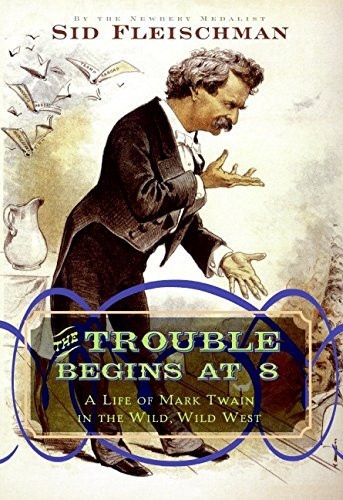
The trouble begins at 8: a life of Mark Twain in the wild, wild West
"Mark Twain was born fully grown, with a cheap cigar clamped between his teeth." So begins Sid Fleischman's ramble-scramble biography of the great American author and wit, who started life in a Missouri village as a barefoot boy named Samuel Clemens. Abandoning a career as a young steamboat pilot on the Mississippi River, Sam took a bumpy stagecoach to the Far West. In the gold and silver fields, he expected to get rich quick. Instead, he got poor fast, digging in the wrong places. His stint as a sagebrush newspaperman led to a duel with pistols. Had he not survived, the world would never have heard of Tom Sawyer or Huckleberry Finn—or red-headed Mark Twain. Samuel Clemens adopted his pen name in a hotel room in San Francisco and promptly made a jumping frog (and himself) famous. His celebrated novels followed at a leisurely pace; his quips at jet speed. "Don't let schooling interfere with your education," he wrote. Here, in high style, is the story of a wisecracking adventurer who came of age in the untamed West; an ink-stained rebel who surprised himself by becoming the most famous American of his time. Bountifully illustrated.
Pledging Allegiance: The Last Campaign of the Cold War
Shows how the end of the cold war has affected American politics, and discusses the issues in the 1988 presidential campaign

From Caligari to Hitler: a psychological history of the German film
A landmark, now classic, study of the rich cinematic history of the Weimar Republic, From Caligari to Hitler was first published by Princeton University Press in 1947. Siegfried Kracauer--a prominent German film critic and member of Walter Benjamin's and Theodor Adorno's intellectual circle--broke new ground in exploring the connections between film aesthetics, the prevailing psychological state of Germans in the Weimar era, and the evolving social and political reality of the time. Kracauer's pioneering book, which examines German history from 1921 to 1933 in light of such movies as The Cabinet of Dr. Caligari, M, Metropolis , and The Blue Angel , has never gone out of print. Now, over half a century after its first appearance, this beautifully designed and entirely new edition reintroduces Kracauer for the twenty-first century. Film scholar Leonardo Quaresima places Kracauer in context in a critical introduction, and updates the book further with a new bibliography, index, and list of inaccuracies that crept into the first edition. This volume is a must-have for the film historian, film theorist, or cinema enthusiast. In From Caligari to Hitler , Siegfried Kracauer made a startling (and still controversial) claim: films as a popular art provide insight into the unconscious motivations and fantasies of a nation. In films of the 1920s, he traced recurring visual and narrative tropes that expressed, he argued, a fear of chaos and a desire for order, even at the price of authoritarian rule. The book has become an undisputed classic of film historiography, laying the foundations for the serious study of film. Kracauer was an important film critic in Weimar Germany. A Jew, he escaped the rise of Nazism, fleeing to Paris in 1933. Later, in anguish after Benjamin's suicide, he made his way to New York, where he remained until his death in 1966. He wrote From Caligari to Hitler while working as a "special assistant" to the curator of the Museum of Modern Art's film division. He was also on the editorial board of Bollingen Series. Despite many critiques of its attempt to link movies to historical outcomes, From Caligari to Hitler remains Kracauer's best-known and most influential book, and a seminal work in the study of film. Princeton published a revised edition of his Theory of Film: The Redemption of Physical Reality in 1997 .

The Standard Edition of the Complete Psychological Works of Sigmund Freud
This 24-volume set contains the whole of Freud's published psychological writings.

The Toilet Papers Recycling Waste and Conserving Water
A classic is back in print! One of the favorite books of 1970s back-to-the-landers, The Toilet Papers is an informative, inspiring, and irreverent look at how people have dealt with their wastes through the centuries. In a historical survey, Van der Ryn provides the basic facts concerning human wastes, and describes safe designs for toilets that reduce water consumption and avert the necessity for expensive and unreliable treatment systems. The Toilet Papers provides do-it-yourself plans for a basic compost privy and a variety of graywater systems.

Kibitzers and Fools Tales My Zayda Told Me
"A saying: It pays to have a little chutzpah (nerve)." With old world charm, universal humor, and just a bit of chutzpah, Simms Taback offers this lively spin on thirteen playful tales?as only he could. Paired with his trademark vibrant and hilarious artwork, these stories illustrate ultimate widespread truths and important life lessons, from the difference between a "shlemiel" and a "shlimazel" to the idea that just because you can talk doesn?t mean you make sense. Taback delivers the perfect combination of wisdom and humor?just the way your "zayda" (grandpa) would.

American folklore studies: an intellectual history
Folklore. Washington Irving and Mark Twain used it in their fiction; Sigmund Freud and William James incorporated it into their work; Henry Ford and Franklin Roosevelt promoted it. Their efforts were set against the background of folklorists who brought collections of traditional tales, songs, and crafts to the attention of a modernizing society. The ideas of these folklorists influenced how Americans thought about the character of their society and the directions it was taking.Here for the first time is a history of American folkloristic ideas and the figures who shaped them. Simon Bronner puts these ideas in cultural context, showing the interconnection of folklore studies with historical events, social changes, and intellectual movements. He follows the beginnings of American folklore studies in the antiquarian literature of the 1830s through the rise of folklore societies in the 1880s to the emergence of an independent discipline in the 1950s. In this progression, Bronner identifies several major themes tying folklore studies to intellectual history: first, the unearthing of a hidden, usable past; second, the charting of time and space; and third, the structuring of communication. More than a chronological or biographical history, this book is an interpretation of folkloristic ideas and their relationship to American society.

Ant farm: and other desperate situations
In Ant Farm , former Harvard Lampoon president Simon Rich finds humor in some very surprising places. Armed with a sharp eye for the absurd and an overwhelming sense of doom, Rich explores the ridiculousness of our everyday lives. The world, he concludes, is a hopelessly terrifying place–with endless comic potential. –If your girlfriend gives you some “love coupons” and then breaks up with you, are the coupons still valid? –What kind of performance pressure does an endangered male panda feel when his captors bring the last remaining female panda to his cage? –If murderers can get into heaven by accepting Jesus, just how awkward is it when they run into their victims? Join Simon Rich as he explores the extraordinary and hilarious desperation that resides in ordinary life, from cradle to grave. "Hilarious." –Jon Stewart

Spoiled brats
This hilarious collection of short stories from the award-winning humorist Simon Rich includes the story that inspired the Seth Rogen comedy An American Pickle. Having skewered the problems of falling in and out of love in The Last Girlfriend on Earth, Simon Rich's next book is another subject we can all relate to: parents and their kids. From the perils of raising an actual monster in Manhattan - it's pretty hard to find teachers who really understand the talents of a five-year-old with horns and a taste for blood - to Sell Out, the story of Simon's ancestor, returned to life decades after an industrial accident involving pickling brine, these stories are inventive, witty and sometimes a bit too much like real life.

A history of Britain

Simone Weil, an anthology
Philosopher, theologian, critic, sociologist, political activist -- Simone Weil was among the foremost thinkers of our time. Best known in this country for her theological writing, Weil wrote on a great variety of subjects ranging from classical philosophy and poetry, to modern labor, to the language of political discourse. The present anthology offers a generous collection of her work, including essays never before translated into English and many that have long been out of print. It amply confirms Elizabeth Hardwick's words that Simone Weil was "one of the most brilliant and original minds of twentieth-century France" and "a woman of transcendent intellectual gifts and the widest learning." A longtime Weil scholar, Sian Miles has selected essays representative of the wide sweep of Weil's work and provides a superb introduction that places Weil's work in context of her life and times.

The Iliad Or the Poem of Force
The Iliad, or: The Poem of Force was written in the summer and fall of 1940, after the fall of France. It may thus be read as an indirect commentary on that tragic event, which signalized the triumph of the most extreme modern expression of force. It was originally published, under the acrostical pseudonym “Emile Novis,” in the December 1940 and January 1941 issues of the Marseilles literary monthly, Cahiers du Sud. The present translation is by Mary McCarthy. The quotations from Homer were first translated from the French manuscript by Miss McCarthy and then checked and revised by Dwight Macdonald in accordance with the Greek text. “The Iliad” appeared in the November 1945 issue of Politics and was later issued in pamphlet form. It is the only one of Weil’s writings on ancient Greek literature which is commonly used in university courses on the Classics. Pendle Hill is grateful to Dwight Macdonald for his permission to reprint the Politics pamphlet edition of Simone Weil’s essay.
