2328 results for "Jewish History"

Paul the convert: the apostolate and apostasy of Saul the Pharisee

Segal, Alan F.
Although Paul's writings have been intensively studied by Christian theologians, they have been dismissed by Jewish scholars as the meditations of an antagonistic apostate who broke completely with his Jewish past. In this revisionist account of Paul's work, Alan Segal argues that Paul's life can be better understood by taking his Jewishness seriously, and that Jewish history can be illuminated greatly by examining Paul's writings. By reading Paul from the viewpoint of the religion he left behind, Segal sheds new light on the man who played a critical role in both Judaism and Christianity.
Yale University Press 1990-01-01 368 pages

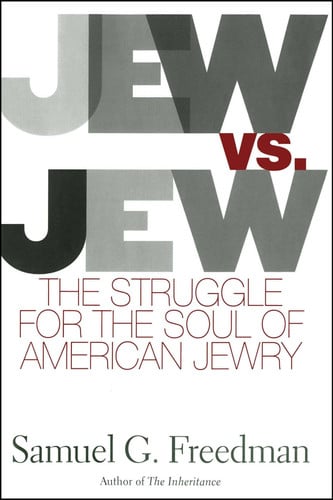
Jew Vs Jew The Struggle For The Soul Of American Jewry

Samuel G. Freedman
At a time when American Jews should feel more secure and cohesive than ever, civil war is tearing apart their community. Congregations, neighborhoods, even families are taking sides in battles about Jewish identity and Jewish authenticity. The conflict pits fundamentalist against secularist, denomination against denomination, even liberal against conservative within each branch of Jewry. Jew vs. Jew tells the story of how American Jewry has increasingly -- and perhaps terminally -- broken apart in the last forty years. Jew vs. Jew stretches in time from 1960 to 2000. It travels the country from Florida to New England, from Los Angeles to the Catskills in New York, from Cleveland to Denver, and it also crosses the ocean to Israel to show how tensions within the Jewish state inflame those among American Jews. The flash-points range from conversion standards to the role of women, from the peace process in Israel to the sexual climate on an Ivy League campus. But behind them all, as Samuel Freedman writes, lie common causes. First, far from unifying American Jews, Israel now divides them on both political and religious grounds. Second, neither America nor the larger world presents Jews with a single enemy against whom to coalesce. Third, and most important, nothing in the Jewish history of persecution, oppression, and exile prepared the Chosen People for the challenge posed by America, the challenge of being absorbed into a tolerant and diverse nation, being accepted so thoroughly that the intermarriage rate tops 50 percent. Jew vs. Jew introduces readers to memorable places and characters. Freedman describes one of the final summers at a Labor Zionist camp in the Catskills whose brand of secular Jewishness is becoming obsolete because Zionism succeeded in creating Israel. He tells the story of Orthodox and Reform Jews in a Cleveland suburb who are fighting about the construction of several synagogues -- and, on a deeper level, about whether unity or pluralism ought to be the goal of Jewish life. He portrays a Florida Jew so violently opposed to the Oslo peace accords that he planted a bomb in a synagogue where Shimon Peres was speaking. He tells about a Los Angeles congregation that spent three years debating whether or not to honor the Biblical matriarchs in its liturgy.We come to know the Long Island neighbors who cannot tolerate sharing even a property line because their versions of Jewish identity are so irreconcilably different. Jew vs. Jew is a work of vigorous reporting, lucid writing, and intellectual curiosity. And even as it chronicles an embittered and polarized community, it refuses to take sides or pass judgment. Instead, with compassion and acuity, Jew vs. Jew bears witness.
Simon & Schuster 2007-09-21 400 pages

The philosophy of Chabad

Mindel, Nissan
Few luminaries in Jewish history, particularly in modern times, have made such a lasting and profound contribution to our spiritual heritage as Rabbi Schneur Zalman of Liadi (1745-1812). His works embrace the entire spectrum of Jewish thought - mysticism, philosophy, psychology, ethics and law - and represent an expression of unparalled creative genius.This richly detailed biography traces Rabbi Schneur Zalman's life from his childhood and formative years to his trials and triumph as a leader who revolutionized Jewish life. It reveals many hitherto unknown facts, and offers the reader considerable insight into his extraordinary strength of character. Vilified by many of his contemporaries and arrested by the Czar, Rabbi Schneur Zalman emerged victorious; today his teachings continue to inspire and vitalize Jewish life all over the world.
Chabad Research Center, Kehot Publication Society 1985 255 pages

If I am not for myself: journey of an anti-Zionist Jew

Marqusee, Mike
This is an eloquent and deeply felt memoir exploring the author's complex relationship with his Jewish identity. "If I Am Not Myself" is a passionate, thought-provoking exploration of what it means to be Jewish in the twenty-first century. It traces the author's upbringing in 1960s Jewish-American suburbia, his anti-war and pro-Palestinian activism on the British Left, and life as a Jew among Muslims in Pakistan, Morocco, and Britain. Interwoven with this are the experiences of his grandfather's life in Jewish New York of the 1930s and '40s, his struggles with anti-Semitism and the twists and turns that led him from anti-Fascism to Militant Zionism. In the course of this deeply personal story, Marqusee refutes the claims of Israel and Zionism on Jewish loyalty and laments their impact on the Jewish Diaspora. Rather, he argues for a richer, more multi-dimensional understanding of Jewish history and identity, and reclaims vital political and personal space for those castigated as self-haters by the Jewish establishment.
Verso 2008 307 pages

Jew and Gentile in the ancient world: attitudes and interactions from Alexander to Justinian

Feldman, Louis H.
Relations between Jews and non-Jews in the Hellenistic-Roman period were marked by suspicion and hate, maintain most studies of that topic. But if such conjectures are true, asks Louis Feldman, how did Jews succeed in winning so many adherents, whether full-fledged proselytes or "sympathizers" who adopted one or more Jewish practices? Systematically evaluating attitudes toward Jews from the time of Alexander the Great to the fifth century A.D., Feldman finds that Judaism elicited strongly positive and not merely unfavorable responses from the non-Jewish population. Jews were a vigorous presence in the ancient world, and Judaism was strengthened substantially by the development of the Talmud. Although Jews in the Diaspora were deeply Hellenized, those who remained in Israel were able to resist the cultural inroads of Hellenism and even to initiate intellectual counterattacks. Feldman draws on a wide variety of material, from Philo, Josephus, and other Graeco-Jewish writers through the Apocrypha, the Pseudepigrapha, the Church Councils, Church Fathers, and imperial decrees to Talmudic and Midrashic writings and inscriptions and papyri. What emerges is a rich description of a long era to which conceptions of Jewish history as uninterrupted weakness and suffering do not apply.
Princetown University Press 1996 679 pages

Views in review: politics and culture in the state of the Jews

Margalit, Avishai
When Zionists first advocated a national home for the Jewish people, they also propounded a revolution in the values that Jews should live by, a whole new way of thinking about Jewish life and Jewish history. Has this revolution in fact occurred? And what the consequences been for Jews and their neighbors? Especially given the extraordinary circumstances that link the United States and Israel, Americans may find the answers to such questions vexing - but the remarkable work of Avishai Margalit goes far to clarify the issues and enlighten the debate. Over the past two decades, Margalit has written major essays for American readers about the political leaders, cultural crises, and historical background of the contemporary Israeli scene. In Views in Review these essays are brought together with new commentary and observations, and their publication in one volume clearly shows that the whole is much more that the sum of its parts. From Ben Gurion to Netanyahu, from "Israeli kitsch" to the meaning of the Holocaust for "the seventh million," Margalit's work traverses the terrain of Israeli life and history and brings a tragically conflicted country into sharp and memorable focus.
Farrar, Straus and Giroux 1998 336 pages

Science in the Bet Midrash: studies in Maimonides

Kellner, Menachem Marc
Science in the Bet Midrash explores the religious thought of Moses Maimonides (1138–1204), one of the most influential Jews of the last thousand years. While covering many aspects of his religious philosophy, these essays focus on the way Maimonides elucidated and expressed the universalistic thrust of the Jewish tradition. Maimonides construed the election of Israel as a challenge, not an endowment. This challenge is ultimately addressed to all human beings, not just to Jews.
Academic Studies Press 2009 392 pages

Beyond patriarchy: Jewish fathers and families

Fuchs, Lawrence H.
Is patriarchy necessary to ensure responsible fathering? Lawrence H. Fuchs, author of Family Matters, argues that the link between male dominance and fatherhood is no longer iron-clad. Analyzing the universality of patriarchy and its incentives for cultural fatherhood, Fuchs concedes that the importance of biological differences between the sexes was a possible, even plausible, basis for the evolution of patriarchy. But in this timely work he imagines a new paradigm of fatherhood for a post-patriarchal age, one inspired by the history of Jewish patriarchy. Two millennia ago the rabbis established the strategies to curb the extreme abuses of patriarchy found in all civilizations. They did so by according wives significant sexual and economic rights. In the last two centuries as Jews became more integrated into the societies in which they lived, their unique variation of patriarchy was disrupted. Fuchs argues that the Jewish story sets the precedent for fundamental change in the nature of patriarchy today, thus breaking what may have been the evolutionary connection between male dominance and incentives for fatherhood. It is Fuchs's startling conclusion that the Jewish precedent points to the next step in evolution: fathers without patriarchy.
Published by University Press of New England, Brandeis University Press 2000 216 pages

Embracing exile: the case for Jewish diaspora

Kraemer, David Charles
"Embracing Exile is a comprehensive history of Jewish responses to and conceptions of their exiles/diasporas. Jews have, since their beginnings, been a wandering people. According to their origin story, they wandered from Ur of Chaldees to Canaan to Egypt and then back to Canaan. From there, they were exiled to Babylon, where they built their longest-lived home, one that survived until the twentieth century. Over the span of centuries, they resettled in Persia, Egypt, Morocco, Spain, Italy, Turkey, Poland, Ukraine, and the United States, often flourishing. Thanks to these experiences, Diaspora became "natural" to Jews, and though they may have hoped for a return to their Promised Land at the End of Days, they made sense of their many homes, defending Diaspora as the realm where Jewish life could grow and Jews fulfill their covenantal obligations in the company of their God. The texts and expressions the volume documents in Defending Diaspora include biblical and rabbinic texts, philosophical treatises, Kabbalah, Hasidism, and a multiplicity of modern expressions. The book offers revised readings of the book of Esther and other biblical texts, a survey of Talmudic treatments of exile, an in-depth analysis of the thought of the Maharal of Prague, analyses of works by Philip Roth, and other modern authors, and much more. The book shows that lament has not been the most common Jewish response to diaspora and that Zionism is not the natural outcome of either Jewish ideology or history"-- Provided by publisher.
Oxford University Press 2025 234 pages

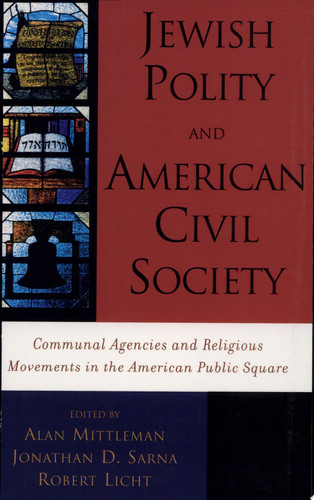
Jewish polity and American civil society: communal agencies and religious movements in the American public sphere

Alan Mittleman,Robert Licht,Jonathan D. Sarna
Jewish Polity and American Civil Society is a study of the civic and political engagements of American Jews as mediated by their communal and denominational institutions. The book explores how the various branches of the organized Jewish community seek to influence public affairs. Over the course of the last century, Jewish agencies and religious movements have tried to shape public debate and public policy on such issues as civil rights, church-state relations, and American foreign policy. The book sets the history of Jewish engagement in these areas into historical context; analyzes the motives, strategies, and tactics of various Jewish groups, and evaluates their successes and failures. The book also explores the underlying idea-the public philosophy-that informs American Jews' understanding of civic and political engagement.
Rowman & Littlefield 2002-07-23 420 pages

The enduring community: the Jews of Newark and MetroWest

Helmreich, William B.
From its founding in the late seventeenth century, Newark, New Jersey, was a vibrant and representative center of Jewish life in America. Geographically and culturally situated between New York City and its outlying suburbs, Newark afforded Jewish residents the advantages of a close-knit community along with the cultural abundance and social dynamism of urban life. In Newark, all of the representative stages of modern Jewish experience were enacted, from immigration and acculturation to upward mobility and community building. The Enduring Community is a lively and evocative social history of the Jewish presence in Newark as well as an examination of what Newark tells us about social assimilation, conflict and change. Grounded in documentary research, the volume makes extensive use of interviews and oral histories. The author traces the growth of the Jewish population in the pre-Revolutionary period to its settlement of German Jews in the 1840s and Eastern European Jews in the 1880s. Helmreich delineates areas of contention and cooperation between these groups and relates how an American identity was eventually forged within the larger ethnic mix of the city. Jewish population in politics, the establishment of Jewish schools, synagogues, labor unions, charities, and community groups are described together with cultural and recreational life. Despite the formal and emotional bonds that formed over a century, Jewish neighborhoods in Newark did not survive the postwar era. The trek to the suburbs, the erosion of Newark's tax base, and deteriorating services accelerated a movement outward that mirrored the demographic patterns of cities across America. By the time of the Newark riots in 1967, the Jewish presence was largely absent. This volume reclaims a lost history and gives personalized voice to the dreams, aspirations, and memories of a dispersed community. It demonstrates how former Newarkers built new Jewish communities in the surrounding suburbs, an area dubbed "MetroWest" by Jewish leaders. The Enduring Community is must reading for students of Jewish social history, sociologists, urban studies specialists, and readers interested in the history of New Jersey. The book includes archival photographs form the periods discussed.
Transaction Publishers 1999 373 pages

In the days of Simon Stern: a novel

Cohen, Arthur A.
Nathan, a blind Jewish scribe, tells the story of the coming of the Messiah in the person of one Simon Stern—from his birth on the Lower East Side, through his career as a millionaire dealer in real estate, to his building of a refuge for the Jewish remnant of World War II. "A majestic work of fiction that should stand world literature's test of time, to be read and reread. A masterpiece."— Commonweal "This book ensnares one of the most extraordinarily daring ideas to inhabit an American novel in a number of years. For one thing, it is that risky devising, dreamed of only by the Thomas Manns of the world, a serious and vastly conceived fiction bled out of the theological imagination. For another, it is clearly an 'American' novel—altogether American, despite its Jewish particularity: it is not so much about the history of the Jews as it is about the idea of the New World as haven. . . . In its teeming particularity every vein of this book runs with a brilliance of Jewish insight and erudition to be found in no other novelist. Arthur Cohen is the first writer of any American generation to compose a profoundly Jewish fiction on a profoundly Western theme."—Cynthia Ozick, New York Times Book Review "This stately, ambitious amalgam of Jewish myth, history, theology, and speculations on the Jewish soul is like an enormous Judaic archeological ruin—often hard for the uninitiated to interpret, but impressive. . . . Intelligent, inventive, fascinating."— New Yorker
University of Chicago Press 1988 464 pages

Spinoza's Short Treatise on God, Man, and His Well-Being Translated and Edited, with an Introduction and Commentary and a Life of Spinoza (Classic Reprint)

Benedictus de Spinoza
Excerpt from Spinoza's Short Treatise on God, Man, and His Well-Being: Translated and Edited, With an Introduction and Commentary and a Life of Spinoza Jewish history and jewish life, and have devoted more attention to Manasseh ben Israel than he has so far received in this connection. It has not been thought necessary to give detailed references to authorities, because the earliest biographies and all the available documents relating to Spinoza have been edited by Prof. Freudenthal in a single volume under the title of Die Lebensgeschichte Spinozas, and the evidence can easily be found there. For the general history of the period I consulted Motley, Blok, and the Cambridge Modern History and Graetz, for the history of the Jews. About the Publisher Forgotten Books publishes hundreds of thousands of rare and classic books. Find more at www.forgottenbooks.com This book is a reproduction of an important historical work. Forgotten Books uses state-of-the-art technology to digitally reconstruct the work, preserving the original format whilst repairing imperfections present in the aged copy. In rare cases, an imperfection in the original, such as a blemish or missing page, may be replicated in our edition. We do, however, repair the vast majority of imperfections successfully; any imperfections that remain are intentionally left to preserve the state of such historical works.
FB&C Limited 2016-10-12 392 pages

The Jewish alchemists: a history and source book

Patai, Raphael
In this monumental work, Raphael Patai opens up an entirely new field of cultural history by tracing Jewish alchemy from antiquity to the nineteenth century. Until now there has been little attention given to the significant role that Jews played in the field of alchemy. Here, drawing on an enormous range of previously unexplored sources, Patai reveals that Jews were major players in what was for centuries one of humanity's most compelling intellectual obsessions.
Princeton University Press 1994 617 pages

The jewelers of the Ummah: a potential history of the Jewish Muslim world

Azoulay, Ariella
"In a series of letters to her father, her great-grandmothers, and her children-and to thinkers such as Frantz Fanon, Hannah Arendt, Ghassan Kanafani, and Sylvia Wynter-Ariella Aïsha Azoulay examines the disruption of Jewish Muslim life in Algeria and broadly in the Maghreb and the Middle East by two colonial projects: French rule and the Zionist colonization of Palestine, which provoked the departure of Jews from these areas"--
Verso Books 2024-09-24 646 pages

Jewish legal theories: writings on state, religion, and morality

Leora Batnitzky,Yonatan Brafman
"Contemporary arguments about Jewish law uniquely reflect both the story of Jewish modernity and a crucial premise of modern conceptions of law generally: the claim of autonomy for the intellectual subject and practical sphere of the law. [This book] collects representative modern Jewish writings on law and provides short commentaries and annotations on these writings that situate them within Jewish thought and history, as well as within modern legal theory. The topics addressed by these documents include Jewish legal theory from the modern nation-state to its adumbration in the forms of Orthodox, Conservative, and Reform Judaism in the German-Jewish context; the development of Jewish legal philosophy in Eastern Europe beginning in the eighteenth century; ultra-Orthodox views of Jewish law premised on the rejection of the modern nation-state; the role of Jewish law in Israel; and contemporary feminist legal theory."--
Brandeis University Press 2018-01-02 260 pages