2051 results for "Psychology"

Mental health interventions in everyday life: beyond psychotherapy to reduce symptoms of mental disorders and improve mental health

Kazdin, Alan E.
"Mental health problems are prevalent worldwide. Psychiatric disorders such as depression and anxiety as well as loneliness, social isolation, and stress are common examples of these problems. The problems not only increase personal misery, but they also interfere with daily functioning and can lead to physical illnesses and earlier than expected death. Sadly, most people in the world in need of mental health services receive nothing, that is, no treatment at all. The huge discrepancy between the many people who have mental health problems and the small fraction that receive any help is referred to as the treatment gap. There are effective treatments available but there are many obstacles in getting those to people in need. This book covers the effectiveness of several activities available in everyday life that have been shown to reduce mental health problems. Examples include exercise, contact with nature, spirituality, volunteering, yoga, tai chi, hobbies, leisure activities, and others. The unique feature of the book is evaluation of these based on scientific research in terms of impact of these activities specifically on mental health problems. The book evaluates these different options and conveys how they can be used to make a difference in the lives of individuals and the population experiencing mental health problems"-- Provided by publisher.
Oxford University Press 2025-10-20 392 pages

Innovations in educational psychology: perspectives on learning, teaching, and human development

David D. Preiss, PhD,Robert J. Sternberg, PhD
The book comprehensively reviews some of the most exciting, state-of-the-art developments in educational psychology and applied cognitive science. Drawing on research methods and perspectives ranging from education and psychology to artificial intelligence and economics, these forward-looking work encompasses a breadth of knowledge that links teaching, learning, and human development. Chapters authors, culled from the best educational researchers across the globe, present cutting-edge findings from cognitive science research that center in critical thinking, the relationship between schooling and human mental development, cultural considerations in education, and much more. Both psychologists and researchers in the fields of cognitive, developmental, educational, and cultural psychology will want this groundbreaking resource on their bookshelves. - Back cover
Springer Pub 2010-01-26 476 pages

Morton Deutsch: Major Texts on Peace Psychology

Coleman, Peter T.,Deutsch, Morton
Commemorating Morton Deutsch's 95th birthday, this book presents ten major texts by this highly respected social psychologist on war and peace. This second volume presents Deutsch in his role as a leading social science activist on issues of war and peace - writing papers, making speeches and participating in demonstrations. After serving in the U.S. Air Force during World War II and being awarded two Distinguished Flying Cross medals, as a psychologist he was determined to work for a more peaceful world. Influenced by Kurt Lewin, who believed that nothing was as practical as a good theory, Deutsch pursued theoretical work on such issues as cooperation-competition, conflict resolution and social justice with regard to issues of war and peace. As President of the Society for the Study of Peace, Conflict and Violence, the Society for the Psychological Study of Social Issues and the International Society of Political Psychology, he helped to foster social science efforts to make for a more peaceful world.
Springer 2015-01-25 184 pages

Mind and body: psychology of emotion and stress

Mandler, George
Dr. Mandler looks at the ways in which human beings interpret emotional experiences, by forming mental structures or schemas. Looking at the depth and variety of human emotional experience, Mandler examines not only the psychological processes but also the bodily reactions. He brings in historical aspects of emotion and human consciousness and discusses applications to lives of clinical psychologists and their patient.
Norton 1984 330 pages

The Psychology of Handwriting

Saudek, Robert
This scarce antiquarian book is a facsimile reprint of the original. Due to its age, it may contain imperfections such as marks, notations, marginalia and flawed pages. Because we believe this work is culturally important, we have made it available as part of our commitment for protecting, preserving, and promoting the world's literature in affordable, high quality, modern editions that are true to the original work.
Kessinger Publishing, LLC 2010-09-10 360 pages

Psychology of Handwriting

SAUDEK, Robert.
This scarce antiquarian book is a facsimile reprint of the original. Due to its age, it may contain imperfections such as marks, notations, marginalia and flawed pages. Because we believe this work is culturally important, we have made it available as part of our commitment for protecting, preserving, and promoting the world's literature in affordable, high quality, modern editions that are true to the original work.
- 1925 300 pages

The psychology of abilities, competencies, and expertise

Robert J. Sternberg,Elena L. Grigorenko
The goal of this book is to characterize the nature of abilities, competencies, and expertise, and to understand the relations among them. The book therefore seeks to integrate into a coherent discipline what formerly have been, to a large extent, three separate disciplines. Such integration makes both theoretical and practical sense, because abilities represent potentials to achieve competencies, and ultimately, expertise. Authors of each chapter (a) present their views on the nature of abilities, competencies, and expertise; (b) present their views on the interrelationships among these three constructs; (c) state their views on how these three constructs can be assessed and developed; (d) present empirical data supporting their position; (e) compare and contrast their position to alternative positions, showing why they believe their position to be preferred; and (f) speculate on the implications of their viewpoint for science, education, and society.
Cambridge University Press 2003-06-23 280 pages

˜Theœ psychology of culture: a course of lectures

Sapir, Edward
This work presents Sapir's most comprehensive statement on the concepts of culture, on method and theory in anthropology and other social sciences, on personality organization, and on the individual's place in culture and society. Extensive discussions on the role of language and other symbolic systems in culture, ethnographic method, and social interaction are also included. Ethnographic and linguistic examples are drawn from Sapir's fieldwork among native North Americans and from European and American society as well. Edward Sapir (1884-1939), one of this century's leading figures in American anthropology and linguistics, planned to publish a major theoretical statement on culture and psychology. He developed his ideas in a course of lectures presented at Yale University in the 1930s, which attracted a wide audience from many social science disciplines. Unfortunately, he died before the book he had contracted to publish could be realized. Like de Saussure's (ours de Linguistique Generale before it, this work has been reconstructed from student notes, in this case twenty-two sets, as well as from Sapir's manuscript materials. Judith Irvine's meticulous reconstruction makes Sapir's compelling ideas - of surprisingly contemporary resonance - available for the first time.
Mouton de Gruyter 1994 266 pages

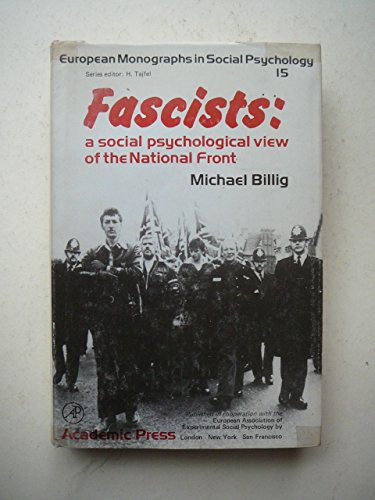
Fascists: a social psychological view of the National Front

Billig, Michael
The growth of the National Front into a political party has shown that fascism is alive and kicking in Britain, and no longer confined to a tiny lunatic fringe.This book examines in detail the official propaganda of the National Front and this, together with an analysis of its basic ideology and interviews with ordinary members, demonstrates a clear historical continuity with Nazism and the survival of the anti-Semitic belief in a world Jewish conspiracy.The idea of a Nazi revival here in Britain is of frightening importance and this book should be read by all those with an interest in the threat posed by contemporary fascism.
Academic Press in co-operation with European Association of Experimental Social Psychology 1978 393 pages

New sexual agendas

Lynne Segal
In this media driven age in which private has become public we have seen the Stonewall riots, which launched the gay rights movement, Hair on Broadway with a nude cast, art from Mapplethorpe to Madonna, AIDS and safe sex campaigns, drag gone mainstream, and adolescents engaging in sexual activity at increasingly younger ages. At the same time, society continually tries to eradicate open expressions of sexuality and harass those who ignore the mandated modes of permissible sexual expression. Taking on those who would limit sexual freedom, New Sexual Agendas challenges the notion that there are fixed sexual behaviors for men and women. This engaging collection draws on a number of disciplines including women's studies, literature, gender studies, cultural studies, history, politics, and education, sociology, and psychology. Including well known thinkers such as Jeffrey Weeks, Leonore Tiefer, and Mary McIntosh, New Sexual Agendas explores our sexual legacy, from turn-of-the-century sexologists to the inequalities of sexually invested social structures, from the rise of the Right and its portent for sexual freedoms to the myth of women as the subordinate sex. Along the way it explores the limits of trust in intimate relationships, the escalating AIDS epidemic, and the dangers of prescribed sex roles for both heterosexual and homosexual relationships.
New York University Press 1997-05 278 pages

Impromptu man: J.L. Moreno and the origins of psychodrama, encounter culture, and the social network

Moreno, Jonathan D.
""Impromptu Man captures the remarkable impact of a singular genius, J.L. Moreno, whose creations-the best-known being psychodrama-have shaped our culture in myriad ways, many unrecognized. The record will be set straight for all time by this can't-put-down biography, a tribute by Jonathan D. Moreno to his father's masterly legacy." -DANIEL GOLEMAN, author of Emotional Intelligence: Why It Can Matter More Than IQ J.L. Moreno (1889-1974), the father of psychodrama, was an early critic of Sigmund Freud, wrote landmark works of Viennese expressionism, founded an experimental theater where he discovered Peter Lorre, influenced Martin Buber, and became one of the most important psychiatrists and social scientists of his time. ?? A mystic, theater impresario and inventor in his youth, Moreno immigrated to America in 1926, where he trained famous actors, introduced group therapy, and was a forerunner of humanistic psychology. As a social reformer, he reorganized schools and prisons, and designed New Deal planned communities for workers and farmers. Moreno's methods have been adopted by improvisational theater groups, military organizations, educators, business leaders, and trial lawyers. His studies of social networks laid the groundwork for social media like Twitter and Facebook. ?? Featuring interviews with Clay Shirky, Gloria Steinem, and Werner Erhard, among others, original documentary research, and the author's own perspective growing up as the son of an innovative genius, Impromptu Man is both the study of a great and largely unsung figure of the last century and an epic history, taking readers from the creative chaos of early twentieth-century Vienna to the wired world of Silicon Valley. Jonathan D. Moreno, called the "most interesting bioethicist of our time" by the American Journal of Bioethics, is a professor at the University of Pennsylvania and a Senior Fellow at the Center for American Progress. "--
Bellevue Literary Press 2014 319 pages

The handbook of impression formation: a social psychological approach

Emily Balcetis,Gordon B. Moskowitz
"Presenting diverse perspectives from eminent scholars and contemporary researchers, The Handbook of Impression Formation contextualizes current and future areas of research in the social psychology of impression formation within a rich historic framework. Affirming that impression formation is at the core of human experience, chapters explore how and why people form snap judgments about others and when those impressions update. They examine the processes through which people infer the reasons for the events they encounter, allowing people to plan for appropriate behavioral responses to social contexts. The research reviewed is informed by the foundational theory of unconscious automatic processes involved in making judgements of other people, pioneered by Professor Jim Uleman who contributes a chapter that suggests important new directions, and concludes the volume by reflecting on the state of the field more broadly. The book explores how certain attributes stimulate categorization, examining current issues around implicit bias, stereotypes, and social media. Chapters cover a range of approaches, featuring personal narratives, presentation of new data and discoveries, comprehensive literature reviews, and contemplations on where the field must go and what questions require focus for progress to be made, calling for even the most advanced scholars to contribute more to the collective investigation of impression formation. This fascinating work provides a solid foundation from which all researchers can build a new and unique program of research, and arms the reader with the intellectual tools they need to chart new theoretical territory and discover aspects of the human experience we have yet to even wonder about. It is essential reading for students and academics in social psychology, and the social sciences more broadly"--
Routledge 2022 519 pages

The quantity theory of morality: together with five supporting propositions and the epilogue

Self, Will
"A blistering, brilliant novel from the Booker-shortlisted author, elegantly reflecting his Geoffrey Faber Memorial award-winning story collection The Quantity Theory of Insanity. In The Quantity Theory of Morality, Will Self 's unconventional new novel, his pen remains dipped in vitriol and elegance as ever. In this dark yet hilariously satirical "state-of-an-era novel," Self 's target is a collective morality that is nothing more or less than pure sociability. His middle-class, middle-English characters appear trapped in a timeless go-round of polite chitchat in dinner parties that refract like a hall of mirrors as the novel progresses, until one day someone says something to the effect of, "This way to the gas chamber, please, ladies and gentlemen." The Quantity Theory of Morality finally solves the equation of time and money that dominates our lives, in a way that is simultaneously deranging, destabilizing, and hilarious. With recurring-if defeated-appearances from now-canonical characters like Zack Busner, the repetition of each chapter, or "Proposition," shows Will Self to be both a master of satire and slapstick humor and a sublime and thoughtful critic of the alienation of modern life. With The Quantity Theory of Morality, Self provides the sequel to his award-winning debut of thirty-four years ago: The Quantity Theory of Insanity. That literary psycho-surgery proved there wasn't enough sanity to go around-now he's established what many of us fear to be the absolute truth: there isn't enough good to go around, either"-- Provided by publisher.
Grove Press 2026-03-10 368 pages