5744 results for "Literature"

Relationality: from attachment to intersubjectivity

Mitchell, Stephen A.
"This book, first published in the year of the author's death, expresses Mitchell's vision for the theory of Relational Psychoanalysis, and provides his most-developed expression of its foundations. Now republished in this Classic Edition, Mitchell's ideas are brought back to the psychoanalytic readership, complete with a new introduction by Donnel Stern. In his final contribution to the psychoanalytic literature, the late Stephen A. Mitchell provided a brilliant synthesis of the interrelated ideas that describe the relational matrix of human experience. Relationality charts the emergence of the relational perspective in psychoanalysis by reviewing the contributions of Loewald, Fairbairn, Bowlby, and Sullivan, whose voices converge in apprehending the fundamental relationality of the human mind. Mitchell draws on the multiple dimensions of attachment, intersubjectivity, and systems theory in espousing a clinical approach equally notable for its responsiveness and responsible restraint. This remains a canonical text for all relational psychoanalysts and psychotherapists"--
Routledge 2022 170 pages

The Black Marble Pool

Stan Leventhal
When you first notice it, something seems a bit unusual. Then it occurs to you that most, if not all, of the pools you've ever seen before were painted blue or white. The Captain's House pool is black. Not painted black. But constructed of black marble and black tile. The marble has streaks of white that look like lightning bolts in a black sky. There is a sexiness to this pool; a personality. It looks and feels like a warm, wet blanket, surrounding and protecting you like a dark, quiet womb. There's a dead body at the bottom of a pool in the backyard of a guest house in Key West. Who is he? And what caused his untimely demise? Maybe it's suicide. Or an accident. But more likely - murder! And who's responsible? One of the guests, the people who run the guest house or one of those mysterious women in town? A Lambda Literary Awards Finalist in 1991, this new edition includes a foreword by renowned LGBTQ publicist and friend of Stan Leventhal, Michele Karlsberg. "The pace is brisk: the plot keeps twisting, as no one is at all who they seem." - Keith John Glaeske, Out In Print "Stan was a literary activist who always gave to, built and endorsed literature and writers. On this Sunday morning, all these years later, I can still see Stan in his apartment window on Christopher Street, next door to the Stonewall Inn, overlooking Sheridan Square as he typed away." - Michele Karlsberg "Stan Leventhal was wonderful company: warm, honest, curious, engaging, and human. [His writing] is the next best thing to hanging out with him." - Christopher Bram
ReQueered Tales 2023-03-14 198 pages

Jewish views of the afterlife

Raphael, Simcha Paull
In Jewish Views of the Afterlife, Simcha Paull Raphael guides the reader through 4,000 years of Jewish thought on the afterlife by investigating pertinent sacred texts produced in each era. Through a compilation of ideas found in the Bible, Apocrypha, rabbinic literature, medieval philosophy, medieval Midrash, Kabbalah, and Hasidism, the reader learns how Judaism conceived of the fate of the individual after death throughout Jewish history. In the wake of the horrifying deaths of six million Jews in the Holocaust, many turned away from Judaism and shunned a God who had seemingly allowed this senseless act of cruelty to occur. Others turned toward the faith, desperately wanting to believe in the doctrine that those whose lives had ended prematurely had passed on to another a better life. But does an afterlife even exist? What role does it play in Jewish theology? While many affirm a belief in the afterlife, a scarce few are aware of where these teachings can be found in Jewish literature. Among the topics discussed in this fascinating volume are heaven and hell, Olam Ha-Ba (The World to Come), Gan Eden, resurrection of the dead, immortality of the soul, and divine judgment prior to death.
J. Aronson 1996 474 pages

The Werewolf of Paris

Guy Endore
Endore's classic werewolf novel--now back in print for the first time in over forty years--helped define a genre and set a new standard in horror fiction. The werewolf is one of the great iconic figures of horror in folklore, legend, film, and literature. And connoisseurs of horror fiction know that The Werewolf of Paris is a cornerstone work, a masterpiece of the genre that deservedly ranks with Mary Shelley's Frankenstein, Bram Stoker's Dracula, and Robert Louis Stevenson's The Strange Case of Dr. Jekyll and Mr. Hyde. Endore's classic novel has not only withstood the test of time since it was first published in 1933, but it boldly used and portrayed elements of sexual compulsion in ways that had never been seen before, at least not in horror literature. In this gripping work of historical fiction, Endore's werewolf, an outcast named Bertrand Caillet, travels across revolutionary Paris in the 1870s seeking to calm the beast within. Stunning in its sexual frankness and eerie, fog-enshrouded visions, this novel was decidedly influential for the generations of horror and science fiction authors who came afterward.
Pocket Books 1976-07-02 277 pages

My futurist years

Jakobson, Roman
An important collection of writings and memoirs on the Russian Futurist movement from one of America's pre-eminent linguists and literary theorists. Born in Moscow in 1896, Roman Jakobson brought an extraordinary rare poet's sensibility to his exploration of language. This volume, which fills a major gap in the literature of the Russian avant-garde, is a lively collection of letters, memoirs, poetry, prose, and essays. It includes recollections of Mayakovsky, Khlebnikow and others.
Marsilio 1997 371 pages

James the Brother of Jesus and the Dead Sea Scrolls II

Robert H. Eisenman
In this concluding volume of James the Brother of Jesus and the Dead Sea Scrolls II: The Damascus Code, the Tent of David, the New Covenant, and the Blood of Christ, renowned biblical scholar Robert Eisenman compresses in a more reader-friendly format the results of previous work, creating a more comprehensive picture of Jesus' brother James as "the pivotal Opposition Leader" of the time leading up to the War against Rome (66-70 CE). Is there an interconnecting code between the New Testament and the Dead Sea Scrolls? Eisenman - who broke the Scrolls monopoly and was the first to identify the so-called "James Ossuary" as fraudulent - shows that there is. Moreover, in this newly-revised volume, he 'decodes' many beloved and famous sayings of the Gospels, such as "Every plant which My Heavenly Father has not planted shall be uprooted," "A man shall not be known by what goes into his mouth but by what comes out of it," "Do not throw Holy Things to dogs," etc. including chapters like "The Dogs who Licked Poor Lazarus' Sores" or "Rabbi Eliezer's Bad Breath and Lazarus' Stinking Body." In identifying the Scrolls as the literature of "the Messianic Movement in Palestine"; he not only connects "James the Brother of Jesus" to the Leadership of 'Early Christianity' in Palestine, but also to "the Righteous Teacher" in the Scrolls. Offering a point-by-point analysis of James' relationship to the Habakkuk Commentary, The Damascus Document, The War Scroll, etc., he also illumines the subjects "the Pella Flight and raising the Fallen Tent of David," "Paul as an Herodian," "the Wilderness Camps," and "Peter"'s role as "a prototypical Essene" but in Acts as a mouthpiece for anti-Semitism. In doing so he, not only clarifies the true history of Palestine in the First Century, but deciphers the way 'the picture' of "Jesus" was put together in the Gospels and, as a consequence, what can be known about the real "Jesus." He also covers subjects like "the New Covenant in the Land of Damascus" and Paul's attack on James on the Temple steps, extending it to the competition between Paul and "the Party of James" over "Circumcision" in Antioch and the conversion of Queen Helen Adiabene and her sons in Northern Syria, who led the "famine relief" effort ascribed to Paul in Acts. Moreover, he will show the figure of James to have been so influential and highly-regarded in the Jerusalem of his day that his death was the capstone event leading up to the Jewish Revolt against Rome. In making these arguments and exposing actual 'overwrites', a crucial new point that emerges is his identification of the Qumran document called by scholars "MMT" as a 'Jamesian' Letter to "the Great King of the Peoples beyond the Euphrates." At the same time, he unravels the real "code" behind the pivotal New Testament allusion: "This is the Cup of the New Covenant in My Blood," connecting it to "the New Covenant in the Land of Damascus" and "giving the Cup of the Right Hand of the Lord ( "the Cup of Divine Wrath") to drink" in both the Damascus Document and Habakkuk Pesher in the Scrolls. Did Paul know the meaning of the famous Damascus Document (discovered in Cairo in the Nineteenth Century) "to set the Holy Things up according to their precise specifications" - or the reverse of it, as Peter is presented as being made to understand by "a Voice out of Heaven" and "a Tablecloth" descending out of it - "to make no distinctions between Holy and profane" - on a rooftop in Gaza? In this series, Eisenman's revelations will extend far beyond these examples. James the Brother of Jesus and the Dead Sea Scrolls, both I and II, will complete the task of rescuing James from the oblivion into which he was cast, either intentionally or via benign neglect. His conclusion will, therefore, definitively bear on the problem of "the Historical Jesus" "Who and whatever James was, so was Jesus." Eisenman's many readers will not be disappointed.
Grave Distractions Publications 2012-09 476 pages

Music from the earliest notations to the sixteenth century

Taruskin, Richard
The universally acclaimed and award-winning Oxford History of Western Music is the eminent musicologist Richard Taruskin's provocative, erudite telling of the story of Western music from its earliest days to the present. Each book in this superlative five-volume set illuminates-through a representative sampling of masterworks- the themes, styles, and currents that give shape and direction to a significant period in the history of Western music. This first volume in Richard Taruskin's majestic history, Music from the Earliest Notations to the Sixteenth Century , sweeps across centuries of musical innovation to shed light on the early forces that shaped the development of the Western classical tradition. Beginning with the invention of musical notation more than a thousand years ago, Taruskin addresses topics such as the legend of Saint Gregory and Gregorian chant, Augustine's and Boethius's thoughts on music, the liturgical dramas of Hildegard of Bingen, the growth of the music printing business, the literary revolution and the English madrigal, the influence of the Reformation and the Counter-Reformation, and the operas of Monteverdi. Laced with brilliant observations, memorable musical analysis, and a panoramic sense of the interactions between history, culture, politics, art, literature, religion, and music, this book will be essential reading for anyone who wishes to understand this rich and diverse period.
Oxford University Press 2010 906 pages

A Tribute to Teachers: Wit and Wisdom, Information and Inspiration About Those Who Change Our Lives

Lederer, Richard
Best-selling author Richard Lederer offers a chorus of praise to those who change our lives one day and one lesson at a time. Readers will meet great teachers throughout history, as well as educators captured in literature, film, and comic strips. Offering compelling proof that teachers really do make a difference in the English, math, history, and science classrooms, A Tribute to Teachers celebrates the most unheralded, exhausting, income-challenged, and ultimately rewarding of all professions.
Waterside Productions 2022-04-06 144 pages

The Messiah texts

Patai, Raphael
Following a detailed introduction to the world of messianic ideology and its significance in Jewish history, The Messiah Texts traces the progress of the messianic legend from its biblical beginnings to contemporary expressions. Renowned scholar Raphael Patai has skillfully selected passages from a voluminous literature spanning three millennia. Using his own translations from Hebrew, Aramaic, Arabic, Latin, and other original texts, Patai excerpts delightful folk tales, apocalyptic fantasies, and parables of prophetic power. All are central to the understanding of a magnificent heritage. patai also investigates the false messiahs who have appeared throughout Jewish history, the modern Messiah-influenced movements such as reform Judaism and Zionism, and the numerous reasons put forth by the various branches of Judaism as to why the Messiah has not yet appeared.
Wayne State University Press 1979 373 pages

Collected poems

Levi, Primo
In his memoirs and fiction, Primo Levi bore witness to the suffering of the Holocaust and books like The Periodic Table and The Drowned and the Saved are now recognised as classics of twentieth-century literature. Throughout his writing life, Levi also produced poetry and this volume collects together all his poems, including eighteen that have not previously appeared in book form. Short and spare, the poems employ the same courageous and steady gaze at the worst that can happen that illuminates his prose.
Faber 1992 104 pages

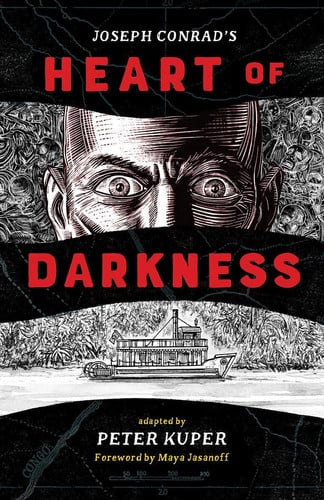
Joseph Conrad's Heart of darkness

Kuper, Peter
"Acclaimed cartoonist Peter Kuper delivers a powerful interpretation of this controversial classic. Heart of Darkness has unsettled generations of readers with its haunting portrait of colonialism and brutal exploitation in Africa. Now award-winning illustrator Peter Kuper reimagines Conrad's masterpiece for a new generation, transforming this dramatic tale of madness, greed, and evil into something visually immersive and profoundly complex. Drawn in pen, black pencil, and ink wash reminiscent of the etchings and lithography of Francisco Goya and Honoré Daumier, Kuper's Heart of Darkness captures the ominous atmosphere and tempo of Charles Marlow's journey up the River Congo. Kuper's images and concise text confront Conrad's colonial attitudes and systemic racism yet leave room for readers to engage with these issues on their own terms. Longtime admirers of the novella will appreciate Kuper's innovative interpretations and see Conrad's opus with fresh eyes, while new readers will discover a brilliant introduction to a canonical work of twentieth- century literature"--
W. W. Norton & Company, Inc 2020 160 pages

The art of hunger: essays, prefaces, interviews

Auster, Paul
In this astonishingly acrobatic work, Paul Auster traces the compulsion to make literature--or art--through essays on Franz Kafka, Samuel Beckett, Paul Celan, Laura Riding, Knut Hamsun, John Ashbery, and other vital figures of our century. In a section of interviews as well as in the revelatory ?The Red Notebook,? Auster reflects on his own work: on the need to break down the boundary between living and writing; on the use of certain genre conventions to penetrate matters of memory and identity. The Art of Hunger undermines and expands our accepted notions about literature and throws an uprecedented light on his own richly allusive writing.
Sun & Moon Press 1992 312 pages

Collected Poems

Paul Auster
A stunning and considered collection of poetry and writings by one of the most intriguing and accomplished voices in contemporary literature. Paul Auster's penetrating and charged verse resembles little else in recent American poetry. This collection of Auster's poetry, translations, and composition notes from early in his career do much to reinforce the idea that Paul Auster is, indeed, a unique and masterful figure in the literary world. Taut, densely lyrical, and everywhere informed by a powerful and subtle music, this selection of writings begins with the compact verse fragments of Spokes (written when Auster was in his early twenties) and Unearth, continues on through the more ample meditations of Wall Writing, Disappearances, Effigies, Fragments From the Cold, Facing the Music, and White Spaces, then moves further back in time to include Auster's revealing translations of many of the French poets who influenced his own writing, as well as the provocative and previously unpublished "Notes From A Composition Book" (1967). An introduction by Norman Finkelstein connects biographical elements to a consideration of the work, and takes in Auster's early literary and philosophical influences. Powerful, haunting, and precise, this view from the past to the present will appeal to those unfamiliar with this aspect of Auster's work, as well as those already acquainted with his poetry.
Harry N. Abrams 2007-06-26 206 pages

The search warrant

Modiano, Patrick
WINNER OF THE NOBEL PRIZE IN LITERATURE, 2014 Haunted by the fate of Dora Bruder - a fifteen-year-old girl listed as missing in an old December 1941 issue of Paris Soir - Nobel Prize-winning author Patrick Modiano sets out to find all he can about her. From her name on a list of deportees to Auschwitz to the fragments he is able to uncover about the Bruder family, Modiano delivers a moving survey of a decade-long investigation that revived for him the sights, sounds and sorrowful rhythms of occupied Paris. And in seeking to exhume Dora Bruder's fate, he in turn faces his own family history. Translated by Joanna Kilmartin 'Absolutely magnificent' Le Monde
Vintage Classics 2020 144 pages

Why are we at war?

Mailer, Norman
Beginning with his debut masterpiece, The Naked and the Dead, Norman Mailer has repeatedly told the truth about war. Why Are We at War? returns Mailer to the gravity of the battlefield and the grand hubris of the politicians who send soldiers there to die. First published in the early days of the Iraq War, Why Are We at War? is an explosive argument about the American quest for empire that still carries weight today. Scrutinizing the Bush administration’s words and actions, Mailer unleashes his trademark moral rigor: “Because democracy is noble, it is always endangered. . . . To assume blithely that we can export democracy into any country we choose can serve paradoxically to encourage more fascism at home and abroad.” Praise for Why Are We at War? “We’re overloaded with information these days, some of it possibly true. Mailer offers a provocative—and persuasive—cultural and intellectual frame.”—Newsweek “[Mailer] still has the stamina to churn out hard-hitting criticism.”—Los Angeles Times “Penetrating . . . There’s plenty of irreverent wit and fresh thinking on display.”—San Francisco Chronicle “Eloquent . . . thoughtful . . . Why Are We at War? pulls no punches.”—Fort Worth Star-Telegram Praise for Norman Mailer “[Norman Mailer] loomed over American letters longer and larger than any other writer of his generation.”—The New York Times “A writer of the greatest and most reckless talent.”—The New Yorker “Mailer is indispensable, an American treasure.”—The Washington Post “A devastatingly alive and original creative mind.”—Life “Mailer is fierce, courageous, and reckless and nearly everything he writes has sections of headlong brilliance.”—The New York Review of Books “The largest mind and imagination [in modern] American literature . . . Unlike just about every American writer since Henry James, Mailer has managed to grow and become richer in wisdom with each new book.”—Chicago Tribune “Mailer is a master of his craft. His language carries you through the story like a leaf on a stream.”—The Cincinnati Post
Random House Trade Paperbacks 2003 111 pages

Double Agent The Critic and Society

Morris Dickstein
Double Agent is a watershed in the recent revival of interest in the role of the public critic and intellectual who writes about culture, politics, and the arts for an intelligent general audience. Offering acute portraits of critics both famous and neglected, Dickstein traces the evolution of cultural criticism over the last century from Matthew Arnold to New Historicism. He examines the development of practical criticism, the rise and fall of literary journalism, and the growth of American Studies, and rereads the work of critics like Arnold, Walter Pater, I.A. Richards, Roland Barthes, Edmund Wilson, R.P. Blackmur, Lionel Trilling, Alfred Kazin, and George Orwell. In essays and books that are themselves works of literature, these writers made criticism central to the public sphere, balancing social and literary values, politic commitment and aesthetic judgment. Though marginalized or ignored by academic histories of criticism, their example has proved immensely valuable for younger critics eager to find a personal voice and reach a wider public. Dickstein concludes with a lively and provocative dialogue that weighs the claims of recent literary theory and the importance of renewing public culture.
Oxford University Press 1996-07 244 pages

Fundamental liberties of a free people: religion, speech, press, assembly

Konvitz, Milton R.
Of the American Bill of Rights, perhaps the forty-five words that comprise the First Amendment-allowing freedom of religion, speech, press, and assembly, and the guaranty of the writ of habeas corpus-are the most precious. Only a legal expert could lay claim to truly understanding the meaning and intention of those basic freedoms. Yet it is precisely the expert, knowing the complexity of the subject, who would be the first to hesitate to claim to possess such a thorough understanding. In analyzing such freedoms basic to American society, Milton Konvitz helps make comprehending our fundamental liberties easier. The book is divided into three parts: I. Freedom of Religion; II. Freedom of Speech, Press, and Assembly; III. Freedom of Speech, Press, and Assembly: The Clear and Present Danger Doctrine. The reader will find included such topics as the debate over the scope of the separation of Church and State, whether or not freedom of religion is an absolute right, religious freedom prior to 1776, the liberty of private schools, heresy, the right for a religious group to seek converts, the freedoms not to speak and listen, obscene literature, picketing in labor disputes, the freedom to think and believe, abridgments of speech and press, and loyalty oaths and guilt by association. Konvitz's work includes an important chapter on the history of the adoption of the Bill of Rights. His careful tracing of the development of constitutional attitudes to the freedoms protected by the First Amendment is a scholarly benchmark, and is still an archetype for students doing research and writing about these issues. It is of critical importance to anyone seeking an authoritative statement on the basic liberties guaranteed by the First Amendment to the United States Constitution. Fundamental Liberties of a Free People is a relevant and practical guide to understanding the liberties so fundamental to a free society. In his new introduction and afterword, author Milton Konvitz brings First Amendment developments up to 2002. It will be welcomed by students and scholars of constitutional law, government, politics, religion, and American history.
Transaction Publishers 2003 452 pages

The case against Israel

Neumann, Michael
The Case Against Israel argues that Zionism was responsible for the conflict between Israelis and Palestinians and that Israel is responsible for its perpetuation. The argument rests on widely accepted factual claims and impeccable sources. It avoids rhetoric and gratuitous moralizing. There is no attempt to blacken Israel through association with colonialism, imperialism, or racism. Instead, Neumann's argument emphasizes the fateful Zionist quest for Jewish sovereignty in Palestine. This quest--not the massacres or plans for transfer or other blots on Zionist history--made violence inevitable and compromise impossible. The prospect of Zionists gaining the power of life and death over all inhabitants of Palestine had to be seen by the Palestinians as a mortal threat. They responded accordingly. The tragic consequences of the quest for sovereignty did not follow all at once, but in two stages. The Zionists established a sovereign Jewish state in 1948. Had they been content with that, peace might have followed the 1967 war, when Israel could have backed the creation of a Palestinian state in the occupied territories. Instead, Zionists pushed to extend Jewish sovereignty, this time through the settler movement. The settlements were a renewed mortal threat to the Palestinians and once again necessitated a violent response. The only solution is for Israel to withdraw, unilaterally, to its 1948 borders. Michael Neumann was born in 1946, the son of German Jewish refugees. He graduated from Columbia University with degrees in European history and English literature, followed by a doctorate in philosophy from the University of Toronto. He teaches moral and political philosophy at a Canadian university. He has written What's Left? , a critique of 1960s radicalism, and numerous articles relating to the Israel/Palestine conflict. His academic work includes The Rule of Law: Politicizing Ethics as well as articles on utilitarianism, rationality, and rights.
CounterPunch 2005 220 pages

Parallel lives

Lind, Michael
Michael Lind has been described by Rolling Stone magazine as “that rarest of figures: an intellectual with name recognition.” Now the Whitehead Senior Fellow at the New America Foundation in Washington, DC, Lind has been an editor or staff writer for The New Yorker, Harper’s Magazine, and The New Republic and writes frequently for The New York Times and Financial Times. He is the author of more than a dozen books of history, political journalism, and fiction, including a poetry chapbook, When You Are Someone Else (2002); Bluebonnet Girl (2004), a children’s book in verse that won an Oppenheimer Toy Prize for children’s literature; and a narrative poem, The Alamo (1997), which the Los Angeles Times named as one of the best books of the year. Parallel Lives is his first collection of verse. Lind’s themes range from geopolitical issues, interpersonal relationships, art, nature and the American landscape, to the nature of poetry itself. Thomas Disch says of Lind, “To read his spare and elegant poems is to be privy to the councils of the unacknowledged legislators of our own day and age.”
Etruscan Press 2007 95 pages