58,196 results in 0.08 seconds

Writing a woman's life

Heilbrun, Carolyn G.
"Astute and provocative....Blends the sophistication of recent feminist theory with highly textured details fro the lives of independent and ambitious women." THE NEW YORK TIMES BOOK REVIEW Drawing on the experience of celebrated women, from George Sand and Virginia Woolf to Dorothy Sayers and Adrienne Rich, Heilbrun examines the struggle these writers undertook when their drives made it impossible for them to follow the traditional "male" script for a woman's life. Refreshing and insightful, this is an homage to brave women past and present, and an invitation to all women to write their own scripts, whatever they may be.
Ballantine Books 2002 144 pages

After the Rights Revolution: reconceiving the regulatory state

Sunstein, Cass R.
In the twentieth century, American society has experienced a "rights revolution": a commitment by the national government to promote a healthful environment, safe products, freedom from discrimination, and other rights unknown to the founding generation. This development has profoundly affected constitutional democracy by skewing the original understanding of checks and balances, federalism, and individual rights. Cass Sunstein tells us how it is possible to interpret and reform this regulatory state regime in a way that will enhance freedom and welfare while remaining faithful to constitutional commitments. Sunstein vigorously defends government regulation against Reaganite/Thatcherite attacks based on free-market economics and pre-New Deal principles of private right. Focusing on the important interests in clean air and water, a safe workplace, access to the air waves, and protection against discrimination, he shows that regulatory initiatives have proved far superior to an approach that relies solely on private enterprise. Sunstein grants that some regulatory regimes have failed and calls for reforms that would amount to an American perestroika: a restructuring that embraces the use of government to further democratic goals but that insists on the decentralization and productive potential of private markets. Sunstein also proposes a theory of interpretation that courts and administrative agencies could use to secure constitutional goals and to improve the operation of regulatory programs. From this theory he seeks to develop a set of principles that would synthesize the modern regulatory state with the basic premises of the American constitutional system. Teachers of law, policymakers and political scientists, economists and historians, and a general audience interested in rights, regulation, and government will find this book an essential addition to their libraries.
Harvard University Press 1990 284 pages

Designing democracy: what constitutions do

Sunstein, Cass R.
"In modern nations, political disagreement is the source of both the gravest danger and the greatest security," writes Cass Sunstein. All democracies face intense political conflict. But is this conflict necessarily something to fear? In this provocative book, one of our leading political and legal theorists reveals how a nation's divisions of conviction and belief can be used to safeguard democracy.Confronting one explosive political issue after another, from presidential impeachment to the limits of religious liberty, from discrimination against women and gays to the role of the judiciary, Sunstein constructs a powerful new perspective from which to show how democracies negotiate their most divisive real-world problems. He focuses on a series of concrete concerns that go to the heart of the relationship between the idea of democracy and the idea of constitutionalism. Illustrating his discussion with examples from constitutional debates and court-cases in South Africa, Eastern Europe, Israel, America, and elsewhere, Sunstein takes readers through a number of highly charged questions: When should government be permitted to control discriminatory behavior by or within religious organizations? Does it make sense to govern on the basis of popular referenda? Can the right to have an abortion be defended? Can we defend Internet regulation? Should the law step in if children are being schooled in discriminatory preferences and beliefs? Should a constitution protect rights to food, shelter, and health care?Disputes over questions such as these can be fierce enough to pose a grave threat. But in a paradox whose elaboration forms the core of Sunstein's book, it is a nation's apparently threatening diversity of opinion that can ensure its integrity.Extending his important recent work on the way deliberation within like-minded groups can produce extremism, Sunstein breaks new ground in identifying the mechanisms behind political conflict in democratic nations. At the same time, he develops a profound understanding of a constitutional democracy's system of checks and balances. Sunstein shows how a good constitution, fostering a "republic of reasons," enables people of opposing ethical and religious commitments to reach agreement where agreement is necessary, while making it unnecessary to reach agreement when agreement is impossible.A marvel of lucid, subtle reasoning, DESIGNING DEMOCRACY makes invaluable reading for anyone concerned with the promises and pitfalls of the democratic experiment.
Oxford University Press 2001-09-27 280 pages

Free markets and social justice

Sunstein, Cass R.
The newest work from one of the most preeminent voices writing in the legal/political arena today, this important book presents a new conception of the relationship between free markets and social justice. The work begins with foundations--the appropriate role of existing "preferences," the importance of social norms, the question whether human goods are commensurable, and issues of distributional equity. Continuing with rights, the work shows that markets have only a partial but instrumental role in the protection of rights. The book concludes with a discussion on regulation, developing approaches that would promote both economic and democratic goals, especially in the context of risks to life and health. Free Markets and Social Justice develops seven basic themes during its discussion: the myth of laissez-faire; preference formation and social norms; the contextual character of choice; the importance of fair distribution; the diversity of human goods; how law can shape preferences; and the puzzles of human rationality. As the latest word from an internationally-renowned writer, this work will raise a number of important questions about economic analysis of law in its conventional form.
Oxford University Press 1997-02-06 407 pages

Human Agency and Behavioral Economics Nudging Fast and Slow

Cass R. Sunstein
This Palgrave Pivot offers comprehensive evidence about what people actually think of “nudge” policies designed to steer decision makers’ choices in positive directions. The data reveal that people in diverse nations generally favor nudges by strong majorities, with a preference for educative efforts – such as calorie labels - that equip individuals to make the best decisions for their own lives. On the other hand, there are significant arguments for noneducational nudges – such as automatic enrollment in savings plans - as they allow people to devote their scarce time and attention to their most pressing concerns. The decision to use either educative or noneducative nudges raises fundamental questions about human freedom in both theory and practice. Sunstein's findings and analysis offer lessons for those involved in law and policy who are choosing which method to support as the most effective way to encourage lifestyle changes.
Springer International Publishing 2018-05-09 116 pages

Infotopia: how many minds produce knowledge

Sunstein, Cass R.
As the dire history of planned economies highlights, small well-informed groups of people will often make far worse decisions than large numbers of people, acting independently, would make. In Infotopia, Cass Sunstein looks at the "wisdom of the many"--particularly as seen on today's Internet--illuminating many new ways of collecting and evaluating information and making effective decisions. Sunstein shows how the on-line efforts of many people coming together help companies, schools, governments, and individuals to amass ever-growing bodies of accurate knowledge. He describes for instance how Wikipedia, through an endless flurry of self-correcting exchanges, collects information on everything from politics and business to science fiction. Open-source software--which licenses programmers to use, change, and improve the software--taps the power of large numbers of people to spur technological development. And prediction markets--such as the famous Iowa Electronic Market, where people bet real money on the outcome of local and national elections--collect information in a way that allows companies, ranging from computer makers to Hollywood studios, to make better decisions about the future. Sunstein reveals why these revolutionary new methods are so astoundingly accurate and he also shows how people can take advantage of "the wisdom of the many" without succumbing to the dangers of herd mentality. "Sunstein, one of the biggest of America's internet big thinkers, has written an intriguing new book in which he argues that Hayek's insights about the genius of markets are equally true of the internet." --Patti Waldmeir, Financial Times "This extraordinary work synthesizes the latest in how we know, with the latest in what the web has become, to map more compellingly than any other book the promise and risk of the information society." --Lawrence Lessig, author of Free Culture and The Future of Ideas "Vivid, readable, and informativea show-me-the-money guide to what soars and what stumbles from the stable of Internet dreams." --Jedediah Purdy, American Prospect "Sunstein, one of the biggest of America's internet big thinkers, has written an intriguing new book in which he argues that Hayek's insights about the genius of markets are equally true of the internet. Sunstein argues, for example, that sharing scientific information online would cure some of the worst problems of the US patent system and foster innovation much more efficiently than costly patent litigation. Sunstein recognizes all the potential flaws of such collaborative projects. Groupthink can be dangerous. But, says Sunstein, the wisdom of the many is a great thing, and sharing knowledge online can lead to remarkable advances for companies, for governments and for the rest of us."--Patti Waldmeir, Financial Times "A survey of the evidence on how information technology affects political debate and institutional decision making. The result is a vivid, readable, and informative work of empiricist skepticism--a show-me-the-money guide to what soars and what stumbles from the stable of Internet dreams."--Jedediah Purdy, merican Prospect, Duke University "This extraordinary work synthesizes the latest in how we know, with the latest in what the web has become, to map more compellingly than any other book the promise and risk of the information society. As with everything Sunstein writes, this beautiful and clear book has something to teach the experts, and lots to teach the rest of us."-Lawrence Lessig, author of Free Culture and The Future of Ideas "Infotopia is a persuasive and sophisticated meditation on the ways in which the Web is not just living up to its early hype, but transcending it. Cass Sunstein has given us a brilliant integrative view of how the distributed users of the Internet can band together to produce extraordinary work--along with the circumstances that best give rise to deliberation r
Oxford University Press 2008 273 pages

Punitive damages.\How juries decide

Cass R. Sunstein,Reid Hastie,John W. Payne,David A. Schkade,W. Kip Viscusi
Over the past two decades, the United States has seen a dramatic increase in the number and magnitude of punitive damages verdicts rendered by juries in civil trials. Probably the most extraordinary example is the July 2000 award of $144.8 billion in the Florida class action lawsuit brought against cigarette manufacturers. Or consider two recent verdicts against the auto manufacturer BMW in Alabama. In identical cases, argued in the same court before the same judge, one jury awarded $4 million in punitive damages, while the other awarded no punitive damages at all. In cases involving accidents, civil rights, and the environment, multimillion-dollar punitive awards have been a subject of intense controversy. But how do juries actually make decisions about punitive damages? To find out, the authors-experts in psychology, economics, and the law-present the results of controlled experiments with more than 600 mock juries involving the responses of more than 8,000 jury-eligible citizens. Although juries tended to agree in their moral judgments about the defendant's conduct, they rendered erratic and unpredictable dollar awards. The experiments also showed that instead of moderating juror verdicts, the process of jury deliberation produced a striking "severity shift" toward ever-higher awards. Jurors also tended to ignore instructions from the judges; were influenced by whatever amount the plaintiff happened to request; showed "hindsight bias," believing that what happened should have been foreseen; and penalized corporations that had based their decisions on careful cost-benefit analyses. While judges made many of the same errors, they performed better in some areas, suggesting that judges (or other specialists) may be better equipped than juries to decide punitive damages. Using a wealth of new experimental data, and offering a host of provocative findings, this book documents a wide range of systematic biases in jury behavior. It will be indispensable for anyone interested not only in punitive damages, but also jury behavior, psychology, and how people think about punishment.
University of Chicago Press 2003-09-15 285 pages

The cost-benefit state: the future of regulatory protection

Sunstein, Cass R.
Gradually, in fits and starts, American Government is becoming a cost-benefit state: government regulation is increasingly assessed by asking whether the benefits of regulation justify the costs of regulation. The rise of the cost-benefit state is creating a number of intriguing and novel challenges for policy analysts, for all branches of government, and for the law in general. If a statute allows agencies to balance lives against costs, how will the balancing occur? What are the legal limitations on the agencies' choice of how to balance costs and benefits? How can lives and health be turned into monetary equivalents? What is the value of life? How should an agency handle a small risk of catastrophe, from terrorism, nuclear power, natural causes or some other source? How, if at all, should future generations be counted? What does it mean to say that agencies can exempt trivial risks from regulation? How do we know that a risk counts as 'trivial'? How can it be legitimate for courts to allow agencies to make such exemptions? This book hopes to make some progress on such questions.
Section of Administrative Law and Regulatory Practice, ABA 2002 199 pages

Genuine Black and White Magic of Marie Laveau Hoodoo's Earliest Grimoire and Spell Book

Catherine Yronwode,Zora Neale Hurston,Anne Fleitman,Bivens,Larry B. Wright,Dorothy Spencer,Helen Pitkin Schertz,The Allan Company,Franz Hartmann,Cyril Arthur Pearson,H. F.
Hoodoo's first grimoire and spell-book, originally edited by the famed folklorist and novelist Zora Neale Hurston, holds a place that no other conjure book can claim, for it provides the modern practitioner with practical training in authentic New Orleans rootwork, circa 1928.Although the author was certainly not Marie Laveau, the more than 50 rites and rituals in this volume present the classic hoodoo spells of the Crescent City, using herbs, candles, incense, powders, baths, and mojo hands to get your way in matters of luck, love, money, family, friendship, protection, uncrossing, and cursing.On the 90th anniversary of its first publication, the Lucky Mojo Curio Company is proud to present a new edition of this seminal text, restored and revised by catherine yronwode. Black and White Magic is truly the one book that every conjure doctor must posses!
Lucky Mojo Curio Company 2019 96 pages

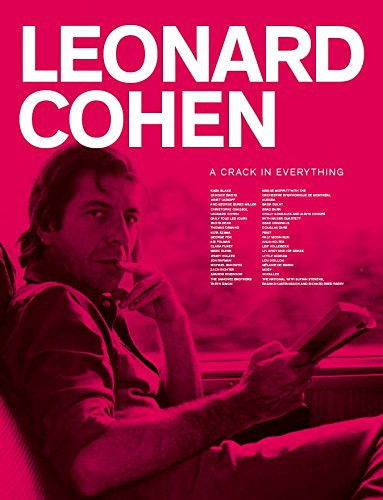
Leonard Cohen: a crack in everything

Victor Shiffman,Sylvie Simmons,Chantal Ringuet,John Zeppetelli
The world-renowned novelist, poet and singer/songwriter inspired generations of writers, musicians and artists. For decades, Leonard Cohen tenaciously supplied the world with melancholy but urgent observations on the state of the human heart. With equal parts gravitas and grace, he teased out a startlingly inventive and singular language, depicting both an exalted spirituality and an earthly sexuality. His interweaving of the sacred and the profane, of mystery and accessibility, was such a compelling combination it became seared into memory. Situated between monograph and devotional exercise, this visually striking publication documents a unique exhibition and pays homage to a global star's enormous cultural achievements. Visual artists, filmmakers, performers and musicians from around the world revisit Cohen's words, songs, and biography with new perspectives. Cohen himself makes an appearance as a visual artist with a projection of his many self-portraits. Co-curators John Zeppetelli and Victor Shiffman discuss the two years that went into bringing the ambitious event to fruition, from its original conception as a celebration to its final form of a tribute suffused in elegy. Cohen biographer Sylvie Simmons reviews Cohen's career from early promise to unexpected paths, through set-backs, and onto its astounding culmination. Chantal Ringuet draws upon specific moments in Cohen's life from early childhood to his last writings where he seems to be reciting his own Kaddish, the Jewish prayer for the dead. Also featured are artist statements from each of the 40 participants.
Musée d'art contemporain 2018 160 pages

Shattered dreams: the failure of the peace process in the Middle East, 1995-2002

Enderlin, Charles
As Middle-East Bureau Chief of the French Public television network and a resident of Jerusalem since 1968, Charles Enderlin has had unequaled access to leaders and negotiators on all sides. Here he takes the reader step-by-step along the path that began with the hope of agreement but led only to the ultimate collapse of the peace process. The dramatic account moves between the occupied territories and the negotiation tables as it follows the emotional shifts in the conflict from the 1995 assassination of Yitzhak Rabin to the years when Benjamin Netenyahu was in power. In a definitive account of the meetings at Camp David in July 2000, Enderlin details what was said between Israeli and Palestinian negotiators brought together by Bill Clinton in the presence of Yasir Arafat, President of the Palestinian Authority, and Israeli Prime Minister Ehud Barak.
Other Press 2003-05-17 458 pages

Killing me softly: my life in music

Fox, Charles
Charles Fox has composed more than 100 motion picture and television scores, among them the themes of many iconic series, including Happy Days, Laverne & Shirley, Love, American Style, and Love Boat. Twice nominated for the Academy Award and a two-time Emmy winner, Fox has also written music for the concert hall and the ballet. Among the hundreds of songs he has written is the Grammy Award-winning "Killing Me Softly with His Song," a number one record in just about every country in the world, by two different artists: Roberta Flack in 1973 and the Fugees, 20 years later. In this memoir, Fox recounts his development as a musician, beginning with his formal music education in Paris. From letters he wrote home between 1959 and 1961, Fox recounts his studies under the tutelage of the most renowned music composition teacher of the 20th century, Nadia Boulanger, whose influence Fox carried throughout his entire professional career. Following his return to the states, Fox describes the cornerstone events of his musical and personal life. He reflects on the highlights of his career, working with some of the greatest names in entertainment, film, television, and records, including Jim Croce, Barry Manilow, Lena Horne, and Fred Astaire. Inducted into the Songwriters Hall of Fame in 2004 and a recipient of the Lifetime Achievement Award from the Society of Composers & Lyricists, Fox's memoir is a compelling story of a musician and composer whose work continues to entertain and inspire listeners around the world.
Scarecrow Press 2010-08-27 293 pages