2220 results for "History"

The dialectical imagination: a history of the Frankfurt School and the Institute of Social Research, 1923-1950

Jay, Martin
Herbert Marcuse, Erich Fromm, Max Horkheimer, Franz Neumann, Theodor Adorno, Leo Lowenthal--the impact of the Frankfurt School on the sociological, political, and cultural thought of the twentieth century has been profound. The Dialectical Imagination is a major history of this monumental cultural and intellectual enterprise during its early years in Germany and in the United States. Martin Jay has provided a substantial new preface for this edition, in which he reflects on the continuing relevance of the work of the Frankfurt School.
Heinemann 1973 382 pages

Slave law in the American South: State v. Mann in history and literature

Tushnet, Mark V.
Product Description Slavery in the American South could not have existed without the authority of law defining slaves as the property of their masters. But the fact that slaves were also human beings placed limits on this harsh reality. When the rigor of the law and the complex bonds of sentiment linking master and slave came into conflict, masters looked to the courts. In one such case, State v. Mann, North Carolina Supreme Court justice Thomas Ruffin ruled that masters could not be prosecuted for assaulting their slaves. In articulating the legal basis for his decision, Justice Ruffin also revealed his own view of the "logic of slavery," in which he sanctioned the owner's rights even as he expressed his own horror at the mistreatment of the slave. Mark Tushnet, one of the foremost living authorities on antebellum slave law, now shows how studying such a simple case can illuminate an entire society. For those who detested slavery, the case represented all that was intolerable about that institution; for those who defended it, it raised vexing and persistent issues that could not be wished away. As further testament to the importance of State v. Mann, Harriet Beecher Stowe even made it central to her second antislavery novel, Dred. Tushnet discusses the opinion's place in the novel-in which she quoted liberally from Ruffin's decision-and evaluates other historians' interpretations of both the opinion and Stowe's provocative novel. Tushnet provides a finely detailed analysis of Ruffin's opinion, portraying the judge as a man compelled by law to uphold the slaveowner's right while moved as a Christian by the slave's maltreatment and ever hopeful that communal morality and a deep-seated sense of honor would moderate the excesses of slave owners. As Tushnet shows, however, slave law was a means for maintaining the ideological hegemony of the Southern master class. Slave Law in the American South paints a broad picture of a landmark case, tying together legal, historical, social, political, and even literary strands to show how the law itself was implicated in the persistence of slavery. It sheds new light on slavery and Southern history, as it probes the conscience of a troubled jurist incapable of fully transcending his times. This book is part of the Landmark Law Cases and American Society series. From the Back Cover "While losing neither objectivity nor moral compass, Mark Tushnet skillfully navigates the murky waters of Southern judicial and legal logic. His inspired study highly deserves close and serious attention."--Bertram Wyatt-Brown, author of The Shaping of Southern Culture: Honor, Grace, and War, 1760-1880s"More than two decades ago, Tushnet ignited the field of slave law studies with his provocative and thoughtful overview of the subject, The American Law of Slavery, 1810-1860. Now he has given us the first book-length study of a classic American slave case. Comprehensive and insightful, it merits the attention of legal scholars, historians, and non-specialists alike."--Timothy S. Huebner, author of The Southern Judicial Tradition: State Judges and Section Distinctness, 1790-1890 About the Author Mark V. Tushnet is Carmack Waterhouse Professor of Constitutional Law at Georgetown University Law Center. A former law clerk to Justice Thurgood Marshall, he is the author of numerous books including Taking the Constitution Away from the Courts and Red, White, and Blue: A Critical Analysis of Constitutional Law.
University Press of Kansas 2003 150 pages

Why history matters: life and thought

Lerner, Gerda
All human beings are practicing historians," writes Gerda Lerner. "We live our lives; we tell our stories. It is as natural as breathing." It is as important as breathing, too. History shapes our self-definition and our relationship to community; it locates us in time and place and helps to give meaning to our lives. History can be the vital thread that holds a nation together, as demonstrated most strikingly in the case of Jewish history. Conversely, for women, who have lived in a world in which they apparently had no history, its absence can be devastating. In Why History Matters, Lerner brings together her thinking and research of the last sixteen years, combining personal reminiscences with innovative theory that illuminate the importance of history and the vital role women have played in it.Why History Matters contains some of the most significant thinking and writing on history that Lerner has done in her entire career--a summation of her life and work. The chapters are divided into three sections, each widely different from the others, each revelatory of Lerner as a woman and a feminist. We read first of Lerner's coming to consciousness as a Jewish woman. There are moving accounts of her early life as a refugee in America, her return to Austria fifty years after fleeing the Nazis (to discover a nation remarkable both for the absence of Jews and for the anti-Semitism just below the surface), her slow assimilation into American life, and her decision to be a historian. If the first section is personal, the second focuses on more professional concerns. Included here is a fascinating essay on nonviolent resistance, tracing the idea from the Quakers (such as Mary Dyer), to abolitionists such as Theodore Dwight Weld (the "most mobbed man" in America), to Thoreau's essay Civil Disobedience, then across the sea to Tolstoy and Gandhi, before finally returning to America during the civil rights movement of the 1950s. There are insightful essays on "American Values" and on the tremendous advances women have made in the twentieth century, as well as Lerner's presidential address to the Organization of American Historians, which outlines the contributions of women to the field of history and the growing importance of women as a subject of history. The highlight of the final section of the book is Lerner's bold and innovative look at the issues of class and race as they relate to women, an essay that distills her thinking on these difficult subjects and offers a coherent conceptual framework that will prove of lasting interest to historians and intellectuals.A major figure in women's studies and long-term activist for women's issues, a founding member of NOW and a past president of the Organization of American Historians, Gerda Lerner is a pioneer in the field of Women's History and one of its leading practitioners. Why History Matters is the summation of the work and thinking of this distinguished historian.
Oxford University Press 1997 249 pages

Illuminating history: a retrospective of seven decades

Bailyn, Bernard
The brilliance of a master historian shines through this “elegant and engaging memoir” of a lifetime’s work (Richard Aldous, Wall Street Journal ). Over a remarkable career Bernard Bailyn has reshaped our understanding of the early American past. Inscribing his superb scholarship with passion and imagination honed by a commitment to rigor, Bailyn captures the particularity of the past and its broad significance in precise, elegant prose. His transformative work has ranged from a new reckoning with the ideology that powered the opposition to British authority in the American Revolution, to a sweeping account of the peopling of America, and the critical nurturing of a new field, the history of the Atlantic world. Illuminating History is the most personal of Bailyn’s works. It is in part an intellectual memoir of the significant turns in an immensely productive and influential scholarly career. It is also alive with people whose actions touched the long arc of history. Among the dramatic human stories that command our attention: a struggling Boston merchant tormented by the tensions between capitalist avarice and a constrictive Puritan piety; an ordinary shopkeeper who in a unique way feverishly condemned British authority as corrupt and unworthy of public confidence; a charismatic German Pietist who founded a cloister in the Pennsylvania wilderness famous for its strange theosophy, its spartan lifestyle, and its rich musical and artistic achievement. And the good townspeople of Petersham, whose response in 1780 to a draft Massachusetts constitution speaks directly to us through a moving insistence on individual freedoms in the face of an imposing central authority. Here is vivid history and an illuminating self-portrait from one of the most eminent historians of our time.
W.W. Norton and Company 2021-06-08 288 pages

The Atlantic frontier of the thirteen American colonies and states: essays in eighteenth century commercial and social history

Price, Jacob M.
The external economy of British North America has attracted considerable scholarly attention in the last two generations, and the papers reprinted here, in this second collection from Jacob Price, make important contributions to quantification, conceptualisation and debate. Studies presenting and analysing new statistical material from the English and Scottish customs accounts are supplemented by a general survey of the transatlantic economy in the 18th century which is required reading for all students of the subject. Price's treatment is diversified into financial arrangements and the role of credit in the slave trade and plantation economies. In a provocative chapter "Who cared about the colonies?," concern in Britain for the 13 colonies between 1714 and 1775 is explored in terms of the ability of the colonies to involve the interests and command the attention and concern of people in Britain from the politically eminent to those in trade and to the nation at large.
Variorum 1996-01 270 pages

The Reform Judaism reader: North American documents

Michael A. Meyer,W. Gunther Plaut
This classic reference book chronicles the history of Reform Judaism. Historical documents and writings by renowned authors that reflect the on-going evolution of Reform Judaism are included. This book will aid the reader in understanding the changing issues that have occurred since its establishment. This timely book traces the development of Reform Judaism in light of the ideas contained in the Statement of Principles for Reform Judaism adopted at the 1999 Pittsburgh Convention of the Central Conference of American Rabbis. The book covers such areas as theology, social action, the Sabbath, and education. -- Ideal for high school and adult study -- Classic reference for every Reform Jewish home and library -- Each document preceded by an introduction by the authors -- Online study guide available at www.uahcpress.com
UAHC Press 2001 228 pages

Learning on the left: political profiles of Brandeis University

Whitfield, Stephen J.
Brandeis University is the United States' only Jewish-sponsored nonsectarian university, and while only being established after World War II, it has risen to become one of the most respected universities in the nation. The faculty and alumni of the university have made exceptional contributions to myriad disciplines, but they have played a surprising formidable role in American politics. Stephen J. Whitfield makes the case for the pertinence of Brandeis University in understanding the vicissitudes of American liberalism since the mid-twentieth century. Founded to serve as a refuge for qualified professors and students haunted by academic antisemitism, Brandeis University attracted those who generally envisioned the republic as worthy of betterment. Whether as liberals or as radicals, figures associated with the university typically adopted a critical stance toward American society and sometimes acted upon their reformist or militant beliefs. This volume is not an institutional history, but instead shows how one university, over the course of seven decades, employed and taught remarkable men and women who belong in our accounts of the evolution of American politics, especially on the left. In vivid prose, Whitfield invites readers to appreciate a singular case of the linkage of political influence with the fate of a particular university in modern America.
Brandeis University Press 2020-09-15 581 pages

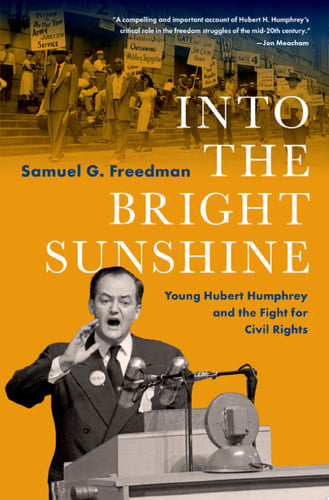
Into the bright sunshine: young Hubert Humphrey and the fight for civil rights

Freedman, Samuel G.
"Hubert Humphrey, a fallen hero and a dying man, rose on rickety legs to approach the podium of the Philadelphia Convention Hall, his pulpit for the commencement address at the University of Pennsylvania. He clutched a sheaf of paper with his speech for the occasion, typed and double-spaced by an assistant from his extemporaneous dictation, and then marked up in pencil by Humphrey himself. A note on the first page, circled to draw particular attention, read simply, "30 years ago--Here." In this place, at that time, twenty-nine years earlier to be precise, he had made history. From the dais now, Humphrey beheld five thousand impending graduates, an ebony sea of gowns and mortarboards, broken by one iconoclast in a homemade crown, two in ribboned bonnets, and another whose headgear bore the masking-tape message HI MA PA. In the horseshoe curve of the arena's double balcony loomed eight thousand parents and siblings, children, and friends. Wearing shirtsleeves and cotton shifts amid the stale heat, they looked like pale confetti from where Humphrey stood, and their flash cameras flickered away, a constellation of pinpricks"--
Oxford University Press 2023 488 pages

Putting meat on the American table: taste, technology, transformation

Horowitz, Roger
Engagingly written and richly illustrated, Putting Meat on the American Table explains how America became a meat-eating nation -- from the colonial period to the present. It examines the relationships between consumer preference and meat processing -- looking closely at the production of beef, pork, chicken, and hot dogs. Roger Horowitz argues that a series of new technologies have transformed American meat. He draws on detailed consumption surveys that shed new light on America's eating preferences -- especially differences associated with income, rural versus urban areas, and race and ethnicity. Putting Meat on the American Table will captivate general readers and interest all students of the history of food, technology, business, and American culture.
The Johns Hopkins University Press 2006 170 pages

Al Smith and his America

Handlin, Oscar
The legendary image of America as a land of opportunity was challenged in 1928 by Al Smith's race for the presidency. Could the governor from New York, a Catholic from the Lower East Side, really become president? His candidacy began a dark episode in American history as Al Smith found himself a victim of the very society that, ironically, gave him his greatest opportunity. p This sympathetic account of Smith's political career demonstrates that a changing society in the decades after World War I propelled Americans toward isolationism and a reassertion of comfortable verities about religion and ethnicity. Oscar Handlin notes that Americans were fundamentalists in 1928, and their anti-Catholicism affected the outcome of the presidential election. But religion was only one symptom of the American anxiety that prejudiced attitudes toward the city, toward foreigners, toward the League of Nations and Prohibition. Disillusioned and betrayed by an unsuccessful peace, Americans searched for external causes on which to lay blame, and Al Smith seemed to epitomize the alien forces that were undermining the nation.
Northeastern University Press 1987-10-30 207 pages

Israel, the embattled ally

Safran, Nadav
Through thirty turbulent years, the United States has been deeply enmeshed in Israel’s destiny. Seldom in the history of international relations has such a world power been involved so intensely for so long with such a small power. How this phenomenon came to pass and how it will affect the future are explained in this compelling history of Israel and its relations with the United States—from the 1947 United Nations resolution through Kissinger’s shuttle diplomacy to Carter’s peace campaign.To form the backdrop for this extraordinary relationship, Nadav Safran paints a detailed portrait of the historical forces that combined to create the Jewish state. He unfolds panel after panel of Israeli life—its physical environment, people, economy, politics, and religion. He examines Israel’s responses to the many security crises it has faced since becoming a nation, and presents a clear and thorough exposition of its defense strategy and descriptions of all its wars.Safran then presents his brilliant analysis of Israel and America in international politics. Cutting through the tangle of the Arab–Israeli conflict, the East–West struggle, the disagreement among Western powers, the conflicts within and among the Arab states, and the impact of special interest groups in the United States on its foreign policy, Safran deftly pursues fluctuations in the American–Israeli relationship as it moved from simple friendship to an alliance of friends. A concluding chapter recapitulates the highlights of that evolution and projects its relevance for the future of the Middle East and American–Israeli relations.
Belknap Press of Harvard University Press 1978-02-27 633 pages

Conceived in liberty

Rothbard, Murray N.
The new single-volume edition of Conceived in Liberty is here! After so many years of having to juggle four volumes, the Mises Institute has finally put it altogether in a single, 1,616-page book. This makes it easier to read, and makes clearer just what a contribution this book is to the history of libertarian literature. There's never been a better time to remember the revolutionary and even libertarian roots of the American founding, and there's no better guide to what this means in the narrative of the Colonial period than Murray Rothbard. For anyone who thinks of Murray Rothbard as only an economic theorist or political thinker, this giant book is something of a surprise. It is probably his least known treatise. It offers a complete history of the Colonial period of American history, a period lost to students today, who are led to believe American history begins with the US Constitution. Rothbard's ambition was to shed new light on Colonial history and show that the struggle for human liberty was the heart and soul of this land from its discovery through the culminating event of the American Revolution. These volumes are a tour de force, enough to establish Rothbard as one of the great American historians. It is a detailed narrative history of the struggle between liberty and power, as we might expect, but it is more. Rothbard offers a third alternative to the conventional interpretive devices. Against those on the right who see the American Revolution as a "conservative" event, and those on the left who want to invoke it as some sort of proto-socialist uprising, Rothbard views this period as a time of accelerating libertarian radicalism. Through this prism, Rothbard illuminates events as never before. The volumes were brought out in the 1970s, but the odd timing and uneven distribution prevented any kind of large audience. They were beloved only by a few specialists, and sought after by many, thanks to their outstanding reputation. The Mises Institute is pleased to be the publisher of this integrated book. This single volume covers the discovery of the Americas and the colonies in the 17th century, the period of "salutary neglect" in the first half of the 18th century, the advance to revolution, from 1760-1775 and the political, military, and ideological history of the revolution and after.
Mises Institute 2011 1616 pages

Theatres in Los Angeles

Suzanne Tarbell Cooper,Amy Ronnebeck Hall,Marc Wanamaker
Los Angeles and the movies grew up together, and a natural extension of the picture business was the premium presentation of the product--the biggest, best, and brightest theatres imaginable. The magnificent movie palaces along Broadway in downtown Los Angeles still represent the highest concentration of vintage theatres in the world. With Hollywood and the movies practically synonymous, the theatres in the studios' neighborhood were state-of-the-art for showbiz, whether they were designed for film, vaudeville, or stage productions. From the elegant Orpheum and the exotic Grauman's Chinese to the modest El Rey, this volume celebrates the architecture and social history of Los Angeles's unique collection of historic theatres past and present. The common threads that connect them all, from the grandest movie palace to the smallest neighborhood theatre, are stories and the ghosts of audiences past waiting in the dark for the show to begin.
Arcadia Publishing Library Editions 2008-01-16 130 pages

The American Congress: the building of democracy

Julian E. Zelizer
Congress is the heart and soul of our democracy, the place where interests are brokered, laws are established, and innovation is turned into concrete action. It is also where some of democracy's greatest virtues clash with its worst vices: idealism and compromise meet corruption and bitter partisanship. The American Congress unveils the rich and varied history of this singular institution. Julian E. Zelizer has gathered together forty essays by renowned historians to capture the full drama, landmark legislation, and most memorable personalities of Congress. Organized around four major periods of congressional history, from the signing of the Constitution to the creation of the Department of Homeland Security, this volume brings a fresh perspective to familiar watershed events: the Civil War, Watergate, the Vietnam War. It also gives a behind-the-scenes look at lesser-known legislation debated on the House and Senate floors, such as westward expansion and war powers control. Here are the stories behind the 1868 vote to impeach President Andrew Johnson; the rise of Jeannette Rankin, the first woman elected to Congress and a leading advocate for pacifism; and the controversy surrounding James Eastland of Mississippi, who carried civil rights bills in his pockets so they could not come up for a vote. Sidebars further spotlight notables including Huey Long, Sam Rayburn, and Tip O'Neill, bringing the sweeping history of our lawmaking bodies into sharp focus. If you've ever wondered how Congress worked in the past or what our elected officials do today, this book gives the engaging, often surprising, answers.
Houghton Mifflin 2004 765 pages

African American Women and Christian Activism New York's Black YWCA, 1905-1945

Judith Weisenfeld
The middle class black women who people Judith Weisenfeld's history were committed both to social action and to institutional expression of their religious convictions. Their story provides an illuminating perspective on the varied forces working to improve quality of life for African Americans in crucial times. When undertaking to help young women migrating to and living alone in New York, Weisenfeld's protagonists chose to work within a national evangelical institution. Their organization of a black chapter of the Young Women's Christian Association in 1905 was a clear step toward establishing a suitable environment for young working women; it was also an expression of their philosophy of social uplift. And predictably it was the beginning of an equal rights struggle--to work as equals with white women activists. Growing and adapting as New York's black community evolved over the decades, the black YWCA assumed a central role both in the community's religious life and as a training ground for social action. Weisenfeld's analysis of the setbacks and successes closes with the National YWCA's vote in 1946 to adopt an interracial charter and move toward integration of local chapters, thus opening the door to a different set of challenges for a new generation of black activists. Weisenfeld's account gives a vibrant picture of African American women as significant actors in the life of the city. And it bears telling witness to the religious, class, gender, and racial negotiations so often involved in American social reform movements.
Harvard University Press 2013-10 239 pages

The journey home

Antler, Joyce
In recent decades, prominent American Jewish women like Bella Abzug and Betty Friedan have made headlines and history, challenging the constraints facing women in American public life. Few realize that these women embody a hundred-year legacy of remarkable activism. From suffrage to birth control, from trade unionism to higher education, from civil rights to feminism to every aspect of popular culture, Jewish women have been in the vanguard, leading key social movements.
Schocken 1998 410 pages

How we forgot the Cold War: a historical journey across America

Wiener, Jon
Hours after the USSR collapsed in 1991, the U.S. Congress began making plans to establish the official memory of the Cold War. Conservatives dominated the proceedings, spending millions of dollars to portray the conflict as a clash of good vs. evil, ending in a defeat of totalitarianism equal in significance to the outcome of World War II. In this book, the author visits Cold War monuments, museums, and memorials across the United States to find out how the era is remembered today. His journey provides a history of the Cold War that turns many conventional notions on their heads
University of California Press 2012 376 pages

Race, space, and riots in Chicago, New York, and Los Angeles

Abu-Lughod, Janet L.
"This study is the first attempt to compare six major race riots that occurred in the three largest American urban areas during the course of the twentieth century: in Chicago in 1919 and 1968; in New York in 1935/1943 and 1964; and in Los Angeles in 1965 and 1992. Race, Space, and Riots in Chicago, New York, and Los Angeles weaves together detailed narratives of each riot, placing them in their changing historical contexts and showing how urban space, political regimes, and economic conditions - not simply an abstract "race conflict"--Have structured the nature and extent of urban rebellions. Building on her previous comparative history of these three cities, Janet Abu-Lughod draws upon archival research, primary sources, case studies, and personal observations to reconstruct events - especially for the 1964 Harlem-Bedford Stuyvesant uprising and Chicago's 1968 riots where no documented studies are available. By focusing on the similarities and differences in each city, identifying the unique and persisting issues, and evaluating the ways political leaders, law enforcement, and the local political culture have either defused or exacerbated urban violence, this book points the way toward alleviating long-standing ethnic and racial tensions." "Race, Space, and Riots In Chicago, New York, and Los Angeles offers a deeper understanding of past - and future - urban race relations while emphasizing that until persistent racial and economic inequalities are meaningfully resolved, the tensions leading to racial violence will continue to exist in America's cities and betray our professed democratic values"--OCLC
Oxford University Press 2007-01 344 pages