204 results for "Children"

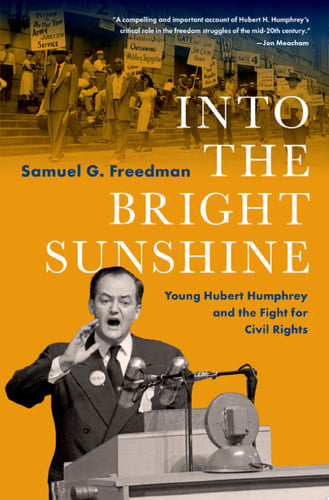
Into the bright sunshine: young Hubert Humphrey and the fight for civil rights

Freedman, Samuel G.
"Hubert Humphrey, a fallen hero and a dying man, rose on rickety legs to approach the podium of the Philadelphia Convention Hall, his pulpit for the commencement address at the University of Pennsylvania. He clutched a sheaf of paper with his speech for the occasion, typed and double-spaced by an assistant from his extemporaneous dictation, and then marked up in pencil by Humphrey himself. A note on the first page, circled to draw particular attention, read simply, "30 years ago--Here." In this place, at that time, twenty-nine years earlier to be precise, he had made history. From the dais now, Humphrey beheld five thousand impending graduates, an ebony sea of gowns and mortarboards, broken by one iconoclast in a homemade crown, two in ribboned bonnets, and another whose headgear bore the masking-tape message HI MA PA. In the horseshoe curve of the arena's double balcony loomed eight thousand parents and siblings, children, and friends. Wearing shirtsleeves and cotton shifts amid the stale heat, they looked like pale confetti from where Humphrey stood, and their flash cameras flickered away, a constellation of pinpricks"--
Oxford University Press 2023 488 pages

Saving one's own: Jewish rescuers during the Holocaust

Paldiel, Mordecai
"In this remarkable, historically significant book, Mordecai Paldiel recounts in vivid detail the many ways in which, at great risk to their own lives, Jews rescued other Jews during the Holocaust. In so doing he puts to rest the widely held belief that all Jews in Nazi-dominated Europe wore blinders and allowed themselves to be led like 'lambs to the slaughter.' Paldiel documents how brave Jewish men and women saved thousands of their fellow Jews through efforts unprecedented in Jewish history. Encyclopedic in scope and organized by country, Saving One's Own tells the stories of hundreds of Jewish activists who created rescue networks, escape routes, safe havens, and partisan fighting groups to save beleaguered Jewish men, women, and children from the Nazis. The rescuers' dramatic stories are often shared in their own words, and Paldiel provides extensive historical background and documentation. The untold story of these Jewish heroes, who displayed inventiveness and courage in outwitting the enemy - and in saving literally thousands of Jews - is finally revealed"--front jacket flap.
University of Nebraska Press 2017 585 pages

The alphabet in my hands: a writing life

Agosín, Marjorie
Marjorie Agosín writes of a beloved childhood nanny: "Since I was Jewish she baptized me with holy water brought forth from the fonts of nearby churches. She told me to stay very still so I wouldn't sprout horns. . . . I was somewhere between taciturn and happy gazing into the mirror as if approaching the edge of a cliff . . . and I watched myself in the deep, transparent veil of this night of all nights." Many of the themes expressed in this vignette--cultural dissonance, family, and community--are poetically intertwined throughout The Alphabet in My Hands . Agosín takes us on a personal journey of discovery that is as much internal reflection as it is an exodus across continents and decades. Agosín's childhood and early adolescence were spent with her Jewish family in Chile. While her family raised her to regard her Jewish heritage with loving awareness, they also participated in the dominant Catholic culture--an aunt organized Easter egg hunts and her mother admired the beauty of Chile's Catholic churches. The young Agosín became keenly aware of her dual identity in her country, both as a participant and an outsider. The second half of The Alphabet in My Hands recounts the events that forced her family to emigrate to America: the overthrow of Salvador Allende by General Augusto Pinochet. Agosín writes of her new life in Athens, Georgia, of the sudden loss of all that was familiar. Ostracized as an emigrant--a "non-white" with a strange foreign accent--her high school years were made even more painful by the news from Chile: prisoners taken and classmates disappearing or shot. Years later, Agosín goes back to Chile and she travels there with her own children. As she stares down at her old homeland from the plane, she writes: "Why do I love this place that forced us into exile, that punished my father for being a Jew?" And in the final chapter of The Alphabet in My Hands , this award-winning poet addresses two important topics: her current residence in New England and the central role of writing and literature in her life.
Rutgers University Press 2000 187 pages

Bookends: two women, one enduring friendship

Rostenberg, Leona
The rare book dealers who delighted readers with the history of their bookselling days in "Old Books, Rare Friends" now offer the other side of their story -- an intimate look at the joys of a relationship that has lasted more than half a century. When their friendship and business partnership began in the 1940s, Leona Rostenberg and Madeleine Stern were pioneers in a man's world. Now approaching their nineties, the duo, who -- among their many discoveries -- unearthed Louisa May Alcott's pseudonymous blood-and-thunder stories, remains a vibrant institution in the rare book trade, even as the Internet changes their field -- and their community -- forever. After publishing "Old Books, Rare Friends," Rostenberg and Stern received a flood of fan mail asking about their personal lives, and they have responded with poignant honesty and the warmth for which they are famous, as they reflect on their lives and their remarkable partnership. "Bookends" recounts their fascinating histories: family backgrounds, business adventures, the men they did not marry, and their approach to the bittersweet trials of aging. More than just a dual memoir, "Bookends" is also a chronicle of the cultural changes of twentieth-century American life and a loving farewell to the golden age of book collecting. Filled with wisdom and humor, this volume is a tribute to Rostenberg and Stern's passion for the written word -- and for life itself. Catching us off guard with their candor, they offer their insights regarding their business, their way of life, and their worldview. Above all, they present the story of a special relationship. At a time when people find it increasingly difficult to connect, here wehave the seamless story of a shared life. It is the unique product of an earlier time, yet it is a timeless reflection on the very nature of friendship. Though their fantastic partnership is un-reproducible, the ideal they have established, for the integration of one life so completely with another, contains lessons for all of us. Without husband or children they created a loving home when this was uncharted territory for women. They nurtured a business and life partnership that has lasted more than half a century and has only gotten stronger with time. When the passing years began to claim one's hearing and the other's sight, they became each other's eyes and ears. A meditation on aging and togetherness, this book is also the narrative of two pioneering single, Jewish women making their way in tandem through a world largely organized to keep them in their place. It is a gentle, wise story, told in their inimitable style, sparse, unadorned, and honest. Their affirmations supersede their uncertainties. As they write, "Bookends support books and come in pairs...If the word encapsulates our past, it looks also to the future, and to the books -- lived together, written together -- that will follow." They confront the challenges of aging in a no-nonsense tone, and, in facing them, give us an ideal of enduring human friendship that can't help but touch the heart.
Free Press 2001 246 pages

Never say you've had a lucky life: especially if you've had a lucky life

Epstein, Joseph
"An autobiography usually requires a justification. The great autobiographies-those by Benvenuto Cellini, Jean-Jacques Rousseau, Benjamin Franklin, and Henry Brooks Adams-were justified by their authors living in interesting times, harboring radically new ideas, or participating in great events. Joseph Epstein qualifies on none of these counts. His life has been quiet, lucky in numerous ways, and far from dramatic. But it has also been emblematic of the great changes in our country since World War II. He grew up in a petit-bourgeois, Midwestern milieu, and the city of Chicago looms large in his life. He drew a lucky ticket in the parent lottery and his was a happy boyhood spent on playgrounds and hanging around drug stores. At high school dances, he was the rhumba king and at drive-in movies he was never allowed to go as far with girls as he so ardently desired. At twenty-six, after two years in the army, he found himself married, the father or stepfather of four children, and living in New York on the meager salary of a magazine subeditor. He was ablaze with ambition and fettered by frustration. He broke out by moving to Little Rock, Arkansas, to direct the city's anti-poverty program at the height of the Civil Rights movement. His writing career blossomed, he began teaching at Northwestern University, and, for twenty-five years, edited one of great intellectual magazines. Never Say You've Had a Lucky Life is an intimate look at one life steeped in radical change: from a traditionally moral culture to a therapeutic one, from an era when the extended family was strong to its current diminished status, from print to digital life featuring the war of pixel on print, and on. But for all the seriousness of Epstein's themes, this book is memorable for its comic point of view and the constant reminder of how unpredictable, various, and wondrously rich life can be"--
Simon & Schuster 2024-04-16 287 pages

Models of my life

Simon, Herbert A.
In this candid and witty autobiography, Nobel laureate Herbert A. Simon looks at his distinguished and varied career, continually asking himself whether (and how) what he learned as a scientist helps to explain other aspects of his life. A brilliant polymath in an age of increasing specialization, Simon is one of those rare scholars whose work defines fields of inquiry. Crossing disciplinary lines in half a dozen fields, Simon's story encompasses an explosion in the information sciences, the transformation of psychology by the information-processing paradigm, and the use of computer simulation for modeling the behavior of highly complex systems. Simon's theory of bounded rationality led to a Nobel Prize in economics, and his work on building machines that think&-- based on the notion that human intelligence is the rule-governed manipulation of symbols&--laid conceptual foundations for the new cognitive science. Subsequently, contrasting metaphors of the maze (Simon's view) and of the mind (neural nets) have dominated the artificial intelligence debate. There is also a warm account of his successful marriage and of an unconsummated love affair, letters to his children, columns, a short story, and political and personal intrigue in academe.
MIT Press 1996-10-08 415 pages

The hard way around: the passages of Joshua Slocum

Wolff, Geoffrey
A masterful biographer now offers a thrilling, definitive portrait of one of history’s most legendary icons of adventure. In 1860, sixteen-year-old Joshua Slocum escaped a hardscrabble childhood in Nova Scotia by signing on as an ordinary seaman to a merchant ship bound for Dublin. Despite having only a third-grade education, Slocum rose through the nautical ranks at a mercurial pace; just a decade later he was commander of his own ship. His subsequent journeys took him nearly everywhere: Liverpool, China, Japan, Cape Horn, the Dutch East Indies, Manila, Hong Kong, Saigon, Singapore, San Francisco, and Australia—where he met and married his first wife, Virginia, who would sail along with him for the rest of her life, bearing and raising their children at sea. He commanded eight vessels and owned four, enduring hurricanes, shipwrecks, pirate attacks, cholera, smallpox, a mutiny, and the death of his wife and three of his children. Yet his ultimate adventure and crowning glory was still to come. In 1895 Slocum set sail from Gloucester, Massachusetts—by himself—in the Spray, a small sloop of thirty-seven feet. More than three years and forty-six thousand miles later, he became the first man to circumnavigate the globe solo, a feat that wouldn’t be replicated until 1925. His account of that voyage, Sailing Alone Around the World , soon made him internationally famous. He met President Theodore Roosevelt on several occasions and became a presence on the lecture circuit, selling his sea-saga books whenever and wherever he could. But scandal soon followed, and a decade later, with his finances failing, he set off alone once more—and was never seen again. Geoffrey Wolff captures this singular life and its flamboyant times—from the Golden Age of Sail to a shockingly different new century—in vivid, fascinating detail.
Alfred A. Knopf 2010 218 pages

Albert and Victoria: the rise and fall of the house of Saxe-Coburg-Gotha

Feuchtwanger, E. J.
When Albert of Saxe-Coburg-Gotha married his cousin, the young Queen Victoria, in 1840, it was not only a match whose fertility and personal devotion provided a model for the queen's subjects, it was also a triumph of dynastic politics. It drew the couple deeply into European politics, where their personal and family relationships with many of the rulers often had repercussions at home. Despite the death of Albert in 1861, the marriage of Victoria's children into Europe's royal houses continued the dynastic theme. It was a tragedy for Germany and Europe that Vicky, Victoria's eldest daughter, and her husband, the heir to the German throne were unable to master Bismarck. Albert and Victoria is a portrait of a marriage. It also traces Albert to his unhappy family roots in Coburg and shows how important his attitudes, most of them shared by Victoria, were in their joint dynastic enterprise. >
Hambledon Continuum 2006-01-01 299 pages

Joseph Goebbels: a biography

Riess, Curt
Coming generations will ask themselves how it was possible that millions of people, victims of an artificially induced enthusiasm, could be moved to do the very things which led to their own ruin. The answer could be given in hundreds of thousands of words, but, if it were expressed in one word alone, that word would be: Goebbels. Curt Riess, a Jewish Berliner who fled Germany upon Hitler's appointment as Chancellor in 1933, considered Goebbels to be 'the most outstanding man of the Nazi regime, not even barring Hitler himself.' Without Goebbels' genius for organization and propaganda, Nazism could never have amassed the support it needed to gain and keep power in Germany. From provincial obscurity, Goebbels scurried through the Nazi ranks to become one of the most dominant and trusted members of Hitler's inner circle. His career was marked by formidable powers of administration, his ruthless hatred of the Jews, his resourcefulness in promoting Nazi ideals, and his inflexible devotion to the Führer, asserted in his final morbid gesture of propaganda: the sacrifice of his wife, six children, and himself in Hitler's bunker in 1945. Riess' biography was first published in 1949 and benefitted greatly from the discovery of Goebbels' diaries in 1946. It explores the many fascinating and pertinent aspects of Goebbels' character: the insecurities brought on by his diminutive stature; his rejection by his family; his consuming jealousy of his rivals; and his obsession with sex. It remains a compelling and authoritative biography of the man whose manipulative genius steered the German nation to ruin.
Fonthill 2013 368 pages

The last gift of time: life beyond sixty

Heilbrun, Carolyn G.
As a young woman, Carolyn Heilbrun made a resolution not to live past "three score years and ten." Taking her own life at the age of seventy, she reasoned, would lend clean closure to a life well lived, and would keep her from the many tragedies of aging--becoming a burden to her children, witnessing the deterioration of her body, falling prey to a crippling disease. But on the advent of her seventieth birthday, she looked back on the past ten years and found, to her surprise, that her sixties had been the happiest decade of all: after fifty years, her marriage had matured into a happy balance of companionship and respect for solitude; she had developed deep friendships with her grown children and a small circle of peers; she had mastered a highly successful career as a scholar and writer. In the poignant, essayistic writing that best showcases her elegant talent and provocative mind, Carolyn Heilbrun celebrates the many pleasures of a mature life. Filled with wisdom, knowledge, wry humor, and literary allusion, The Last Gift of Time is a moving book for all women invested in the pursuit of leading a woman's life to its fullest capacity.
Dial Press 1997 225 pages

What time and sadness spared: mother and son confront the Holocaust

Ben-Atar, Roma Nutkiewicz,Ben-Atar, Doron S.
Roma Ben-Atar resisted until late in life the urging of her family to share the memories of her Nazi-era experiences. The Holocaust exerted a dark pressure on all of their lives but was never openly discussed. It was only when her granddaughter insisted on hearing the whole truth, with a directness partly generational, that Mrs. Ben-Atar agreed to tell her story. What Time and Sadness Spared is a journey of both loss and endurance, moving with shocking speed from a carefree adolescence in upper-middle-class Warsaw to the horrors of the Final Solution. The young girl sees her neighborhood transformed into a ghetto populated by skeletal figures both alive and dead. Unbelievably, things only grow worse as this ruin gives way to the death factories of Majdanek and Auschwitz and the death marches of 1945. Life in the camps changes her in less than a day, as if "the person in my body was a stranger I had never met." Her only consolation is to lie on her wooden bunk, no mattress, and speak to the soul of her mother, who, like virtually her entire family, had already been swept away. Roma must summon astonishing powers of adaptation simply to survive, bringing her finally through the wreckage of postwar Europe and to an entirely new life in Israel. In this unique family collaboration Roma Ben-Atar's son Doron, a historian who brings with him fluency in psychoanalysis, contributes through his commentary an awareness of the difficulties presented by historical narrative and memory. A visitor to the much-changed sites in which his mother grew up and was interned by the Nazis, he also voices the perspective of the survivors' children and their ambivalence over being "protected" from this past. As the generation that endured the camps passes from this world, What Time and Sadness Spared illustrates with particular urgency the historical responsibilities of the survivors' descendants, who must become the new vessels for a story that will not remain alive on its own but demands our courage and curiosity.
University of Virginia Press 2018-07-05 196 pages

Parallel lines

Lantos, Peter L.
Memoirs of Lantos, born to the Leipniker family in 1939 in Makó, Hungary. In 1944, after his older brother was taken away, the rest of the family was sent to the ghetto of Szeged, but the Jews there were soon deported. He and his parents were first sent to Strasshof in Austria for a short time, then to Wiener Neustadt and to Bergen-Belsen, where his father died. He and his mother were then sent on a death transport, during which they were liberated by American soldiers. They returned to Hungary and found that his brother had perished. Lantos later studied medicine in England, and in 1969 decided to remain there.
Arcadia Books 2006 246 pages

Alva's boy

Collins, Alan
"This book is a frank, confronting yet surprisingly funny memoir based on the life experiences and recollections of a Jewish childhood over a time span from 1928 to the mid-forties. In some telling, names of people, places and dates have been changed. Mercifully, those named who are or were of a repellent nature have long since gone to God. The stories present incidents from the life of one person, the first-person narrator. The memoir is purposely unsentimental. The writer has worked hard to circumvent cheap emotion. Some readers might find it confronting. The linked stories encompass a childs unsparingly honest observations as he is buffeted by events which range from indifference and naked cruelty to sparkling life-affirming exuberance."--Provided by publisher.
Hybrid Publishers 2008 180 pages

The Holocaust odyssey of Daniel Bennahmias, Sonderkommando

Fromer, Rebecca
A poignant reminder of the ways enslaved Jews and others were forced to destroy their families and fellow prisoners In The Holocaust Odyssey , Rebecca Fromer leads us through the experiences of Danny Bennahmias, a Greek Jew of Italian citizenship whose forced labor as a Sonderkommando at Auschwitz included the disentangling of hundreds of thousands of gassed men, women, and children. The book is the result of a diligent collaboration. As it unfolds, it becomes a poignant reminder of the manner in which enslaved Jews and others were forced to destroy their families and fellow prisoners. It is a story of human decency, the spark of which remains against all odds.
University of Alabama 1993 151 pages

Waiting for Daisy: the true story of one couple's quest to have a baby

Orenstein, Peggy
Waiting for Daisy is about doing all the thinsg you swore you'd never do to get something you hadn't even been sure you wanted. It's a real-life journey of loss, love, anger and redemption. Told with raw candour and a rare wit that marks Waiting for Daisy as a future classic, Peggy Orenstein's story begins when she tells her new husband that she's not certain she ever wants to be a mother. It ends six years later after she's done almost everything humanly possible to have a baby. Along the way she visits an ex-boyfriend who now has fifteen children, encounters 'parasite singles' in Tokyo (women who are rejecting marriage and motherhood in favour of shopping sprees and foreign travel), and shares stories with women survivors of the atomic bomb in Hiroshima. The world's professional women are only now beginning to become aware of the risks and realities of 'having it all', and Orenstein's poignant saga unfolds as infertility is developing scarily into a boom industry, with many thousands of women a year seeking treatment.
Bloomsbury 2008 224 pages