450 results for "Economics"

Keynes for Our Times

Skidelsky, Robert
"John Maynard Keynes (1883-1946) was arguably the most important economist of the twentieth century; his ideas have fundamentally altered the way governments approach economic policy. Exploring the enduring relevance of his ideas, Robert Skidelsky emphasizes Keynes's conception of economics as a moral science. Keynes was deeply invested in the broader societal implications of economic policies, and this book highlights his belief in economics as a tool for achieving the good life. Skidelsky sheds new light on Keynes's views on capitalism, discusses his advocacy of low interest rates, and delves into his thoughts on economic instability. He also offers fresh insight into Keynes's ideas about money, his philosophical foundations, and his unique approach to uncertainty and probability. Ultimately, Skidelsky shows how Keynes's vision of an economic policy that prioritizes the common good can be adapted to help solve our current economic and political challenges"--
Yale University Press 2026-06-23 186 pages

The crisis of vision in modern economic thought

Heilbroner, Robert L.
A deep and widespread crisis affects modern economic theory, a crisis that derives from the absence of a "vision"--a set of widely shared political and social preconceptions--on which all economics ultimately depends. This absence, in turn, reflects the collapse of the Keynesian view that provided such a foundation from 1940 through the early 1970s, comparable to earlier visions provided by Smith, Ricardo, Mill, and Marshall. The "unraveling" of Keynesianism has been followed by a division into discordant and ineffective camps whose common denominator seems to be their shared analytical refinement and lack of practical applicability. This provocative analysis attempts both to describe this state of affairs, and to suggest the direction in which economic thinking must move if it is to regain the relevance and remedial power it now pointedly lacks.
Cambridge University Press 1995 131 pages

Inside the economist's mind: conversations with eminent economists

Paul A. Samuelson,William A. Barnett
By focusing on the human side as well as the intellectual dimensions of how economists work and think, this collection of interviews with top economists of the 20th century becomes a startling and lively introduction to the modern world of macroeconomics. A fun read! For more information, frequent updates, and to comment on the forthcoming book, visit William A. Barnett's weblog at http://economistmind.blogspot.com/. Acclaim for Inside the Economist's Mind "In candid interviews, these great economists prove to be fabulous story tellers of their lives and times. Unendingly gripping for insiders, this book should also help non-specialists understand how economists think." Professor Julio Rotemberg, Harvard University Business School, and Editor, Review of Economics and Statistics. "Economics used to be called the 'dismal science'. It will be impossible for anybody to hold that view anymore ... This is science with flesh and blood, and a lot of fascinating stories that you will find nowhere else." Dr. Jean-Pascal Bénassy, Paris-Jourdan Sciences Économiques, Paris, France "This book provides a rare and intriguing view of the personal and professional lives of leading economists ... It is like A Beautiful Mind , scaled by a factor of 16 [the number of interviews in the book]." Professor Lee Ohanian, University of California at Los Angeles " ... if you want an insider view of how economics has been developing in the last decades, this is the (only) book for you." Professor Giancarlo Gandolfo, University of Rome ‘La Sapienza,’ Rome "Here we see the HUMAN side of path-breaking research, the personalities and pitfalls, the DRAMA behind the science." Professor Francis X. Diebold, University of Pennsylvania, Philadelphia
Blackwell Pub 2007 419 pages

On the Principles of Political Economy and Taxation

David Ricardo
On the Principles of Political Economy and Taxation (19 April 1817) is a book by David Ricardo on economics. The book concludes that land rent grows as population increases. It also presents the theory of comparative advantage, the theory that free trade between two or more countries can be mutually beneficial, even when one country has an absolute advantage over the other countries in all areas of production.
CreateSpace Independent Publishing Platform 2018-08-19 244 pages

Bankers and Pashas: International Finance and Economic Imperialism in Egypt

David S. Landes
فى نهاية الخمسينات عثر الباحث الإقتصادى الأمريكى ديفيد لاندز على أرشيف سرى فى باريس يحتوى على مراسلات اثنين من كبار ممولى الخديوى اسماعيل الأجانب. وقد ألقت هذه المراسلات ضوءا جديدا على قصة النهب الأوروبى لثروة مصر فى عهد أسرة محمد على, والوصول بها إلى مرحلة الخراب ثم الإحتلال ...يحتوى الكتاب أيضا على دراسة للمترجم وهو المفكر اليسارى د. عبد العظيم أنيس - أحد رواد النضال الوطنى والتقدمى منذ الأربعينات - بعنوان : الخراب الحديث لمصر المحروسة
Harper Torchbooks 1969-01-01 354 pages

Uninsured in America: life and death in the land of opportunity

Sered, Susan Starr
Reaching beyond statistics and prevalent assumptions, Uninsured in America goes to the heart of why more than forty million Americans are falling through the cracks in the health care system, and what it means for society as a whole when so many people suffer the consequences of inadequate medical care. Based on interviews with 120 uninsured men and women and dozens of medical providers, policymakers, and advocates from around the nation, this book takes a fresh look at one of the most important social issues facing the United States today. The vivid and moving stories of those interviewed illustrate the complicated dilemmas—including full-time family caregiving, sudden illness, self-employment, layoffs, and on-the-job injuries—faced by those trying to balance medical problems with housing costs and other daily necessities. This engrossing, accessible, and timely book concludes that our current health care system is leading to fundamental structural changes in American society.
University of California Press 2005-04-11 247 pages

Worth the risk: innovation and the future of finance

Merton, Robert C.
The 2008 financial crisis cost $15 trillion in the U.S. stock and residential housing markets. The crash hit institutions and citizens, threatening economic survival, employment, and retirement prospects. What went wrong? And how can we prevent a similar disaster? In Worth the Risk, Robert Merton--the Nobel Prize-winning economist whose work revolutionized financial markets--offers answers. Merton maintains that the magnitude of the crisis points to more fundamental forces at work than the greed, selfishness, or criminal behavior of some financial-system players and consumers. In clear, accessible language, he demystifies those forces. For example, he shows: -Why the professionals underestimated the riskiness of mortgage-backed securities and corporate loan portfolios. -How the financial innovations that brought home ownership to millions of Americans combined with other benign developments to inject huge, systemic risk into the U.S. economy. Merton then identifies specific reforms that could improve regulation and transparency in the financial-services industry and head off a similar crash in the future. In particular, he offers strategies for minimizing risks in the innovation of financial instruments--which remains essential for our economy's health. And he suggests innovations that could open the door to security and growth for nations, corporations, and individuals. Engaging and authoritative, Worth the Risk provides answers to the burning questions on everyone's mind'and paints an encouraging picture of a far more solid financial future.
Harvard Business 2010-10 130 pages

A Theory of the Consumption Function

Milton Friedman
What is the exact nature of the consumption function? Can this term be defined so that it will be consistent with empirical evidence and a valid instrument in the hands of future economic researchers and policy makers? In this volume a distinguished American economist presents a new theory of the consumption function, tests it against extensive statistical J material and suggests some of its significant implications. Central to the new theory is its sharp distinction between two concepts of income, measured income, or that which is recorded for a particular period, and permanent income, a longer-period concept in terms of which consumers decide how much to spend and how much to save. Milton Friedman suggests that the total amount spent on consumption is on the average the same fraction of permanent income, regardless of the size of permanent income. The magnitude of the fraction depends on variables such as interest rate, degree of uncertainty relating to occupation, ratio of wealth to income, family size, and so on. The hypothesis is shown to be consistent with budget studies and time series data, and some of its far-reaching implications are explored in the final chapter.
Must Have Books 2022-03-15 254 pages

Principles of Political Economy and Taxation

David Ricardo
David Ricardo's On the Principles of Political Economy and Taxation the implications of land rent increases along with population among other things. Ricardo argues for the acceptance of free trade and shows how it's both short and long term advantages. The arguments laid out in this book form the basis of modern trade theory and are, therefore, of interest in today's global economy.
CreateSpace Independent Publishing Platform 2010-09-24 220 pages

National Power and the Structure of Foreign Trade

Albert Hirschman
This study begins with a brief survey of economic thought on the relationship between foreign trade and national power, from the Mercantilists on. Chapter II attempts a systematic theoretical approach to the subject. It first makes clear the fundamental basis of the possible use of foreign trade as an instrument of national power policy. Using well-known concepts of economic analysis, it proceeds to show under what conditions and by means of what policies this instrument is likely to attain its highest efficiency. The principles of power policy thus deduced theoretically are then compared with the actual practices followed by German trading methods in recent years. Toward the end of this chapter the reader will be carried into a detailed discussion of certain problems of the theory of international trade, which are touched upon earlier in the chapter. Chapter III is applied to the historical background of our problem. It gives a survey of the literature on "economic aggression" before and during World War I and brings out the importance of the Paris Economic Conference of the Allies in 1916 for the Versailles Treaty and postwar economic policies. In Chapter IV we review in the light of our theoretical and historical analyses certain safeguards or remedies which could be or have been proposed to prevent the use of foreign trade as an instrument of national power policies. Certain questions raised in Part 1 can be answered in quantitative terms. Part 2 consists, therefore, of an exposition of various trends of international trade in recent years disclosed by statistical analysis. In Chapter V we calculate an index number expressing the extent to which the trade of the large trading nations is or has been directed by preference toward the smaller trading countries. Chapter VI gives index numbers for the degree of concentration of their foreign trade on one or a few big markets or sources of supply. Finally, in Chapter VII we measure the extent to which world trade has been based primarily on an exchange of manufactures against raw materials and foodstuffs. This title is part of UC Press's Voices Revived program, which commemorates University of California Press’s mission to seek out and cultivate the brightest minds and give them voice, reach, and impact. Drawing on a backlist dating to 1893, Voices Revived makes high-quality, peer-reviewed scholarship accessible once again using print-on-demand technology. This title was originally published in 1945, with an expanded edition published in 1980.
Univ of California Press 2024-06-14 194 pages

On justification: economies of worth

Boltanski, Luc
A vital and underappreciated dimension of social interaction is the way individuals justify their actions to others, instinctively drawing on their experience to appeal to principles they hope will command respect. Individuals, however, often misread situations, and many disagreements can be explained by people appealing, knowingly and unknowingly, to different principles. On Justification is the first English translation of Luc Boltanski and Laurent Thévenot's ambitious theoretical examination of these phenomena, a book that has already had a huge impact on French sociology and is likely to have a similar influence in the English-speaking world. In this foundational work of post-Bourdieu sociology, the authors examine a wide range of situations where people justify their actions. The authors argue that justifications fall into six main logics exemplified by six authors: civic (Rousseau), market (Adam Smith), industrial (Saint-Simon), domestic (Bossuet), inspiration (Augustine), and fame (Hobbes). The authors show how these justifications conflict, as people compete to legitimize their views of a situation. On Justification is likely to spark important debates across the social sciences.
Princeton University Press 2006-04-16 389 pages

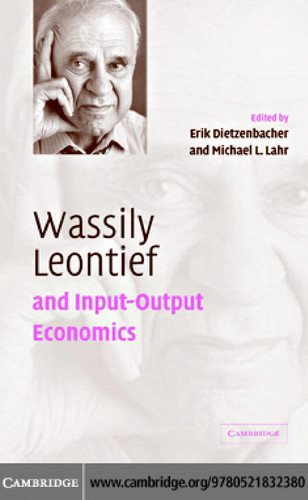
Wassily Leontief and input-output economics

Wassily Leontief,Erik Dietzenbacher,Michael L. Lahr
Wassily Leontief (1905–1999) was the founding father of input-output economics, for which he received the Nobel Prize in 1973. This book offers a collection of papers in memory of Leontief by his students and close colleagues. The first part, 'Reflections on Input-Output Economics', focuses upon Leontief as a person and scholar as well as his personal contributions to economics. It includes contributions by Nobel Laureate Paul A. Samuelson who shares his memories of a young Professor Leontief at Harvard and ends with the last joint interview with Wassily and his wife, to date previously unpublished. The second part, 'Perspectives of Input-Output Economics', includes theoretical and empirical research inspired by Leontief's work and offers a wide-ranging sample of the state of interindustry economics, a field Leontief founded. This is a strong collection likely to appeal to a wide range of professionals in universities, government, industry and international organizations.
Cambridge University Press 2004-03-25 396 pages

Keynes: useful economics for the world economy

Temin, Peter
As the global economic crisis continues to cause damage, some policy makers have called for a more Keynesian approach to current economic problems. In this book, the economists Peter Temin and David Vines provide an accessible introduction to Keynesian ideas that connects Keynes's insights to today's global economy and offers readers a way to understand current policy debates. John Maynard Keynes (1883-1946) created the branch of economics now known as macroeconomics. He played a major role in the reconstruction of Europe and the world economy after the Second World War. Keynesian economics came to be identified with efforts to mitigate the Great Depression and with postwar economic policies that helped power a golden age of economic growth. Temin and Vines argue that Keynes also provided a way to understand the interactions among nations, and therein lies his relevance for today's global crisis. Temin and Vines survey economic thinking before Keynes and explain how difficult it was for Keynes to escape from conventional wisdom. They set out the Keynesian analysis of a closed economy and expand the analysis to the international economy, using a few simple graphs to present Keynes's formal analyses in an accessible way. They discuss problems of today's world economy, showcasing the usefulness of a simple Keynesian approach to current economic policy choices. Keynesian ideas, they argue, can lay the basis for a return to economic growth.
The MIT Press 2014-09-12 117 pages