475 results for "Management"

Administrative Behavior

Simon, Herbert A.
In this fourth edition of his ground-breaking work, Herbert A. Simon applies his pioneering theory of human choice and administrative decision-making to concrete organizational problems. To commemorate the fiftieth anniversary of the book's original publication, Professor Simon enhances his timeless observations on the human decision-making process with commentaries examining new facets of organizational behavior. Investigating the impact of changing social values and modem technology on the operation of organizations, the new ideas featured in this revised edition update a book that has become a worldwide classic. Named by Public Administration Review as "Book of the Half Century," Administrative Behavior is considered one of the most influential books on social science thinking, and was referred to by the Nobel Committee as "epoch-making." Written for managers and other professionals who wish to understand the decision-making processes at the heart of organization and management, it is also essential reading for students in business and management, economics, sociology, psychology computer science, government, and law.
The Macmillan Company 1957 259 pages

Good for the money: my fight to pay back America

Benmosche, Bob
"In 2009, at the peak of the financial crisis, AIG - the American insurance behemoth - was sinking fast. It was the peg upon which the nation hung its ire and resentment during the financial crisis: the pinnacle of Wall Street arrogance and greed. When Bob Benmosche climbed aboard as CEO, it was widely assumed that he would go down with his ship. In mere months, he turned things around, pulling AIG from the brink of financial collapse and restoring its profitability. Before three years were up, AIG had fully repaid its staggering debt to the U.S. government - with interest.Good for the Money is an unyielding leader's memoir of a career spent fixing companies through thoughtful, unconventional strategy. With his brash, no-holds-barred approach to the job, Benmosche restored AIG's employee morale and good name. His is a story of perseverance, told with refreshing irreverence in unpretentious terms.Called "an American hero" by Andrew Ross Sorkin, author of Too Big to Fail, Benmosche was a self-made man who never forgot what life is like for the nation's 99-percent; again and again, he pushed back against obstinate colleagues to salvage American jobs and industry. Good for the Money affords you a front-row seat for Benmosche's heated battles with major players from Geithner to Obama to Cuomo, and offers incomparable lessons in leadership from the legendary CEO who changed the way Wall Street does business"--
St. Martin's Press 2016-04-12 271 pages

Data Science and Digital Business

Fausto Pedro García Márquez,Benjamin Lev
This book combines the analytic principles of digital business and data science with business practice and big data. The interdisciplinary, contributed volume provides an interface between the main disciplines of engineering and technology and business administration. Written for managers, engineers and researchers who want to understand big data and develop new skills that are necessary in the digital business, it not only discusses the latest research, but also presents case studies demonstrating the successful application of data in the digital business.
Springer International Publishing 2019-01-16 316 pages

Familial breast and ovarian cancer: genetics, screening, and management

Patrick J. Morrison,Shirley V. Hodgson,Neva E. Haites
This publication surveys the profound and far-reaching ramifications that have arisen from the very significant advances in understanding the genetic basis of familial breast and ovarian cancer. Written by international experts from Europe and North America, this book provides the busy clinician with a contemporary and wide-ranging guide to the latest developments in diagnosis, genetics, screening, prevention, and management. In addition, the volume discusses ethical and insurance issues, distinct cultural differences in breast cancer and use of recently devised cancer genetics clinics. The different referral criteria and patterns to these clinics are detailed.
Cambridge University Press 2005-07-21 401 pages

Can You Outsmart an Economist? 100+ Puzzles to Train Your Brain

Steven E. Landsburg
"Will delight and inform anyone who enjoys rigorous thinking and the unexpected conclusions it delivers." -- Jamie Whyte, author of Crimes Against Logic "This ingenious gallop through the mind of Steven Landsburg enables you to think like an economist without incurring a Keynesian headache or a huge student loan. You may even end up 'smarter than Google.' But you will not readily put down this exhilarating adventure in ideas." -- George Gilder, author of Knowledge and Power and Life After Google Can you outsmart an economist? Steven Landsburg, acclaimed author and professor of economics, dares you to try. In this whip-smart, entertaining, and entirely unconventional economics primer, he brings together over one hundred puzzles and brain teasers that illustrate the subject's key concepts and pitfalls. From warm-up exercises to get your brain working, to logic and probability problems, to puzzles covering more complex topics like inferences, strategy, and irrationality, Can You Outsmart an Economist? will show you how to do just that by expanding the way you think about decision making and problem solving. Let the games begin "Entertaining as well as edifying. Read it, expand your mind, and have fun "-- N. Gregory Mankiw, Robert M. Beren Professor of Economics, Harvard University
Houghton Mifflin Harcourt 2018 304 pages

The promise of mediation: the transformative approach to conflict

Bush, Robert A. Baruch
The award-winning first edition of The Promise of Mediation, published ten years ago, is a landmark classic that changed the field's understanding of the theory and practice of conflict intervention. That volume first articulated the "transformative model" of mediation, which greatly humanized the vision of how the mediation process could help parties in conflict. In the past decade, the transformative model has proved itself and gained increasing acceptance. It is now being used in such diverse arenas as workplace, community, family, organizational, and public policy conflicts, among others. In this new edition, the authors draw on a decade of work in theory development, training, practice, research, and assessment to present a thoroughly revised and updated account of the transformative model of mediation and its practical application, including a compelling description of how the field has moved toward increasing acceptance of the transformative modela new and clearer presentation of the theory and practices of transformative mediation, with many concrete examplesa new case study that provides a vivid picture of the model in practice, with a commentary full of new information about how to use it effectively clarifications of common misconceptions about the model a vision for the future that shows how the model can coexist with other approaches and where the "market" for transformative mediation is emerging. This volume is a foundational resource on transformative practice, for both readers of the first edition and new readers - including mediators, facilitators, lawyers, administrators, human resource professionals, policymakers, and conflict resolution researchers and educators. More generally, this book will strike a chord with anyone interested in humanizing our social institutions and building on a relational vision of society.
Jossey-Bass 2005 287 pages

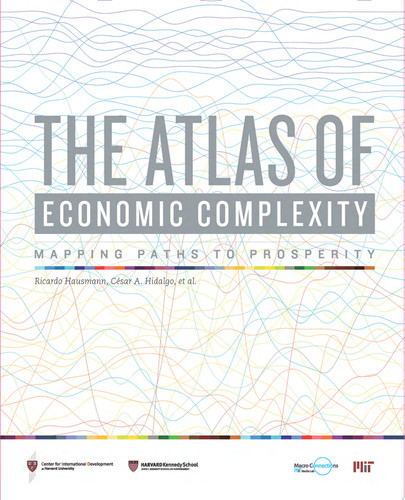
The atlas of economic complexity: mapping paths to prosperity

Ricardo Hausmann,Cesar A. Hidalgo,Sebastian Bustos,Michele Coscia,Alexander Simoes
Maps capture data expressing the economic complexity of countries from Albania to Zimbabwe, offering current economic measures and as well as a guide to achieving prosperity Why do some countries grow and others do not? The authors of The Atlas of Economic Complexity offer readers an explanation based on "Economic Complexity," a measure of a society's productive knowledge. Prosperous societies are those that have the knowledge to make a larger variety of more complex products. The Atlas of Economic Complexity attempts to measure the amount of productive knowledge countries hold and how they can move to accumulate more of it by making more complex products. Through the graphical representation of the "Product Space," the authors are able to identify each country's "adjacent possible," or potential new products, making it easier to find paths to economic diversification and growth. In addition, they argue that a country's economic complexity and its position in the product space are better predictors of economic growth than many other well-known development indicators, including measures of competitiveness, governance, finance, and schooling. Using innovative visualizations, the book locates each country in the product space, provides complexity and growth potential rankings for 128 countries, and offers individual country pages with detailed information about a country's current capabilities and its diversification options. The maps and visualizations included in the Atlas can be used to find more viable paths to greater productive knowledge and prosperity.
The MIT Press 2013 367 pages

The resolution of conflict: constructive and destructive processes

Deutsch, Morton
The basic question to which this book is addressed is not how to eliminate or prevent conflict but rather how to make it productive, or minimally, how to prevent it from being destructive. I shall not deal with situations of "pure" conflict in which inevitably one side loses what the other gains. My interest is in conflict where there is a mixture of cooperative and competitive interests, where a variety of outcomes is possible; mutual loss, gain for one and loss of the other, and mutual gain. Thus my query can be restated, as an investigation of the conditions under which the participants will evolve a cooperative relationship or a competitive relationship in a situation which permits either. -- from the introduction.
Yale University Press 1973-01 420 pages

Better Business, Plus MyBizLab without eText

Solomon, Michael R
Directed primarily toward undergraduate business college/university majors, this text also provides practical content to current and aspiring industry professionals. Better Business offers the business content aspiring professionals need, but in a better way. By presenting the material in a stimulating Q&A format, Better Business encourages readers to fully engage with the materials and understand rather than memorize key concepts. 0133098796 / 9780133098792 Better Business Plus MyBizLab with Pearson eText -- Access Card Package Package consists of 0133059049 / 9780133059045 Better Business 0133059448 / 9780133059441 MyBizLab with Pearson eText -- Access Card -- for Better Business
Pearson Education Limited

MASTERING THE BASICS OF BITCOIN AND CRYPTO: GO FROM CRYPTO CURIOUS TO CRYPTO COMPETENT WITH JUST ONE BOOK

Shrem, Charlie,Kimelman, Michael
Whether you are brand spanking new to bitcoin and crypto or already understand the basics and want to expand your knowledge, this is the book for you! “Mastering the Basics” is a one-stop guide to help you immediately go from “crypto curious” to “crypto competent.” We know how confusing bitcoin and crypto looks to the uninitiated. The potential is massive and world-changing, but it's intimidating and you don't know where to start. That’s why we wrote this step-by-step guide in simple, plain-English terms that anyone can grasp. After completing this book, you will have a comprehensive working knowledge of the concepts and technologies that make digital assets possible. We’ll take away the mystery and empower you with the knowledge and ability to understand bitcoin and profitably buy, sell, secure, and trade cryptos with ease. This is incredibly valuable knowledge taught by two of the most respected experts in the space with over a decade long track record of success. With one book you can equip yourself with the expertise that only a tiny fraction of people alive today possess. There’s no time like the present to get started and get savvy about the greatest opportunity in history for financial success and personal freedom. It starts here. It starts today. What are you waiting for?
Independently published 2022-06-19 191 pages

Gladiators, Pirates and Games of Trust How Game Theory, Strategy and Probability Rule Our Lives

Haim Shapira
This book provides many humorous anecdotes and insightful examples of how our daily lives are affected by Game Theory. Game Theory is the mathematical formalization of interactive decision-making - it assumes that each player's goal is to maximize his/her benefit, whatever it may be. Players may be friends, foes, political parties, states, or any entity that behaves interactively, whether collectively or individually. One of the problems with game analysis is the fact that, as a player, it's very hard to know what would benefit each of the other players; some of us are not even clear about our own goals or what might actually benefit us. Haim Shapira uses multiple examples to explain what Game Theory is and how the different interactions between decision-makers can play out. In this book you will: Meet the Nobel Laureate John F Nash and familiarize yourself with his celebrated equilibrium Learn the basic ideas of the art of negotiation Visit the gladiators' ring and apply for a coaching position Build an airport and divide inheritance Issue ultimatums and learn to trust
ReadHowYouWant.com, Limited 2017-05-12 234 pages

Isn't it obvious

Eliyahu M. Goldratt,Ilan Eshkoli,Joe Brownleer
This book does for retail what Goldratt's International best-seller did for manufacturing. A breakthrough solution is exposed when some unexpected events force Caroline and Paul, a married couple working for their family's retail business, to make a few small changes in the way things are done. A solution that propels the family's regional chain of stores into a very profitable, rapidly growing, international enterprise. If there is a hint of Jonah, from THE GOAL, reappearing in this novel, it is Henry, the soon-to-retire president and majority owner of the company who logically states that, if you do not deal directly with the core problem, don't expect significant improvement. Eli Goldratt's Theory of Constraints is woven throughout this book but answers are not handed to you. The reader, along with the characters in the book, work through the process together to discover solutions.
North River Press 2009 232 pages

Philosophy made simple

Popkin, Richard H.
For almost four decades, Made Simple books have set the standard for continuing education and home study. In answer to the changing needsof today's marketplace, the Made Simple series for the '90s presents a thoroughly up-to-the-minute portfolio of skills, information, and experience, with revised and updated editions of bestselling titles, plus a whole range of new subjects from personal finance to office management to desktop publishing. B & W illustrations throughout
Doubleday 1993-07-01 332 pages

Conservation biology for all

Sodhi, Navjot S.,Ehrlich, Paul R.
Conservation Biology for All provides cutting-edge but basic conservation science to a global readership. A series of authoritative chapters have been written by the top names in conservation biology with the principal aim of disseminating cutting-edge conservation knowledge as widely as possible. Important topics such as balancing conversion and human needs, climate change, conservation planning, designing and analyzing conservation research, ecosystem services, endangeredspecies management, extinctions, fire, habitat loss, and invasive species are covered. Numerous textboxes describing additions
Oxford University Press 2010-03-12 344 pages

Occupy

Chomsky, Noam
PRAISE FOR NOAM CHOMSKY'S OCCUPY AND ZUCCOTTI PARK PRESS: "Having spent so much time thinking about and engaging with social movements, Chomsky is both optimistic about the energy of Occupy and realistic about the challenges it faces. He appreciates the "just do it" ethos and embraces its radical approach to participatory democracy...What makes Chomsky's perspective so interesting, aside from the wealth of his political experience, is the range of his interests. He draws from examples around the world to demonstrate his points. ...It's a big agenda that Occupy has identified, nothing less than a complete renewal of U.S. society and the U.S. role in the world. Chomsky sees not only the radical agenda but also the radical practice of the Occupiers. "Part of what functioning, free communities like the Occupy communities can be working for and spreading to others is just a different way of living, which is not based on maximizing consumer goods, but on maximizing values that are important for life," he concludes in this valuable set of remarks and interviews." --John Feffer, Foreign Policy in Focus, Pick Review "For decades, Chomsky has been marginalized for his insightful, levelheaded, and accurate observations about how our society functions. In Occupy , Chomsky... sets the record straight. And he's got an answer for everything. "It's necessary," Chomsky warns, "to get out into the country and get people to understand what this is about, and what they can do about it, and what the consequences are of not doing anything about it." Occupy begins with a powerful editor's note from Greg Ruggiero, who comments on 'the heartlessness and inhumanity of the system, ' where 'people's stolen homes are sold off to the highest bidder.' And if it isn't obvious to those who are still asking what the demands of Occupy Wall Street are, Ruggiero puts it plainly: 'Occupy embodies a vision of democracy that is fundamentally antagonistic to the management of society as a corporate-controlled space that funds a political system to serve the wealthy, ignore the poor.' One can only cringe at the thought of what will happen if we continue to ignore the wisdom of Noam Chomsky. He gives a clue in Occupy ...." --The Coffin Factory, The Magazine for People who Love Books Occupy is another vital contribution from Chomsky to the literature of defiance and protest, and a red-hot rallying call to forge a better, more egalitarian future. --Alternet Chomsky advocates intelligent activism by those who see the divorce between public policy and public opinion. He is both optimistic and realistic towards this "first major public response to 30 years of class war." --IRISH TIMES, PICK REVIEW " Occupy , is at once a vivid portrait of the now-global movement and a practical guide to intelligent activism, infused with Chomsky's signature meditations on everything from how the wealthiest 1% came to steer society to what a healthy democracy would look like to how we can separate money from politics. Alongside Chomsky's words are some of the most moving and provocative photographs from the Occupy movement. ... [One of] 10 essential books on protest." --Maria Popova, Brain Pickings In Occupy , Chomsky discusses the cornerstone issues, questions and demands that have been driving ordinary Americans to critique the influence of the 1%. The book begins and ends with Chomsky celebrating the life and work of his longtime friend and colleague, Howard Zinn, author of A People's History of the United States. As a call to action, Chomsky encourages people to continue organizing, to continue struggling, and to continue defending citizenship and community-driven democracy from predation from the relentless encroachments of wealth and corporate power.
Zuccotti Park Press 2012 125 pages

The shifts and the shocks: what we've learned -- and have still to learn -- from the financial crisis

Wolf, Martin
"From the chief economic commentator for the Financial Times, a brilliant tour d'horizon of the new global economy and its trajectory There have been many books that have sought to explain the causes and courses of the financial and economic crisis which began in 2007-8. The Shifts and the Shocks is not another detailed history of the crisis, but the most persuasive and complete account yet published of what the crisis should teach us about modern economies and economics. The book identifies the origin of the crisis in the complex interaction between globalization, hugely destabilizing global imbalances and our dangerously fragile financial system. In the eurozone, these sources of instability were multiplied by the tragically defective architecture of the monetary union. It also shows how much of the orthodoxy that shaped monetary and financial policy before the crisis occurred was complacent and wrong. In doing so, it mercilessly reveals the failures of the financial, political and intellectual elites who ran the system. The book also examines what has been done to reform the financial and monetary systems since the worst of the crisis passed. "Are we now on a sustainable course?" Wolf asks. "The answer is no." He explains with great clarity why "further crises seem certain" and why the management of the eurozone in particular "guarantees a huge political crisis at some point in the future." Wolf provides far more ambitious and comprehensive plans for reform than any currently being implemented. Written with all the intellectual command and trenchant judgment that have made Martin Wolf one of the world's most influential economic commentators, The Shifts and the Shocks matches impressive analysis with no-holds-barred criticism and persuasive prescription for a more stable future. It is a book no one with an interest in global affairs will want to neglect. "--
Penguin Press 2015 503 pages