637 results for "Mathematics"

Basic Algebra: Groups, Rings and Fields

Cohn, Paul M.
Basic Algebra is the first volume of a new and revised edition of P.M. Cohn's classic three-volume text Algebra which is widely regarded as one of the most outstanding introductory algebra textbooks. For this edition, the text has been reworked and updated into two self-contained, companion volumes, covering advanced topics in algebra for second- and third-year undergraduate and postgraduate research students. In this first volume, the author covers the important results of algebra; the companion volume, Further Algebra and Applications, brings more advanced topics and focuses on the applications. Readers should have some knowledge of linear algebra and have met groups and fields before, although all the essential facts and definitions are recalled. The coverage is comprehensive and includes topics such as: - Groups - lattices and categories - rings, modules and algebras - fields The author gives a clear account, supported by worked examples, with full proofs. There are numerous exercises with occasional hints, and some historical remarks.
Springer London Ltd 2012-11-12 465 pages

Linear Programming 1 Introduction

George B. Dantzig,Mukund N. Thapa
By George B. Dantzig LINEAR PROGRAMMING The Story About How It Began: Some legends, a little about its historical sign- cance, and comments about where its many mathematical programming extensions may be headed. Industrial production, the ?ow of resources in the economy, the exertion of military e?ort in a war, the management of ?nances—all require the coordination of interrelated activities. What these complex undertakings share in common is the task of constructing a statement of actions to be performed, their timing and quantity(calledaprogramorschedule), that, ifimplemented, wouldmovethesystem from a given initial status as much as possible towards some de?ned goal. While di?erences may exist in the goals to be achieved, the particular processes, and the magnitudes of e?ort involved, when modeled in mathematical terms these seemingly disparate systems often have a remarkably similar mathematical str- ture. The computational task is then to devise for these systems an algorithm for choosing the best schedule of actions from among the possible alternatives. The observation, in particular, that a number of economic, industrial, ?nancial, and military systems can be modeled (or reasonably approximated) by mathem- ical systems of linear inequalities and equations has given rise to the development of the linear programming ?eld.
Springer New York 2013-04-26 435 pages

Foundations of Analysis Third Edition

Edmund Landau
Certainly no clearer treatment of the foundations of the number system can be offered … one can only be thankful to the author for this fundamental piece of exposition, which is alive with his vitality and genius. —American Mathematical Monthly Why does $2 times 2 = 4$? What are fractions? Imaginary numbers? Why do the laws of algebra hold? And how do we prove these laws? What are the properties of the numbers on which the Differential and Integral Calculus is based? In other words, what are numbers? And why do they have the properties we attribute to them? Thanks to the genius of Dedekind, Cantor, Peano, Frege, and Russell, such questions can now be given a satisfactory answer. This English translation of Landau's famous Grundlagen der Analysis answers these important questions.
American Mathematical Society 2022-07-14 136 pages

Theory of Finite and Infinite Graphs

König, Denes
To most graph theorists there are two outstanding landmarks in the history of their subject. One is Euler's solution of the Konigsberg Bridges Problem, dated 1736, and the other is the appearance of Denes Konig's textbook in 1936. "From Konigsberg to Konig's book" sings the poetess, "So runs the graphic tale . . . " [10]. There were earlier books that took note of graph theory. Veb len's Analysis Situs, published in 1931, is about general combinato rial topology. But its first two chapters, on "Linear graphs" and "Two-Dimensional Complexes," are almost exclusively concerned with the territory still explored by graph theorists. Rouse Ball's Mathematical Recreations and Essays told, usually without proofs, of the major graph-theoretical advances ofthe nineteenth century, of the Five Colour Theorem, of Petersen's Theorem on I-factors, and of Cayley's enumerations of trees. It was Rouse Ball's book that kindled my own graph-theoretical enthusiasm. The graph-theoretical papers of Hassler Whitney, published in 1931-1933, would have made an excellent textbook in English had they been collected and published as such. But the honour of presenting Graph Theory to the mathe matical world as a subject in its own right, with its own textbook, belongs to Denes Konig. Low was the prestige of Graph Theory in the Dirty Thirties. It is still remembered, with resentment now shading into amuse ment, how one mathematician scorned it as "The slums of Topol ogy.""
Birkhäuser 2012-10-18 436 pages

The Interpretation of Nature and the Psyche

Carl Gustav Jung,Wolfgang Ernst Pauli
Carl Gustav Jung (1875-1961) and Wolfgang Ernst Pauli (1900 - 1958) were two of the greatest thinkers of modern times. Jung is the founder of Analytical Psychology and is one of the best known researchers in the field of Dream Interpretation and Symbolization. Pauli was one of the pioneers of Quantum Physics. In 1945, Pauli received the Nobel Prize in Physics after being nominated by Albert Einstein for his "decisive contribution through his discovery of a new law of Nature, the exclusion principle" involving spin theory underpinning the structure of matter and the whole of chemistry. Together they collaborated on this book that was First published in 1952 in German as Naturerklarung und Psyche. C. G. Jung: Synchronizitat als ein Prinzip akausaler Zusammenhange. W. Pauli: Der Einfluss archetypischer Vorstellungen auf die Bildung naturwissenschaftlicher Theorien bei Kepler. However, our reviewer, himself an eminent professor of mathematics, concludes, "After thoroughly studying their writings for many months now, I have come to see clearly that they are both utterly mad.""
Ishi Press International 2012-02 280 pages

Linear algebra problem book

Halmos, Paul R.
Can one learn linear algebra solely by solving problems? Paul Halmos thinks so, and you will too once you read this book. The Linear Algebra Problem Book is an ideal text for a course in linear algebra. It takes the student step by step from the basic axioms of a field through the notion of vector spaces, on to advanced concepts such as inner product spaces and normality. All of this occurs by way of a series of 164 problems, each with hints and, at the back of the book, full solutions. This book is a marvelous example of how to teach and learn mathematics by 'doing' mathematics. It will work well for classes taught in small groups and can also be used for self-study. After working their way through the book, students will understand not only the theorems of linear algebra, but also some of the questions which were asked which enabled the theorems to be discovered in the first place. They will gain confidence in their problem solving abilities and be better prepared to understand more advanced courses. As the author explains, 'I don't think I understand a subject until I know the questions ... I wrote this book to organize those questions, problems, in my own mind.' Try this book with your students and they too will be able to organize and understand the questions of linear algebra.
Mathematical Association of America 1995 336 pages

Stochastic processes

Doob, Joseph L. mathématicien
The theory of stochastic processes has developed so much in the last twenty years that the need for a systematic account of the subject has been felt, particularly by students and instructors of probability. This book fills that need. While even elementary definitions and theorems are stated in detail, this is not recommended as a first text in probability and there has been no compromise with the mathematics of probability. Since readers complained that omission of certain mathematical detail increased the obscurity of the subject, the text contains various mathematical points that might otherwise seem extraneous. A supplement includes a treatment of the various aspects of measure theory. A chapter on the specialized problem of prediction theory has also been included and references to the literature and historical remarks have been collected in the Appendix.
J. Wiley 1967 654 pages

Scientific Conversations Interviews on Science from The New York Times

Claudia Dreifus
In these thirty-eight interviews, originally published in the weekly Science Times section of The New York Times , Claudia Dreifus brings all of her colorful personality to bear on her subjects, as well as an arsenal of philosophy, literature, and current events, and an unmistakable curiosity. As each conversation unfolds, we learn surprising and fascinating things about some of the most intriguing figures and issues in science today. Dreifus's outsider status in the world of science is perhaps one of her greatest interviewing strengths. A political journalist for much of her career, she stumbled into a position at the Science Times section. With little more scientific background than the average person, she scrambled to prepare for her meetings with some of the greatest minds in a broad range of disciplines-from astronomy to geology, from biology and medicine to computer science and mathematics. She soon found herself in a refreshingly candid environment, so unlike the one she had known on the political beat. It is from this perspective that she makes science tangible, accessible, and entertaining.
Henry Holt and Company 2002-11-01 272 pages

What's luck got to do with it? the history, mathematics, and psychology behind the gambler's illusion

Mazur, Joseph
"Mazur's book treats luck in a fresh light. The philosophy and emotional aspects (along with a little mathematics) are all there. The reader who delves in will be lucky indeed." --Persi Diaconis, Stanford University "Blending math with memoir, probability with psychology, and heuristics with history, Mazur has written an essential book for anyone who wants to get a better idea of why we consistently bet against the odds. From the betting window to Wall Street, he offers insights into both the mechanics of chance and the enduring appeal that luck holds for those who wager every day, whether they call it gambling, speculation, or just hoping for the best. Engaging and illuminating, this is a guaranteed winner." --David G. Schwartz, director of the Center for Gaming Research at the University of Nevada, Las Vegas, and author of Roll the Bones: The History of Gambling "This is a fascinating book. It's a fresh, funny, philosophical look at gambling by a mathematician who knows what he's talking about, and who has quite obviously thought about gambling for a long time. Mazur isn't afraid to make provocative, opinionated statements. I have not seen a gambling book like this before. I think it will attract a lot of readers." --Paul J. Nahin, author of Digital Dice "This book is significant in that it offers a lively and diverse collection of gambling-related ideas. Mazur's robust blend of anecdotes, history, psychology, and mathematics differs from other attempts to discuss these ideas. He offers plenty of insights into the questions and issues he raises." --Edward Packel, author of The Mathematics of Games and Gambling
Princeton University Press 2010-06-06 277 pages

Where mathematics comes from: how the embodied mind brings mathematics into being

Lakoff, George
When you think about it, it seems obvious: The only mathematical ideas that human beings can have are ideas that the human brain allows. We know a lot about what human ideas are like from research in Cognitive Science. Most ideas are unconscious, and that is no less true of the mathematical ones. Abstract ideas, for the most part, arise via conceptual metaphor-a mechanism for projecting embodied (that is, sensory-motor) reasoning to abstract reasoning. This book argues that conceptual metaphor plays a central, defining role in mathematical ideas within the cognitive unconscious-from arithmetic and algebra to sets and logic to infinity in all of its forms: transfinite numbers, points at infinity, infinitesimals, and so on. Even the real numbers, the imaginary numbers, trigonometry, and calculus are based on metaphorical ideas coming out of the way we function in the everyday physical world. This book is about mathematical ideas, about what mathematics means-and why. The authors believe that understanding the metaphors implicit in mathematics will make mathematics make more sense. Moreover, understanding mathematical ideas and how they arise from our bodies and brains will make it clear that the brain's mathematics is mathematics, the only mathematics we know or can know. -- Publisher description.
Basic Books 2000 492 pages

One, Two, Three Absolutely Elementary Mathematics

David Berlinski
The acclaimed author of A Tour of the Calculus and The Infinite Ascent offers an enlightening and enthralling tour of the basics of mathematics, and reveals a world of fascination in fundamental mathematical ideas. One, Two, Three is David Berlinski’s captivating exploration of the foundation of mathematics, its fundamental ideas, and why they matter. By unraveling the complex answers to these most elementary questions—What is a number? How do addition, subtraction, and other functions actually work? What are geometry and logic?—Berlinski reveals the intricacy behind their seemingly simple exteriors. Peppered with enlightening historical anecdotes and asides on some of history’s most fascinating mathematicians, One, Two, Three, revels in the beauty of numbers as Berlinski shows us how and why these often slippery concepts are as essential to the field of mathematics as to who we are.
Knopf Doubleday Publishing Group 2012-05-01 224 pages

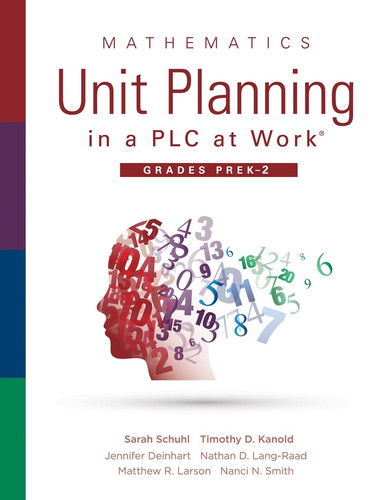
Mathematics unit planning in a PLC at work, grades PreK-2

Schuhl, Sarah,Kanold, Timothy D.,Deinhart, Jennifer,Lang, Nathan D.,Larson, Matthew R.,Smith, Nanci N.
"This book is part of the Every Student Can Learn Mathematics series. In Mathematics Unit Planning in a PLC at Work, Grades PreK-2, authors Sarah Schuhl, Timothy D. Kanold, Jennifer Deinhart, Nathan D. Lang-Raad, Matthew R. Larson, and Nanci N. Smith provide grades preK-2 mathematics teachers with a framework for collectively planning a unit of study. This book helps teams identify what students need to know by the end of each unit and how to build student self-efficacy. The authors advocate using the PLC at Work process for increasing mathematics achievement, and as teams answer the four critical questions of a PLC, they provide students with a more equitable learning experience. The authors share tools and protocols for effectively performing collaborative tasks, such as unwrapping standards, generating unit calendars, determining academic vocabulary and rigorous lessons, utilizing and sharing self-reflections, and designing foundational addition and subtraction units. By reading Mathematics Unit Planning in a PLC at Work, Grades PreK-2, teachers will receive practical insight into collaborative planning and inspiring detailed models of this work in action"--
Solution Tree Press 2021 152 pages

Uncountable: a philosophical history of number and humanity from antiquity to the present

Nirenberg, David,Nirenberg, Ricardo L.
"From the time of Pythagoras, we have been tempted to treat numbers as the ultimate or only truth. This book tells the history of that habit of thought. But more, it argues that the logic of counting sacrifices much of what makes us human, and that we have a responsibility to match the objects of our attention to the forms of knowledge that do them justice. Humans have extended the insights and methods of number and mathematics to more and more aspects of the world, even to their gods and their religions.Today those powers are greater than ever, as computation is applied to virtually every aspect of human activity.But the rules of mathematics do not strictly apply to many things-from elementary particles to people-in the world.By subjecting such things to the laws of logic and mathematics, we gain some kinds of knowledge, but we also lose others. How do our choices about what parts of the world to subject to the logics of mathematics affect how we live and how we die?This question is rarely asked, but it is urgent, because the sciences built upon those laws now govern so much of our knowledge, from physics to psychology.Number and Knowledge sets out to ask it. In chapters proceeding chronologically from Ancient Greek philosophy and the rise of monotheistic religions to the emergence of modern physics and economics, the book traces how ideals, practices, and habits of thought formed over millennia have turned number into the foundation-stone of human claims to knowledge and certainty.But the book is also a philosophical and poetic exhortation to take responsibility for that history, for the knowledge it has produced, and for the many aspects of the world and of humanity that it ignores or endangers.To understand what can be counted and what can't is to embrace the ethics of purposeful knowing"--
University of Chicago Press 2021-10-20 420 pages

The Mathematician's Shiva: a novel

Rojstaczer, Stuart
" A comic, bittersweet tale of family evocative of The Yiddish Policemen's Union and Everything Is Illuminated Alexander "Sasha" Karnokovitch and his family would like to mourn the passing of his mother, Rachela, with modesty and dignity. But Rachela, a famous Polish e;migre; mathematician and professor at the University of Wisconsin, is rumored to have solved the million-dollar, Navier-Stokes Millennium Prize Problem. Rumor also has it that she spitefully took the solution to her grave. To Sasha's chagrin, a ragtag group of socially challenged mathematicians arrives in Madison and crashes the shiva, vowing to do whatever it takes to find the solution-even if it means prying up the floorboards for Rachela's notes. Written by a trained geophysicist, this hilarious and multi-layered debut novel brims with colorful characters and brilliantly captures humanity's drive not just to survive, but to solve the impossible"--
Penguin Books 2014 366 pages

Introduction to topology

Lefschetz, Solomon
In this book, which may be used as a self-contained text for a beginning course, Professor Lefschetz aims to give the reader a concrete working knowledge of the central concepts of modern combinatorial topology: complexes, homology groups, mappings in spheres, homotopy, transformations and their fixed points, manifolds and duality theorems. Each chapter ends with a group of problems. Originally published in 1949. The Princeton Legacy Library uses the latest print-on-demand technology to again make available previously out-of-print books from the distinguished backlist of Princeton University Press. These editions preserve the original texts of these important books while presenting them in durable paperback and hardcover editions. The goal of the Princeton Legacy Library is to vastly increase access to the rich scholarly heritage found in the thousands of books published by Princeton University Press since its founding in 1905.
Princeton University Pres 2017 228 pages

Probability, Statistics and Truth

Mises, Richard von
The science of probability - the systematic study of mass phenomena and repetitive events - was not fully established as such until about 1919. Nine years later, Richard von Mises, one of its pioneers, brought out the first edition of this book - what has become the classic treatment of the foundations of probability theory. The present text reproduces the most authoritative translation of the definitive 1951 German edition, which was fully revised in the light of over two decades of developments in the field. Step by step, in clear, simple language and with exceptionally well chosen examples, the author unfolds what in all likelihood is still the most comprehensive investigation ever undertaken of probablity, its relation to statistics, and its truth-finding value. Professor Richard von Mises (1883-1953) was a world-renowned mathematician, aeronautical scientist and positivist philosopher. Like all of his books, this one is rigorously logical and systematic, and at the same time thoroughly grounded in empirical evidence and practical situations.
George Allen & Unwin 1957 258 pages

Handbook of Mathematical Economics

M.D. Intriligator,Kenneth J. Arrow
The Handbook of Mathematical Economics aims to provide a definitive source, reference, and teaching supplement for the field of mathematical economics. It surveys, as of the late 1970's the state of the art of mathematical economics. This is a constantly developing field and all authors were invited to review and to appraise the current status and recent developments in their presentations. In addition to its use as a reference, it is intended that this Handbook will assist researchers and students working in one branch of mathematical economics to become acquainted with other branches of this field. Volume 2 elaborates on Mathematical Approaches to Microeconomic Theory , including consumer, producer, oligopoly, and duality theory, as well as Mathematical Approaches to Competitive Equilibrium including such aspects of competitive equilibrium as existence, stability, uncertainty, the computation of equilibrium prices, and the core of an economy. For more information on the Handbooks in Economics series, please see our home page on http://www.elsevier.nl/locate/hes
Elsevier Science 1982-03-15 689 pages