417 results for "Mathematics"

Post-Quantum Cryptography

Daniel J. Bernstein,Johannes Buchmann,Erik Dahmen
Quantum computers will break today's most popular public-key cryptographic systems, including RSA, DSA, and ECDSA. This book introduces the reader to the next generation of cryptographic algorithms, the systems that resist quantum-computer attacks: in particular, post-quantum public-key encryption systems and post-quantum public-key signature systems. Leading experts have joined forces for the first time to explain the state of the art in quantum computing, hash-based cryptography, code-based cryptography, lattice-based cryptography, and multivariate cryptography. Mathematical foundations and implementation issues are included. This book is an essential resource for students and researchers who want to contribute to the field of post-quantum cryptography.
Springer Berlin Heidelberg 2010-10-19 246 pages

Abstract Set Theory

Abraham Adolf 1891-1965 Fraenkel
This work has been selected by scholars as being culturally important and is part of the knowledge base of civilization as we know it. This work is in the public domain in the United States of America, and possibly other nations. Within the United States, you may freely copy and distribute this work, as no entity (individual or corporate) has a copyright on the body of the work. Scholars believe, and we concur, that this work is important enough to be preserved, reproduced, and made generally available to the public. To ensure a quality reading experience, this work has been proofread and republished using a format that seamlessly blends the original graphical elements with text in an easy-to-read typeface. We appreciate your support of the preservation process, and thank you for being an important part of keeping this knowledge alive and relevant.
Creative Media Partners, LLC 2021-09-09 312 pages

Mathematics without apologies: portrait of a problematic vocation

Harris, Michael
What do pure mathematicians do, and why do they do it? Looking beyond the conventional answers--for the sake of truth, beauty, and practical applications--this book offers an eclectic panorama of the lives and values and hopes and fears of mathematicians in the twenty-first century, assembling material from a startlingly diverse assortment of scholarly, journalistic, and pop culture sources.
Princeton University Press 2017-05-30 438 pages

Algebraic Geometry

Solomon Lefschetz
The first application of modern algebraic techniques to a comprehensive selection of classical geometric problems. Written with spirit and originality, this is a valuable book for anyone interested in the subject from other than the purely algebraic point of view. Originally published in 1953. The Princeton Legacy Library uses the latest print-on-demand technology to again make available previously out-of-print books from the distinguished backlist of Princeton University Press. These editions preserve the original texts of these important books while presenting them in durable paperback and hardcover editions. The goal of the Princeton Legacy Library is to vastly increase access to the rich scholarly heritage found in the thousands of books published by Princeton University Press since its founding in 1905.
Princeton University Press 2016-04-19 244 pages

Representation and reality

Putnam, Hilary
Preface Introduction Chapter 1 Meaning and Mentalism Fodor and Chomsky Three Reasons Why Mentalism Can't Be Right 1 Meaning Is Holistic 2 Meaning Is in Part a Normative Notion 3 Our Concepts Depend on Our Physical and Social Environment in a Way That Evolution (Which Was Com ... Connections between 1, 2, and 3 Chapter 2 Meaning, Other People, and the World The Division of Linguistic Labor Elms, Beeches, and Searle The Contribution of the Environment An Indexical Component Other Natural Kinds Reference and Theory Change Meaning and "Mental Representation" Chapter 3 Fodor and Block on "Narrow Content" Narrow Content as a "Function of Observable Properties" "Narrow Content" and "Conceptual Role" Concluding Remarks Chapter 4 Are There Such Things as Reference and Truth? Why "Folk Psychology" and Not "Folk Logic"? Disquotation, Anyone? The "Semantical Conception" of Truth Disquotation as Disappearance Chapter 5 Why Functionalism Didn't Work Sociofunctionalism What "In Principle" Means Here The Single-Computational-State Version of Functionalism Equivalence Surveying Rationality Chapter 6 Other Forms of Functionalism David Lewis and I Lewis's Theory Further Examined Conclusion Chapter 7 A Sketch of an Alternative Picture Objectivity and Conceptual Relativity Internal Realism as an Alternative Picture My Present Diagnosis of the "Functionalism" Issue Appendix Notes Author Index
MIT Press 1988 136 pages

Structure of Algebras

Abraham Adrian Albert
This work has been selected by scholars as being culturally important and is part of the knowledge base of civilization as we know it. This work is in the public domain in the United States of America, and possibly other nations. Within the United States, you may freely copy and distribute this work, as no entity (individual or corporate) has a copyright on the body of the work. Scholars believe, and we concur, that this work is important enough to be preserved, reproduced, and made generally available to the public. To ensure a quality reading experience, this work has been proofread and republished using a format that seamlessly blends the original graphical elements with text in an easy-to-read typeface. We appreciate your support of the preservation process, and thank you for being an important part of keeping this knowledge alive and relevant.
HASSELL STREET Press 2021-09-09 232 pages

Scientific Computing and Differential Equations An Introduction to Numerical Methods

Gene H. Golub,James M. Ortega,Department of Computer Science James M Ortega
Scientific Computing and Differential Equations: An Introduction to Numerical Methods, is an excellent complement to Introduction to Numerical Methods by Ortega and Poole. The book emphasizes the importance of solving differential equations on a computer, which comprises a large part of what has come to be called scientific computing. It reviews modern scientific computing, outlines its applications, and places the subject in a larger context. This book is appropriate for upper undergraduate courses in mathematics, electrical engineering, and computer science; it is also well-suited to serve as a textbook for numerical differential equations courses at the graduate level. * An introductory chapter gives an overview of scientific computing, indicating its important role in solving differential equations, and placing the subject in the larger environment * Contains an introduction to numerical methods for both ordinary and partial differential equations * Concentrates on ordinary differential equations, especially boundary-value problems * Contains most of the main topics for a first course in numerical methods, and can serve as a text for this course * Uses material for junior/senior level undergraduate courses in math and computer science plus material for numerical differential equations courses for engineering/science students at the graduate level
Elsevier Science & Technology Books 1991-09-30 344 pages

Essays on the foundations of mathematics

Pasch, Moritz
Moritz Pasch (1843-1930) is justly celebrated as a key figure in the history of axiomatic geometry. Less well known are his contributions to other areas of foundational research. This volume features English translations of 14 papers Pasch published in the decade 1917-1926. In them, Pasch argues that geometry and, more surprisingly, number theory are branches of empirical science; he provides axioms for the combinatorial reasoning essential to Hilbert’s program of consistency proofs; he explores "implicit definition" (a generalization of definition by abstraction) and indicates how this technique yields an "empiricist" reconstruction of set theory; he argues that we cannot fully understand the logical structure of mathematics without clearly distinguishing between decidable and undecidable properties; he offers a rare glimpse into the mind of a master of axiomatics, surveying in detail the thought experiments he employed as he struggled to identify fundamental mathematical principles; and much more. This volume will: Give English speakers access to an important body of work from a turbulent and pivotal period in the history of mathematics, help us look beyond the familiar triad of formalism, intuitionism, and logicism, show how deeply we can see with the help of a guide determined to present fundamental mathematical ideas in ways that match our human capacities, will be of interest to graduate students and researchers in logic and the foundations of mathematics.
Springer 2010-09-03 245 pages

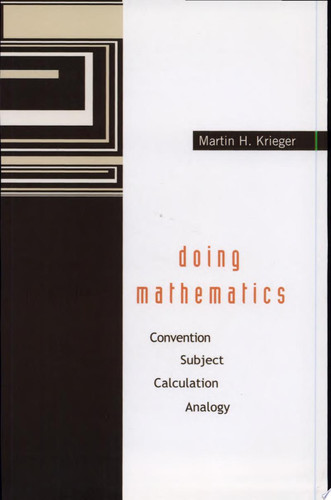
Doing mathematics: convention, subject, calculation, analogy

Krieger, Martin H.
This book discusses some ways of doing mathematical work and the subject matter that is being worked upon and created. It argues that the conventions we adopt, the subject areas we delimit, what we can prove and calculate about the physical world, and the analogies that work for mathematicians--all depend on mathematics, what will work out and what won't. And the mathematics, as it is done, is shaped and supported, or not, by convention, subject matter, calculation, and analogy. The causes studied include the central limit theorem of statistics, the sound of the shape of a drum, the connection between algebra and topology, the stability of matter, the Ising model, and the Langlands Program in number theory and representation theory. Contents: Convention: How Means and Variances are Entrenched as Statistics; Subject: The Fields of Topology; Appendix: The Two-Dimensional Ising Model of a Ferromagner; Calculation: Strategy, Structure, and Tactics in Applying Classical Analysis; Analogy; A Syzygy Between a research Program in Mathematics and a Research Program in Physics, Each of Which is Itself an Analogy; Mathematics in Concreto. Readership: Mathematicians, Physicists, philosophers and historians of science.
World Scientific 2003 454 pages

Mathematics and logic

Kac, Mark
A description of the historical development of mathematics with a brief survey of high points and trenchant influences, originally published in 1986 by Praeger. A remarkable bargain. Fascinating study considers the origins and nature of mathematics, its development and role in the history of scientific thinking, impact of high-speed computers, 20th-century changes in the foundations of mathematics and mathematical logic, mathematization of science and technology, much more. Compelling reading for mathematicians, physicists, students₇anyone interested in the evolution of mathematical thought. 34 illustrations. 1968 edition.
Dover 1992 170 pages

Lectures on Boolean Algebras

Paul Richard Halmos
"In a bold and refreshingly informal style, this exciting text steers a middle course between elementary texts emphasizing connections with philosophy, logic, and electronic circuit design, and profound treatises aimed at advanced graduate students and professional mathematicians. It is written for readers who have studied at least two years of college-level mathematics. With carefully crafted prose, lucid explanations, and illuminating insights, it guides students to some of the deeper results of Boolean algebra-and in particular to the important interconnections with topology-without assuming a background in algebra, topology, and set theory. The parts of those subjects that are needed to understand the material are developed within the text itself." "Highlights of the book include the normal form theorem; the homomorphism extension theorem; the isomorphism theorem for countable atomless Boolean algebras; the maximal ideal theorem; the celebrated Stone representation theorem; the existence and uniqueness theorems for canonical extensions and completions; Tarski's isomorphism of factors theorem for (J'-algebras, and Hanf's related counterexamples; and an extensive treatment of the algebraictopological duality, including the duality between ideals and open sets, homomorphisms and continuous functions, subalgebras and quotient spaces, and direct products and Stone-Cech compactifications." A special feature of the book is the large number of exercises of varying levels of difficulty, from routine problems that help readers understand the basic definitions and theorems, to intermediate problems that extend or enrich material developed in the text, to harder problems that exploreimportant ideas either not treated in the text, or that go substantially beyond its treatment. Hints for the solutions to the harder problems are given in an appendix. A detailed solutions manual for all exercises is available for instructors who adopt the text for a course.
Van Nostrand 1963 147 pages

Computability: Turing, Gödel, Church, and beyond

B. Jack Copeland,Carl J. Posy,Oron Shagrir
Computer scientists, mathematicians, and philosophers discuss the conceptual foundations of the notion of computability as well as recent theoretical developments. In the 1930s a series of seminal works published by Alan Turing, Kurt Gödel, Alonzo Church, and others established the theoretical basis for computability. This work, advancing precise characterizations of effective, algorithmic computability, was the culmination of intensive investigations into the foundations of mathematics. In the decades since, the theory of computability has moved to the center of discussions in philosophy, computer science, and cognitive science. In this volume, distinguished computer scientists, mathematicians, logicians, and philosophers consider the conceptual foundations of computability in light of our modern understanding.Some chapters focus on the pioneering work by Turing, Gödel, and Church, including the Church-Turing thesis and Gödel's response to Church's and Turing's proposals. Other chapters cover more recent technical developments, including computability over the reals, Gödel's influence on mathematical logic and on recursion theory and the impact of work by Turing and Emil Post on our theoretical understanding of online and interactive computing; and others relate computability and complexity to issues in the philosophy of mind, the philosophy of science, and the philosophy of mathematics.ContributorsScott Aaronson, Dorit Aharonov, B. Jack Copeland, Martin Davis, Solomon Feferman, Saul Kripke, Carl J. Posy, Hilary Putnam, Oron Shagrir, Stewart Shapiro, Wilfried Sieg, Robert I. Soare, Umesh V. Vazirani
The MIT Press 2013-06-07 362 pages

Elementary Methods in Number Theory

Nathanson, Melvyn B.
Elementary Methods in Number Theory begins with "a first course in number theory" for students with no previous knowledge of the subject. The main topics are divisibility, prime numbers, and congruences. There is also an introduction to Fourier analysis on finite abelian groups, and a discussion on the abc conjecture and its consequences in elementary number theory. In the second and third parts of the book, deep results in number theory are proved using only elementary methods. Part II is about multiplicative number theory, and includes two of the most famous results in mathematics: the Erdös-Selberg elementary proof of the prime number theorem, and Dirichlets theorem on primes in arithmetic progressions. Part III is an introduction to three classical topics in additive number theory: Warings problems for polynomials, Liouvilles method to determine the number of representations of an integer as the sum of an even number of squares, and the asymptotics of partition functions. Melvyn B. Nathanson is Professor of Mathematics at the City University of New York (Lehman College and the Graduate Center). He is the author of the two other graduate texts: Additive Number Theory: The Classical Bases and Additive Number Theory: Inverse Problems and the Geometry of Sumsets.
Springer 2013-07-13 540 pages

Quantum theory: concepts and methods

Peres, Asher
This book will be useful to anyone who wants to understand the use of quantum theory for the description of physical processes. It is a graduate level text, ideal for independent study, and includes numerous figures, exercises, bibliographical references, and even some computer programs. The first chapters introduce formal tools: the mathematics are precise, but not excessively abstract. The physical interpretation too is rigorous. It makes no use of the uncertainty principle of other ill-defined notions. The central part of the book is devoted to Bell's theorem and to the Kochen-Specker theorem. It is here that quantum phenomena depart most radically from classical physics. There has recently been considerable progress on these issues, and the latest developments have been included. The final chapters discuss further topics of current research: spacetime symmetries, quantum thermodynamics and information theory, semiclassical methods, irreversibility, quantum chaos, and especially the measuring process. In particular, it is shown how modern techniques allow the extraction of more information from a physical system than traditional measurement methods. For physicists, mathematicians and philosophers of science with an interest in the applications and foundations of quantum theory. The volume is suitable as a supplementary graduate textbook.
Kluwer Academic Publishers 1995-09-30 446 pages

˜Theœ Apprenticeship of a Mathematician

Weil, André
"Extremely readable recollections of the author... A rare testimony of a period of the history of 20th century mathematics. Includes very interesting recollections on the author's participation in the formation of the Bourbaki Group, tells of his meetings and conversations with leading mathematicians, reflects his views on mathematics. The book describes an extraordinary career of an exceptional man and mathematicians. Strongly recommended to specialists as well as to the general public." EMS Newsletter (1992) "This excellent book is the English edition of the author's autobiography. ... This very enjoyable reading is recommended to all mathematicians." Acta Scientiarum Mathematicarum (1992)
Springer Basel 2012-10-09 197 pages

Introduction to Logic And to the Methodology of Deductive Sciences

Alfred Tarski
This classic undergraduate treatment examines the deductive method in its first part and explores applications of logic and methodology in constructing mathematical theories in its second part. Exercises appear throughout. Alfred Tarski, one of the greatest logicians of all time, is widely thought of as 'the man who defined truth'. His work on the concepts of truth and logical consequence as defined by mathematical theory are cornerstones of modern logic, influencing developments in mathematics, philosophy, linguistics, and computer science. His teaching on logic and mathematics culminated in the 1941 classic INTRODUCTION TO LOGIC, which uses the method of deduction and explores logic and methodology as it pertains to creating mathematical theories.
Must Have Books 2021-02-25 258 pages