
560 results for "Physics"

The beginning of infinity: explanations that transform the world

Deutsch, David
"A bold and all-embracing exploration of the nature and progress of knowledge from one of today's great thinkers. Throughout history, mankind has struggled to understand life's mysteries, from the mundane to the seemingly miraculous. In this important new book, David Deutsch, an award-winning pioneer in the field of quantum computation, argues that explanations have a fundamental place in the universe. They have unlimited scope and power to cause change, and the quest to improve them is the basic regulating principle not only of science but of all successful human endeavor. This stream of ever improving explanations has infinite reach, according to Deutsch: we are subject only to the laws of physics, and they impose no upper boundary to what we can eventually understand, control, and achieve. In his previous book, The Fabric of Reality, Deutsch describe the four deepest strands of existing knowledge-the theories of evolution, quantum physics, knowledge, and computation-arguing jointly they reveal a unified fabric of reality. In this new book, he applies that worldview to a wide range of issues and unsolved problems, from creativity and free will to the origin and future of the human species. Filled with startling new conclusions about human choice, optimism, scientific explanation, and the evolution of culture, The Beginning of Infinity is a groundbreaking book that will become a classic of its kind"--
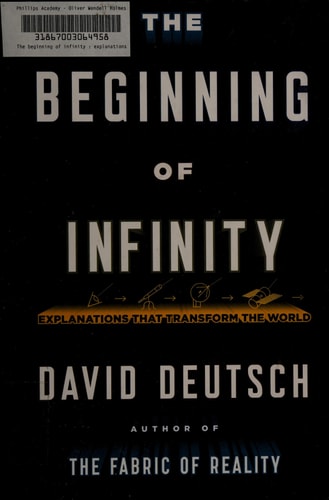
Viking 2011 487 pages

Conversations with Carl Sagan

Sagan, Carl
Though a well-regarded physicist Carl Sagan (1934-1996) is best-known as a writer of popular nonfiction and science fiction and as the host of the PBS series Cosmos . Through his writings and spoken commentary, he worked to popularize interests in astronomy, the universe, and the possibility of extraterrestrial life. From the beginning of his public career, when he co-wrote Intelligent Life in the Universe to the very end as he worked on the 1997 film adaptation of his novel Contact , these subjects absorbed him. This interest in space was rooted in his understanding of the smallness and vulnerability of humanity measured against the immense size and power of the universe. This profound philosophical humility, mixed with personal exuberance, comes through in Conversations with Carl Sagan . In interviews and profiles, Sagan discusses with verve a wide variety of topics--the environment, nuclear disarmament, religion, politics, extraterrestrial life, astronomy, physics, robotics. Whether he is discussing his science fiction or his well-researched nonfiction works, his voice embraces reason and skepticism. This volume shows how Sagan, a lifelong skeptic, refined his views and expressed amazement that Earth, for all his belief in extraterrestrial life, encompasses everything about which he cared. Tom Head of Jackson, Mississippi, is a writer and poet whose work includes Women and Families (Voices from the Civil War) , Possessions and Exorcisms (Fact or Fiction?) , and 1966 (The Turbulent 60s) .
University Press of Mississippi 2006 167 pages

Atom and void: essays on science and community

Oppenheimer, J. Robert
J. Robert Oppenheimer was one of the outstanding physicists of his generation. He was also an immensely gifted writer and speaker, who thought deeply about the way that scientific discoveries have changed the way people live and think. Displaying his subtlety of thought and expression as do few other documents, this book of his lectures discusses the moral and cultural implications of developments in modern physics. Originally published in 1989. The Princeton Legacy Library uses the latest print-on-demand technology to again make available previously out-of-print books from the distinguished backlist of Princeton University Press. These editions preserve the original texts of these important books while presenting them in durable paperback and hardcover editions. The goal of the Princeton Legacy Library is to vastly increase access to the rich scholarly heritage found in the thousands of books published by Princeton University Press since its founding in 1905.
Princeton University Press 1989 155 pages

Uranium wars: the scientific rivalry that created the nuclear age

Aczel, Amir D.
Called "one of our best science popularizers" by Publishers Weekly , Amir D. Aczel tackles the cause of one of last century's most destructive events--the scientific discovery of nuclear power. Drawing on his rich storytelling skills, Aczel presents the fascinating and suspenseful story of the scientists who first uncovered the potential of uranium. Uranium Wars takes the reader on a whirlwind tour of 1920s Europe where the scientific elite of the day were embroiled in a fierce rivalry to achieve nuclear fission. Leading us to an understanding of both the processes that take place inside a uranium nucleus and its destructive power are the brilliant men and women at the heart of the race--mammoth figures such as Marie Curie, Enrico Fermi, and Lise Meitner. Enmeshed in the story of scientific intrigue is the complex and ongoing story of uranium itself, which Aczel presents as a dynamic, dual natured force, capable of providing both abundant usable energy and generating unfathomable destructive power. From the nuclear programs in the Middle East to plans for nuclear reactors at home, the element uranium is never far from today's headlines.
Palgrave Macmillan 2010-11-09 256 pages

Theory and applications of cellular automata: including selected papers, 1983-1986

Wolfram, Stephen
Are mathematical equations the best way to model nature? For many years it had been assumed that they were. But in the early 1980s, Stephen Wolfram made the radical proposal that one should instead build models that are based directly on simple computer programs. Wolfram made a detailed study of a class of such models known as cellular automata, and discovered a remarkable fact: that even when the underlying rules are very simple, the behavior they produce can be highly complex, and can mimic many features of what we see in nature. And based on this result, Wolfram began a program of research to develop what he called “A Science of Complexity.”The results of Wolfram's work found many applications, from the so-called Wolfram Classification central to fields such as artificial life, to new ideas about cryptography and fluid dynamics. This book is a collection of Wolfram's original papers on cellular automata and complexity. Some of these papers are widely known in the scientific community; others have never been published before. Together, the papers provide a highly readable account of what has become a major new field of science, with important implications for physics, biology, economics, computer science and many other areas.
World Scientific 1986 560 pages

The Greatest Story Ever Told--So Far Why Are We Here?

Lawrence M. Krauss
From award-winning physicist, public intellectual, and the bestselling author of A Universe from Nothing Lawrence Krauss, comes “a masterful blend of history, modern physics, and cosmic perspective that empowers the reader to not only embrace our understanding of the universe, but also revel in what remains to be discovered” (Neil deGrasse Tyson, American Museum of Natural History). In this grand poetic vision of the universe, Lawrence Krauss tells the dramatic story of the discovery of the hidden world that underlies reality—and our place within it. Reality is not what you think or sense—it’s weird, wild, and counterintuitive, and its inner workings seem at least as implausible as the idea that something can come from nothing. With his trademark wit and accessible style, Krauss leads us to realms so small that they are invisible to microscopes, to the birth and rebirth of light, and into the natural forces that govern our existence. His unique blend of rigorous research and engaging storytelling invites us into the lives and minds of remarkable scientists who have helped unravel the unexpected fabric of reality with reasoning rather than superstition and dogma, and to explain how everything we see—and can’t see—came about. A passionate advocate for reason, Krauss gives the rationale for the seemingly irrational—and the mysteries and apparent contradictions of quantum physics, and explores what that means for our lives here on Earth—and beyond. At its core, The Greatest Story Ever Told—So Far is about the best of what it means to be human—an epic history of our ultimately purposeless universe that addresses the question, “Why are we here?”
Atria Books 2018-02-27 336 pages

Nanowires Building Blocks for Nanoscience and Nanotechnology

Anqi Zhang,Gengfeng Zheng,Charles M. Lieber
This book provides a comprehensive summary of nanowire research in the past decade, from the nanowire synthesis, characterization, assembly, to the device applications. In particular, the developments of complex/modulated nanowire structures, the assembly of hierarchical nanowire arrays, and the applications in the fields of nanoelectronics, nanophotonics, quantum devices, nano-enabled energy, and nano-bio interfaces, are focused. Moreover, novel nanowire building blocks for the future/emerging nanoscience and nanotechnology are also discussed.Semiconducting nanowires represent one of the most interesting research directions in nanoscience and nanotechnology, with capabilities of realizing structural and functional complexity through rational design and synthesis. The exquisite control of chemical composition, morphology, structure, doping and assembly, as well as incorporation with other materials, offer a variety of nanoscale building blocks with unique properties.
Springer International Publishing 2018-05-30 321 pages

Thermal physics: energy and entropy

Goodstein, David L.
Written by distinguished physics educator David Goodstein, this fresh introduction to thermodynamics, statistical mechanics, and the study of matter is ideal for undergraduate courses. The textbook looks at the behavior of thermodynamic variables and examines partial derivatives - the essential language of thermodynamics. It also explores states of matter and the phase transitions between them, the ideal gas equation, and the behavior of the atmosphere. The origin and meaning of the laws of thermodynamics are then discussed, together with Carnot engines and refrigerators, and the notion of reversibility. Later chapters cover the partition function, the density of states, and energy functions, as well as more advanced topics such as the interactions between particles and equations for the states of gases of varying densities. Favoring intuitive and qualitative descriptions over exhaustive mathematical derivations, the textbook uses numerous problems and worked examples to help readers get to grips with the subject.
Cambridge University Press 2015-02-19 165 pages

Einstein His Life And Times

Philipp Frank
Much has been written about Albert Einstein, technical and biographical, but very little remains as valuable as this unique hybrid of a book written by Einstein's colleague and contemporary. Both rich in personal insights and grounded in a deep knowledge of twentieth-century science, Phillip Frank's biography anchors the reader with a lucid overview of physics and draws an intimate portrait of the Nobel Prize–winner.
Da Capo Press 2002-03-01 358 pages

Metamathematics: foundations & physicalization

Wolfram, Stephen
""What is mathematics?" is a question that has been debated since antiquity. This book presents a groundbreaking and surprising answer to the question-showing through the concept of the physicalization of metamathematics how both mathematics and physics as experienced by humans can be seen to emerge from the unique underlying computational structure of the recently formulated ruliad. Written with Stephen Wolfram's characteristic expositional flair and richly illustrated with remarkable algorithmic diagrams, the book takes the reader on a unprecedented intellectual journey to the center of some of the deepest questions about mathematics and its nature-and points the way to a new understanding of the foundations and future of mathematics, taking a major step beyond ideas from Plato, Kant, Hilbert, Gödel and others"--
Wolfram Media, INC 2022 446 pages

The extravagant universe: exploding stars, dark energy, and the accelerating cosmos

Kirshner, Robert P.
The Extravagant Universe tells the story of a remarkable adventure of scientific discovery. One of the world's leading astronomers, Robert Kirshner, takes readers inside a lively research team on the quest that led them to an extraordinary cosmological discovery: the expansion of the universe is accelerating under the influence of a dark energy that makes space itself expand. In addition to sharing the story of this exciting discovery, Kirshner also brings the science up-to-date in a new epilogue. He explains how the idea of an accelerating universe--once a daring interpretation of sketchy data--is now the standard assumption in cosmology today. This measurement of dark energy--a quality of space itself that causes cosmic acceleration--points to a gaping hole in our understanding of fundamental physics. In 1917, Einstein proposed the "cosmological constant" to explain a static universe. When observations proved that the universe was expanding, he cast this early form of dark energy aside. But recent observations described first-hand in this book show that the cosmological constant--or something just like it--dominates the universe's mass and energy budget and determines its fate and shape. Warned by Einstein's blunder, and contradicted by the initial results of a competing research team, Kirshner and his colleagues were reluctant to accept their own result. But, convinced by evidence built on their hard-earned understanding of exploding stars, they announced their conclusion that the universe is accelerating in February 1998. Other lines of inquiry and parallel supernova research now support a new synthesis of a cosmos dominated by dark energy but also containing several forms of dark matter. We live in an extravagant universe with a surprising number of essential ingredients: the real universe we measure is not the simplest one we could imagine.
Princeton University Press 2016-10-04 290 pages

Why? what makes us curious

Livio, Mario
Astrophysicist and author Mario Livio investigates perhaps the most human of all our characteristics—curiosity—in this “lively, expert, and definitely not dumbed-down account” ( Kirkus Reviews ) as he explores our innate desire to know why . Experiments demonstrate that people are more distracted when they overhear a phone conversation—where they can know only one side of the dialogue—than when they overhear two people talking and know both sides. Why does half a conversation make us more curious than a whole conversation? “Have you ever wondered why we wonder why? Mario Livio has, and he takes you on a fascinating quest to understand the origin and mechanisms of our curiosity. I thoroughly recommend it.” (Adam Riess, Nobel Prize Winner in Physics, 2011). Curiosity is not only at the heart of mystery and suspense novels, it is also essential to other creative endeavors, from painting to sculpture to music. It is the principal driver of basic scientific research. Even so, there is still no definitive scientific consensus about why we humans are so curious, or about the mechanisms in our brain that are responsible for curiosity. In the ever-fascinating Why? Livio interviewed scientists in several fields to explore the nature of curiosity. He examined the lives of two of history’s most curious geniuses, Leonardo da Vinci and Richard Feynman. He also talked to people with boundless curiosity: a superstar rock guitarist who is also an astrophysicist; an astronaut with degrees in computer science, biology, literature, and medicine. What drives these people to be curious about so many subjects? An astrophysicist who has written about mathematics, biology, and now psychology and neuroscience, Livio has firsthand knowledge of his subject which he explores in a lucid, entertaining way that will captivate anyone who is curious about curiosity.
Simon & Schuster 2017 252 pages

Einstein for the 21st century: his legacy in science, art, and modern culture

Peter Galison,Gerald James Holton,Silvan S. Schweber
More than fifty years after his death, Albert Einstein's vital engagement with the world continues to inspire others, spurring conversations, projects, and research, in the sciences as well as the humanities. Einstein for the 21st Century shows us why he remains a figure of fascination. In this wide-ranging collection, eminent artists, historians, scientists, and social scientists describe Einstein's influence on their work, and consider his relevance for the future. Scientists discuss how Einstein's vision continues to motivate them, whether in their quest for a fundamental description of nature or in their investigations in chaos theory; art scholars and artists explore his ties to modern aesthetics; a music historian probes Einstein's musical tastes and relates them to his outlook in science; historians explore the interconnections between Einstein's politics, physics, and philosophy; and other contributors examine his impact on the innovations of our time. Uniquely cross-disciplinary, Einstein for the 21st Century serves as a testament to his legacy and speaks to everyone with an interest in his work. The contributors are Leon Botstein, Lorraine Daston, E. L. Doctorow, Yehuda Elkana, Yaron Ezrahi, Michael L. Friedman, Jürg Fröhlich, Peter L. Galison, David Gross, Hanoch Gutfreund, Linda D. Henderson, Dudley Herschbach, Gerald Holton, Caroline Jones, Susan Neiman, Lisa Randall, Jürgen Renn, Matthew Ritchie, Silvan S. Schweber, and A. Douglas Stone.
Princeton University Press 2008 363 pages

When the Game Was War The NBA's Greatest Season

Rich Cohen
The gritty, no-holds-barred account of the 1987 NBA season, a thrilling year of fierce battles and off-the-court drama between Magic Johnson, Larry Bird, Isiah Thomas, and Michael Jordan—from New York Times bestselling author Rich Cohen. “Plug in to a world where rivalries really mattered.”—Bob Ryan, sports columnist emeritus, The Boston Globe AN ESQUIRE BEST BOOK OF THE YEAR Four historic teams. Four legendary players. One unforgettable season. The 1980s were a transformative decade for the NBA. Since its founding in 1946, the league had evolved from a bruising, earthbound game of mostly nameless, underpaid players to one in which athletes became household names for their thrilling, physics-defying play. The 1987–88 season was the peak of that golden era, a year of incredible drama that featured a pantheon of superstars in their prime—the most future Hall of Famers competing at one time in any given season—battling for the title, and for their respective legacies. In When the Game Was War, bestselling author Rich Cohen tells the story of this incredible season through the four teams, and the four players, who dominated it: Larry Bird and the Boston Celtics, Magic Johnson and the Los Angeles Lakers, Isiah Thomas and the Detroit Pistons, and a young Michael Jordan and his Chicago Bulls. From rural Indiana to the South Side of Chicago, suburban North Carolina to rust-belt Michigan, Cohen explores the diverse journeys each of these iconic players took before arriving on the big stage. Drawing from dozens of interviews with NBA insiders, Cohen brings to vivid life some of the most colorful characters of the era—like Bill Laimbeer, Kareem Abdul-Jabbar, Danny Ainge, and Charles Oakley—who fought like hell to help these stars succeed. For anyone who longs to understand how the NBA came to be the cultural juggernaut it is today—and to relive the magic and turmoil of those pivotal years— When the Game Was War brilliantly recasts one unforgettable season and the four transcendent players who were at the center of it all.
Random House 2024-10-15 288 pages

The Interpretation of Nature and the Psyche

Carl Gustav Jung,Wolfgang Ernst Pauli
Carl Gustav Jung (1875-1961) and Wolfgang Ernst Pauli (1900 - 1958) were two of the greatest thinkers of modern times. Jung is the founder of Analytical Psychology and is one of the best known researchers in the field of Dream Interpretation and Symbolization. Pauli was one of the pioneers of Quantum Physics. In 1945, Pauli received the Nobel Prize in Physics after being nominated by Albert Einstein for his "decisive contribution through his discovery of a new law of Nature, the exclusion principle" involving spin theory underpinning the structure of matter and the whole of chemistry. Together they collaborated on this book that was First published in 1952 in German as Naturerklarung und Psyche. C. G. Jung: Synchronizitat als ein Prinzip akausaler Zusammenhange. W. Pauli: Der Einfluss archetypischer Vorstellungen auf die Bildung naturwissenschaftlicher Theorien bei Kepler. However, our reviewer, himself an eminent professor of mathematics, concludes, "After thoroughly studying their writings for many months now, I have come to see clearly that they are both utterly mad.""
Ishi Press International 2012-02 280 pages

The human test: how predictability, creativity, and the quantum mind will redefine life in the age of AI

Folman, Ron
"As data harvesting continues its exponential growth and computing power increases beyond what we can even imagine, AI and Big Data will be able to predict what we want for breakfast, what shoes we will buy, which political party we will vote for, and who we will fancy in a bar. Indeed, these deep-learning machines will know us better than we know ourselves. The day awaits when academia and big business will be able to quantify just how predictable each of us are. If indeed we are predictable like machines, to what extent are we alive, and under what definition? In The Human Test, quantum physicist Ron Folman unites findings from cognitive science, quantum physics, philosophy, and technology to offer a prescient look into this startling new era of human existence. If we are indeed found to be predictable, it will change everything we thought we knew about human nature. The Human Test strives for a new paradigm, and this new paradigm is found in human predictability. Existing monitors of general brain activity measure only very rudimentary aspects of the human experience, or what may be called human life; could the advent of a disruptive new technology bring about a much more insightful measure of who we are? While The Human Test describes a new and profound near-future impact of AI, it is rooted in a topic of paramount importance to humans: the enigma of consciousness and how it defines human life-or, what differentiates humans from all other life forms. Ultimately, The Human Test addresses some of the most fundamental questions about our species, starting with the most crucial: do we have free will, or are we merely machines? Fortunately, there is an antidote to predictability: creativity, that wondrous state of being original and inherently not predictable. Ultimately, Folman argues that if we can understand predictability, we can learn how to distance ourselves from it, and transcend to a purer idea of what human life should look like"-- Provided by publisher.
Prometheus 2025-03-25 267 pages