167 results for "Public Policy"

The battle of ideas in the war on terror: essays on U.S. public diplomacy in the Middle East

Satloff, Robert
In this collection of essays -- including several written expressly for this volume -- Robert Satloff takes aim at the conventional wisdom concerning the post-9/11 "battle of ideas" and offers a bold, hopeful, and unapologetic vision for U.S. public diplomacy in the Middle East. The essays take a closer look at U.S. government efforts to reach out to Arabs and Muslims and recommends how--and how not--to wage a campaign for their "hearts and minds."
The Washington Institute for Near East Policy 2004 106 pages

Regulation and its Reform

Breyer, Stephen G.
This book will become the bible of regulatory reform. No broad, authoritative treatment of the subject has been available for many years except for Alfred Kahn’s Economics of Regulation (1970). And Stephen Breyer’s book is not merely a utilitarian analysis or a legal discussion of procedures; it employs the widest possible perspective to survey the full implications of government regulation—economic, legal, administrative, political—while addressing the complex problems of administering regulatory agencies. Only a scholar with Judge Breyer’s practical experience as chief counsel to the Senate Judiciary Committee could have accomplished this task. He develops an ingenious original system for classifying regulatory activities according to the kinds of problems that have called for, or have seemed to call for, regulation; he then examines how well or poorly various regulatory regimes remedy these market defects. This enables him to organize an enormous amount of material in a coherent way, and to make significant and useful generalizations about real-world problems. Among the regulatory areas he considers are health and safety; environmental pollution, trucking, airlines, natural gas, public utilities, and telecommunications. He further gives attention to related topics such as cost-of-service ratemaking, safety standards, antitrust, and property rights. Clearly this is a book whose time is here—a veritable how-to-do-it book for administration deregulators, legislators, and the judiciary; and because it is comprehensive and superbly organized, with a wealth of highly detailed examples, it is practical for use in law schools and in courses on economics and political science.
Harvard University Press 1982 472 pages

The fall of the Bell system: a study in prices and politics

Temin, Peter
AT&T's divestiture was the largest corporate reorganization in history and has had international repercussions. It was a major development in American economic policy, and a prominent part of the deregulation movement of the late 1970s. This study reveals the internal decision-making process at AT&T and explains how private and public interests combined to shape corporate and public policy in late 20th-century America. Temin weaves the strands of politics, economics, business, and law into an accessible narrative history that will be of interest to the general reader who wants to know about government business interaction and how it affects American citizens. Temin portrays divestiture as a great experiment in public policy, competition, openness, and international policy. He concludes that the experiment has been a mix of deliberate design and uncontrollable forces whose outcome was not foreseen.
Cambridge University Press 1987-12-25 378 pages

Public matters: essays on politics, policy and religion

Galston, William A.
Product Description After preparing to lead a quiet life as a teacher and scholar of political theory, William Galston has spent the past quarter century crossing the boundaries between academia and public life, including a two-year stint as Deputy Assistant for Domestic Policy under President Clinton. Reflecting these boundary-crossings, Public Matters contains a selection of Galston's essays on politics, policy, and religion. Each is viewed through the prisms of history, theory, and ethical concerns. The essays on politics tell the story of Galston's efforts to help redirect the Democratic Party so that it speaks more clearly to the concerns of 21st century Americans. The essays in the policy section reflect the range of issues with which Galston has grappled as a political activist and public official. Finally, the essays on religion try to come to grips with the challenges that religion, taken seriously (as it should be) poses for the governance of constitutional democracies. Review "William Galston is a unique and indispensable voice, because he's a first-rate political theorist who is also active in the political arena. In this book he offers illuminating and wise comments on a wide range of topics ― the rise of New Democrats, the 2004 elections, preemptive war, the role of religion, and human embryo research. Written with style and panache, Public Matters is highly instructive ― and also a lot of fun." -- Cass Sunstein, University of Chicago Law School An excellent introduction to Galston's thinking on divisive policy questions (stem-cell research, the war in Iraq), the role of religion in public life, and the future of the Democratic Party. ― Commonweal Magazine There is no better example in America today of someone who is both a practical politician and a serious moral thinker than William Galston. His reflections on subjects from domestic politics to war and peace deserve the widest possible audience. -- Alan Wolfe, Director of the Boisi Center for Religion & American Public Life at Boston College About the Author William A. Galston is director of the Institute for Philosophy and Public Policy, Saul I. Stern Professor of Civic Engagement at the School of Public Policy at the University of Maryland, and director of the Center for Information & Research on Civic Learning & Engagement (CIRCLE). Galston is the author of five books and nearly one hundred articles in moral and political theory, American politics, and public policy.
Rowman & Littlefield Publishers 2005-09-20 183 pages

Reconnecting disadvantaged young men

Edelman, Peter B.
By several recent counts, the United States is home to 2 to 3 million youth age 16 through 24 who are out of school and out of work Much has been written on disadvantaged youth, and government policy has gone through many incarnations, yet questions remain unanswered. Why are so many young people “disconnected,” and what can public policy do about it? And why has disconnection become more common for young men—particularly African-American men and low-income men—than for young women? In Reconnecting Disadvantaged Young Men, Edelman, Holzer, and Offner offer analysis and policy prescriptions to solve this growing crisis. They carefully examine field programs and research studies and recommend specific strategies to enhance education, training, and employment opportunities for disadvantaged youth; to improve the incentives of less-skilled young workers to accept employment; and to address the severe barriers and disincentives faced by some youth, such as ex-offenders and noncustodial fathers. The result is a clear guidebook for policymakers, and an important distillation for anyone interested in the plight of today’s disconnected youth. With a foreword by Hugh Price, former President and CEO, National Urban League
Urban Institute Press 2006 156 pages

Choices and Echoes in Presidential Elections Rational Man and Electoral Democracy

Benjamin I. Page
This volume examines how voters and politicians influence each other, and how these interactions affect the outcome of elections and the making of policy. This work looks at how political parties and candidates form platforms and make their political stands and to what degree do politicians take policy stands that are close to the midpoint of public opinion. The author investigates the nature and magnitude of the differences between the policy stands of opposing candidates and he accesses how specific or vague candidates are in advocating policy alternatives, identifies the forums they use for policy statements, and suggests ways they camouflage vagueness. This book also examines the rhetoric and reality of problems, past performance, and general goals for the future and also considers what sorts of candidates, with what personal characteristics, are offered to the voters, and what techniques are used in personal image making.
University of Chicago Press 1978 336 pages

Inside the Presidential Debates Their Improbable Past and Promising Future

Newton N. Minow,Craig L. LaMay
Newton Minow’s long engagement with the world of television began nearly fifty years ago when President Kennedy appointed him chairman of the Federal Communications Commission. As its head, Minow would famously dub TV a “vast wasteland,” thus inaugurating a career dedicated to reforming television to better serve the public interest. Since then, he has been chairman of PBS and on the board of CBS and elsewhere, but his most lasting contribution remains his leadership on televised presidential debates. He was assistant counsel to Illinois governor Adlai Stevenson when Stevenson first proposed the idea of the debates in 1960; he served as cochair of the presidential debates in 1976 and 1980; and he helped create and is currently vice chairman of the Commission on Presidential Debates, which has organized the debates for the last two decades. Written with longtime collaborator Craig LaMay, this fascinating history offers readers for the first time a genuinely inside look into the origins of the presidential debates and the many battles—both legal and personal—that have determined who has been allowed to debate and under what circumstances. The authors do not dismiss the criticism of the presidential debates in recent years but do come down solidly in favor of them, arguing that they are one of the great accomplishments of modern American electoral politics. As they remind us, the debates were once unique in the democratic world, are now emulated across the globe, and they offer the public the only real chance to see the candidates speak in direct response to one another in a discussion of major social, economic, and foreign policy issues. Looking to the challenges posed by third-party candidates and the emergence of new media such as YouTube, Minow and LaMay ultimately make recommendations for the future, calling for the debates to become less formal, with candidates allowed to question each other and citizens allowed to question candidates directly. They also explore the many ways in which the Internet might serve to broaden the debates’ appeal and informative power. Whether it’s Clinton or Obama vs. McCain, Inside the Presidential Debates will be welcomed in 2008 by anyone interested in where this crucial part of our democracy is headed—and how it got there.
University of Chicago Press 2016-07-28 237 pages

The art of peace: engaging a complex world

Pilon, Juliana Geran
Sun Tzu, author of 'The Art of War', believed that the acme of leadership consists in figuring out how to subdue the enemy with the least amount of fighting--a fact that America's Founders also understood, and practiced with astonishing success. For it to work, however, a people must possess both the ability and the willingness to use all available instruments of power in peace as much as in war. US foreign policy has increasingly neglected the instruments of civilian power and become overly dependent on lethal solutions to conflict. The steep rise in unconventional conflict has increased the need for diplomatic and other non-hard power tools of statecraft. The United States can no longer afford to sit on the proverbial three-legged national security stool ("military, diplomacy, development"), where one leg is a lot longer than either of the other two, almost forgetting altogether the fourth leg--information, especially strategic communication and public diplomacy. The United States isn't so much becoming militarized as DE civilianized. According to Sun Tzu, self-knowledge is as important as knowledge of one's enemy: "if you know neither yourself nor the enemy, you will succumb in every battle." Alarmingly, the United States is deficient on both counts. And though we can stand to lose a few battles, the stakes of losing the war itself in this age of nuclear proliferation are too high to contemplate.
Transaction Publishers 2016 385 pages

Papers on the War

Daniel Ellsberg
In his second public contribution to ending the American intervention in Vietnam, Daniel Ellsberg brings together and revises his papers that best explain US policy and strategies during the war. Drawing upon his virtually unique range of experience as a participant, field observer, analyst, and critic, Papers on the War shares a selection of Daniel Ellsberg’s writings as he critiques the presence of US policies in Vietnam. With the major contribution of a greatly expanded and redefined version of his crucial study “The Quagmire Myth and the Stalemate Machine,” Ellsberg reveals consistent patterns of decision-making with respect to Indo-china that ran from Truman’s Administration into Nixon’s. From the first participant permitted to make use of the entire study that led to the Pentagon Papers, this book shares analysis on the invasion of Laos, the internal policies of South Vietnam, the failure of rural pacification, the American way of war, and the renewed escalation in the spring of 1972.
Simon & Schuster 2009-12-18 312 pages

Populations, public health, and the law

Parmet, Wendy E.
A fundamental tension in the American political and legal landscape is this: individual liberty v. the common good. When does one trump the other? This ongoing tension becomes particularly problematic when new threats to public health appear, such as HIV or pandemic influenza. Parmet explores this terrain by offering a population-based approach to legal analysis, claiming that law should seek, among other things, to protect and promote public health--something that has been badly neglected, she claims, in legal discourse and biomedical models of disease in our hyper-individualistic society. In the first few chapters she defines public health, establishing its importance to human activity, and lays out the basics of a population-based approach. In subsequent chapters she employs this approach to several issues: constitutional law, health law, tort law, international law and human rights, as well as specific controversial subjects such as obesity--to what degree should law govern the fast food industry?--the use of tobacco, toxic chemicals, global warming, and the emergence of new infections. Along the way she demonstrates how a population-based approach can better help us analyze, for example, the relationship between health and socioeconomic status. The book concludes with Parmet's musings on the future of population-based legal analysis and its central claim: that by recognizing the importance of public health law, and also recognizing the interests of the individual, we can not only better protect the health of communities but also enhance contemporary legal discourse.
Georgetown University Press 2009 292 pages

Debates on U.S. health care

Jennie Jacobs Kronenfeld,Wendy E. Parmet,Mark A. Zezza
This issues-based reference work (available in both print and electronic formats) shines a spotlight on health care policy and practice in the United States. Impassioned debates about the best solutions to health care in America have perennially erupted among politicians, scholars of public policy, medical professionals, and the general public. The fight over the Health Care Reform Act of 2010 brought to light a multitude of fears, challenges, obstacles, and passions that often had the effect of complicating rather than clarifying the debate. The discourse has never been more heated. The complex issues that animate the health care debate have forced the American public to grapple with the exigencies of the present system with regard to economic, fiscal, and monetary policy, especially as they relate to philosophical, often ideologically driven approaches to the problem. Americans have also had to examine their ideas about the relationship of the individual to and interaction with the state and the varied social and cultural beliefs about what an American solution to the problem of health care looks like. In light of the need to keep students, researchers, and other interested readers informed and up-to-date on the issues surrounding health care in the U.S., this volume uses introductory essays followed by point/counterpoint articles to explore prominent and perennially important debates, providing readers with views on multiple sides of this complex issue. Features & Benefits: The volume is divided into three sections, each with its own Section Editor: Quality of Care Debates (Dr. Jennie Kronenfeld), Economic & Fiscal Debates (Dr. Mark Zezza), and Political, Philosophical, & Legal Debates (Prof. Wendy Parmet). Sections open with a Preface by the Section Editor to introduce the broad theme at hand and provide historical underpinnings. Each Section holds 12 chapters addressing varied aspects of the broad theme of the section. Chapters open with an objective, lead-in piece (or "headnote") followed by a point article and a counterpoint article. All pieces (headnote, point article, counterpoint article) are signed. For each chapter, students are referred to further readings, data sources, and other resources as a jumping-off spot for further research and more in-depth exploration. Finally, the volume concludes with a comprehensive index, and the electronic version of the book includes search-and-browse features, as well as the ability to link to further readings cited within chapters should they be available to the library in electronic format.
SAGE Publications 2012-09-27 569 pages

The Peace puzzle: America's quest for Arab-Israeli peace, 1989-2011

Kurtzer, Daniel
"Having observed earlier periods of determined, persistent, creative and wise American diplomacy on the Arab-Israeli conflict, we are left to ponder whether that kind of American leadership and diplomatic wisdom can be recaptured. We also are left to wonder whether the supportive domestic environment in which previous administrations operated will recur, or whether Congressional and public support for Israel has limited administration options and thus changed the very nature of the American role in the peace process. Our overall conclusions in this volume represent a mix of process, politics, and substantive lessons learned, offered in the hope that a better understanding of the past can inform future policy."-from The Peace Puzzle Each phase of Arab-Israeli peacemaking has been inordinately difficult in its own right, and every critical juncture and decision point in the long process has been shaped by U.S. politics and the U.S. leaders of the moment. The Peace Puzzle tracks the American determination to articulate policy, develop strategy and tactics, and see through negotiations to agreements on an issue that has been of singular importance to U.S. interests for more than forty years. In 2006, the authors of The Peace Puzzle formed the Study Group on Arab-Israeli Peacemaking, a project supported by the United States Institute of Peace, to develop a set of "best practices" for American diplomacy. The Study Group conducted in-depth interviews with more than 120 policymakers, diplomats, academics, and civil society figures and developed performance assessments of the various U.S. administrations of the post-Cold War period. This book, an objective account of the role of the United States in attempting to achieve a lasting Arab-Israeli peace, is informed by the authors' access to key individuals and official archives.
Cornell University Press 2013 336 pages

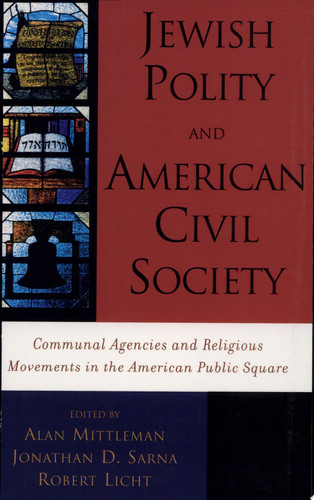
Jewish polity and American civil society: communal agencies and religious movements in the American public sphere

Alan Mittleman,Robert Licht,Jonathan D. Sarna
Jewish Polity and American Civil Society is a study of the civic and political engagements of American Jews as mediated by their communal and denominational institutions. The book explores how the various branches of the organized Jewish community seek to influence public affairs. Over the course of the last century, Jewish agencies and religious movements have tried to shape public debate and public policy on such issues as civil rights, church-state relations, and American foreign policy. The book sets the history of Jewish engagement in these areas into historical context; analyzes the motives, strategies, and tactics of various Jewish groups, and evaluates their successes and failures. The book also explores the underlying idea-the public philosophy-that informs American Jews' understanding of civic and political engagement.
Rowman & Littlefield 2002-07-23 420 pages

Navigating public opinion: polls, policy, and the future of American democracy

Professor of Sociology Jeff Manza,Jeff Manza,Fay Lomax Cook,Professor of Human Development and Social Policy in the School of Education and Social Policy Fay Lomax Cook,Benjamin I. Page,Gordon Scott Fulcher Professor of Decision Making in the Department of Political Science Benjamin I Page
Do politicians listen to the public? How often and when? Or are the views of the public manipulated or used strategically by political and economic elites? Navigating Public Opinion brings together leading scholars of American politics to assess and debate these questions. It describes how the relationship between opinion and policy has changed over time; how key political actors use public opinion to formulate domestic and foreign policy; and how new measurement techniques might improve our understanding of public opinion in contemporary polling and survey research. The distinguished contributors shed new light on several long-standing controversies over policy responsiveness to public opinion. Featuring a new analysis by Robert Erikson, Michael MacKuen, and James Stimson that builds from their pathbreaking work on how public mood moves policy in a macro-model of policymaking, the volume also includes several critiques of this model by Lawrence Jacobs and Robert Shapiro, another critique by G. William Domhoff, and a rejoinder by Erikson and his coauthors. Other highlights include discussions of how political elites, including state-level policymakers, presidents, and makers of foreign policy, use (or shape) public opinion; and analyses of new methods for measuring public opinion such as survey-based experiments, probabilistic polling methods, non-survey-based measures of public opinion, and the potential and limitations of Internet polls and surveys. Introductory and concluding essays provide useful background context and offer an authoritative summary of what is known about how public opinion influences public policy. A must-have for all students of American politics, public opinion, and polling, this state-of-the-art collection addresses issues that lie at the heart of democratic governance today.
Oxford University Press 2002 376 pages

Failing the future: a dean looks at higher education in the twenty-first century

Kolodny, Annette
Both revealing and compelling, Annette Kolodny’s Failing the Future: A Dean Looks at Higher Education in the Twenty-first Century is drawn from the author’s experience as a distinguished teacher, a prize-winning scholar of American literature, a feminist thinker, and an innovative administrator at a major public university. In chapters that range from the changing structure of the American family and its impact on both curriculum and university benefits policies to recommendations for overhauling the culture of decision making on campus, this former Dean of the College of Humanities at the University of Arizona explores the present state of higher education and offers a sobering view of what lies ahead. In this volume Kolodny explains the reasons for the financial crisis in higher education today and boldly addresses the challenges that remain ignored, including rising birthrates, changing demographics both on campus and across the country, the accelerating globalization of higher education and advanced research, and the necessity for greater interdisciplinarity in undergraduate education. Moreover, while sensitive to the complex burdens placed on faculty today, Kolodny nonetheless reveals how the professoriate has allowed itself to become vulnerable to public misperceptions and to lampooning by the media. Not simply a book about current problems and future challenges, Failing the Future is rich with practical solutions and workable programs for change. Among her many insights, Kolodny offers a thorough defense of the role of tenure and outlines a new set of procedures to ensure its effective implementation; she proposes a structure for an “Antifeminist Intellectual Harassment Policy”; and she provides a checklist of family-sensitive policies universities can offer their staff, faculty, and administrators. Kolodny calls on union leaders, campus communities, policymakers, and the general public to work together in unprecedented partnerships. Her goal, as she states in a closing coda, is to initiate a revitalized conversation about public education. This book should be required reading for all those concerned with the future of higher education in this country—from college trustees to graduate students entering the professoriate, from faculty to university administrators, from officers of campus-based unions to education policymakers.
Duke University Press 1998-03-18 298 pages

The paradox of American democracy: elites, special interests, and the betrayal of the public trust

Judis, John B.
John B. Judis, one of our most insightful political commentators, most rational and careful thinkers, and most engaged witnesses in Washington, has taken on a challenge that even the most concerned American citizens shrink from: forecasting the American political climate at the turn of the century. The Paradox of American Democracy is a penetrating examination of our democracy that illuminates the forces and institutions that once enlivened it and now threaten to undermine it. It is the well-reasoned discussion we need in this era of unrestrained expert opinions and ideologically biased testimony. The disenchantment with our political system can be seen in decreasing voter turnout, political parties co-opted by consultants and large contributors, the corrupting influence of "soft money," and concern for national welfare subverted by lobbying organizations and special-interest groups. Judis revisits particular moments -- the Progressive Era, the New Deal, the 1960s -- to discover what makes democracy the most efficacious and, consequently, most inefficacious. What has worked in the past is a balancing act between groups of elites --- trade commissions, labor relations boards, policy groups -- whose mandates are to act in the national interest and whose actions are governed by a disinterested pursuit of the common good. Judis explains how the displacment of such elites by a new lobbying community in Whashington has given rise to the cynicism that corrodes the current political system. The Paradox of American Democracy goes straight to the heart of every political debate in this country.
Pantheon Books 2000-02-15 305 pages

The militarization of Indian country

LaDuke, Winona
"When it became public that Osama bin Laden's death was announced with the phrase "Geronimo, EKIA!" many Native people, including Geronimo's descendants, were insulted to discover that the name of a Native patriot was used as a code name for a world-class terrorist. Geronimo descendant Harlyn Geronimo explained, "Obviously to equate Geronimo with Osama bin Laden is an unpardonable slander of Native America and its most famous leader." The Militarization of Indian Country illuminates the historical context of these negative stereotypes, the long political and economic relationship between the military and Native America, and the environmental and social consequences. This book addresses the impact that the U.S. military has had on Native peoples, lands, and cultures. From the use of Native names to the outright poisoning of Native peoples for testing, the U.S. military's exploitation of Indian country is unparalleled and ongoing."--Publisher's website.
Makwa Enewed 2012 92 pages

Lawfare: the war against free speech ; a first amendment guide for reporting in an age of Islamist lawfare

Goldstein, Brooke,Meyer, Aaron Eitan
The free speech rights of authors, researchers and journalists writing on issues of public security and national concern are increasingly under attack through both violent and non-violent means. An important non-violent challenge to free speech has emerged in the form of "Islamist lawfare," the use of the law as a weapon of war to silence and punish free speech about militant Islam, terrorism and its sources of financing. The strategic end of Islamist lawfare is to further the goals of the Islamist movement, one of which is to abolish public discourse critical of Islam and punish anything deemed blasphemous to its prophet, Mohammad. Another goal of Islamist lawfare is to impede the free flow of public information about the threat of Islamist terrorism, thereby limiting our ability to understand it and destroy it. In this way, Islamist lawfare takes the form of a complementary legal campaign to terrorism and asymmetric warfare. Written by two of America's experts in this field. Describes this phenomenon and gives practical guidance about navigating this new terrain to journalists who wish to speak truthfully about the national security threats we face.
Center for Security Policy 2011-11 240 pages

All in a Life-time

Morgenthau, Henry,Strother, French
"All in a Life-time" offers a rare and compelling glimpse into the world of early 20th-century diplomacy and United States foreign relations. Written by Henry Morgenthau and French Strother, this political memoir chronicles a distinguished career in public service. As a key figure during World War I, Morgenthau provides firsthand accounts and insightful observations on critical historical events. His experiences as an ambassador offer a unique perspective on the complexities of international relations and the challenges of representing the United States on the world stage. This meticulously prepared print republication allows readers to delve into the past and gain a deeper understanding of the historical context that shaped the 20th century. "All in a Life-time" remains a vital resource for anyone interested in biography, United States history, and the intricacies of public policy. Its enduring appeal lies in its timeless exploration of leadership, diplomacy, and the pursuit of a life dedicated to service. This work has been selected by scholars as being culturally important, and is part of the knowledge base of civilization as we know it. This work is in the public domain in the United States of America, and possibly other nations. Within the United States, you may freely copy and distribute this work, as no entity (individual or corporate) has a copyright on the body of the work. Scholars believe, and we concur, that this work is important enough to be preserved, reproduced, and made generally available to the public. We appreciate your support of the preservation process, and thank you for being an important part of keeping this knowledge alive and relevant.
Anson Street Press 2025-03-29 324 pages