1277 results for "Science"

100 people who are screwing up America

Goldberg, Bernard
The number one New York Times bestselling author of Bias delivers another bombshell—this time aimed at . . . 100 People Who Are Screwing Up America No preaching. No pontificating. Just some uncommon sense about the things that have made this country great—and the culprits who are screwing it up. Bernard Goldberg takes dead aim at the America Bashers (the cultural elites who look down their snobby noses at "ordinary" Americans) . . . the Hollywood Blowhards (incredibly ditzy celebrities who think they're smart just because they're famous) . . . the TV Schlockmeisters (including the one whose show has been compared to a churning mass of maggots devouring rotten meat) . . . the Intellectual Thugs (bigwigs at some of our best colleges, whose views run the gamut from left wing to far left wing) . . . and many more. Goldberg names names, counting down the villains in his rogues' gallery from 100 all the way to 1—and, yes, you-know-who is number 37. Some supposedly "serious" journalists also made the list, including the journalist-diva who sold out her integrity and hosted one of the dumbest hours in the history of network television news. And there are those famous miscreants who have made America a nastier place than it ought to be—a far more selfish, vulgar, and cynical place. But Goldberg doesn't just round up the usual suspects we have come to know and detest. He also exposes some of the people who operate away from the limelight but still manage to pull a lot of strings and do all sorts of harm to our culture. Most of all, 100 People Who Are Screwing Up America is about a country where as long as anything goes, as one of the good guys in the book puts it, sooner or later everything will go. This is serious stuff for sure. But Goldberg will also make you laugh as he harpoons scoundrels like the congresswoman who thinks there aren't enough hurricanes named after black people, and the environmentalist to the stars who yells at total strangers driving SUVs—even though she tools around the country in a gas-guzzling private jet. With Bias, Bernard Goldberg took us behind the scenes and exposed the way Big Journalism distorts the news. Now he has written a book that goes even further. This time he casts his eye on American culture at large—and the result is a book that is sure to become the voice of all those Americans who feel that no one is speaking for them on perhaps the most vital issue of all: the kind of country in which we want to live.
HarperCollins 2005-07-05 305 pages

Fighting Terrorism: How Democracies Can Defeat Domestic And International Terrorism

Netanyahu, Benjamin
Benjamin Netanyahu, the leader of Israels Likud Party & a noted authority on international terrorism, offers a compelling approach to understanding terrorism. He cites diverse examples to demonstrate that domestic terrorist groups are usually no match for an advanced technological society. But he sees a more potent threat from the new international terrorism, which is increasingly the product of Islamic militants, who draw their inspiration & directives from Iran & its growing cadre of satellite states. He advocates specific measures to combat them. An excellent road map to understanding terrorism — in moral, historical, & practical terms.
Diane Pub Co 1995-08-01 151 pages

Eupsychian Management: A Journal

Maslow, Abraham H.
This volume is a product of an informal, personal journal kept by Professor Maslow during his tenure of observation at a California electronics plant, a visit made at the invitation of the firm’s president. “I came there for no specific task or purpose, but I became very much interested in what was going on there for various reasons,” states Professor Maslow. It was the first time he had been confronted with an enlightened, modern management in a business firm. He began to take notes on the operation of the firm. As a theoretical-clinical-personality psychologist, he made suggestions concerning business and organization theory. This volume is composed of knowledge gained from the firm and from the general literature of an enlightened business management, and knowledge acquired through adopted suggestions by the author concerning business organization and theory.
Richard D. Irwin Publishing 1965 277 pages

What this comedian said will shock you

Maher, Bill
The hilarious and controversial host of HBO’s Real Time with Bill Maher has written his funniest, most opinionated, and most necessary book ever—a brilliantly astute and acerbically funny vivisection of American life, politics, and culture. Some of the smartest commentary about what’s happening in America is coming from a comedian—this comedian being Bill Maher. If you want to understand what’s wrong with this country, it turns out that one of the best informed and most thought-provoking analysts is this very funny pothead. The book was inspired by the “editorial” Bill delivers at the end of each episode of Real Time. These editorials are direct-to-camera sermons about culture, politics, and what’s happening in the world. To put this book together, Maher reviewed more than a decade of his editorials, rewriting, reimagining, and updating them, and adding new material to speak exactly to the moment we’re in. Free speech, cops, drugs, race, religion, the generations, cancel culture, the parties, the media, show biz, romance, health—Maher covers it all. The result is a hugely entertaining work of commentary about American culture in the tradition of Mark Twain, Will Rogers, and H. L. Mencken.
Simon & Schuster 2024-05-21 378 pages

The human use of human beings: cybernetics and society

Wiener, Norbert
"In 1950, mathematician-philosopher Norbert Wiener ended this classic book on the place of machines in society with a warning: "We shall never receive the right answers to our questions unless we ask the right questions.... The hour is very late, and the choice of good and evil knocks at our door." Wiener, the founder of the science of cybernetics--the study of the relationship between computers and the human nervous system--was widely mislabeled as an advocate for the automation of human life. As The Human Use for Human Beings reveals, his vision was much more complex and interesting, and is more relevant in today's world of AI than anyone could have anticipated. In his new introduction, Brian Christian aptly calls Wiener the "progenitor of contemporary AI-safety discourse." Wiener hoped that machines would release people from relentless and repetitive drudgery to achieve more creative pursuits, yet he anticipated the danger of dehumanizing and displacement. His pioneering views on the human-machine relationship as a "communicative process" are only more crucial now, as we carry in our pockets AI devices that we can literally speak to. His prescient warnings illuminate our contemporary relationships with language, art, and even social media. The Human Use of Human Beings examines the implications of cybernetics for education, law, language, science, technology, as Wiener anticipates the enormous impact--in effect, a third industrial revolution--that the computer has had on our lives."-- Provided by publisher
Mariner Classics 2025-08-12 240 pages

The spirit of green: the economics of collisions and contagions in a crowded world

Nordhaus, William D.
"From a Nobel Prize-winning pioneer in environmental economics, an innovative account of how and why "green thinking" could cure many of the world's most serious problems-from global warming to pandemics Solving the world's biggest problems-from climate catastrophe and pandemics to wildfires and corporate malfeasance-requires, more than anything else, coming up with new ways to manage the powerful interactions that surround us. For carbon emissions and other environmental damage, this means ensuring that those responsible pay their full costs rather than continuing to pass them along to others, including future generations. In The Spirit of Green, Nobel Prize-winning economist William Nordhaus describes a new way of green thinking that would help us overcome our biggest challenges without sacrificing economic prosperity, in large part by accounting for the spillover costs of economic collisions. In a discussion that ranges from the history of the environmental movement to the Green New Deal, Nordhaus explains how the spirit of green thinking provides a compelling and hopeful new perspective on modern life. At the heart of green thinking is a recognition that the globalized world is shaped not by isolated individuals but rather by innumerable interactions inside and outside the economy. He shows how rethinking economic efficiency, sustainability, politics, profits, taxes, individual ethics, corporate social responsibility, finance, and more would improve the effectiveness and equity of our society. And he offers specific solutions-on how to price carbon, how to pursue low-carbon technologies, how to design an efficient tax system, and how to foster international cooperation through climate clubs. The result is a groundbreaking new vision of how we can have our environment and our economy too"--
Princeton University Press 2021-05-18 355 pages

Stone age economics

Sahlins, Marshall David
Stone Age Economics is a classic study of anthropological economics, first published in 1974. As Marshall Sahlins stated in the first edition, "It has been inspired by the possibility of 'anthropological economics,' a perspective indebted rather to the nature of the primitive economies than to the categories of a bourgeois science." Ambitiously tackling the nature of economic life and how to study it comparatively, the book includes six studies which reflect the author's ideas on revising traditional views of the hunter-gatherer and so-called primitive societies, revealing them to be the original affluent society. The book examines notions of production, distribution and exchange in early communities and examines the link between economics and cultural and social factors. It consists of a set of detailed and closely related studies of tribal economies, of domestic production for livelihood, and of the submission of domestic production to the material and political demands of society at large. Marshall Sahlins is one of the most prominent American anthropologists of our time. He holds the title of Charles F. Grey Distinguished Service Professor of Anthropology at the University of Chicago. His most recent book is How Natives Think: About Captain Cook, for Example.
Transaction Publishers 2011 348 pages

Language City The Fight to Preserve Endangered Mother Tongues in New York

Ross Perlin
From the co-director of the Endangered Language Alliance, a captivating portrait of contemporary New York City through six speakers of little-known and overlooked languages, diving into the incredible history of the most linguistically diverse place ever to have existed on the planet Half of all 7,000-plus human languages may disappear over the next century and--because many have never been recorded--when they're gone, it will be forever. Ross Perlin, a linguist and co-director of the Manhattan-based non-profit Endangered Language Alliance, is racing against time to map little-known languages across the most linguistically diverse city in history: contemporary New York. In Language City , Perlin recounts the unique history of immigration that shaped the city, and follows six remarkable yet ordinary speakers of endangered languages deep into their communities to learn how they are maintaining and reviving their languages against overwhelming odds. Perlin also dives deep into their languages, taking us on a fascinating tour of unusual grammars, rare sounds, and powerful cultural histories from all around the world. Seke is spoken by 700 people from five ancestral villages in Nepal, a hundred of whom have lived in a single Brooklyn apartment building. N'ko is a radical new West African writing system now going global in Harlem and the Bronx. After centuries of colonization and displacement, Lenape, the city's original Indigenous language and the source of the name Manhattan ("the place where we get bows"), has just one fluent native speaker, bolstered by a small band of revivalists. Also profiled in the book are speakers of the Indigenous Mexican language Nahuatl, the Central Asian minority language Wakhi, and the former lingua franca of the Lower East Side, Yiddish. A century after the anti-immigration Johnson-Reed Act closed America's doors for decades and on the 400th anniversary of New York's colonial founding, Perlin raises the alarm about growing political threats and the onslaught of "killer languages" like English and Spanish. Both remarkable social history and testament to the importance of linguistic diversity, Language City is a joyful and illuminating exploration of a city and the world that made it.
Grove/Atlantic, Incorporated 2025-02-11 432 pages

ESSAYS OF MICHEL DE MONTAIGNE

MONTAIGNE, MICHEL DE
Essays of Michel de Montaigne, Volumes 2 and 3 Translated by Charles Cotton and edited by William Carew Hazlitt, these volumes of Michel de Montaigne's Essays delve into the human condition through a variety of thought-provoking topics. Volume 2 includes essays on subjects such as sorrow, idleness, and the nature of our affections. Volume 3 explores themes including the force of imagination, the punishment of cowardice, and the philosophical inquiry into death. Each essay offers a unique perspective on human nature, often drawing from Montaigne's personal reflections and classical sources.
Independently published 2024-06-16 115 pages

The three trillion dollar war: the true cost of the Iraq conflict

Stiglitz, Joseph E.
The true cost of the Iraq War is $3 trillion rather than the $50 billion projected by the White House. Apart from its tragic human toll, the Iraq War will be staggeringly expensive in financial terms. This sobering study by Nobel Prize winner Joseph E. Stiglitz and Harvard professor Linda J. Bilmes casts a spotlight on expense items that have been hidden from the U.S. taxpayer, including not only big-ticket items like replacing military equipment (being used up at six times the peacetime rate) but also the cost of caring for thousands of wounded veterans for the rest of their lives. Shifting to a global focus, the authors investigate the cost in lives and economic damage within Iraq and the region. Finally, with the chilling precision of an actuary, the authors measure what the U.S. taxpayer's money would have produced if instead it had been invested in the further growth of the U.S. economy. Written in language as simple as the details are disturbing, this book will forever change the way we think about the war.
W.W. Norton 2008-02-17 311 pages

The language of thought

Fodor, Jerry A.
In a compelling defense of the speculative approach to the philosophy of mind, Jerry Fodor argues that, while our best current theories of cognitive psychology view many higher processes as computational, computation itself presupposes an internal medium of representation. Fodor’s prime concerns are to buttress the notion of internal representation from a philosophical viewpoint, and to determine those characteristics of this conceptual construct using the empirical data available from linguistics and cognitive psychology.
The Harvester Press 1978 214 pages

The wires of war: technology and the global struggle for power

Helberg, Jacob
From the former news policy lead at Google, an urgent and groundbreaking account of the high-stakes global cyberwar brewing between Western democracies and the autocracies of China and Russia that could potentially crush democracy. From 2016 to 2020, Jacob Helberg led Google's global internal product policy efforts to combat disinformation and foreign interference. During this time, he found himself in the midst of what can only be described as a quickly escalating two-front technology cold war between democracy and autocracy. On the front-end, we're fighting to control the software--applications, news information, social media platforms, and more--of what we see on the screens of our computers, tablets, and phones, a clash which started out primarily with Russia but now increasingly includes China and Iran. Even more ominously, we're also engaged in a hidden back-end battle--largely with China--to control the Internet's hardware, which includes devices like cellular phones, satellites, fiber-optic cables, and 5G networks. This tech-fueled war will shape the world's balance of power for the coming century as autocracies exploit twenty-first-century methods to re-divide the world into twentieth century-style spheres of influence. Helberg cautions that the spoils of this fight are power over every meaningful aspect of our lives, including our economy, our infrastructure, our national security, and ultimately, our national sovereignty. Without a firm partnership with the government, Silicon Valley is unable to protect democracy from the autocrats looking to sabotage it from Beijing to Moscow and Tehran. The stakes of the ongoing cyberwar are no less than our nation's capacity to chart its own future, the freedom of our democratic allies, and even the ability of each of us to control our own fates, Helberg says. And time is quickly running out.
Avid Reader Press 2022 360 pages

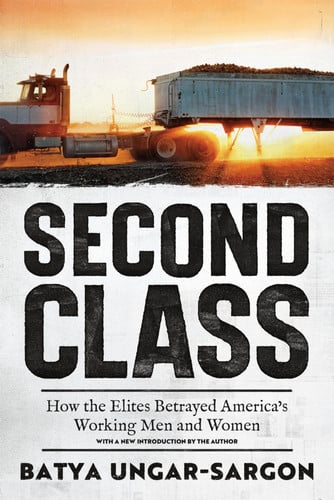
Second class: how the elite betrayed America's working men and women

Ungar-Sargon, Batya
A personal, journalistic ethnography of the modern American working class, based on the travels and interactions of the author through the American heartland. " Second Class is the most important book you will read all year. A political realignment is coming, and it's my hope that the end result will work in favor of our all-too-neglected American working class. When that realignment comes, Batya and her book will help lead the way." --Greg Lukianoff, CEO of the Foundation for Individual Rights in Education, and co-author of The Coddling of the American Mind Who is the American working class? Do they still have a fair shot at the American Dream? What do they think about their chances to secure the hallmarks of a middle-class life? While writing this book, Batya Ungar-Sargon visited states across the nation to speak with members of the American working class who are fighting tooth and nail to survive. In Second Class , working-class Americans of all races, political orientations, and occupations share their stories--cleaning ladies, health care aides, cops, truck drivers, fast food workers, electricians, and more. In their own words, these working-class Americans explain the struggles and triumphs of their increasingly precarious lives--as well as what policies they think would improve them. Second Class combines deep reporting with a look at the data and expert opinions on America's emergent class divide, in which the most basic elements of a secure and stable life are increasingly out of reach for those without a college education. America has broken its contract with its laboring class. So, how do we get back to the American Dream? How do we once again become the land of opportunity, the promised land, where hard work and commitment to family are enough to protect you from poverty? It's not that hard actually. All it would take, as this book illustrates, is for those in power to once again respect the dignity of work--and the American worker.
Encounter Books 2025 248 pages

Decolonising my body: a radical exploration of rituals and beauty

Hirsch, Afua
A 2023 POLITICAL BOOK OF THE YEAR (WATERSTONES) 'GROUND-BREAKING' Bernardine Evaristo ' UNIVERSAL AND TIMELY ' Elif Shafak ' IMPORTANT' Sathnam Sanghera ' A GENEROUS OFFERING ' Nana Darkoa Sekiyamah ' QUIETLY RADICAL' Evening Standard ' INTIMATE ' Guardian 'I LEARNT A LOT' Gillian Anderson What can ancestral practices teach us about how to live fuller lives today? Upon turning forty, Afua Hirsch had an encounter that forever altered her preconceived notions of ancestry and body image, making her question everything from body-modification rituals such as tattoos and piercings to the foundations of sexuality, as well as attitudes towards puberty, ageing and death. This book charts her year-long journey of radical unlearning. Bringing together global scholarship, on-the-ground reportage, personal anecdotes and interviews with beauty experts, practitioners and service users, she reassesses notions of body image beyond those of the colonial, patriarchal gaze. Decolonising My Body is a powerful excavation of the Eurocentric beauty standards that have long shaped how, in particular, those from the Global Majority are perceived and view themselves. Taking us from puberty to end-of-life, Hirsch shows us that the ways in which we adorn and present ourselves have spiritual implications and shape the possibilities we see for ourselves in the world. These insights and discoveries will empower you to reconnect with your own ancestry, better understand the link between beauty, history and (respectability) politics, and liberate yourself from mainstream standards and systems that aren't serving you. *Co-host of the LOYALTY podcast with Peter Frankopan*
Vintage 2025 240 pages

The Evolution of Fatherhood

Jeffrey Moussaieff Masson
Inspired by the wonder of his own parental experiences, former psychoanalyst and New York Times best-selling author Jeffrey Masson offers a remarkable look at one of the most fulfilling roles in the animal world: fatherhood. In The Evolution of Fatherhood , he explores the extraordinary dedication and behavior of nature's most outstanding dads. Discover the male emperor penguin incubating his egg through Antarctic blizzards, prairie dog dads teaching their pups vital life skills through play, and the South American tamarin monkey who actively "coaches" his mate through labor. Learn why wolves make devoted fathers, while their close relatives, dogs, often don't display the same level of paternal care. With captivating writing and impeccable research, Masson celebrates the unique and often surprising role males play in the lives of their young. He contrasts these heroes with nature's less involved fathers--like lions, langurs, and bears--and challenges the notion that paternal care is purely biological. Masson passionately demonstrates that for many animals, fatherhood is a profound, all-encompassing emotional experience. Compelling and inspirational, The Evolution of Fatherhood is a book that will forever change how you perceive parenthood, family bonds, and the rich emotional lives of the animals who share our world.
Histria Books 2024-02-06 242 pages

In the time of the nations

Lévinas, Emmanuel
The 'nations' of the title are the 'seventy nations': in the Talmudic idiom, the whole of humanity surrounding Israel. In this major collection of essays, Levinas considers Judaism's uncertain relationship to European culture since the Enlightenment, problems of distance and integration. It also includes five Talmudic readings from between 1981 and 1986, essays on Franz Rosenzweig and Moses Mendelssohn, and a discussion with Francoise Armengaud which raises questions of central importance to Jewish philosophy in the context of general philosophy. This work brings to the fore the vital encounter between philosophy and Judaism, a hallmark of Levinas's thought.
Indiana University Press 1994-01-08 197 pages

A project to find the fundamental theory of physics

Wolfram, Stephen
'In many ways it s the ultimate question in natural science: How does our universe work? Is there a fundamental theory? An incredible amount has been figured out about physics over the past few hundred years. But even with everything that s been done and it's very impressive - we still, after all this time, don t have a truly fundamental theory of physics.' The Wolfram Physics Project is a bold effort to find the fundamental theory of physics. It combines new ideas with the latest research in physics, mathematics and computation in the push to achieve this ultimate goal of science. Written with Stephen Wolfram's characteristic expository flair, this book provides a unique opportunity to learn about a historic initiative in science right as it is happening. A Project to Find the Fundamental Theory of Physics includes: The announcement of the project; A technical introduction; A history section that outlines the backstory which led Wolfram to this point; Background information from computational essays published by the author in 2015 and 2017; Foundational information, including historical notes and an excerpt from Wolfram's; 2002 New York Times Best Seller A New Kind of Science; Hundreds of beautiful full-colour visualisations. Stephen Wolfram is a distinguished scientist and best-selling author, and the creator of some of the world's most respected software systems, including Mathematica, Wolfram|Alpha and Wolfram Language. For more than 30 years he has been the CEO of the global technology company Wolfram Research.
Wolfram Media 2020 778 pages

The Political Philosophy of Hobbes

Strauss, Leo
In this classic analysis, Leo Strauss pinpoints what is original and innovative in the political philosophy of Thomas Hobbes. He argues that Hobbes's ideas arose not from tradition or science but from his own deep knowledge and experience of human nature. Tracing the development of Hobbes's moral doctrine from his early writings to his major work The Leviathan, Strauss explains contradictions in the body of Hobbes's work and discovers startling connections between Hobbes and the thought of Plato, Thucydides, Aristotle, Descartes, Spinoza, and Hegel.
University of Chicago Press 1984