152 results for "Trade"

Virginity or death! and other social and political issues of our time

Pollitt, Katha
“As this book, which is greater than the sum of its brilliant parts makes clear, Katha Pollitt, who is famously a feminist, is also a humorist, a moralist and a most hilarious, wise, and incisive observer.” –Victor Navasky, author of A Matter of Opinion Through presidential administrations Democratic and Republican, Katha Pollitt has observed and exposed the inconsistencies and illogic of those who stand in the way of progress solely to hold on to their power. In defense of human rights and equality, she assails the corrupt and educates the misguided with compassion, Swiftian wit, and complete literary authority. In this compelling collection, Pollitt skewers one hypocrite after another. She suggests, for example, that creationists be permitted to oppose the teaching of evolution only so long as they agree to forgo the benefits of the theory–such as flu vaccines. She gently wonders if those who denounced the decision to allow Terri Schiavo to die in peace would themselves be satisfied to be video-diagnosed by Senator Bill Frist. And in the title essay about fundamentalists’ antagonism toward sex education and STD prevention, she asks, “What is it with these right-wing Christians? Faced with a choice between sex and death, they choose death every time.” Pollitt is one of the most eloquent and persuasive voices in American political conversation of this or any other era, and Virginity or Death! Is a marvelous demonstration of her keen insight, mordant humor, and sense of justice. “Katha Pollitt has long and rightly been hailed for her brilliance, wit, and great insight into politics, social issues, and women’s rights. As with all of her work, I am enormously grateful for Virginity or Death!, and also deeply jealous.” –Anne Lamott, author of Traveling Mercies
Random House Trade Paperbacks 2006 265 pages

Reforming the international monetary system: from Roosevelt to Reagan

Hormats, Robert D.
This book examines the changed, and changing, international monetary system. It describes how the system has evolved under nine Presidents, from Franklin D. Roosevelt to Ronald Reagan. It also discusses the broader evolution of the world economy during this period, including the trade and investment issues to which international monetary policy is closely linked. The subjects are predominantly international but have a major impact on domestic economies. These international effects are why they should be of concern to most people. The dollar is viewed as both a national and an international money. The International Monetary Fund (IMF) is viewed as one vehicle to support sound domestic economic policies, ease the developing nations debt problem, and maintain currency rates that facilitate the orderly flow of finance and trade. The table of contents lists the following chapters: (1) "The Bretton Woods System"; (2) "Cracks in the System"; (3) "The Camp David Bombshell and the Move Toward Floating Rates"; (4) "Floating Rates"; (5) "The Oil Crisis, the Debt Crisis and IMF Conditionality"; and (6) "Reform of the Monetary System." An appendix which contains a summary of proposals for improving or reforming the international monetary system, discussion questions, a reading list, and a glossary also are included. (EH)
Foreign Policy Association 1987 79 pages

Trade with Japan: has the door opened wider?

Krugman, Paul R.
The realities of Japanese-U.S. trade and investment relations are clouded by mistrust, misinformation, and myth. In what way is the Japanese economic system different, and is it to be emulated or challenged? The contributors, from both the United States and Japan, explore Japanese trade patterns, market structure and trade, financial markets, and industrial and trade policy. Offering analysis of the issues, Trade with Japan is a valuable resource for economists, policymakers, and the business community.
University of Chicago Press 1991-01 339 pages

Temptations of a superpower

Steel, Ronald
America is the last remaining superpower. Yet what does this triumph mean when the challenges we face often defy military solutions? In Temptations of a Superpower , one of our most eloquent and incisive foreign policy analysts takes a hard look at this question, with all its implications for America's role in the post-Cold War world. Ronald Steel offers a devastating critique of a high-stakes game of foreign policy played by rules that no longer apply, and then proposes a more realistic--and pragmatic--view of the world and our place in it. The Cold War imposed a certain order on the world, giving us a secure sense of our enemies and allies, our interests and our mission. Steel paints a disturbing picture of the world now deprived of its ordering principle, where ethnic conflicts and national rivalries once held in check erupt in violence, where the shifting allegiances and fevered ambitions flout familiar strategies for keeping peace, conducting trade, and protecting human rights. He explores the history of our present predicament and explains the dangers of adapting outmoded but habitual policies to a new world whose shape is fast evolving. What, for instance, is the future of America's military, deeply embedded as it is in our culture and economy? If Wilsonian idealism, with its vision of converting the world to democracy, replaces anti-communism as the guiding principle behind foreign policy, how far should it take us? What distinctions should we make between our nearest neighbors and distant nations? How are we to balance economic needs and ethical imperatives? Analyzing the turmoil sweeping the world from China to Bosnia, Haiti to the Caucasus, Steel depicts the shattering dilemmas facing American policymakers. What concern should the United States have with many world quarrels? How can national interest be reconciled with strategic considerations and morality? When should domestic needs take precedence over foreign policy? The alternatives that Steel proposes to current policies defy much of the conventional wisdom and are certain to provoke controversy. He asks not only what America should do for the world, but what it must do for itself. Reminding us that foreign and domestic policy are inseparable, Steel argues that a renewed foreign policy must address not only changes in the world order, but the pressing, unmet needs within America itself.
Harvard University Press 1995 144 pages

Forbidden Grounds: the case against employment discrimination laws

Epstein, Richard Allen
This timely and controversial book presents powerful theoretical and empirical arguments for the repeal of the anti-discrimination laws within the workplace. Richard Epstein demonstrates that these laws set one group against another, impose limits on freedom of choice, unleash bureaucratic excesses, mandate inefficient employment practices, and cause far more invidious discrimination than they prevent. Epstein urges a return to the now-rejected common law principles of individual autonomy that permit all persons to improve their position through trade, contract, and bargain, free of government constraint.
Harvard University Press 1992 530 pages

The paradox of American democracy: elites, special interests, and the betrayal of the public trust

Judis, John B.
John B. Judis, one of our most insightful political commentators, most rational and careful thinkers, and most engaged witnesses in Washington, has taken on a challenge that even the most concerned American citizens shrink from: forecasting the American political climate at the turn of the century. The Paradox of American Democracy is a penetrating examination of our democracy that illuminates the forces and institutions that once enlivened it and now threaten to undermine it. It is the well-reasoned discussion we need in this era of unrestrained expert opinions and ideologically biased testimony. The disenchantment with our political system can be seen in decreasing voter turnout, political parties co-opted by consultants and large contributors, the corrupting influence of "soft money," and concern for national welfare subverted by lobbying organizations and special-interest groups. Judis revisits particular moments -- the Progressive Era, the New Deal, the 1960s -- to discover what makes democracy the most efficacious and, consequently, most inefficacious. What has worked in the past is a balancing act between groups of elites --- trade commissions, labor relations boards, policy groups -- whose mandates are to act in the national interest and whose actions are governed by a disinterested pursuit of the common good. Judis explains how the displacment of such elites by a new lobbying community in Whashington has given rise to the cynicism that corrodes the current political system. The Paradox of American Democracy goes straight to the heart of every political debate in this country.
Pantheon Books 2000-02-15 305 pages

David Thompson

James K. Smith
Surveyor, fur-trader and explorer, David Thompson was the first European to descend the Columbia River from its source to its mouth. A partner in the North West Company, Thompson explored western Canada exhaustively, and the maps he produced became the basis for many future maps of the region. Thompson first came to Canada in 1784 as a clerk for the Hudson's Bay Company. He spent several years gaining knowledge of the fur trade, making extensive expeditions and learning the ways of the aboriginal peoples. After learning the use of sextant, chronometer, telescope, compass and nautical almanac, surveying became his primary interest. He explored new territory whenever possible, keeping detailed journals of his bearings and weather conditions, and charted all of his journeys.
Fitzhenry & Whiteside 2003 64 pages

51st state?

Altman, Dennis
Australian prime ministers since Harold Holt have all fostered close relationships with the United States, but John Howard has initiated economic and military policies that have bound the two countries even tighter. As a result, many Australians now believe that not only our sovereignty but also our very identity as a nation is under threat, and that we are fast becoming America's 51st state. If this view is correct, it should be reflected not only in our foreign policy but also in our domestic policies. Indeed, the weakening of social safety nets, the privatisation of areas long seen as government responsibilities, and the signing of the Free Trade Agreement all point to the triumph of US-style neo-liberalism. Yet, as Dennis Altman shows, the story is not so simple. Even as official rhetoric immerses us ever deeper into the US worldview, the resilience of the Australian social contract is imposing real limits on the application of neo-liberal principles. And, despite his enthusiastic membership of the coalition of the willing, Howard has assiduously cultivated economic and political ties within our region which, as the global balance of power shifts, will become increasingly relevant. In this elegant and sophisticated meditation on Australian identity, Altman suggests that the tendency to attribute malign American influence to everything we dislike about the contemporary world is the flipside of seeing the US as the only model worthy of emulation, and serves to conceal the deeper questions we face namely, how does Australia imagine its future?
Scribe Short Books 2006 136 pages

The Other 1492 Jewish Settlement in the New World

Norman H. Finkelstein
Mention 1492 and most people conjure up images of three stout ships making their way west. But 1492 was the year in which the vibrant Jewish community of Spain came to an abrupt and tragic end. This book details the expulsion of the Jews from Spain and Portugal and their early immigration to the New World. European anti-Semitism followed the Jews but the newcomers persevered and made a home for themselves in the New World. Starred Review and Editor’s Choice, Booklist, NCCS/CBC Notable Children’s Trade Book and American Bookseller Pick of the Lists, 1990.
iUniverse 2001-01-11 116 pages

The transformational decade: snapshots of a decade from 9/11 to the Obama presidency

London, Herbert I.
"The Transformational Decade shows the transformation that took place in American life from the attack on the World Trade Center to the emergence of the Obama presidency. It is not a strict history, but rather snapshots of a decade that has fundamentally altered perceptions of the United States. In some respects, this book is modeled after Frederick Lewis Allen's Only Yesterday and Since Yesterday, acclaimed books that sought to capture the spirit of the 1920s and '30s. London sees the period from 2001 to 2008 as "post yesterday," a period that broke with the past, challenged the essence of the free market, and contested America's role on the world stage. In an effort to limn these snapshots from recent history, London has written several "decade" books: The Overheated Decade, The Counterfeit Decade, and The Decade of Denial. This book, The Transformational Decade, differs in that it represents a separation from the past. London illuminates a decade that he considers to be a new and more frightful period than any in recent American history."--Publisher's website.
University Press of America, Inc 2012-05-14 177 pages

Basketball Belles How Stanford, Cal, and One Scrappy Player Put Womens Hoops on the Map

Sue Macy
Witness the birth of women's basketball in this illustrated introduction from renowned nonfiction author Sue Macy. Raised on a cattle ranch, Agnes Morley was sent to Stanford University to learn to be a lady. But she soon exchanged her breeches and spurs for bloomers and a basketball—and in April 1896, she made history. In a heart-pounding game against the University of California at Berkeley, Agnes led her team to victory in the first-ever inter-collegiate women's basketball game, earning national attention and putting women's basketball on the map. This fast-paced story of perseverance and success digs deep into the history of one of America's most popular sports, and how it came to be so big. Realistic illustrations by Matt Collins put readers in the middle of the action, and you'll want cheer along with the crowd. With comprehensive backmatter including a timeline, author's note, select bibliography, and recommended places to visit for more information, Basketball Belles is a perfect introduction to an intriguing moment in sports and women's history. A Junior Library Guild Selection Booklist Top 10 Sports Books for Youth Booklist Editors' Choice, Books for Youth, Nonfiction, Middler Readers NCSS Notable Social Studies Trade Books for Young People, History/Life & Culture in the Americas
Holiday House 2019-05-28 32 pages

Unlocking the Middle East: the writings of Richard Falk

Falk, Richard A.
This volume explores the trade in television programme formats, which is a crucially important ingredient in the globalization of culture, in Asia. It examines how much traffic there is in programme formats, the principal direction of flow of such traffic, and the economic and cultural significance of this trade for the territories involved and for the region as a whole. It shows how new technology, deregulation, privatization and economic recession have greatly intensified competition between broadcasters in Asia, as in other parts of the world, and discusses how this in turn has multiplied the incidence of television format remakes, with some countries developing dedicated format companies and others becoming net importers and adapters of formats.
Arris 2003 305 pages

Leo Melamed: escape to the futures

Melamed, Leo
Acclaim for Leo Melamed Escape to the Futures "A well-written, fascinating memoir of a remarkable man of many parts, who arrived in the United States at age 9, fleeing the Holocaust. Almost single-handedly, he transformed a minor commodity exchange into the leading futures market in the world. His influence was and remains worldwide." —Milton Friedman Senior Research Fellow Hoover Institution, Stanford University "There are only a few people who have revolutionized big portions of the business world. Warren Buffett did it in investing, Bill Gates in software. Leo Melamed, author of this book, is in that same league. He truly revolutionized futures trading in the United States, and in the world. This book tells how." —Ambassador Clayton Yeutter Past President of the Chicago Mercantile Exchange Former U.S. Trade Representative "A grizzled old Merc trader once assured me that nobody ever lost by being long on Leo. Why that's so, this endlessly fascinating personal history makes clear. It shows how an immigrant boy, after surviving unimaginable horrors, drew on the 'elan, combativeness, and sophisticated conviction' learned from his equally remarkable father to build the CME and to lay the foundations of the modern, Chicago-based, financial services industry." — Merton H. Miller 1990 Nobel Laureate Emeritus Professor University of Chicago Graduate School of Business "Leo tells it all. To say there would not have been a financial futures industry without Leo is probably only a slight exaggeration!!!" — John Damgard President Futures Industry Association "Escape to the Futures tells the remarkable story of a young boy's escape from the Nazis and the impact of his life on the financial markets of the world. It also serves as yet another poignant reminder of the immeasurable losses —in the arts, sciences, professions, and everyday life—humanity suffered because of the Holocaust." — Benjamin Meed President American Gathering of Jewish Holocaust Survivors He is one of the most powerful figures in the world of finance—a visionary who pioneered the modern futures industry and launched the International Monetary Market (IMM). Yet, Leo Melamed was not born to wealth and influence. His is an extraordinary rags-to-riches tale of intelligence, drive, savvy, timing, and the overpowering force of a uniquely charismatic personality. Now the inside story of the remarkable life and career of Leo Melamed is revealed in this long-awaited autobiography. A Holocaust survivor, Leo Melamed had barely begun the first grade in 1939 when he and his parents fled their native Poland one step ahead of the oncoming Nazi juggernaut. Crossing Siberia en route to a brief stay in Japan—just months before Pearl Harbor—the family arrived in the United States to begin life anew. They settled in Chicago, where young Leo became a product of the inner city and embraced his new country and its culture. Seeking part-time employment while attending law school, Leo Melamed answered a classified ad that would change his life. Hired by what he presumed was a law firm named Merrill, Lynch, Pierce, Fenner & Bean, he found himself on the floor of the Chicago Mercantile Exchange. "I was Alice stepping through the Looking Glass into a world of not just one Mad Hatter, but hundreds. The shouting among the traders, the movement of their bodies and hands, captivated me like nothing before . . . there was a life force on that floor that was magical and exciting, and though I didn't understand what was going on, I wanted to be a part of it." Leo Melamed became much more than just a part of it. From modest beginnings as a pork belly trader, he led the Chicago Merc for the next quarter of a century, introducing finance to an industry that was the exclusive domain of agriculture. As his reputation as a financial genius grew, so did the tales of his larger-than-life personality. In Leo Melamed: Escape to the Futures, you'll meet the man behind the legend. Written with the assistance of award-winning journalist Bob Tamarkin, this enthralling memoir deftly weaves intimate personal details with behind-the-scenes accounts of some of the most momentous financial events of our century—including Leo's role as advisor to the White House after the Hillary Rodham Clinton cattle futures trading episode. You'll read fascinating accounts of his dealings with political powerhouses like Bob Dole, Tip O'Neill, Dan Rostenkowski, and others. Offering penetrating insights into the workings of a multibillion dollar industry, this is a story that has as much to say about human nature as it does about the nature of today's markets. Hailed as both hero and tyrant, Leo Melamed is undeniably one of the most colorful and intriguing personalities of our time. This intimate, revealing personal account is not to be missed.
John Wiley & Sons 1996-05-02 463 pages

Yankee go home? Canadians and anti-Americanism

Granatstein, J. L.
Whether it is resentment over trade barriers, fear of cultural domination, disapproval of U.S. foreign policy, or merely old-fashioned jealousy of a more powerful neighbour, Canadians have made excellent anti-Americans. Yankee Go Home? traces the winding course of this feeling over two centuries - from the United Empire Loyalists who fled north to escape unbridled republicanism, through the early twentieth century when the barons of business were determined to keep out U.S. competition, to the post-war period when Canadian nationalists took up the cry. Granatstein maintains that what began as a justifiable fear of invasion eventually became a tool of the economic and political elites bent on preserving their power. At first, anti-Americanism was largely the Tory way of keeping pro-British attitudes uppermost in the minds of Canadians. Later, with the right wing embracing the free-trade deal, it became the most important weapon of the nationalist left. Today, anti-Americanism is weaker than ever before. And what of the future? Will we inevitably become more "American" in spite of ourselves? Can we even agree on what being "Canadian" means?
HarperCollins 1996 317 pages

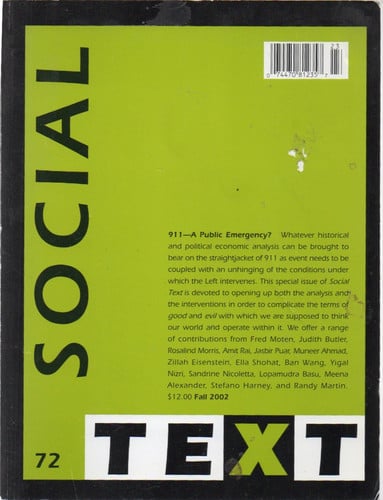
911 a Public Emergency?

Brent Hayes Edwards,Stefano Harney,Randy Martin,Ella Shohat,Timothy Mitchell,Fred Moten
Since September 11, public discourse has often been framed in terms of absolutes: an age of innocence gives way to a present under siege, while the United States and its allies face off against the Axis of Evil. This special issue of Social Text aims to move beyond these binaries toward thoughtful analysis. The editors argue that the challenge for the Left is to develop an antiterrorism stance that acknowledges the legacy of U.S. trade and foreign policy as well as the diversity of the Muslim faith and the dangers presented by fundamentalism of all kinds. Examining the strengths and shortcomings of area, race, and gender studies in the search for understanding, this issue considers cross-cultural feminism as a means of combating terrorism; racial profiling of Muslims in the context of other racist logics; and the homogenization of dissent. The issue includes poetry, photographic work, and an article by Judith Butler on the discursive space surrounding the attacks of September 11. This impressive range of contributions questions the meaning and implications of the events of September 11 and their aftermath. Contributors . Muneer Ahmad, Meena Alexander, Lopamudra Basu, Judith Butler, Zillah Eisenstein, Stefano Harney, Randy Martin, Rosalind C. Morris, Fred Moten, Sandrine Nicoletta, Yigal Nizri, Jasbir K. Puar, Amit S. Rai, Ella Shohat, Ban Wang
Duke University Press 2002-09-20 208 pages

The Washington diaries, 1981-1989

Gotlieb, Allan
Canada’s legendary ambassador to the United States reveals his personal diaries from his time in Washington, from 1981 to 1989. Allan Gotlieb was ambassador to the United States during a high point in U.S.-Canada relations, the Reagan and Mulroney eras. One of our country’s most effective diplomats, he was renowned for forging inside connections to the capital’s key decision-makers, and as he has said, “In Washington, gossip is not gossip — gossip is intelligence.” Gotlieb kept a diary almost daily during his time in Washington, and its entries are filled with anecdotes about meetings and parties with the capital’s social, media, and political elite. Katharine Graham, Jesse Helms, and Sandra Day O’Connor are just a few who appear in its pages, as are such Canadian visitors as Jean Chrétien, Joe Clark, and even Wayne Gretzky. With frankness and self-deprecating wit, Gotlieb recounts the absurdities and pretensions of life in Washington and his fight to make Canada’s voice heard. His diaries chronicle not only the major international issues of the time — such as the forging of the Free Trade Agreement — but also his own growth from Washington outsider to sophisticated power-broker.
McClelland & Stewart 2006-11-28 649 pages