2501 results for "American History"

The Once and Future Spy

Littell, Robert
By national best-selling author, Robert Littell, whose most recent novel The Company received rave reviews across the nation, The Once and Future Spy is finally back in print. This is Littell at the top of his form, constructing a tale of espionage and counterespionage revealing the dirty tricks and dangerous secrets about the subjects he knows intimately the CIA and American history, past and present. Littell proves beyond all doubt that he is a storyteller of inimitable caliber. As Stephen Coonts put it, “Eric Ambler invented the modern spy novel. Robert Littell perfected it. The Once and Future Spy is a classic spy story.” At the center of Littell’s plot is an elite plan, so secret and so dangerous that its existence is known only to a tiny group of specialists within CIA headquarters. There is virtually no paper trail but, somehow, the plan has sprung a leak. The plotters must urgently trace it or face deadly consequences. Meanwhile, at work elsewhere on another highly sensitive project for "the Company" is an operative known as “the Weeder” a man obsessed with American history and one of its heroes. When the Weeder's and Washington's clandestine worlds collide, the present faces the past and disturbing moral choices are weighed against a shining patriotic dream. What is the truth? Whose truth should be believed?
The Overlook Press 2003-02-10 294 pages

Strangeland: how Britain stopped making sense

Sopel, Jon
From Jon Sopel, bestselling author and presenter of hit podcast The News Agents , comes an incisive examination of post-Brexit Britain and what it means for our future. 'I like and trust Jon Sopel and you should too' JOE LYCETT 'A thrilling, nerve-wracking book. You couldn't make the last ten years up; thanks to Jon Sopel, you don't have to' PETER FRANKOPAN 'A hugely entertaining and quite traumatic rollercoaster' ARMANDO IANNUCCI 'Acute and unflinching - Sopel deploys his foreign correspondent skills on home shores as well as far ones, and brings together the story of a tumultuous few years on both sides of the Atlantic' MISHAL HUSAIN Returning to the UK in some ways has been disconcerting - or maybe discombobulating would be a better word. It is, after all, my home; it is where I grew up, a country I love and am proud of. But either it' s changed, or I have. Maybe both. It just feels like a strange land. After eight years of political reporting in the US, Jon Sopel returned home to the UK to find a very different place than the one he left. In his first book since launching the global hit podcast The News Agents , Jon explores what has happened to the country he once knew. Either Britain has changed dramatically, or he has. Perhaps it' s both. As a second Trump administration begins, and a new chapter of American history exerts its influence over our own isle, Strangeland paints an unforgettable portrait of a country gone through the looking glass.
Ebury Press 2025-05-29 352 pages

Leading from the Center Why Moderates Make the Best Presidents

Gil Troy
George Washington, Abraham Lincoln, Theodore Roosevelt, Franklin Delano Roosevelt, John F. Kennedy-most would agree their presidencies were among the most successful in American history. But what made these very different men such effective leaders? According to presidential historian Gil Troy, these presidents succeeded not because of their bold political visions, but because of their moderation. Although many of the presidential hopefuls for 2008 will claim to be moderates, the word cannot conceal a political climate defined by extreme rhetoric and virulent partisanship. InLeading From the Center, Gil Troy argues that this is a distinctlyun-American state of affairs. The great presidents of American history have always sought a golden mean-from Washington, who brilliantly mediated between the competing visions of Thomas Jefferson and Alexander Hamilton, to Lincoln, who rescued the Union with his principled pragmatism, to the two Roosevelts, who united millions of Americans with their powerful, affirmative, nationalist visions. As America lines up to select a president for the future, Gil Troy astutely reminds us of the finest traditions of presidential leadership from our nation’s past.
ReadHowYouWant.com 2009-11-04 316 pages

Enhancing government: federalism for the 21st century

Chemerinsky, Erwin
Federalism—the division of power between national and state governments—has been a divisive issue throughout American history. Conservatives argued in support of federalism and states' rights to oppose the end of slavery, the New Deal, and desegregation. In the 1990s, the Rehnquist Court used federalism to strike down numerous laws of public good, including federal statutes requiring the clean up of nuclear waste and background checks for gun ownership. Now the Roberts Court appears poised to use federalism and states' rights to limit federal power even further. In this book, Erwin Chemerinsky passionately argues for a different vision: federalism as empowerment. He analyzes and criticizes the Supreme Court's recent conservative trend, and lays out his own challenge to the Court to approach their decisions with the aim of advancing liberty and enhancing effective governance. While the traditional approach has been about limiting federal power, an alternative conception would empower every level of government to deal with social problems. In Chemerinsky's view, federal power should address national problems like environmental protection and violations of civil rights, while state power can be strengthened in areas such as consumer privacy and employee protection. The challenge for the 21st century is to reinvent American government so that it can effectively deal with enduring social ills and growing threats to personal freedom and civil liberties. Increasing the chains on government—as the Court and Congress are now doing in the name of federalism—is exactly the wrong way to enter the new century. But, an empowered federalism, as Chemerinsky shows, will profoundly alter the capabilities and promise of U.S. government and society.
Stanford Law Books, an imprint of Stanford University Press 2008-05-22 299 pages

American Quartet

Warren Adler
Detective Fiona Fitzgerald is an unlikely force for justice in Washington D.C's predominantly male police force. As a Senator's daughter and top investigator in the homicide division of the Metropolitan Police Department, Fiona maneuvers between two vastly different worlds, moving quickly from opulent State galas to gritty crime scenes. Born into the elite social circles of the nation's capital, and armed with intimate knowledge of the true face of the political establishment, Fiona is determined to expose the chicanery concealed within the highest echelons of the American political aristocracy. When a string of inexplicable murders rocks the hallowed streets of central D.C., Fiona finds herself charging through shadows of a mysterious conspiracy. Faced with an investigation with no leads and a rising body count, Fiona's reputation as top investigator of the Homicide Division is called into question. At the brink of professional ruin, an encounter with the eccentric yet charismatic Thaddeus Remington III at his museum-like mansion sends Fiona hurtling headlong through a whirlwind of clues. Where once the desperate detective blundered through traceless footsteps of a triple murderer, the answers to her case now seem to be whispered from bloodstained graves of fallen Presidents. Fiona stands ready, her finger on the trigger, as an assassination plot decades in the making is about to change history forever. American Quartet is the first book in the Fiona Fitzgerald mystery series.
CreateSpace Independent Publishing Platform 2016-05-09 378 pages

The Reader of Gentlemen's Mail

David Kahn
One of the most colorful and controversial figures in American intelligence, Herbert O. Yardley (1889-1958) gave America its best form of information, but his fame rests more on his indiscretions than on his achievements. In this highly readable biography, a premier historian of military intelligence tells Yardley's story and evaluates his impact on the American intelligence community. Yardley established the nation's first codebreaking agency in 1917, and his solutions helped the United States win a major diplomatic victory at the 1921 disarmament conference. But when his unit was closed in 1929 because "gentlemen do not read each other's mail," Yardley wrote a best-selling memoir that introduced-and disclosed-codemaking and codebreaking to the public. David Kahn de-scribes the vicissitudes of Yardley's career, including his work in China and Canada, offers a capsule history of American intelligence up to World War I, and gives a short course in classical codes and ciphers. He debunks the accusations that the publication of Yardley's book caused Japan to change its codes and ciphers and that Yardley traitorously sold his solutions to Japan. And he asserts that Yardley's disclosures not only did not hurt but actually helped American codebreaking during World War II.
Yale University Press 2011-03-08 368 pages

Whose Torah? a concise guide to progressive Judaism

Alpert, Rebecca T.
Rabbi Rebecca Alpert is a leading voice in progressive Judaism. A crusader for reform within the Jewish community, she was one of the first women in Jewish history to be ordained a rabbi. Alpert is a celebrated teacher, an expert on Jewish American religious history, and a key public advocate for progressive social issues in contemporary Jewish life. In Whose Torah?, Alpert sketches a compelling portrait of the progressive values that belong to the core of Judaism today. Reaching deeply into the sources of Jewish tradition, she highlights with unflinching moral clarity the textual basis for a truly just vision of life for all who care about sexual, economic, and racial justice and for those who would oppose all forms of discrimination, unjust war, and the destruction of the environment. Alpert also carefully considers what it means to be Jewish in contemporary America―offering both a passionate and deeply learned defense of progressive Jewish identity. Whose Torah? will be an essential intellectual resource for progressive Jews and for anyone searching for the religious underpinnings of contemporary progressive politics. Elaine Pagels, Harrington Spear Paine Foundation Professor of Religion at Princeton University, is the author of numerous, widely acclaimed books on Gnosticism and early Christianity, including The Gnostic Gospels, Beyond Belief, and Reading Judas.
New Press 2008-06-01 164 pages

Woody Guthrie: a life

Klein, Joe
Perhaps now best known as an acclaimed (and bestselling) author of fiction, Joe Klein has for nearly three decades been one of contemporary journalism's premiere reporters. In "Woody Guthrie: A Life", Klein's signature style of insightful narrative nonfiction brings to life a vivid chapter in the history of American culture. In 1998, the Woody Guthrie Foundation made public for the first time more than 10,000 of his papers, letters, song lyrics, and artworks, sparking renewed interest in the life of an American folk legend who influenced generations of musicians to come. The New York Times, reporting on the phenomenon, described Guthrie's appeal and legacy succinctly: "(Woody Guthrie was) one of the most influential cultural figures of the century. Guthrie inspired Bob Dylan and virtually created the modern folk tradition and singer-songwriter genre, and his music remains as vital today as when he was performing". Born in Oklahoma in 1912, Guthrie spent his early years among the farmers and migrant workers of the dust bowl. As a young man during the Great Depression, he traveled across the country by boxcar with his guitar, composing the indelible folk ballads that made him a leader of the politically vital folk movement of the pre-war era. Tragically, the onset of Huntington's disease, gradually diminished his mind, body, and work, and led to his untimely death at the age of 55. Still, Guthrie's life and music have inspired every important folk and folk rock artist since, from Pete Seeger, Bob Dylan, and Joan Baez to Bruce Springsteen, Billy Bragg, and Ani DiFranco.
Ballantine 1986 493 pages

My life is in your hands ; &, Take my life: the autobiographies of Eddie Cantor

Cantor, Eddie
A giant in the history of American entertainment, Eddie Cantor (1892-1964) won over the American public time and time again, first on stage, bowling audiences over in the Ziegfeld Follies, then in films, on the radio, and on television. His career ran from Vaudeville to video making all stops in between. A tireless person even when not on the stage, Cantor helped found the March of Dimes, and was the first national president of the Screen Actor's Guild (SAG), the American Federation of Radio Artists (later AFTRA), and the Jewish Theatrical Guild. Yet another medium in which Cantor succeeded was print. He authored and co-authored several books that upheld his standing as one of America's leading comedians. My Life Is In Your Hands & Take My Life combines for the first time in a single volume two memoirs written in 1928 and 1957, in which Eddie remembers his beginnings as an orphan on the Lower East Side and his hard-won climb from poverty to the bright lights of Broadway. The book also contains a lost chapter in which Eddie recalls his reactions to the stock market crash of 1929, along with a new complete index, discography, and filmography. In My Life Is In Your Hands & Take My Life, Cantor's humor is as sharp as ever and his sentiment is 100% genuine. While not at all modest about his decades of public adoration, Cantor shows a willingness to laugh at his blunders (such as his second film, "Special Delivery"), and to praise the many talented people with whom he collaborated. Along with telling the story of show business in the first half of the 20th century, Cantor also lets readers in on fond stories of his friends, from Jimmy Durante (who worked as a pianist in the Coney Island restaurant where Cantor was a singing waiter), to Ziegfeld alumni Will Rogers and W. C. Fields, to fellow entertainers Clara Bow and Fanny Brice.
Cooper Square Press 2000-06 319 pages

Negative space: Manny Farber on the movies

Farber, Manny
Manny Farber, one of the most important critics in movie history, championed the American action film-the bravado of Howard Hawks, the art brut styling of Samuel Fuller, the crafty, sordid entertainments of Don Siegel-at a time when other critics dismissed the genre. His witty, incisive criticism later worked exacting language into an exploration of the feelings and strategies that went into low-budget and radical films as diverse as Michael Snow's Wavelength, Werner Herzog's Fata Morgana, and Chantal Akerman's Jeanne Dielman. Expanded with an in-depth interview and seven essays written with his wife, artist Patricia Patterson, Negative Space gathers Farber's most influential writings, making this an indispensable collection for all lovers of film". --Publisher.
Da Capo Press 1998 412 pages

Philharmonic: a history of New York's orchestra

Shanet, Howard
In this book the author traces the history of America's oldest symphonic organization down to the beginning of Pierre Boulez's conductorship. Against the background of changing cultural patterns of American life over a century and a quarter, the author examines interactions between the New York Philharmonic and the society in which it functioned. There are colorful personality portraits, often tied to surprising reappraisals of such glamorous Philharmonic stars as Arturo Toscanini (who enjoined other conductors to play every note "as written," but who felt free - as the author documents - to make his own changes to the scores of the masters), Gustav Mahler, Dimitri Mitropoulos, Leopold Stokowski, Bruno Walter, and the spectacular Leonard Bernstein. The author gives the reader insight into an organization that has helped shape America's musical taste - an organization that has brought its performances to the largest audiences in the annals of symphonic music, yet has often suffered from "the vast, and largely unjustified, inferiority complex that has oppressed American music throughout its history."
Doubleday 1975 788 pages

The drawings of the Florentine painters

Berenson, Bernard
This monumental work, Drawings of Florentine Painters by Bernard Berenson, was named in 2013 by Thames & Hudson one of the "books that shaped art history". Berenson was an influential American art historian of the late 19th and 20th centuries. He specialized in Renaissance Art and was a major force in building the US market for paintings by the Old Masters. American collectors of the time regarded Berenson as the ultimate Renaissance art authority. If he judged a painting authentic, its value was greatly increased. Originally published in 1938, and significantly revised and enlarged by the author in several subsequent editions, the 1970 publication by University of Chicago Press, Chicago and London, consists of three volumes. (Heavy 4tos 11 1/4" x 8 7/8". Dark blue cloth stamped in gilt. In slipcase. No dust jackets issued.) Some of the Florentine artists covered in the three volumes are: da Vinci, Michelangelo, Albertinelli, Angelico, Gozzoli, Uccello, Verrocchio, Filippo, Botticelli, Lippi, Garbo, Carli, di Cosimo, Bartolommeo, Falconi, Cungi, del Sarto, Pontormo, Rosso, Manfredi, Rosselli, and Artetino. The first volume, Text (xiv, 367 pp; 12 chapters, 15 appendices), consists of Berenson's description and analysis -- using his own critical method and assumptions -- of the work of the artists. His unique and controversial method grouped paintings according to how he considered the artist handled critical aspects, such as surface texture (labeled "tactile imagination" by Berenson) or the weight and volume of any painted figures. Volume 2, Catalogue (xii, 388 pp.), is an illustrated presentation of works by the Italian painters. Volume 3, Illustrations (400+pp., 1109 plate figures and index), includes illustrated plates of the artists' work, first published by John Murray, and in a limited edition by E. P. Dutton, in 1903. While Berenson published other works, in his lifetime, Drawings of Florentine Painters is considered his masterpiece.
University of Chicago Press 1970 420 pages

Slave law in the American South: State v. Mann in history and literature

Tushnet, Mark V.
Product Description Slavery in the American South could not have existed without the authority of law defining slaves as the property of their masters. But the fact that slaves were also human beings placed limits on this harsh reality. When the rigor of the law and the complex bonds of sentiment linking master and slave came into conflict, masters looked to the courts. In one such case, State v. Mann, North Carolina Supreme Court justice Thomas Ruffin ruled that masters could not be prosecuted for assaulting their slaves. In articulating the legal basis for his decision, Justice Ruffin also revealed his own view of the "logic of slavery," in which he sanctioned the owner's rights even as he expressed his own horror at the mistreatment of the slave. Mark Tushnet, one of the foremost living authorities on antebellum slave law, now shows how studying such a simple case can illuminate an entire society. For those who detested slavery, the case represented all that was intolerable about that institution; for those who defended it, it raised vexing and persistent issues that could not be wished away. As further testament to the importance of State v. Mann, Harriet Beecher Stowe even made it central to her second antislavery novel, Dred. Tushnet discusses the opinion's place in the novel-in which she quoted liberally from Ruffin's decision-and evaluates other historians' interpretations of both the opinion and Stowe's provocative novel. Tushnet provides a finely detailed analysis of Ruffin's opinion, portraying the judge as a man compelled by law to uphold the slaveowner's right while moved as a Christian by the slave's maltreatment and ever hopeful that communal morality and a deep-seated sense of honor would moderate the excesses of slave owners. As Tushnet shows, however, slave law was a means for maintaining the ideological hegemony of the Southern master class. Slave Law in the American South paints a broad picture of a landmark case, tying together legal, historical, social, political, and even literary strands to show how the law itself was implicated in the persistence of slavery. It sheds new light on slavery and Southern history, as it probes the conscience of a troubled jurist incapable of fully transcending his times. This book is part of the Landmark Law Cases and American Society series. From the Back Cover "While losing neither objectivity nor moral compass, Mark Tushnet skillfully navigates the murky waters of Southern judicial and legal logic. His inspired study highly deserves close and serious attention."--Bertram Wyatt-Brown, author of The Shaping of Southern Culture: Honor, Grace, and War, 1760-1880s"More than two decades ago, Tushnet ignited the field of slave law studies with his provocative and thoughtful overview of the subject, The American Law of Slavery, 1810-1860. Now he has given us the first book-length study of a classic American slave case. Comprehensive and insightful, it merits the attention of legal scholars, historians, and non-specialists alike."--Timothy S. Huebner, author of The Southern Judicial Tradition: State Judges and Section Distinctness, 1790-1890 About the Author Mark V. Tushnet is Carmack Waterhouse Professor of Constitutional Law at Georgetown University Law Center. A former law clerk to Justice Thurgood Marshall, he is the author of numerous books including Taking the Constitution Away from the Courts and Red, White, and Blue: A Critical Analysis of Constitutional Law.
University Press of Kansas 2003 150 pages

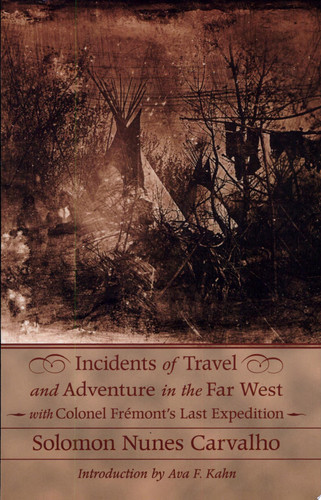
Incidents of travel and adventure in the Far West: with Colonel Fremont's last expedition across the Rocky Mountains, including three months' residence in Utah, and a perilous trip across the great American desert to the Pacific

Carvalho, Solomon Nunes
n August 1853, an American-born Sephardic Jew, Solomon Nunes Carvalho, accepted John Fremont's invitation to join his fifth expedition to find the best overland route to California. A Baltimore artist, inventor, and daguerreotypist, Carvalho was given the job of creating a photographic record of the lands and peoples along the way. Fremont's party left the Missouri on September 14, 1853, traveled up the Kansas River, overland to the Arkansas, upriver past Bent's Fort to the Huerfano, and traversed the Sandhill Pass into the Rocky Mountains. Beset by heavy snows and intense cold, they were reduced to eating their horses and mules and the occasional beaver or porcupine while making their way in midwinter across the Grand, Green, and Sevier Rivers. Suffering from frostbite, scurvy, and dysentery, Carvalho left the expedition in Utah; spent four months among the Mormons in Salt Lake City, where he observed with keen interest their system of spiritual wives; and reached California in 1854. Carvalho became the first Jewish writer to publish accounts of the Great American West and was also one of the first people to photograph the American West. Although only one of his plates is known to survive, others became the models for wood and steel engravings that broadcast the image of the West throughout the world. This Bison Books edition restores the discourses on Mormon doctrine omitted from previous twentieth-century editions. Ava F. Kahn is a visiting scholar at the California Studies Center, University of California, Berkeley. Her books include Jewish Voices of the California Gold Rush: A Documentary History, 1849-1880; Jewish Life in the American West: Perspectives on Migration, Settlement, and Community; and California Jews (coedited with Marc Dollinger).
University of Nebraska Press 2004-01-01 130 pages

Putting meat on the American table: taste, technology, transformation

Horowitz, Roger
Engagingly written and richly illustrated, Putting Meat on the American Table explains how America became a meat-eating nation -- from the colonial period to the present. It examines the relationships between consumer preference and meat processing -- looking closely at the production of beef, pork, chicken, and hot dogs. Roger Horowitz argues that a series of new technologies have transformed American meat. He draws on detailed consumption surveys that shed new light on America's eating preferences -- especially differences associated with income, rural versus urban areas, and race and ethnicity. Putting Meat on the American Table will captivate general readers and interest all students of the history of food, technology, business, and American culture.
The Johns Hopkins University Press 2006 170 pages

The American Congress: the building of democracy

Julian E. Zelizer
Congress is the heart and soul of our democracy, the place where interests are brokered, laws are established, and innovation is turned into concrete action. It is also where some of democracy's greatest virtues clash with its worst vices: idealism and compromise meet corruption and bitter partisanship. The American Congress unveils the rich and varied history of this singular institution. Julian E. Zelizer has gathered together forty essays by renowned historians to capture the full drama, landmark legislation, and most memorable personalities of Congress. Organized around four major periods of congressional history, from the signing of the Constitution to the creation of the Department of Homeland Security, this volume brings a fresh perspective to familiar watershed events: the Civil War, Watergate, the Vietnam War. It also gives a behind-the-scenes look at lesser-known legislation debated on the House and Senate floors, such as westward expansion and war powers control. Here are the stories behind the 1868 vote to impeach President Andrew Johnson; the rise of Jeannette Rankin, the first woman elected to Congress and a leading advocate for pacifism; and the controversy surrounding James Eastland of Mississippi, who carried civil rights bills in his pockets so they could not come up for a vote. Sidebars further spotlight notables including Huey Long, Sam Rayburn, and Tip O'Neill, bringing the sweeping history of our lawmaking bodies into sharp focus. If you've ever wondered how Congress worked in the past or what our elected officials do today, this book gives the engaging, often surprising, answers.
Houghton Mifflin 2004 765 pages

The journey home

Antler, Joyce
In recent decades, prominent American Jewish women like Bella Abzug and Betty Friedan have made headlines and history, challenging the constraints facing women in American public life. Few realize that these women embody a hundred-year legacy of remarkable activism. From suffrage to birth control, from trade unionism to higher education, from civil rights to feminism to every aspect of popular culture, Jewish women have been in the vanguard, leading key social movements.
Schocken 1998 410 pages