2577 results for "Poetry"

The apothecary's daughter

Schonstein, Patricia
"A nobleman and his wife, an apothecary nun, an astronomer-mathematician, an inquisitor, a poet who is both lover and villain, a portraitist, a queen and loyal servants deftly act out a beautiful drama of tantalizing relationships. They take up their roles in castle and convent, some surrounded by ornate interiors, garbed in velvets and silks, garlanded with precious jewels; while others abide in simple space devoid of art or representation, and dressed in plain linens and dull calicos. THE APOTHECARY'S DAUGHTER is a wondrous tale, rendered in erotic prose and poetry, stitched through with rich imagery, humour and tenderness. It is also a story of trade and exotic travel, both across the surface of the earth and among the stars."
Bantam 2004 224 pages

Banquet at Brabazan

Schonstein, Patricia
"In Banquet at Brabazan, Patricia Schonstein takes us to the heart of Cape Town's violent inner city, creating a cornucopia of baroque magic realism featuring an angel, drug-money, a muti murder, superb food, romance, a cappella, a miracle or two, librettos, reflections on South Africa's war in Angola, visions of the Afterlife, poetry, Shakespearean drama and various works of fine art, with flashbacks to her wondrous A Time of Angels."--P. [4] of cover.
Jacana Media 2010 261 pages

PreDictionary Experiments in Verbal Creativity

Mikhail Epstein
MIKHAIL EPSTEIN "PreDictionary. Experiments in Verbal Creativity". Mikhail EPSTEIN is a literary scholar and critical thinker and Professor of Cultural Theory at Emory University (Atlanta, USA). PreDictionary is a dictionary of would-be words that are designed to fill gaps in language and generate new concepts and meanings. Focused on the creative potential of a neologism and a dictionary entry, this book is dedicated to both poetry and poetics. The main part of the book includes 150 entries in 14 thematic sections. All new words are supplied with definitions and examples of usage. "Amazing collection of coinages. Much more impressive than the pop proposals of Faith Popcorn. And what a wonderful word is "predictionary"!" --Allan METCALF, Professor of English at MacMurray College and Executive Secretary of the American Dialect Society.
Lulu.com 2011 131 pages

American odyssey, 1963-1999

Mark, Mary Ellen
The unspoken poetry of our nation revealed by an American master. The first collection of the extensive and superlative work realized by Mary Ellen Mark in the United States, Mary Ellen Mark is composed of many previously unpublished images, as well as photographs from several of her best-known projects. From "Streetwise" to "The Damm Family," Mary Ellen Mark includes the most iconic images from these groundbreaking stories, as well as powerful, never-before-seen photographs Mark accomplished in subsequent years. She makes a deeply felt commitment to her subjects, and her empathy and humanity come through in every image. Mark is unsurpassed at shaping not only the odd but the everyday into genuinely surprising visual icons. With an eye for symbolism and a gift for meticulous composition, she is drawn to a variety of spectacles and situations, and demonstrates a particular affinity for children. Her elegantly revealing imagery creates a fascinating portrait of our complex, amusing, and occasionally unsettling country.
Aperture 1999 151 pages

My cousin, my gastroenterologist

Leyner, Mark
Product Description Welcome to Mark Leyner’s America, where you can order gallium arsenide sushi at a roadside diner, get loaded on a cocktail of growth hormones and anabolic steroids, and support your habit by appearing on TV game shows. Welcome to a wildly post-Einsteinian fictional universe where the locals include a speech pathologist with a waterbug fetish, a kamikaze airline pilot, and the lead singer for Brazil’s most notoriously nihilistic samba band. From Publishers Weekly These 17 loosely linked short stories are intelligent, funny and incredibly bizarre. Though not all are science fiction, each displays a supercharged cyberpunk writing style jam-packed with elements of tabloid journalism, bits of advertising slogans, references to kung fu films, literary allusions, television trivia, deadpan non sequiturs, puns and poetry. The fiercely imaginative Leyner ( I Smell Esther Williams ) announces: "Dad was in the basement centrifuging mouse spleen hybridoma, when I informed him that I'd enrolled at the Wilford Military Academy of Beauty." He also discusses the difficulty of finding a haberdashery near the Mitsubishi Heavy Industries shipyard and speculates on a televised encounter between Tennessee's youngest member of the House of Representatives and 17th-century metaphysician Baruch Spinoza. Squads of displaced, armed and dangerous combatants inhabit a young boy's bedroom in the marvelous "In the Kingdom of Boredom, I Wear the Royal Sweatpants." It's an exuberant, adventurous and audacious collection. Some of the pieces were originally published in Esquire, Harper's and Fiction International , among other magazines. Copyright 1990 Reed Business Information, Inc. Review "I really, really liked it. It's like nothing else. I laughed out loud in the bathroom." -- David Byrne Welcome to Mark Leyner's America, where you can order gallium arsenide sushi at a roadside diner, get loaded on a cocktail of growth hormones and steroids, and support your habit by appearing on TV game shows. Welcome to a wildly post-Einsteinian fictional universe where the locals include a speech pathologist with a waterbug fetish, a kamikaze airline pilot, and the lead singer for Brazil's most notoriously nihilistic samba band. My Cousin, My Gastroenterologist is fiction the brain can dance to, by one of the funniest and most subversive young writers of this or any other decade. "Most current fiction is as well made and exciting as floral wallpaper; but here is a writer willing to decorate the room with the contents of his own dynamited head." -- Entertainment Weekly "Reading this is like fishing in some hallucinated lake of the subconscious. No telling what term, idea, or thing you'll pull up next." -- Houston Post From the Back Cover This book is fiction the brain can dance to, by one of the funniest and most subversive young writers of this or any other decade. About the Author Mark Leyner is the author of two novels, Et Tu, Babe and The Tetherballs of Bougainville; two collections of stories , I Smell Esther Williams and Other Stories and My Cousin, My Gastroenterologist; and a collection of fiction, plays, and journalism, Tooth Imprints on a Corn Dog. His work has also appeared in The New Yorker, Esquire, The New Republic, George, and Harper’s.
HarperCollins 1991 160 pages

Yesterday and Today

Untermeyer, L.
From the preface, "Considering the great interest in modern poetry, and the variou anthologies covering the period, one is struck by two oustanding facts-- first, the similarity of most compilations of contemporary verse and second, the neglect (and, in many cases, the disparegement) of the poetry of the immediate past. For some time th editor has thought of a volume which would answer both of these objections. The result is this comparative collection, which hopes to bring to light first, a number of the fully representative poems of the period, and second, to provide not merely a background to contemporary verse but an equally satisfying record of the poetry which preceded it.
Harcourt 1926-01

The best hour of the night: poems

Simpson, Louis
Here is a new collection of twenty-one poems by the Pulitzer Prize-winning poet Louis Simpson. In The Best Hour of the Night, he presents scenes and characters from contemporary American life in a lean, ironic narrative style with a lyric slow. Louis Simpson (1923 - 2012) was the author of seventeen books of poetry, including four from BOA Editions: Armidale (1979); People Live Here, Selected Poems 1949 - 1983 (1983); The Owner of the House: New Collected Poems 1940 - 2001 (2003), a finalist for the National Book Award for Poetry and the Griffin Poetry Prize; and Struggling Times (2009). Simpson was the recipient of the 1964 Pulitzer Prize for Poetry for his collection At the End of the Open Road (Wesleyan University Press, 1964). Other awards include a Guggenheim Fellowship, the Rome Prize from the American Academy of Arts and Letters, and the Harold Morton Landon Translation Award for Modern Poets of France: A Bilingual Anthology (Story Line Press).
Ticknor & Fields 1983 69 pages

Jiří Orten: selected poems

Orten, Jiří
"I want to be a poet with all my heart. With all my heart and, even more, I want to die for it!" These were the words Jirí Orten wrote to the poet Frantisek Halas in 1939, who published his first book of poetry The First Reader Spring, which appeared under the pseudonym Karel Jílek because Orten, being a Jew, could not be published under his own name. On the 30th August 1941, the day of his twenty-second birthday, he was knocked down by a German ambulance in a Prague street. As a Jew, he was refused first-aid treatment in a nearby hospital. He died two days later of a brain hemorrhage in the Jewish ward of another hospital. Thus his prophetic words from the letter to Halas came true. Jirí Orten, despite dying so young at the age of twenty two years, left behind a large body of work. Three of his books, written from autumn 1938 until the eve of his death in 1941, The Blue Book, The Striped Book and The Red Book, are concluded by the poem My Trees of Years. An extensive composition The Lamentations of Jeremiah, written in 1941, repeats the verse "I'm that land of Night" several times, evoking not only the loss of The Promised Land, but also of his fatherland, which was enslaved by Nazis. The poem To the Silenced One, which was the eulogy for Jirí Orten written by Frantisek Halas, concludes with the verse: "At the time when fish will swim in the cathedrals, this poet will be called on by his name."
Arima Pub 2008 104 pages

Led by the nose: a garden of smells

Joseph, Jenny
Jenny Joseph was no ordinary poet - and Led by the Nose is no ordinary memoir. Shaped around the smells of the English countryside, it is full of the wilful personality and the sly humour that characterised the purple-clad old woman in her iconic poem 'Warning'. Joseph's eccentricities permeate each chapter as she flows through the gardening year with its chores and blossoms, frequently leading the reader off the garden path to stop, smell the roses, and ignore the world for a while. Full of the sensual awareness of Jenny Joseph's poetry, Led by the Nose is a singular memoir: a work of delicious diversion and literary flair, horticultural anxieties and countercultural tendencies, providing a glimpse - or sniff - of the landscape of this treasured poet's life.
Souvenir Press 2023 208 pages

Isaac Rosenberg

Rosenberg, Isaac
The first volume to be published in the new 21st-Century Oxford Authors series presents all of the surviving writings of Isaac Rosenberg (1890-1918): poetry, plays, prose works, and letters. The book also provides a commentary giving details of the composition and publication of the poems and plays and throws light on the people, places, and incidents described in both these and the letters. An introduction places the collection in context and a chronological table describes the main events of his life. There are also examples of his paintings and drawings. Although best known as a war poet, most of Rosenberg's work pre-dates the war. The son of Jewish immigrants from Lithuania, he grew up in London's East End. Financially impoverished, he nevertheless lived in a society that valued artistic creativity - among his friends were Mark Gertler and David Bomberg. He was a painter as well as a poet, and studied at the Slade School of Art. He knew many of the leading poets of the day, and his letters, in particular those to Edward Marsh and Gordon Bottomley, throw fascinating light on his own poetic creativitiy and the response to his work of those around him. In both his letters and prose works we find an insightful commentator on both poetry and painting. Though never a member of any movement, he was aware of the issues that preoccupied the artistic circles of his day. His artistic independence gives both power and insight to his work.
Oxford University Press 2008-11-06 456 pages

Counting (Scruffy Teddy)

Hilary Tham
One long poem threaded with personal, evocative poetry constantly moving. A Zen journey. A journey of love. The Absence of Zen. Becoming Jewish. The Kaddish. Blessings. A very readable work of what was known before and what is known now. From "The world is a hard place": We look at our empty handsand feel shadows and shade,sky drying where water has bee,and are left with wind, know themonly by their absence. Water. Wind.-- Melissa Bell review in VISIONS-International 2001
Parragon 2002-06-01 16 pages

The terror of our days: four American poets respond to the Holocaust

Parmet, Harriet L.
Analyzes poetry by four Americans, none of whom directly experienced the Holocaust. For these poets, writing becomes a moral obligation as commemoration, catharsis, atonement, history, insistence on human sensitivities, resistance to brutalization, indifference, and flight from consequences. Plath attempts to work herself out of her private turmoil by using the Holocaust as a metaphor for this pain. While God and the Holocaust are equally impenetrable and unfathomable, Plath's recourse is to be found in Christian symbolism. Heyen, whose parents emigrated from Germany in 1928, leaving behind members of the family who became Nazis, felt driven to confront history as part of his own background. Stern, who grew up in the safety of America, must expiate this guilt by envisaging and transposing himself into the victims. When Rothenberg visited Poland, he realized that his parents' native town was only 15 miles from Treblinka, where nearly all of his relatives were murdered. The silence of the death camp created for him "a vacuum in which the dead are free to speak". States that if Adorno's proposition - "to write poetry after Auschwitz is barbaric" - were to be taken literally, it would undermine the validity of this endeavor. But poets from time immemorial did not permit their world to collapse because of catastrophe and calamity. Includes an introductory chapter addressing the issue raised by Adorno, as well as a survey and interpretation of the components of the Holocaust genre.
Lehigh University Press 2001-05 268 pages

Scandal at the Alphorn Factory New and Selected Short Fiction, 2024-1984

Gary Barwin
A new collection of stories by Scotiabank Giller Prize finalist Gary Barwin that puts the fab in fabulist. Scandal at the Alphorn Factory: New and Selected Short Fiction, 1984-2024 couples brand new and uncollected stories with selections of the most playful and ambitious of Barwin's previous collections, including Cruelty to Fabulous Animals , Big Red Baby , Doctor Weep and Other Strange Teeth , and I, Dr. Greenblatt, Orthodontist, 251-1457 . Barwin's prose kicks against short fiction's more traditional forms: these are pieces that flirt with poetry and playwriting. Whole stories--and worlds--are packed into single compact paragraphs. There are narrators and fleas and lists and imperatives and Hitler's moustache and radiant happiness. Known as a "whiz-bang storyteller" who can deliver magical, dream-like sequences and truisms about the human condition in the same paragraph, Barwin's trademark brilliance, wit, and originality are on display in this can't-miss collection of short fiction.
Assembly Press 2024-09-03 304 pages

Erotomania: a romance : a novel

Levy, Francis
"[A] hilariously satirical debut novel. Miller, Lawrence, and Genet stop by like proud ancestors... But it's a more recent generation of mischievous deviant writers (Nicholson Baker, Mary Gaitskill) that truly looms large — Erotomania's closest predecessor might be Baker's The Fermata. [An] ambitious book... [A] biting satire." —Zach Baron, Village Voice "Sex is familiar, but it's perennial, and Levy makes it fresh." —Richard Rayner, Los Angeles Times Book Review "Levy seems to have an eye for detail for all that is absurd, commonly human, and uniquely American." —Beth Harrington, Bookslut "It's a great book, written with flawless verve by a tremendous fictioneer and thinker, and it deserves glory. A classic." —Andre Codrescu, Exquisite Corpse "[Erotomania] can just as easily be a bookend to the beautifully nuanced prose of Milan Kundera as it can be a long-version story for a nudie mag minus the accompanying photographs. It's all in the context — as it is with most relationships." —Quarterly Conversation "Erotomania wields a comedic punch that makes it, above all, a fun novel to read." —Nerve.com Erotomania is an absurdist portrait of a modern-day romance. It follows James and Monica from their early days as couple that is forced to move into a nuclear fall-out bunker so their explosive sex life doesn’t physically harm their neighbors, down the long journey to marriage counseling. Francis Levy’s short stories, criticism, humor, and poetry have appeared in The New York Times, The Washington Post, The New Republic, The Village Voice, and The Quarterly.
Two Dollar Radio 2008 162 pages

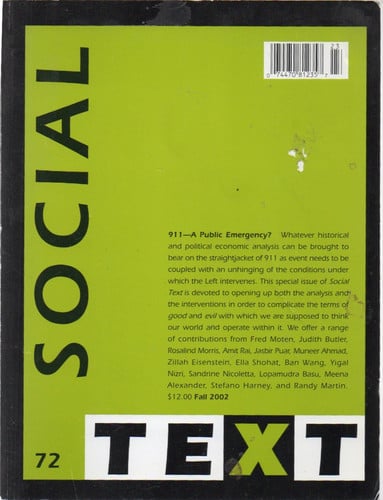
911 a Public Emergency?

Brent Hayes Edwards,Stefano Harney,Randy Martin,Ella Shohat,Timothy Mitchell,Fred Moten
Since September 11, public discourse has often been framed in terms of absolutes: an age of innocence gives way to a present under siege, while the United States and its allies face off against the Axis of Evil. This special issue of Social Text aims to move beyond these binaries toward thoughtful analysis. The editors argue that the challenge for the Left is to develop an antiterrorism stance that acknowledges the legacy of U.S. trade and foreign policy as well as the diversity of the Muslim faith and the dangers presented by fundamentalism of all kinds. Examining the strengths and shortcomings of area, race, and gender studies in the search for understanding, this issue considers cross-cultural feminism as a means of combating terrorism; racial profiling of Muslims in the context of other racist logics; and the homogenization of dissent. The issue includes poetry, photographic work, and an article by Judith Butler on the discursive space surrounding the attacks of September 11. This impressive range of contributions questions the meaning and implications of the events of September 11 and their aftermath. Contributors . Muneer Ahmad, Meena Alexander, Lopamudra Basu, Judith Butler, Zillah Eisenstein, Stefano Harney, Randy Martin, Rosalind C. Morris, Fred Moten, Sandrine Nicoletta, Yigal Nizri, Jasbir K. Puar, Amit S. Rai, Ella Shohat, Ban Wang
Duke University Press 2002-09-20 208 pages

Hermann Nitsch: life and work

Spera, Danielle
The oral autobiography of the controversial Vienna Aktionist, with archival materials and additional writings by Nitsch A pioneer of Vienna's postwar avant-garde and the most notorious member of the Vienna Aktionist group, Hermann Nitsch (1938-2022) united performance, painting and musical composition in dramatic, often blood-soaked rituals. Newly translated into English from the original German, this oral autobiography offers the readers Nitsch's life story in his own words. Over the course of an in-depth interview with Austrian journalist Danielle Spera, he recounts his family history, early childhood, the evolution of his artistic practice and the fraught reception of his work, as well as his various romantic and financial struggles. The interview is illustrated with images of his work, in the studio and in action; archival photographs; and other ephemeral material, such as flyers and news clips. Excerpts from Nitsch's writings, including "Blood Organ Manifesto" and "Verbal Poetry of the Orgies Mysteries Theatre," punctuate the interview between Spera and the artist.
Nitsch Foundation 2023 439 pages