
2501 results for "American History"

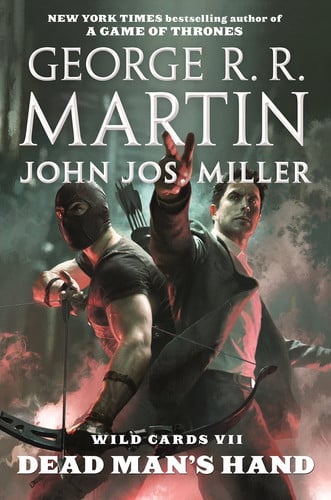
Wild Cards VII: Dead Man's Hand Book Four of the Puppetman Quartet

George R. R. Martin,John Jos. Miller,Wild Cards Trust
Dead Man's Hand combines the writing talents of George R. R. Martin & John Jos. Miller Chrysalis, the glass-skinned queen of the Joker underworld, has been found brutally murdered in her popular restaurant, the Crystal Palace. New two men are out to find her killer: Jay Ackroyd, the Ace private investigator who discovered her ruined body, and the vigilante archer known as the Yeoman, who has been framed for the crime. Their quest leads them on a nightmare odyssey of madness, violence, passion, and political intrigue that will forever alter the fates of Aces and Jokers everywhere. Experience this gripping tale of mystery and suspense, brought to you from the incredible imaginations of George R. R. Martin and John Jos. Miller in their first collaborative novel. EXPLORE THE WILD CARDS UNIVERSE An alien virus has changed the course of history, and the surviving population of Manhattan struggles to understand the new world left in its wake. Natural humans share the rough city with those given extraordinary—and sometimes terrifying—traits. While most manage to coexist in an uneasy peace, not everyone is willing to adapt. The Wild Cards Universe The Original Triad #1 Wild Cards #2 Aces High #3 Jokers Wild The Puppetman Quartet #4: Aces Abroad #5: Down and Dirty #6: Ace in the Hole #7: Dead Man’s Hand The Rox Triad #8: One-Eyed Jacks #9: Jokertown Shuffle #10: Dealer’s Choice #11: Double Solitaire #12: Turn of the Cards The Card Sharks Triad #13: Card Sharks #14: Marked Cards #15: Black Trump #16: Deuces Down #17: Death Draws Five The Committee Triad #18: Inside Straight #19: Busted Flush #20: Suicide Kings The Fort Freak Triad #21: Fort Freak #22: Lowball #23: High Stakes The American Triad #24: Mississippi Roll #25: Low Chicago #26: Texas Hold 'Em
Tor Publishing Group 2017-06-13 352 pages

The Street Sweeper

Elliot Perlman
How breathtakingly close we are to lives that at first seem so far away. From the civil rights struggle in the United States to the Nazi crimes against humanity in Europe, there are more stories than people passing one another every day on the bustling streets of every crowded city. Only some stories survive to become history. Recently released from prison, Lamont Williams, an African American probationary janitor in a Manhattan hospital and father of a little girl he can’t locate, strikes up an unlikely friendship with an elderly patient, a Holocaust survivor who was a prisoner in Auschwitz-Birkenau. A few blocks uptown, historian Adam Zignelik, an untenured Columbia professor, finds both his career and his long-term romantic relationship falling apart. Emerging from the depths of his own personal history, Adam sees, in a promising research topic suggested by an American World War II veteran, the beginnings of something that might just save him professionally, and perhaps even personally. As these men try to survive in early-twenty-first-century New York, history comes to life in ways neither of them could have foreseen. Two very different paths—Lamont’s and Adam’s—lead to one greater story as The Street Sweeper , in dealing with memory, love, guilt, heroism, the extremes of racism and unexpected kindness, spans the twentieth century to the present, and spans the globe from New York to Chicago to Auschwitz. Epic in scope, this is a remarkable feat of storytelling.
Penguin Publishing Group 2012-12-04 640 pages

The story of Lynx

Lévi-Strauss, Claude
"In olden days, in a village peopled by animal creatures, lived Wild Cat (another name for Lynx). He was old and mangy, and he was constantly scratching himself with his cane. From time to time, a young girl who lived in the same cabin would grab the cane, also to scratch herself. In vain Wild Cat kept trying to talk her out of it. One day the young lady found herself pregnant; she gave birth to a boy. Coyote, another inhabitant of the village, became indignant. He talked all of the population into going to live elsewhere and abandoning the old Wild Cat, his wife, and their child to their fate . . . " So begins the Nez Percé myth that lies at the heart of The Story of Lynx , Claude Lévi-Strauss's most accessible examination of the rich mythology of American Indians. In this wide-ranging work, the master of structural anthropology considers the many variations in a story that occurs in both North and South America, but especially among the Salish-speaking peoples of the Northwest Coast. He also shows how centuries of contact with Europeans have altered the tales. Lévi-Strauss focuses on the opposition between Wild Cat and Coyote to explore the meaning and uses of gemellarity , or twinness, in Native American culture. The concept of dual organization that these tales exemplify is one of non-equivalence: everything has an opposite or other, with which it coexists in unstable tension. In contrast, Lévi-Strauss argues, European notions of twinness—as in the myth of Castor and Pollux—stress the essential sameness of the twins. This fundamental cultural difference lay behind the fatal clash of European and Native American peoples. The Story of Lynx addresses and clarifies all the major issues that have occupied Lévi-Strauss for decades, and is the only one of his books in which he explicitly connects history and structuralism. The result is a work that will appeal to those interested in American Indian mythology.
University of Chicago Press 1995 276 pages

Style and Idea

Arnold Schoenberg
This book is full of essays which Arnold Schoenberg wrote on style and idea. He talks about the relationship to the text, new and outmoded music, composition in twelve tones, entertaining through composing, the relationship of heart and mind in music, evaluation of music, and other essays. Arnold Schoenberg (13 September 1874 - 13 July 1951) was an Austrian and later American composer, associated with the expressionist movement in German poetry and art, and leader of the Second Viennese School. He used the spelling Schönberg until after his move to the United States in 1934 (Steinberg 1995, 463), "in deference to American practice" (Foss 1951, 401), though one writer claims he made the change a year earlier (Ross 2007, 45). Schoenberg was known early in his career for successfully extending the traditionally opposed German Romantic traditions of both Brahms and Wagner, and later and more notably for his pioneering innovations in atonality. During the rise of the Nazi party in Austria, his music was labeled, alongside swing and jazz, as degenerate art. In the 1920s, he developed the twelve-tone technique, a widely influential compositional method of manipulating an ordered series of all twelve notes in the chromatic scale. He also coined the term developing variation, and was the first modern composer to embrace ways of developing motifs without resorting to the dominance of a centralized melodic idea. Schoenberg's approach, both in terms of harmony and development, is among the major landmarks of 20th century musical thought; at least three generations of composers in the European and American traditions have consciously extended his thinking and, in some cases, passionately reacted against it. Schoenberg was also a painter, an important music theorist, and an influential teacher of composition; his students included Alban Berg, Anton Webern, Hanns Eisler, and later John Cage, Lou Harrison, Earl Kim, Wayne Barlow, and many other prominent musicians. Many of Schoenberg's practices, including the formalization of compositional method, and his habit of openly inviting audiences to think analytically, are echoed in avant-garde musical thought throughout the 20th century. His often polemical views of music history and aesthetics were crucial to many of the 20th century's significant musicologists and critics, including Theodor Adorno, Charles Rosen, and Carl Dahlhaus. Schoenberg's archival legacy is collected at the Arnold Schönberg Center in Vienna.
Philosophical Library 1950 236 pages

Moving toward life: five decades of transformational dance

Halprin, Anna
Anna Halprin is one of the most important innovators in the history of modern dance, performance art, and post-modern dance. Moving Toward Life brings together for the first time her essays, interviews, manifestos, and teaching materials, along with over 100 illustrations, providing a rich account of the work that radicalized an entire generation of performers. Since the late 1950s, Halprin has been at the forefront of experiments in dance, from improvisation and street theatre to dances in the environment and healing dances. A brief overview of Halprin's career shows how her work has prefigured -- and transfigured -- crucial developments in postmodern dance. In the 1960s, Halprin invented the "workshop," and in the wake of the Watts riots, her multiracial company broke boundaries in their confrontational political performances. In the 1970s, she organized "community rituals" to explore how individual creativity feeds positively into group dynamics. These healing social events led to her current work with cancer survivors and people challenging AIDS and their caregivers. Depicting Halprin's deep commitment to social change, Moving Toward Life presents an engaging, critical document of the life of one of the most influential and least known luminaries of American dance. Sally Banes and Janice Ross join Rachel Kaplan in providing introductory essays to sections of the book.
Wesleyan University Press 1995 274 pages

Crisis and covenant: the Holocaust in American Jewish fiction

Berger, Alan L.
Examines the effect of the Holocaust on traditional attempts to explain the Jewish people's sufferings while retaining the concept of covenant with God. also examines its influence on the self-image of American Jewry. Analyzes the works of Elie Wiesel, Isaac Bashevis Singer, Saul Bellow, and Cynthia Ozick, among others, and suggests that awareness of a covenantal concept of Judaism is a criterion for authentic Holocaust literature. Adopts the definition of the Holocaust as a unique event - the plan to exterminate an entire nation, and describes various approaches to theological problems raised by the Holocaust.
State University of New York Press 1985-01-01 226 pages

Lift every voice: African American oratory, 1787-1900

Philip Sheldon Foner,Robert J. Branham
An anthology comprising 150-plus selections, making accessible the orations of both well-known and lesser-known African Americans. Each speech is presented with an introduction that sets the context. Many are previously unpublished, uncollected, or long out of print. The volume is based on Philip Foner's 1972 Voice of Black America. Annotation copyrighted by Book News, Inc., Portland, OR
University of Alabama Press 1998 925 pages

Two Models of Government A New Classification of Governments in Terms of Power

Michael Arnheim
This book offers a fresh and original analysis of the power structure of a number of societies, past and present. There are and ever have been only two essential models of government: minority rule of all types (labelled "oligocracy") and regimes in which power is concentrated in the hands of a single individual (labelled "monocracy"). The present-day "democracies" of Britain and the United States are in reality composite oligocracies made up of several disparate elements. Oligocracies are by definition regimes with a high degree of inequality, but with variable levels of liberty. Oligocracy and inequality are the "default" features of human society. Equality is unattainable except by a radical monocracy like Fidel Castro's Cuba, and then only with difficulty and at the expense of liberty and probably of lives as well. Equality of opportunity must not be equated with equality. Equality of opportunity means an equal opportunity to become unequal. For genuine freedom of expression to exist there also needs to be equality, because the little man standing on his soap-box and shouting his lungs out at Speaker's Corner in London's Hyde Park cannot compete with the media moguls -- which is why genuine freedom of expression is rare. Once these truths are recognised, it becomes clear that for a Western nation to combine "regime change" in a foreign state with an attempt to impose "democracy" and Western "liberal" values on it is likely to be doomed to failure - as is amply demonstrated by the recent history of Iraq, Afghanistan and Libya.
Black House Publishing, Limited 2016-07-29 372 pages

The Central Eskimo

Franz Boas
This early work by Franz Boas was originally published in 1888 and we are now republishing it with a brand new introductory biography. 'The Central Eskimo' was his first monograph and details his time spent on Baffin Island studying the Inuit people. Franz Boas was born on July 9th 1958, in Minden, Westphalia. Even though Boas had a passion the natural sciences, he enrolled at the University at Kiel as an undergraduate in Physics. Boas completed his degree with a dissertation on the optical properties of water, before continuing his studies and receiving his doctorate in 1881. Boas became a professor of Anthropology at Columbia University in 1899 and founded the first Ph.D program in anthropology in America. He was also a leading figure in the creation of the American Anthropological Association (AAA). Franz Boas had a long career and a great impact on many areas of study. He died on 21st December 1942.
Read Books 2013-07 586 pages

Fighting words: a toolkit for combating the religious right

Morgan, Robin
The religious right is gaining enormous power in the United States, thanks to a well-organized, media-savvy movement with powerful friends in high places. Yet many Americans — both observant and secular — are alarmed by this trend, especially by the religious right's attempts to erase the boundary between church and state and re-make the U.S. into a Christian nation. But most Americans lack the tools for arguing with the religious right, especially when fundamentalist conservatives claim their tradition started with the Framers of The Constitution. Fighting Words is a a tool-kit for arguing, especially for those of us who haven't read the founding documents of this nation since grade school. Robin Morgan has assembled a lively, accessible, eye-opening primer and reference tool, a "verbal karate" guide, revealing what the Framers and many other leading Americans really believed — in their own words — rescuing the Founders from images of dusty, pompous old men in powdered wigs, and resurrecting them as the revolutionaries they truly were: a hodgepodge of freethinkers, Deists, agnostics, Christians, atheists, and Freemasons — and they were radicals as well.
Nation Books 2006-08-25 146 pages

Slavery and African Ethnicities in the Americas Restoring the Links

Gwendolyn Midlo Hall
Enslaved peoples were brought to the Americas from many places in Africa, but a large majority came from relatively few ethnic groups. Drawing on a wide range of materials in four languages as well as on her lifetime study of slave groups in the New World, Gwendolyn Midlo Hall explores the persistence of African ethnic identities among the enslaved over four hundred years of the Atlantic slave trade. Hall traces the linguistic, economic, and cultural ties shared by large numbers of enslaved Africans, showing that despite the fragmentation of the diaspora many ethnic groups retained enough cohesion to communicate and to transmit elements of their shared culture. Hall concludes that recognition of the survival and persistence of African ethnic identities can fundamentally reshape how people think about the emergence of identities among enslaved Africans and their descendants in the Americas, about the ways shared identity gave rise to resistance movements, and about the elements of common African ethnic traditions that influenced regional creole cultures throughout the Americas.
University of North Carolina Press 2005 225 pages

Ranking the wishes

Dennis, Carl
In his seventh book, Carl Dennis explores the ways in which our wishes - those in our power to fulfill at any moment and those that have no chance of ever being realized - define who we are. While some of the poems view wishing as a failure to do justice to the world we have, others regard it as a recognition that no present, however rich, can satisfy the imagination, and suggest that one of the functions of poetry is to keep significant wishes alive. In showing with moving clarity how wishes are essential to giving shape and direction to the moment, these poems make use of a rich variety of genres: elegy, advice, meditation, warning, consolation, and prophecy.
Penguin Books 1997-06-01 71 pages

In search of American Jewish culture

Whitfield, Stephen J.
In drama and in musical comedy, in popular song and in symphonic music, in movies and in literature, Jews have contributed to American culture in the 20th century to a degree out of all proportion to their numbers. But does this vast creative output coalesce into something identifiable as an American Jewish culture? Stephen J. Whitfield answers this question with a resounding "yes!" Whitfield focuses on areas where the specifically Jewish contribution has been little explored. He surveys such fields as popular music, musical theater, and drama, focusing on key figures from Jerome Kern and the Gershwins to Stephen Sondheim and Jerome Robbins; Leonard Bernstein and Aaron Copland to Irving Berlin and Bob Dylan; Arthur Miller and Lillian Hellman to David Mamet and Wendy Wasserstein. At the same time, Whitfield tackles the complex issue of race and American Jewish culture, tracing the extensive interpenetrations of Jewish and African American music. He also offers a stunning examination of Jewish American representations of the Holocaust, focusing on stage and film adaptations of Anne Frank's Diary and on Steven Spielberg's Schindler's List. In a poignant, final chapter, Whitfield ponders the future of American Jewish culture after a century of assimilationist pressure and mainstream success. The distinctive culture that he has traced through the 20th century, Whitfield concludes, may finally become submerged and lost. Only a renewed emphasis on Judaism itself, he believes, offers the hope for American Jews to maintain the dual cultural identities that they have so long succeeded in nurturing --
University Press of New England 2001 333 pages

Hebrew infusion: language and community at American Jewish summer camps

Benor, Sarah,Krasner, Jonathan B.,Avni, Sharon
"Each summer, tens of thousands of American Jews attend residential camps, where they may see Hebrew signs, sing and dance to Hebrew songs, and hear a camp-specific hybrid language register called Camp Hebraized English, as in: "Let's hear some ruach (spirit) in this chadar ochel (dining hall)!" Using historical and sociolinguistic methods, this book explains how camp directors and staff came to infuse Hebrew in creative ways and how their rationales and practices have evolved from the early 20th century to today. Some Jewish leaders worry that Camp Hebraized English impedes Hebrew acquisition, while others recognize its power to strengthen campers' bonds with Israel, Judaism, and the Jewish people. Hebrew Infusion explores these conflicting ideologies, showing how hybrid language can serve a formative role in fostering religious, diasporic communities. The insightful analysis and engaging descriptions of camp life will appeal to anyone interested in language, education, or American Jewish culture"--Provided by publisher.
Rutgers University Press 2020-07-17 304 pages

The Oxford encyclopedia of economic history

Joel Mokyr
Review: "While many dictionaries of economics are available for purchase, this title is unique because of its greater depth of treatment. It offers histories and backgrounds on a significant number of economic topics, not only for the United States but also for other countries and geographic regions. Entries cover such topics as economic concepts; markets and industries; economic development in various countries; biographical essays on key people in economics and business; business products, including coffee, gas, and oil; and the economic aspects of historical events and time periods, including the Great Depression."--"The Top 20 Reference Titles of the Year," American Libraries, May 2004
Oxford University Press 2003 539 pages

Shaped by war and trade: international influences on American political development

Ira Katznelson,Martin Shefter
In the twenty-first century, globalization poses major challenges to the key players in U.S. domestic politics--challenges similar to many that Americans have faced from abroad since the nation's founding. But it is only in recent decades that links have been drawn between the study of American political development and international relations; even now, emphasis falls primarily on how domestic politics affects the world arena. This book redresses the imbalance. Ten leading scholars explore how, over the past two centuries, the changing positions of the United States in the world economy and in the international political order have shaped U.S. political institutions and domestic politics. Ira Katznelson, Aristide R. Zolberg, and Robert O. Keohane demonstrate the central role that efforts to contend with foreign military and economic competition played in forming the major institutions of U.S. government from the framing of the Constitution through the Civil War. Martin Shefter, Theda Skocpol (writing with Ziad Munson, Andrew Karch, and Bayliss Camp), Ronald Rogowski, and Judith Goldstein show how the nation's political institutions were transformed by problems of war and trade the U.S. subsequently faced. Aaron L. Friedberg, Bartholomew H. Sparrow, and Peter A. Gourevitch conclude the volume by analyzing how international conflicts during and after the Cold War influenced governmental institutions and domestic politics in the United States over the past fifty years. Shaped by War and Trade sets the agenda for further exploration of a topic whose discussion is long overdue.
Princeton University Press 2002-04-21 372 pages