58,196 results in 0.08 seconds

Truth Is a Total Defense My Fifty Years in Television

Steven Bochco
Insightful, candid, and utterly entertaining, Steven Bochco's memoir TRUTH IS A TOTAL DEFENSE: My Fifty Years in Television is an in-studio view of the inception of the second Golden Age of television, delivered by the man who helped create it. Bochco reveals the mad genius, vision, mayhem, and brilliance behind his groundbreaking, widely popular hits (and near misses). Sparing no one, including himself, he shares insider anecdotes from his triumphs-"Hill Street Blues," "L.A. Law," "Doogie Howser, M.D.," and "NYPD Blue"-and turbulent times in broadcast TV. He started reading and synopsizing scripts, plays, and books for Sam Goldwyn, Jr. Moving through his 10-Emmy Award career (so far), to his hot, homicide detective show "Murder in the First" now on TNT, the prolific and successful TV writer and producer describes generous, tough, and conniving mentors and moguls. He shares the how-tos and better-nots of working with highly talented writers, directors, actors, and remembrances of building remarkable television and a memorable life. His remembrances include: Albert Einstein once wangling an invitation to one of his dad's Sunday musical soirees; being nominated for an Emmy for the first "Columbo" he wrote, directed by some young director on the lot named Steven Spielberg; Bruce Paltrow (father of Gwyneth and Jake) teaching him how to have fun at work; Brandon Tartikoff calling to say, "I'm moving 'L.A. Law' to a better time slot. You're replacing 'Hill Street'"; "NYPD Blue" co-creator David Milch asking for an advance because he'd lost $1 million betting on football games that day; Stephen J. Cannell turning down a cop show pilot at ABC, telling their head of development that "Hill Street Blues" was the best cop show ever made, and he didn't want to compete with it; fighting ABC to hire Neil Patrick Harris for "Doogie Howser, M.D."; and keeping friends and family close during his 70-day in-hospital cancer treatment with witty, heartfelt emails signed-as time went on-Cancer Boy, Remission and Retention Boy, Transplant Boy (Soon to be Transplanted Boy), and (The newly reconstructed) Steven. Writers, as he says, write. He also describes the creative arc of building his shows, including several script excerpts, the finances and finagling of modern television production, and more. Combining discerning and from-the-hip thoughts on the business of television writing and production, tales from the wild side, and personal lessons from his life-threatening and altering battle with a rare form of leukemia, Steven Bochco delivers a revealing, wryly humorous page turner. Praise for TRUTH IS A TOTAL DEFENSE: My Fifty Years in Television "An inside look at television from the man who transformed it. The origins of today's golden age of television dramas can be traced to one man: Steven Bochco. This juicy and fascinating account tells you how he did it. A must read." -David E. Kelley, Emmy Award winner and prolific creator of TV hits "Picket Fences," "Chicago Hope," "The Practice," "Ally McBeal," "Boston Public," and "Boston Legal" "Steven Bochco's Truth Is A Total Defense: My Fifty Years in Television is a great in-the-room chronicle of the modern television industry, told by a man who's created some of the most influential and popular shows of the last forty years. I highly recommend it." -Neil Patrick Harris, Emmy and Tony Award-winning actor "It's raucous, it's witty, and very savvy on the business of television. It's master storyteller Steven Bochco telling the story of his life and his life's work-creating groundbreaking TV shows. Fascinating and funny. Read it." -Danny DeVito, Golden Globe and Emmy Award-winning actor, director, and producer
CreateSpace Independent Publishing Platform 2016-05-10 344 pages

Duke Ellington: an American composer and icon

Ellington, Mercedes,Brower, Steven
Beautifully illustrated and unparalleled in scope, this is an elegant visual celebration befitting the life and work of the "prince of the piano." Duke Ellington was the undisputed father of the American songbook. A prolific writer and consummate performer, Ellington was the author of such standards as "Solitude," "Prelude to a Kiss," and "It Don’t Mean a Thing (If It Ain’t Got that Swing)." With a career that spanned five decades, he is one of the defining composers of the Jazz Age. With unprecedented access to the Ellington family archives, this long overdue book illuminates the life and work of an icon of twentieth-century music from his humble beginnings to his long-lasting success. Every stage of Ellington’s career is brought to life, from sepia photographs of his early days in Washington, DC, to colorful playbills from the Harlem Renaissance of the 1920s, his triumphant tours of Europe in the 1930s, and his pioneering explosion of form and genre in the 1940s and beyond. Alongside more than two hundred stunning images, contributions from peers such as Dave Brubeck, Cornel West, Quincy Jones, and Tony Bennett shed light on Ellington’s musical legacy, while the voice of his granddaughter Mercedes reveals the character behind the charisma, and the man behind the piano.
Rizzoli 2016-03-22 224 pages

Fair play: what your child can teach you about economics, values, and the meaning of life

Landsburg, Steven E.
How should we feel about taxes that redistribute income? Ask how parents feel about children who forcibly "redistribute" other children's toys. How should we respond to those who complain that their neighbors are too wealthy? Ask how parents respond when children complain that their siblings got too much cake. By insisting that fairness can't mean one thing for children and another for adults, Landsburg shows that the instincts of the parent have profound consequences for economic justice.
Free Press 1997-11-08 230 pages

Why men rule: a theory of male dominance

Goldberg, Steven
The first edition of this book was lavishly praised by many authorities as the most formidable demonstration of an unpopular truth: males rule in all societies known to history or anthropology, for reasons arising from innate physiology, a brute fact that can never be conjured away by tinkering with social institutions. This new edition has been completely rewritten in the light of two decades of scholarship and debate, taking account of all published criticisms of earlier editions.
Open Court 1993 254 pages

Spinoza's Ethics: an introduction

Nadler, Steven M.
Spinoza's Ethics is one of the most remarkable, important, and difficult books in the history of philosophy: a treatise simultaneously on metaphysics, knowledge, philosophical psychology, moral philosophy, and political philosophy. It presents, in Spinoza's famous 'geometric method', his radical views on God, Nature, the human being, and happiness. In this wide-ranging 2006 introduction to the work, Steven Nadler explains the doctrines and arguments of the Ethics, and shows why Spinoza's endlessly fascinating ideas may have been so troubling to his contemporaries, as well as why they are still highly relevant today. He also examines the philosophical background to Spinoza's thought and the dialogues in which Spinoza was engaged - with his contemporaries (including Descartes and Hobbes), with ancient thinkers (especially the Stoics), and with his Jewish rationalist forebears. His book is written for the student reader but will also be of interest to specialists in early modern philosophy.
Cambridge University Press 2006-05-25 281 pages

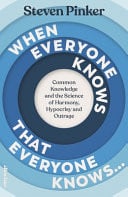
WHEN EVERYONE KNOWS THAT EVERYONE KNOWS... : COMMON KNOWLEDGE AND THE SCIENCE OF HARMONY, HYPOCRISY

PINKER, STEVEN, 1954-
Common knowledge is necessary for coordination, for making arbitrary but complementary choices like driving on the right, using paper currency, and coalescing behind a political leader or movement. It's also necessary for social coordination: everything from rendezvousing at a time and place to speaking the same language to forming enduring relationships of friendship, romance, or authority. Humans have a sixth sense for common knowledge, and we create it with signals like laughter, tears, blushing, eye contact, and blunt speech. But people also go to great lengths to avoid common knowledge -- to ensure that even if everyone knows something, they can't know that everyone else knows they know it. And so we get rituals like benign hypocrisy, veiled bribes and threats, sexual innuendo, and pretending not to see the elephant in the room. Pinker shows how the hidden logic of common knowledge can make sense of many of life's enigmas: financial bubbles and crashes, revolutions that come out of nowhere, the posturing and pretense of diplomacy, the eruption of social media shaming mobs and academic cancel culture, the awkwardness of a first date. Artists and humorists have long mined the intrigues of common knowledge, and Pinker liberally uses their novels, jokes, cartoons, films, and sitcom dialogues to illuminate social life's tragedies and comedies. Along the way he answers questions like: Why do people hoard toilet paper at the first sign of an emergency? Why are Super Bowl ads filled with ads for crypto? Why, in American presidential primary voting, do citizens typically select the candidate they believe is preferred by others rather than their favorite? Why did Russian authorities arrest a protester who carried a blank sign? Why is it so hard for nervous lovers to say goodbye at the end of a phone call? Why does everyone agree that if we were completely honest all the time, life would be unbearable? Consistently riveting in explaining the paradoxes of human behavior, When Everyone Knows That Everyone Knows... invites us to understand the ways we try to get into each other's heads and the harmonies, hypocrisies, and outrages that result. -- Provided by publisher.
ALLEN LANE 2025-09-04 384 pages

Becoming Ageless The Four Secrets to Looking and Feeling Younger Than Ever

Strauss Zelnick
How would you like to have the mind, body, and spirit of someone half your age, and add more years to your life? Or have people stare in disbelief when they discover how old you really are? How would you like to become...ageless? You can. It's possible. And the proof is inside this very book. Becoming Ageless: The Four Secrets to Looking and Feeling Younger Than Ever is the result of years of research into the science of longevity, written by a man who looks and feels eternal. He made it work, and it will work for you. On this easy and effective plan, you'll: * Lose stubborn belly fat and watch the pounds melt away. * Enjoy amazing meals, workouts, and a sense of community. * Look and feel noticeabley younger—for life! Developed by media mogul Strauss Zelnick—founder of the private equity firm Zelnick Media Capital (ZMC) and Chairman and CEO of Take-Two Interactive Software, Inc.—the strategies contained inside are the same ones he used to evolve from a skinny business executive to "America's fittest CEO." In Becoming Ageless , you'll discover: * An easy and effective program for everyone that will help you flatten your gut and become healthier than you ever thought possible. * Delicious, healthy, and easy-to-make recipes including hearty breakfasts, easy-to-make lunches, filling dinners, and even desserts. * A full workout plan that will sculpt your body and help you prevent back pain and sleep better. * A holistic mind/body approach that really works. Look and feel better than ever without deprivation dieting, counting calories—or ever feeling hungry! With Becoming Ageless, you'll feel fitter, sharper, and more energized than ever before—with the body of someone half your age!
Galvanized Media 2018-09-04 261 pages

Formations of modernity

Bram Gieben,Stuart Hall
Formations of Modernity is a major introductory textbook offering an account of the important historical processes, institutions and ideas that have shaped the development of modern societies. This challenging and innovative book 'maps' the evolution of those distinctive forms of political, economic, social and cultural life which characterize modern societies, from their origins in early modern Europe to the nineteenth century. It examines the roots of modern knowledge and the birth of the social sciences in the Enlightenment, and analyses the impact on the emerging identity of 'the West' of its encounters through exploration, trade, conquest and colonization, with 'other civilizations'. Designed as an introduction to modern societies and modern sociological analyses, this book is of value to students on a wide variety of social science courses in universities and colleges and also to readers with no prior knowledge of sociology. Selected readings from a broad range of classical writers (Weber, Durkheim, Marx, Freud, Adam Smith, Montesquieu, Hobbes, Locke, Rousseau) and contemporary thinkers (Michael Mann, E.P. Thompson, Edward Said) are integrated in each chapter, together with student questions and exercises.
Polity in association with Open University 1992 342 pages

How to be a Perfect Stranger The Essential Religious Etiquette Handbook

Stuart M. Matlins,Arthur J. Magida
Updated and Revised! Includes Glossary of Popular Religious Symbols We North Americans live in a remarkably diverse society, and it's increasingly common to be invited to a wedding, funeral or other religious service of a friend, relative or coworker whose faith is different from our own. These can be awkward situations ... What will happen? What do I do? What do I wear? What do I say? What should I avoid doing, wearing, saying? Is it okay to use a video camera? How long will it last? What are their basic beliefs? Will there be a reception? Will there be food? Should I bring a gift? When is it okay to leave? These are just a few of the basic questions answered in How to Be a Perfect Stranger. This easy-to-read guidebook, with an "Everything You Need to Know Before You Go" checklist, helps the well-meaning guest to feel comfortable, participate to the fullest extent possible and avoid violating anyone's religious principles--while enriching their own spiritual understanding. For people of all faiths, all backgrounds. African American Methodist Churches * Assemblies of God * Bahá'í Faith * Baptist * Buddhist * Christian Church (Disciples of Christ) * Christian Science (Church of Christ, Scientist) * Churches of Christ * Episcopalian and Anglican * Hindu * Islam * Jehovah's Witnesses * Jewish · Lutheran * Mennonite/Amish * Methodist * Mormon (Church of Jesus Christ of Latter-day Saints) * Native American/First Nations * Orthodox Churches * Pentecostal Church of God * Presbyterian * Quaker (Religious Society of Friends) * Reformed Church in America/Canada * Roman Catholic * Seventh-day Adventist * Sikh * Unitarian Universalist * United Church of Canada * United Church of Christ
SkyLight Paths Publishing 2015 383 pages

Studs Terkel

Terkel, Studs
The name Studs was a nick-name derived from the function character Studs Lonigan in James T. Farrell's 1920s trilogy. Studs Terkel is one of the great oral historians of this century. His literature speaks to and for the common man. He was born in 1903 and throughout his life he never drove a car but preferred to take a bus and share life with the regular people.Studs started his career in the early '50s doing interviews for radio WFMT in Chicago. By the mid '60s his interviews were being noticed and his first oral history was published. He won the Pulitzer Prize for his 1985 book The Good War. He has been inducted into the Academy of Arts and Letters and has received an award for Distinguished Contribution to American Letters by the National Book Foundation.In best-selling books that began in 1970 with Hard Times, and a legendary radio show that started on WFMT in Chicago, Studs Terkel told the tales that real people had told him. IDEAS host Paul Kennedy interviews Studs Terkel.
Canadian Broadcasting Corporation/Societe Radio-Canada 2005-12

American woman: a novel

Choi, Susan
On the lam for an act of violence against the American government, twenty-five-year-old Jenny Shimada agrees to care for three younger fugitives whom a shadowy figure from her former radical life has spirited out of California. One of them, the kidnapped granddaughter of a wealthy newspaper magnate in San Francisco, has become a national celebrity for embracing her captors' ideology and joining their revolutionary cell. A meditation on themes of race, identity, and class, this fictionalization of the Patty Hearst kidnapping explores the psychology of young radicals, and intensity of their isolated existence, and the paranoia and fear that undermine their ideals.
Perennial 2004 369 pages

Elizabeth I

Doran, Susan
Queen Elizabeth I, the daughter of Henry VIII and Anne Boleyn, reigned from 1558 until her death in 1603 and is remembered not only as a powerful, often ruthless and successful monarch but also as a virtuous, gracious, and caring ruler. This new biography of Elizabeth I, by a leading scholar, reveals a tough and determined "Virgin Queen", whose education, wit, and wisdom enabled her to succeed in the often turbulent and hostile world of her reign. Charting Elizabeth's childhood, schooling, and family life as well as her relationships with her ministers and suitors, Susan Doran discusses her motivation and the personal qualities that sustained her as queen. Her years in power were often dominated by political intrigue, marriage proposals, disputes over the succession, plots against her life, and warfare. Elizabeth made clever use of events, such as the defeat of the Spanish Armada, and unique interests and attributes, such as her love of theatrical pageant, to enhance her reputation and status. In an era of political and religious upheaval, Elizabeth I emerges as one of the most skillful and formidable monarchs in history. Illustrated throughout with portraits, rare historical documents, and letters in Elizabeth's own hand, this book provides an engaging, authoritative account of Queen Elizabeth I's life and times.
New York University Press 2003-08 144 pages

The myth of Elizabeth

Susan Doran,Thomas Freeman
Elizabeth I is one of England's most admired and celebrated rulers. She is also one of its most iconic: her image is familiar from paintings, film and television. This wide-ranging interdisciplinary collection of essays examines the origins and development of the image and myths that came to surround the Virgin Queen. The essays question the prevailing assumptions about the mythic Elizabeth and challenge the view that she was unambiguously celebrated in the literature and portraiture of the early modern era. They explain how the most familiar myths surrounding the queen developed from the concerns of her contemporaries and yet continue to reverberate today. Published to mark the 400th anniversary of the queen's death, this volume will appeal to all those with an interest in the historiography of Elizabeth's reign and Elizabethan, and Jacobean, poets, dramatists and artists.
Palgrave Macmillan 2003-02-20 269 pages