7908 results for "Science"

Science And Human Values

Jacob Bronowski
Science and Human Values is a thought-provoking book by Jacob Bronowski that explores the relationship between science and human values. The author argues that science is not just a collection of facts and theories, but a way of thinking that shapes our understanding of the world and our place in it. He contends that science and human values are intimately connected, and that science has the power to transform our understanding of ourselves and the world around us.The book is divided into five chapters, each of which explores a different aspect of the relationship between science and human values. The first chapter discusses the nature of scientific inquiry and the role of imagination in scientific discovery. The second chapter examines the relationship between science and art, arguing that both are essential to our understanding of the world. The third chapter explores the ethical implications of scientific research, particularly in the areas of genetics and nuclear physics.The fourth chapter examines the role of science in shaping our understanding of human nature, while the final chapter discusses the implications of scientific progress for our future as a species. Throughout the book, Bronowski emphasizes the importance of human values in shaping scientific research and the need for scientists to be mindful of the ethical implications of their work.Overall, Science and Human Values is a thought-provoking and insightful book that challenges readers to think deeply about the relationship between science and human values. It is a must-read for anyone interested in the role of science in our lives and the ethical implications of scientific research.The Impact Of Science On Ethics And Human Values.This scarce antiquarian book is a facsimile reprint of the old original and may contain some imperfections such as library marks and notations. Because we believe this work is culturally important, we have made it available as part of our commitment for protecting, preserving, and promoting the world's literature in affordable, high quality, modern editions, that are true to their original work.
Literary Licensing, LLC 2011-09 98 pages

The art and politics of science

Varmus, Harold
A Nobel Prize–winning cancer biologist, leader of major scientific institutions, and scientific adviser to President Obama reflects on his remarkable career. A PhD candidate in English literature at Harvard University, Harold Varmus discovered he was drawn instead to medicine and eventually found himself at the forefront of cancer research at the University of California, San Francisco. In this “timely memoir of a remarkable career” ( American Scientist ), Varmus considers a life’s work that thus far includes not only the groundbreaking research that won him a Nobel Prize but also six years as the director of the National Institutes of Health; his current position as the president of the Memorial Sloan-Kettering Cancer Center; and his important, continuing work as scientific adviser to President Obama. From this truly unique perspective, Varmus shares his experiences from the trenches of politicized battlegrounds ranging from budget fights to stem cell research, global health to science publishing.
W. W. Norton 2010-04-27 315 pages

Reflections on gender and science

Keller, Evelyn Fox
Why are objectivity and reason characterized as male and subjectively and feeling as female? How does this characterization affect the goals and methods of scientific enquiry? This groundbreaking work explores the possibilities of a gender-free science and the conditions that could make such a possibility a reality. "Keller’s book opens up a whole new range of ideas for anyone who cares to think about the history of science, that is, the history of the modern world. . . Let us be glad to be in times when such a sparkling, innovative. . . book can be produced, a book to start all of us thinking in new directions.”--Ian Hacking, New Republic "A brilliant and sensitive undertaking that does credit not only to feminist scholarship but, in the end, to science as well.”--Barbara Ehrenreich, Mother Jones "This book represents the expression of a particular feminist perspective made all the more compelling by Keller’s evident commitment to and understanding of science. As a lively and important contribution to the scholarship of science, it will undoubtedly stimulate argument and controversy.”--Helen Longino, Texas Humanist "Provocative arguments, presented with authority.”-- Kirkus Reviews "Consistently thoughtful, provocative, and interconnected. . . A well-made book that will be useful in upper-level undergraduate and graduate women’s studies, philosophy, and history of science.”--E.C. Patterson, Choice "Written with grace and clarity, [this book] will stand as an important contribution to feminist theory, to the sociology of knowledge and to the continuing critique of the established scientific method.”--Lillian B. Rubin "A powerful book.”--Jessie Bernard
Yale University Press 1985 193 pages

Science and survival

Commoner, Barry
In Science and Survival, Barry Commoner announces that "the age of innocent faith in science and technology may be over." A massive electric power failure all over the Northeast, the admission of children to a St. Louis hospital 15 years after they had been exposed to radio-iodine from Nevada nuclear bomb tests, the disturbing news about DDT, and the potential menace of recombinant DNA - not to mention the threat of "nuclear winter" in the event of thermonuclear war, a prospect Commoner discussed years before most Americans even heard of it - led him to the conclusion that science, like the magic practiced by the legendary Sorcerer's Apprentice, was getting out of control. Therefore, scientists could no longer simply remain at their work; they had to go out and alert the nonscientists to the problems that their work was creating. "Science can reveal the depth of this crisis," the book concluded, "but only social action can resolve it."
Viking Press 1967-08-15 150 pages

Fashionable nonsense: postmodern intellectuals' abuse of science

Sokal, Alan D.
From Jacques Lacan and Julia Kristeva to Luce Irigaray and Jean Baudrillard, the authors document the errors made by some postmodernists using science to bolster their arguments and theories. Fashionable Nonsense dispels the notion that scientific theories are mere "narratives" or social constructions, and explores the abilities and the limits of science to describe the conditions of existence. --from publisher description.
Picador 1998 300 pages

Atom and void: essays on science and community

Oppenheimer, J. Robert
J. Robert Oppenheimer was one of the outstanding physicists of his generation. He was also an immensely gifted writer and speaker, who thought deeply about the way that scientific discoveries have changed the way people live and think. Displaying his subtlety of thought and expression as do few other documents, this book of his lectures discusses the moral and cultural implications of developments in modern physics. Originally published in 1989. The Princeton Legacy Library uses the latest print-on-demand technology to again make available previously out-of-print books from the distinguished backlist of Princeton University Press. These editions preserve the original texts of these important books while presenting them in durable paperback and hardcover editions. The goal of the Princeton Legacy Library is to vastly increase access to the rich scholarly heritage found in the thousands of books published by Princeton University Press since its founding in 1905.
Princeton University Press 1989 155 pages

Physics for Entertainment

Yakov Perelman
Published in 1913, a best-seller in the 1930s and long out of print, Physics for Entertainment was translated from Russian into many languages and influenced science students around the world. Among them was Grigori Yakovlevich Perelman, the Russian mathematician (unrelated to the author), who solved the Poincaré conjecture, and who was awarded and rejected the Fields Medal. Grigori's father, an electrical engineer, gave him Physics for Entertainment to encourage his son's interest in mathematics. In the foreword, the book's author describes the contents as "conundrums, brain-teasers, entertaining anecdotes, and unexpected comparisons," adding, "I have quoted extensively from Jules Verne, H. G. Wells, Mark Twain and other writers, because, besides providing entertainment, the fantastic experiments these writers describe may well serve as instructive illustrations at physics classes." The book's topics included how to jump from a moving car, and why, "according to the law of buoyancy, we would never drown in the Dead Sea." Ideas from this book are still used by science teachers today.
Amazon Digital Services LLC - Kdp 2011 270 pages

All life is problem solving

Popper, Karl R.
'Never before has there been so many and such dreadful weapons in so many irresponsible hands.' - Karl Popper, from the Preface All Life is Problem Solving is a stimulating and provocative selection of Popper's writings on his main preoccupations during the last twenty-five years of his life. This collection illuminates Popper's process of working out key formulations in his theory of science, and indicates his view of the state of the world at the end of the Cold War and after the collapse of communism.
Routledge 1999 171 pages

The Pope of Physics Enrico Fermi and the Birth of the Atomic Age

Gino Segrè,Bettina Hoerlin
A New York Times Book Review Editors’ Choice Named a Best Book of the Year by Bloomberg (Chosen by Philip Tetlock), Booklist ’s Top 10 Science Books of the Year, and Shortlisted for Physics World ’s Book of the Year A Major Biography of the Nobel Prize–Winning Physicist, Enrico Fermi, a Leading Architect of the Atomic Age Enrico Fermi is unquestionably among the greats of the world’s physicists, the most famous Italian scientist since Galileo. Called “the Pope” by his peers, he was regarded as infallible in his instincts and research. His discoveries changed our world; they led to weapons of mass destruction and conversely to life-saving medical interventions. This unassuming man struggled with issues relevant today, such as the threat of nuclear annihilation and the relationship of science to politics. Fleeing Fascism and anti-Semitism, Fermi became a leading figure in America’s most secret project: building the atomic bomb. An examination of the human dramas that touched Fermi’s life as well as a thrilling history of scientific innovation in the twentieth century, this is the comprehensive biography that Fermi deserves.
Picador 2017-10-10 384 pages

Debating Darwin's Doubt A Scientific Controversy that Can No Longer be Denied

David Klinghoffer
In 2013 Stephen Meyer's book Darwin's Doubt: The Explosive Origin of Animal Life and the Case for Intelligent Design became a national bestseller, provoking a wide-ranging debate about the adequacy of Darwinian theory to explain life's history. In Debating Darwin's Doubt: A Scientific Controversy that Can No Longer Be Denied , leading scholars in the intelligent design community respond to critiques of Meyer's book and show that the core challenge posed by Meyer remains unanswered: Where did the influx of information essential to the creation of new body plans come from? In addition to ten chapters by Stephen Meyer, Debating Darwin's Doubt also includes contributions from biologists Richard Sternberg, Douglas Axe, and Ann Gauger; philosopher of biology Paul Nelson; mathematicians William Dembski and David Berlinski; and Center for Science and Culture research coordinator Casey Luskin. In forty-four chapters, these contributing authors explore topics such as orphan genes, cladistics, small shelly fossils, protein evolution, the length of the Cambrian explosion, the God-of-the-Gaps objection to intelligent design, and criticisms raised by proponents of theistic evolution. Anyone who wants to understand the cutting-edge of current scientific debates over modern Darwinian theory needs to read this book.
Discovery Institute Press 2015 350 pages

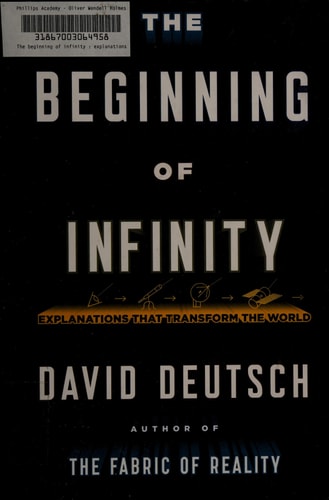
The beginning of infinity: explanations that transform the world

Deutsch, David
"A bold and all-embracing exploration of the nature and progress of knowledge from one of today's great thinkers. Throughout history, mankind has struggled to understand life's mysteries, from the mundane to the seemingly miraculous. In this important new book, David Deutsch, an award-winning pioneer in the field of quantum computation, argues that explanations have a fundamental place in the universe. They have unlimited scope and power to cause change, and the quest to improve them is the basic regulating principle not only of science but of all successful human endeavor. This stream of ever improving explanations has infinite reach, according to Deutsch: we are subject only to the laws of physics, and they impose no upper boundary to what we can eventually understand, control, and achieve. In his previous book, The Fabric of Reality, Deutsch describe the four deepest strands of existing knowledge-the theories of evolution, quantum physics, knowledge, and computation-arguing jointly they reveal a unified fabric of reality. In this new book, he applies that worldview to a wide range of issues and unsolved problems, from creativity and free will to the origin and future of the human species. Filled with startling new conclusions about human choice, optimism, scientific explanation, and the evolution of culture, The Beginning of Infinity is a groundbreaking book that will become a classic of its kind"--
Viking 2011 487 pages

Planet Earth

Jonathan Weiner
"This book is a guide to our lving, changing planet. We journey to the rim of a great meteor crater ... we travel back in time to 1930, in the icy heart of Greenland ... We journey to the outer reaches of our solar system, dive to a rock erupt from the heart of the earth to form new undersea mountains and a new ocean floor. Ulimately we will come to see this planet not as a hunk of stone in space but more like a living organism -- with its own internal dynamics, exchanging gases, healing itself, increasingly dependent on a new host creature -- man-- to shape its future."--Fly leaf.
Bantam Books 1986 370 pages

Inference to the best explanation

Lipton, Peter
How do we go about weighing evidence, testing hypotheses, and making inferences? According to the model of Inference to the Best Explanation, we work out what to infer from the evidence by thinking about what would actually explain that evidence, and we take the ability of a hypothesis to explain the evidence as a sign that the hypothesis is correct. In Inference to the Best Explanation, Peter Lipton gives this important and influential idea the development and assessment it deserves. The second edition has been substantially enlarged and reworked, with a new chapter on the relationship between explanation and Bayesianism, and an extension and defence of the account of contrastive explanation. It also includes an expanded defence of the claims that our inferences really are guided by diverse explanatory considerations, and that this pattern of inference can take us towards the truth. This edition of Inference to the Best Explanation has also been updated throughout and includes a new bibliography.
Routledge/Taylor and Francis Group 2004 219 pages

Doing physics: how physicists take hold of the world

Krieger, Martin H.
Doing Physics makes concepts of physics easier to grasp by relating them to everyday knowledge. Addressing some of the models and metaphors that physicists use to explain the physical world, Martin H. Krieger describes the conceptual world of physics by means of analogies to economics, anthropology, theater, carpentry, mechanisms such as clockworks, and machine tool design. The interaction of elementary particles or chemical species, for example, can be related to the theory of kinship—who can marry whom is like what can interact with what. Likewise, the description of physical situations in terms of interdependent particles and fields is analogous to the design of a factory with its division of labor among specialists. For the new edition, Krieger has revised the text and added a chapter on the role of mathematics and formal models in physics. Doing Physics will be of special interest to economists, political theorists, anthropologists, and sociologists as well as philosophers of science.
Indiana University Press 2012-11-19 218 pages

Diamond Design A Study of the Reflection and Refraction and Refraction of Light in a Diamond (Classic Reprint)

Marcel Tolkowsky
Excerpt from Diamond Design: A Study of the Reflection and Refraction and Refraction of Light in a Diamond This book is written principally for students of precious stones and jewellers, and more particularly, for' diamond manufacturers and diamond cutters and polishers. The author will follow the evolution of the shape given to a cut diamond, and discuss the values of the various shapes and the reason for' the discarding of the old shapes and the practically universal adoption of the brilliant.' About the Publisher Forgotten Books publishes hundreds of thousands of rare and classic books. Find more at www.forgottenbooks.com This book is a reproduction of an important historical work. Forgotten Books uses state-of-the-art technology to digitally reconstruct the work, preserving the original format whilst repairing imperfections present in the aged copy. In rare cases, an imperfection in the original, such as a blemish or missing page, may be replicated in our edition. We do, however, repair the vast majority of imperfections successfully; any imperfections that remain are intentionally left to preserve the state of such historical works.
LULU Press 2018-04-19 114 pages

Darwin for Beginners

Jonathan Miller,Borin Van Loon
The Beginner Books -- "Their cartoon format and irreverent wit make difficult ideas accessible and entertaining." -- Newsday aking us through the upheavals in biological thought which made The Origins of Species possible, Jonathan Miller introduces us to that odd revolutionary, Charles Darwin -- a remarkably timid man who spent most of his life in seclusion; a semi-invalid riddled with doubts, fearing the controversy his theories might unleash; yet also the man who finally undermined belief in God's creation. Along the way we meet a fascinating cast of characters: Darwin's scientific predecessors, his contemporaries (including Alfred Russell Wallace, whose anticipation of natural selection forced Darwin to publish), his opponents, and his successors whose work in modern genetics provided necessary modifications to Darwin's own work. Splendidly illustrated, this clever, witty, highly informative book is the perfect introduction to Darwin's life and thought.
National Geographic Books 2003-07-15 176 pages