248 results for "Biography"

Judah Benjamin: counselor to the confederacy

Traub, James
Judah P. Benjamin (1811-1884) was a brilliant and successful lawyer in New Orleans, and one of the first Jewish members of the U.S. Senate. He then served in the Confederacy as secretary of war and secretary of state, becoming the confidant and alter ego of Jefferson Davis. In this new biography, author James Traub grapples with the difficult truth that Benjamin, who was considered one of the greatest legal minds in the United States, was a slave owner who deployed his oratorical skills in defense of slavery. How could a man as gifted as Benjamin, knowing that virtually all serious thinkers outside the American South regarded slavery as the most abhorrent of practices, not see that he was complicit with evil? This biography makes a serious moral argument both about Jews who assimilated to Southern society by embracing slave culture and about Benjamin himself, a man of great resourcefulness and resilience who would not, or could not, question the practice on which his own success, and that of the South, was founded.
Yale University Press 2021 185 pages

Blair unbound

Seldon, Anthony
The first volume of Anthony Seldon's riveting and definitive life of Tony Blair was published to great acclaim in 2004. Now, as the Labour Party and the country get used to the idea of a new leader and a new Prime Minister, Seldon delivers the most complete, authoritative and compelling account yet of the Blair premiership. Picking up the story in dramatic fashion on 11 September 2001, Seldon recaps very briefly Blair's trajectory to what may now be regarded as the high-point of his leadership, and then brings us right up to date as Blair hands over the reins to his arch-rival, Gordon Brown. Based on hundreds of original interviews with key insiders, many of whose views have hitherto been kept private, Blair Unbound serves both as a fascinating 'volume two' of this masterclass in political biography and a highly revealing and compelling book in its own right.
Pocket 2008 669 pages

One-car caravan: the amazing true saga of the 2004 Democratic race from its humble beginnings to the Boston convention

Shapiro, Walter
By the time most Americans see the presidential candidates on the campaign trail, they are practiced performers surrounded by a platoon of staffers and a brigade of reporters. But on their initial forays into Iowa and New Hampshire in 2002 and early 2003, their entourages were decidedly unpresidential--just an aide or two, perhaps a local reporter, and the candidate himself. Their motorcades were literally one-car caravans; their campaign stops, small gatherings in living rooms. The national media only intermittently follow the candidates as they struggle to define themselves, work out the kinks in their message and refine their personas. But Walter Shapiro did. One-Car Caravan is Shapiro's revealing account of the humble roots of the current presidential campaign, and he provides a telling picture of the 2004 Democratic contenders in their metaphorical boxers and briefs. He shows us John Kerry, Dick Gephardt, Joe Lieberman, John Edwards, Howard Dean, and the others with their hair down, their ties askew, and their foibles bared. It's not pretty to watch a candidate who dreams of flying on Air Force One bump his head on a luggage bin on a small commuter jet, but it can be pretty funny.
PublicAffairs 2004-09-29 254 pages

Boris Johnson: the gambler

Bower, Tom
With his trademark access, insight and candour, Britain's leading investigative biographer tackles his most fascinating subject yet: Alexander Boris de Pfeffel Johnson, the UK's Prime Minister. As divisive as he is beguiling, as misunderstood as he is scrutinised, Boris Johnson is a singular figure. Many of us think we know his story well. His ruthless ambition was evident from his insistence, as a three-year-old, that he would one day be 'world king'. Eton and Oxford prepared him well for a frantic career straddling the dog-eat-dog worlds of journalism and politics. His transformation from bumbling stooge on Have I Got New for You to a triumphant Mayor of London was overshadowed only by his colourful personal life, brimming with affairs, scandals and transgressions. His ascent to Number 10 in the wake of the acrimonious, era-defining Brexit referendum would prove to be only the first act in an epic drama that saw him play both hero and villain - from proroguing parliament to his controversial leadership of the Covid-19 Crisis, all against the backdrop of divorce, marriage, the birth of his sixth child, revolts among Tory MPs and the countdown to Brexit. Yet despite his celebrity, decades of media scrutiny, the endless vitriol of his critics and the enduring adoration of his supporters, there is so much we've never understood about Boris - until now. Previous biographies have either dismissed him as a lazy, deceitful opportunist or been transfixed by his charm, wit and drive. Both approaches fall short, and so many questions about Boris remain unanswered. What seismic events of his childhood have evaded scrutiny? How has he so consistently defied the odds, proved his critics wrong, and got away with increasingly reckless gambles? What were his real achievements and failures as Mayor of London, what was really going on during his time as Foreign Secretary, and why did he write two articles for the Telegraph, one in favour of Leave and the other for Remain? How have the women in his life exerted more influence than any of us realise, and why is his story ultimately one overshadowed by family secrets? Based on a wealth of new interviews and research, this is the deepest, most rounded and most comprehensive portrait to date of the man, the mind, the politics, the affairs, the family - of a loner, a lover, a leader. Revelatory, unsettling and compulsively readable, it is the most timely and indispensable book yet from Britain's leading investigative biographer
WH Allen 2020 578 pages

The investigator: fifty years of uncovering the truth

Lenzner, Terry F.
The Los Angeles Times once called investigative lawyer Terry Lenzner “one of the most powerful and dreaded private investigators in the world.” In his fifty-year career, Lenzner has worked with politicians, celebrities, governments, and corporations worldwide; with a steadfast commitment to the truth, he has uncovered facts that have shaped policy and influenced major legal battles. In this captivating memoir, Lenzner speaks about his varied career and high-profile cases for the first time. At the Justice Department in 1964, he investigated the murder of three civil rights workers—an infamous event that inspired the film Mississippi Burning . He led the national Legal Services Program for the poor, prosecuted organized crime in New York, defended peace activist Philip Berrigan, and represented CIA operative Sid Gottlieb. As a counsel to the Senate Watergate Committee, Lenzner investigated Nixon’s dirty tricks and followed the money trail that led to the Watergate burglary and cover-up. He was the first person to deliver a congressional subpoena to a sitting U.S. president. He uncovered cost overruns of the Alaska oil pipeline, helped identify the Unabomber, investigated the circumstances of Princess Diana’s death, and cleared Hugo Chavez of false corruption charges. Lenzner also worked with President Clinton’s defense team during the impeachment hearings. The Investigator is a riveting personal account: Lenzner astounds with anecdotes of scandal and intrigue, offers lessons in investigative methods, and provides an eye-opening look behind some of the most talked-about media stories and world events of our time.
Blue Rider Press, a member of Penguin Group (USA) 2013 371 pages

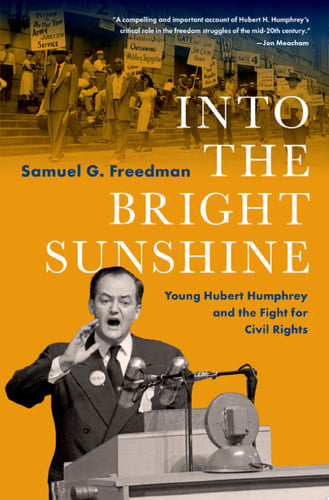
Into the bright sunshine: young Hubert Humphrey and the fight for civil rights

Freedman, Samuel G.
"Hubert Humphrey, a fallen hero and a dying man, rose on rickety legs to approach the podium of the Philadelphia Convention Hall, his pulpit for the commencement address at the University of Pennsylvania. He clutched a sheaf of paper with his speech for the occasion, typed and double-spaced by an assistant from his extemporaneous dictation, and then marked up in pencil by Humphrey himself. A note on the first page, circled to draw particular attention, read simply, "30 years ago--Here." In this place, at that time, twenty-nine years earlier to be precise, he had made history. From the dais now, Humphrey beheld five thousand impending graduates, an ebony sea of gowns and mortarboards, broken by one iconoclast in a homemade crown, two in ribboned bonnets, and another whose headgear bore the masking-tape message HI MA PA. In the horseshoe curve of the arena's double balcony loomed eight thousand parents and siblings, children, and friends. Wearing shirtsleeves and cotton shifts amid the stale heat, they looked like pale confetti from where Humphrey stood, and their flash cameras flickered away, a constellation of pinpricks"--
Oxford University Press 2023 488 pages

A legacy of liberation: Thabo Mbeki and the future of the South African dream

Gevisser, Mark
In this gripping social history of South Africa, award-winning journalist Mark Gevisser follows the family of former South African President Thabo Mbeki to make sense of his legacy and understand the future of the country under new President Jacob Zuma. With unparalleled access to Mbeki and Zuma, as well as other key players in the ANC, Gevisser presents an intimate yet accessible account of South Africa's past, present and future. With his stunning account of the Mbeki family's history as a backdrop, Gevisser fleshes out a monumental period in world history that will continue to shape African politics for years to come.
Palgrave Macmillan 2010-06-08 376 pages

In praise of public life

Lieberman, Joseph I.
What It Means to Serve the Public In a vigorous defense of public life, Senator Joseph Lieberman, renowned as one of our most articulate and respected politicians, defines the duty, the honor and the privilege of public life in the face of Americans' perennial cynicism about it. Drawing widely from his own experience as a politician and his pride in public service, Lieberman makes a passionate, hopeful argument for the value of public life -- its place and necessity in our democracy and our need for more Americans to embrace it if we are to sustain our self-government.
Simon & Schuster 2000 174 pages

American Burke: the uncommon liberalism of Daniel Patrick Moynihan

Weiner, Greg
Daniel Patrick Moynihan may be best known as a statesman. He served in the administrations of presidents Kennedy, Johnson, Nixon, and Ford; was ambassador to India and the United Nations; and represented New York in the U.S. Senate for 4 terms. But he was also an intellectual of the first order, whose books and papers on topics ranging from welfare policy and ethnicity in American society to international law stirred debate and steered policy. Moynihan was, journalist Michael Barone remarked, the nation's best thinker among politicians since Lincoln and its best politician among thinkers since Jefferson. He was, Greg Weiner argues, Americas answer to the 18th-century Anglo-Irish scholar-statesman Edmund Burke. In its incisive analysis of Moynihans political thought, American Burke lays out the terms for such a recovery. The book traces Moynihans development through the broad sweep of his writings and career. The central conservative truth is that it is culture, not politics, that determines the success of a society, Moynihan once wrote. The central liberal truth is that politics can change a culture and save it from itself. In his ability to embrace both of these truths, this American Burke makes it bracingly clear that a wise political thinker can also be an effective political actor, and that commitments to both liberal and conservative values can coexist peaceably and productively. Weiners work is not only a thorough and thoroughly engaging intellectual exploration of one of the most important politicians of the twentieth century; it is also a timely prescription for the healing of our broken system.
University Press of Kansas 2015 189 pages

Republican party animal: the "Bad Boy of Holocaust History" blows the lid off Hollywood's secret right-wing underground

Cole, David
"David Stein brought right-wing congressmen, celebrities, writers and entertainment industry figures together for shindigs, closed to outsiders. . . . There was just one problem. Stein was not who he claimed."-- The Guardian "I disagreed with lots of the book and found the depiction of some people to be cruel, but no denying it was also funny, intriguing and eye-opening." --Rory Carroll Author Comandante: Hugo Chavez's Venezuela , reporter for The Guardian In 2013, Republican "hero" David Stein made international headlines when he was unmasked as David Cole, the notorious Jewish Holocaust denier who made an entirely different set of headlines in the 1990s with his videos from within the gates of Auschwitz and his appearances on shows like 60 Minutes and Donahue . After a $25,000 bounty was put on his head by a violent extremist group, Cole left behind the bizarre world of Holocaust revisionism, a landscape populated by Hitler fetishists who Cole himself detested. Then, David Stein the Republican organizer was born. Stein soon became a major force in the closed-door world of Hollywood right-wingers--people who felt as alienated from the mainstream of their profession as Cole had felt as the lone Jewish Holocaust revisionist. Soon enough, Stein was working with major GOP power players and far-right Hollywood A-listers, creating huge private events for the West Coast GOP elite . . . until it all came crashing down when a vengeful former girlfriend outed him publicly. Condemned by those who had previously lauded him, Cole was left with nothing but his story. And here he tells it, warts and all, including the first-ever exposé of the secretive Hollywood far-right underground, "Friends of Abe."
Feral House 2014 320 pages

Guns or butter: the presidency of Lyndon Johnson

Bernstein, Irving
The presidency of Lyndon Johnson was a pivotal moment in twentieth-century American history. From the decisive social programs of the Great Society, to the triumph of the Civil and Voting Rights Acts, to the catastrophe of the Vietnam War and domestic unrest, it was an era of dramatic accomplishment and wrenching tragedy. In Guns or Butter, renowned historian Irving Bernstein brings those five climactic years of the sixties vividly to life, from the moment Lee Harvey Oswald aimed a rifle from the window of the Texas School Depository to the tense ballot-counting that put Richard Nixon in the White House in 1968.
Oxford University Press 1996-01-11 606 pages

War of words: memoir of a South African journalist

Pogrund, Benjamin
When Benjamin Pogrund, one of South Africa's most distinguished journalists, first began his career as a young reporter in the 1950s, "There had been little reason at that stage to believe that anything revolutionary was about to start." As the "African affairs reporter," and then deputy editor, it was Pogrund who first brought the words of black leaders like Robert Sobukwe and Nelson Mandela to the pages of South Africa's leading newspaper, the Rand Daily Mail. This was the period of apartheid in South Africa and for most of the next thirty years, the Rand Daily Mail was the country's liberal white voice against the tyranny of the Afrikaner Nationalist government. A riveting memoir and a complex commentary on apartheid and freedom of the press, War of Words offers an insider's perspective on one of the most turbulent, and arguably one of the most significant, periods in modern history.
Seven Stories 2000-03-07 381 pages