331 results for "Business"

Contract law and theory

Posner, Eric A.
Contract Law and Theory conveys a grasp of theory and policy that makes all of the contract rules easier to understand. By explaining and applying contract theory to a wide range of contracts cases, Eric Posner reveals not only the "what" of doctrine but also the "why"--why one rule rather than another makes sense from a policy perspective. An understanding of what contract theory is and how it is applied will help you to understand not only Contracts, as taught in law school, but also the many areas of law in which contractual ideas operate, such as bankruptcy law, secured transactions, and corporate law. An exciting new Student Treatise from an eminent authority, Contract Law and Theory features: Complete coverage of contracts that includes the principal cases covered in most first-year contracts courses A general explication of the rules of contract that begins with the simplest ideas and gradually builds in complexity A consistent emphasis on the application of theory to doctrine, through analysis of a rich selection of cases A readable and expert treatment of the role of economics in contract law Illustrative examples that point to noteworthy cases Suitable for use alongside any casebook
Wolters Kluwer Law & Business 2011 243 pages

Out of left field: Jews and Black baseball

Alpert, Rebecca T.
Here is an eye-opening look at one of baseball's most intriguing and little known stories: the many-faceted relationship between Jews and black baseball in Jim Crow America. In Out of Left Field, Rebecca Alpert explores how Jewish sports entrepreneurs, political radicals, and a team of black Jews from Belleville, Virginia called the Belleville Grays--the only Jewish team in the history of black baseball--made their mark on the segregated world of the Negro Leagues. Through in-depth research, Alpert tells the stories of the Jewish businessmen who owned and promoted teams as they both acted out and fell victim to pervasive stereotypes of Jews as greedy middlemen and hucksters. Some Jewish owners produced a kind of comedy baseball, akin to basketball's Harlem Globetrotters--indeed, Globetrotters owner Abe Saperstein was very active in black baseball--that reaped financial benefits for both owners and players but also played upon the worst stereotypes of African Americans and prevented these black "showmen" from being taken seriously by the major leagues. But Alpert also shows how Jewish entrepreneurs, motivated in part by the traditional Jewish commitment to social justice, helped grow the business of black baseball in the face of the oppressive Jim Crow restrictions, and how radical journalists writing for the Communist Daily Worker argued passionately for an end to baseball's segregation. In fact, the campaign to convince manager Branch Rickey to integrate the Brooklyn Dodgers was initiated by Daily Worker sports writer Bill Mardo, in an open letter in the paper. Deftly written and meticulously researched, Out of Left Field offers a unique perspective on the economic and social negotiations between blacks and Jews in the first half of the 20th century, shedding new light on the intersection of race, religion, and sports in America.
Oxford University Press 2011 236 pages

Management cases

Drucker, Peter F.
The companion to Drucker's seminal work Management, completely revised and updated Management Cases, Revised Edition is a collection of thought-provoking case studies—each a timeless representative of a challenge that all managers will face at some point in their careers. Longtime Drucker colleague, collaborator, and eminent management professor Joseph A. Maciariello has organized the material to be used in conjunction with Management, Revised Edition , making the book particularly useful in undergraduate, MBA, and executive education classrooms. It contains fifteen completely new cases written especially for this edition plus another thirty-five revised and updated cases, ensuring that the book provides comprehensive coverage of the most important management dilemmas and most timeless leadership wisdom. An essential resource for business students and working professionals alike, the book will help readers test and hone their management skills.
HarperCollins 2009 241 pages

The Promise President Obama, Year One

Jonathan Alter
Barack Obama’s inauguration as president on January 20, 2009, inspired the world. But the great promise of “Change We Can Believe In” was immediately tested by the threat of another Great Depression, a worsening war in Afghanistan, and an entrenched and deeply partisan system of business as usual in Washington. Despite all the coverage, the backstory of Obama’s historic first year in office has until now remained a mystery. In The Promise: President Obama, Year One , Jonathan Alter, one of the country’s most respected journalists and historians, uses his unique access to the White House to produce the first inside look at Obama’s difficult debut. What happened in 2009 inside the Oval Office? What worked and what failed? What is the president really like on the job and off-hours, using what his best friend called “a Rubik’s Cube in his brain?" These questions are answered here for the first time. We see how a surprisingly cunning Obama took effective charge in Washington several weeks before his election, made trillion-dollar decisions on the stimulus and budget before he was inaugurated, engineered colossally unpopular bailouts of the banking and auto sectors, and escalated a treacherous war not long after settling into office. The Promise is a fast-paced and incisive narrative of a young risk-taking president carving his own path amid sky-high expectations and surging joblessness. Alter reveals that it was Obama alone—“feeling lucky”—who insisted on pushing major health care reform over the objections of his vice president and top advisors, including his chief of staff, Rahm Emanuel, who admitted that “I begged him not to do this.” Alter takes the reader inside the room as Obama prevents a fistfight involving a congressman, coldly reprimands the military brass for insubordination, crashes the key meeting at the Copenhagen Climate Change conference, and bounces back after a disastrous Massachusetts election to redeem a promise that had eluded presidents since FDR. In Alter’s telling, the real Obama is an authentic, demanding, unsentimental, and sometimes overconfident leader. He adapted to the presidency with ease and put more “points on the board” than he is given credit for, but neglected to use his leverage over the banks and failed to connect well with an angry public. We see the famously calm president cursing leaks, playfully trash-talking his advisors, and joking about even the most taboo subjects, still intent on redeeming more of his promise as the problems mount. This brilliant blend of journalism and history offers the freshest reporting and most acute perspective on the biggest story of our time. It will shape impressions of the Obama presidency and of the man himself for years to come.
Simon & Schuster 2011-01-11 496 pages

The age of Clinton: America in the 1990s

Troy, Gil
"The 1990s was a decade of extreme change. Shifts in culture, politics, and technology radically altered the way Americans did business, expressed themselves, and thought about their role in the world. At the center of it all was Bill Clinton, the charismatic and flawed baby boomer president, along with his polarizing but increasingly popular wife, Hillary. Although it was in many ways a Democratic Gilded Age, the 1990s was also a time of great anxiety. The Cold War was over. America was stable and prosperous. Yet Americans felt more unmoored and isolated. This was the era of glitz and grunge, when we relished living in the Republic of Everything even as we feared it might degenerate into the Republic of Nothing. Bill Clinton dominated this era, but his complex legacy has yet to be clearly defined. Historian Gil Troy examines Clinton's presidency alongside the decade's cultural changes. Taking the '90s year by year, Troy shows how the culture of the day shaped the Clintons even as the Clintons shaped it, offering answers to two enduring questions about Bill Clinton's legacy: How did such a talented politician leave Americans thinking he accomplished so little when he actually accomplished so much? And to what extent was Clinton responsible for the catastrophes of the following decade, specifically 9/11 and the collapse of the housing market? Even more relevant as we head toward the 2016 election, The Age of Clinton will appeal to readers on both sides of the aisle as it chronicles the wild, transformative decade and the president at its center"--
Thomas Dunne Books/St. Martin's Press 2015-10-06 368 pages

What Americans really want--really: the truth about our hopes, dreams, and fears

Luntz, Frank I.
No one in America has done more observing of more people than Dr. Frank I. Luntz. From Bill O'Reilly to Bill Maher, America's leading pundits, prognosticators, and CEOs turn to Luntz to explain the present and to predict the future. With all the upheavals of recent events, the plans and priorities of the American people have undergone a seismic shift. Businesses everywhere are trying to market products and services during this turbulent time, but only one man really understands the needs and desires of the New America. From restaurant booths to voting booths, Luntz has watched and assessed our private habits, our public interests, and our hopes and fears. What are the five things Americans want the most? What do they really want in their daily lives? In their jobs? From their government? For their families? And how does understanding what Americans want allow businesses to thrive? Luntz disassembles the preconceived notions we have about one another and lays all the pieces of the American condition out in front of us, openly and honestly, then puts the pieces back together in a way that reflects the society in which we live. What Americans Really Want...Really is a real, if sometimes scary, discussion of Americans' secret hopes, fears, wants, and needs. The research in this book represents a decade of face-to-face interviews with twenty-five thousand people and telephone polls with one million more, as well as the exclusive, first-ever "What Americans Really Want" survey. What Luntz offers is a glimpse into the American psyche, along with analysis that will rock assumptions and right business judgment. He proves that success in virtually any profession demands that we either understand what Americans really want, or suffer the consequences. Praise for Frank Luntz: "When Frank Luntz invites you to talk to his focus group, you talk to his focus group." --President Barack Obama, spoken on June 28, 2007, to a PBS-sponsored focus group following the Democratic presidential debate at Howard University "Frank Luntz understands the American people better than anyone I know." --Newt Gingrich, former Speaker of the House "The Nostradamus of pollsters." --Sir David Frost "America's top companies listen to Frank Luntz because he understands what customers want and what employees think. He has a keen sense of the American psyche and an outstanding command of language that empowers and persuades." --Thomas J. Donohue, President & CEO, U.S. Chamber of Commerce
Hyperion 2010-09-14 336 pages

The Sixties

Richard Avedon,Doon Arbus
The photographer Richard Avedon and the writer Doon Arbus began collaborating on this book thirty years ago. The photographs and interviews they did then remain faithful to what was, like the contents of a time capsule. Meeting somebody and balling them means something, but it doesn't mean near as much as it used to. --Janis Joplin, September 1969 In a society where there is institutionalized oppression, the thing is to catch government and business in the grass--actually humping. --Florynce Kennedy, August 1969 I was so afraid of being bad and being caught at it. --Dr. Benjamin Spock, September 1969 The connection between all the rhetoric and all the poetry, between the words of a Black Panther and those of a rock star or a pacifist, between the scars of a pop artist and those of a napalm victim, have haunted and informed the structuring of this book, with its own peculiar version of a beginning, a middle, and an end.
Random House, Incorporated 1999-10

Aaron Spelling: a prime-time life

Spelling, Aaron
The world of Aaron Spelling is one we all know from hours spent in front of the TV screen. Dynasty, Melrose Place, Beverly Hills 90210, Charlie's Angels, The Love Boat, The Mod Squad, Hart to Hart - these shows claimed huge audiences and define him as one of the most successful showmen of all time. Never told before, Aaron Spelling is the story of his life from the Prime-Time King himself - personal, revealing, filled with confidential facts on such Hollywood greats as Michelle Pfeiffer, Heather Locklear, Farrah Fawcett, Joan Collins, and Ricardo Montalban. Now for the first time, Spelling opens the door to his backstage world with his candid observations about Hollywood and the TV business, along with the inspiring rags-to-riches story of a poor Jew from Texas who overcame insurmountable odds to become the most successful TV producer ever.
St. Martin's Press 1996 228 pages

When I stop talking, you'll know I'm dead: useful stories from a persuasive man

Weintraub, Jerry
Here is the story of Jerry Weintraub: the self-made, Brooklyn-born, Bronx-raised impresario, Hollywood producer, legendary deal maker, and friend of politicians and stars. No matter where nature has placed him--the club rooms of Brooklyn, the Mafia dives of New York's Lower East Side, the wilds of Alaska, or the hills of Hollywood, with Elvis or Sinatra, Robert Altman or George Clooney--he has found a way to put on a show and sell tickets at the door. "All life was a theater and I wanted to put it up on a stage," he writes. "I wanted to set the world under a marquee that read: 'Jerry Weintraub Presents.'" With wit, wisdom, and the cool confidence that has colored his remarkable career, Jerry chronicles a quintessentially American journey, one marked by luck, love, and improvisation. The stories he tells and the lessons we learn are essential, not just for those who love movies and music, but for businessmen, entrepreneurs, artists--everyone.--From publisher description.
Twelve 2010-04-07 291 pages

The Geraldo show: a memoir

Rivera, Geraldo
During my half a century in public life, my image and reputation have had more ups and downs than the Cyclone roller coaster at Coney Island. I have been called savior and sinner, fool and wise man, crusader and exploiter, hothead and dope. I am routinely scorned, admired, beloved, and belittled—which one is usually based on when the viewer tuned in. Were you around for my early days as a crusading local newsman? Did you waste an evening with me inside Al Capone's empty vault? Were you watching when the bombs dropped in Afghanistan or Iraq, or did you tune in to the raucous talk show when my nose was broken in the best television studio brawl ever caught on tape? Since the attacks of September 11, 2001, and my employment by the conservative rabble-rousers of Fox News—and, more recently, with the coming of the Age of Trump—my professional life has been even more difficult to define. How could a sincerely progressive native-born Jew-Rican New Yorker like me ever work for an outfit better suited to the vibes of Orange County, California, the Dixie, Appalachia, or the Mountain West? How could I not condemn and obstruct a wrecking ball like Donald Trump? Over five decades, I have met most of the era's good and bad guys, from Ronald Reagan to Charles Manson, Fidel Castro to Yasser Arafat, Muhammad Ali to John Lennon, and Elvis Presley to Michael Jackson. Two figure heavily in this book, both longtime friends: Roger Ailes, the disgraced yet undeniably brilliant creator of Fox News; and Donald Trump, once a flamboyant playboy, billionaire businessman, and now 45th President of the United States. At the vigorous twilight of a long and largely improvised life lived in plain sight, I have little left to prove. Faced with a series of random chances, for better and worse, what I made of my life is what I made of those chances. Time has enlightened and humbled me. Sincerely, Geraldo Rivera
BenBella Books, Inc 2018-04-03 366 pages

The business of America: how consumers have replaced citizens and how we can reverse the trend

Landau, Saul
When President Bush promoted shopping as a patriotic duty, the American culture of consumption hit a new low. But a quiet revolution is growing in the developing world and in a new generation of Americans, fighting the advance of the shopping malls and the desolation they leave behind. Written by one of the most insightful critics of American commercialism, The Business of America probes the forces that have transformed citizens into consumers eager to take as much as they can from the planet. From on-line shopping to spectator sports to the cash-and-carry ethos of political campaigns, Saul Landau decodes the subtle ways in which advertising images tell us to correct our inadequacies with more things: SUVs, credit cards, air conditioning, video games. The winds of change are blowing, Landau shows, from resurgent student protests for underpaid janitors to the Group of 21, the developing countries that stopped the World Trade Organization dead in its tracks in 2003. Eschewing nostalgia for a simpler time--a less-interconnected world that can never return-The Business of America shows how we as citizens can regain our identities, stripping away the plastic overlay of consumerism.
Routledge 2004 195 pages

Adventures of a bystander

Drucker, Peter F.
"It is [a] belief in diversity and pluralism and the uniqueness of each person that underlies all my writings . . . " -from the Preface. Regarded as the most influential and widely read thinker on modern organizations and their management, Peter Drucker has also established himself as an unorthodox and independent analyst of politics, the economy, and society. A man of impressive scope and expertise, he has paved significant inroads in a number of key areas, sharing his knowledge and keen insight on everything from the plight of the employee and the effects of technology to the vicissitudes of the markets and the future of the new world order. Adventures of a Bystander is Drucker's rich collection of autobiographical stories and vignettes, in which this legendary figure paints a portrait of his remarkable life, and of the larger historical realities of his time. In a style that is both unique and engaging, Drucker conveys his life story -from his early teen years in Vienna through the interwar years in Europe, the New Deal era, World War II, and the postwar period in America-through intimate profiles of a host of fascinating people he's known through the years. Their personal histories are, as Drucker tells us, the beads for which his own life serves as the string. A colorful group, these diverse, often unpredictable, always multidimensional individuals were chosen "because each of them, in his or her own highly personal way, reflects and refracts the thirty crucial years from the end of World War I to the first post-World War II decade-the thirty years that largely formed the world in which we now live." An amazing pageant of characters, both famous and otherwise, springs from these pages, illuminating and defining one of the most tumultuous periods in world history. Along with bankers and courtesans, artists, aristocrats, prophets, and empire-builders, we meet members of Drucker's own family and close circle of friends, among them such prominent figures as Sigmund Freud, Henry Luce, Alfred Sloan, John Lewis, and Buckminster Fuller. Playing to perfection their roles as those who "reflect and refract" the customs, beliefs, and attitudes of the times, these singular personalities lend Adventures of a Bystander a striking "you-are-there" feel. A brief encounter with Freud becomes the catalyst for an absorbing, multidimensional description of the economics, politics, and social psychology of pre-World War II Europe. Drucker introduces us to Fritz Kraemer, a brilliant, monocle-wearing eccentric who became an influential mentor to the young Henry Kissinger. His personal memoir of Henry Luce documents the development of modern journalism, while in "The Indian Summer of Innocence," he rescues and preserves the very heart of the American experience during the last New Deal years before World War II. Shedding light on a turbulent and important era, Adventures of a Bystander also reflects Peter Drucker himself as a man of imaginative sympathy and enormous interest in people, ideas, and history. These enthralling stories complement and complete the groundbreaking analytical writing for which he is so revered. Luminous autobiographical stories by one of the greatest thinkers of our time "The cast of characters among whom Drucker moves is superbly rich, and the informed glimpse he provides of a vanished social and political universe is an education in itself. Adventures of a Bystander is better than a novel, more lively than an essay, and as thoughtful as both at their best." -The Harvard Business Review. "Adventures of a Bystander is a virtuoso performance in which Drucker displays a dazzling diversity of personal interests and knowledge, an awesome power of recall, and a crisp, highly readable writing style." -BusinessWeek. "Adventures of a Bystander appears in a stroke to have restored the art of the memoir and of the essay. It will doubtless be a while before its like comes round again." -The Washington Post.
Wiley 1997 344 pages

Transaction Man Traders, Disrupters, and the Dismantling of Middle-Class America

Nicholas Lemann
An Amazon Best History Book of 2019 "A splendid and beautifully written illustration of the tremendous importance public policy has for the daily lives of ordinary people." —Ryan Cooper, Washington Monthly Over the last generation, the United States has undergone seismic changes. Stable institutions have given way to frictionless transactions, which are celebrated no matter what collateral damage they generate. The concentration of great wealth has coincided with the fraying of social ties and the rise of inequality. How did all this come about? In Transaction Man , Nicholas Lemann explains the United States’—and the world’s—great transformation by examining three remarkable individuals who epitomized and helped create their eras. Adolf Berle, Franklin Delano Roosevelt’s chief theorist of the economy, imagined a society dominated by large corporations, which a newly powerful federal government had forced to become benign and stable institutions, contributing to the public good by offering stable employment and generous pensions. By the 1970s, the corporations’ large stockholders grew restive under this regime, and their chief theoretician, Harvard Business School’s Michael Jensen, insisted that firms should maximize shareholder value, whatever the consequences. Today, Silicon Valley titans such as the LinkedIn cofounder and venture capitalist Reid Hoffman hope “networks” can reknit our social fabric. Lemann interweaves these fresh and vivid profiles with a history of the Morgan Stanley investment bank from the 1930s through the financial crisis of 2008, while also tracking the rise and fall of a working-class Chicago neighborhood and the family-run car dealerships at its heart. Incisive and sweeping, Transaction Man is the definitive account of the reengineering of America and the enormous impact it has had on us all.
Picador 2020-11-10 320 pages

The art of being unreasonable: lessons in unconventional thinking

Broad, Eli
Eli Broad?s embrace of "unreasonable thinking" has helped him build two Fortune 500 companies, amass personal billions, and use his wealth to create a new approach to philanthropy. He has helped to fund scientific research institutes, K-12 education reform, and some of the world?s greatest contemporary art museums. By contrast, "reasonable" people come up with all the reasons something new and different can?t be done, because, after all, no one else has done it that way. This book shares the "unreasonable" principles-from negotiating to risk-taking, from investing to hiring-that have made Eli Broad such a success.
John Wiley & Sons 2012-05-08 192 pages

Thinking in time: the uses of history for decision-makers

Neustadt, Richard E.
“A convincing case that careful analysis of the history, issues, individuals, and institutions can lead to better decisions—in business as well as in government” ( BusinessWeek ). Two noted professors offer easily remembered rules for using history effectively in day-to-day management of governmental and corporate affairs to avoid costly blunders. “An illuminating guide to the use and abuse of history in affairs of state” (Arthur Schlesinger).
Free Press 1986 329 pages

The new health insurance solution: how to get cheaper, better coverage

Pilzer, Paul Zane
You no longer need a traditional employer plan to get good, affordable health insurance. The New Health Insurance Solution can help you cut your health insurance costs in half if: You're self-employed, an independent contractor, or your employer doesn't provide health insurance (you can probably get coverage on your own for about $94/month—a fraction of what an employer would have to pay for the same coverage) You are employed and pay extra to cover your spouse or children under your employer-sponsored plan—you may save 50% by taking them off your employer plan You own a small business and are getting killed by double-digit premium increases—you can now give employees tax-free money to buy their own plans and get your company out of the health insurance business The book also explains in detail the best solutions for you if: You can't find affordable health insurance because you or a child have an expensive preexisting medical problem (your state has a program to provide you with guaranteed coverage ) You're currently putting money into an IRA or a 401(k)—because you don't realize that an HSA is always a better option You're unsure how you or your parents will be able to afford health insurance during retirement, or how to maximize benefits from Medicare—including the new Part D prescription drug plan The New Health Insurance Solution is the definitive guide to the new ways every American can now get affordable health care—without an employer. PAUL ZANE PILZER is a world-renowned economist, a former advisor in two White House administrations, an entrepreneur/employer, an award-winning adjunct professor at NYU, and a New York Times bestselling author.
Wiley 2007-01-02 336 pages

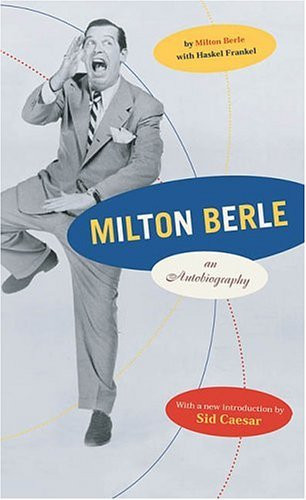
Milton Berle: an autobiography

Berle, Milton
(Applause Books). When Milton Berle died in the Spring of 2002, THE NEW YORK TIMES declared that the legendary comic "may have had a more profound influence on our way of life than some presidents or Nobel Prize winners." This landmark memoir, as startling today as it was when it was first published, reveals the life and times of the man known affectionately to millions as Uncle Miltie. Told with unflinching candor, here is one of the most fabled and influential show business careers of all time: from performing as a child in Vaudeville and making silent movies with Charlie Chaplin and Mary Pickford, to nightclub performances for Al Capone, working on radio during World War II, performing in Broadway musicals, and, finally, superstardom on television. Perhaps even more fascinating is Berle's scandal-ridden private life: his star-crossed love affair with a 1930's movie queen and the child they had out of wedlock, his numerous affairs with women ranging from evangelist Aimee Semple McPherson to Marilyn Monroe, and his stormy relationship with beautiful showgirl Joyce Mathews, whom Berle married twice. It is Berle's unsparing account of his life and his determination to show the world his real face that led Frank Sinatra, at the time, to call this "the gutsiest book I've read in years." Told with equal amounts of comedy and pathos, and featuring colorful appearancesby all the major stars of his day, MILTON BERLE is simply one of the best show business memoirs ever written.
Applause Theatre & Cinema Books 2002-09-01 337 pages