262 results for "Children"

Families, history, and social change: life course and cross-cultural perspectives

Hareven, Tamara K.
One of the prevailing myths about the American family is that there once existed a harmonious family with three generations living together, and that this "ideal" family broke down under the impact of urbanization and industralization. The essays in this volume challenge this myth and provide dramatic revisions of simplistic notions about change in the American family. Based on detailed research in a variety of sources, including extensive oral history interviews of ordinary people, these essays examine major changes in family life, dispel myths about the past, and offer new directions in research and interpretation. The essays cover a wide spectrum of issues and topics, ranging from the organization of the family and household, to the networks available to children as they grow up, to the role of the family in the process of industralization, to the division of labor in the family along gender lines, and to the relations between the generations in the later years of life. While discussing family relations in the past and revising prevailing notions of social change, these interdisciplinary essays also provide important perspectives on the present.
Westview Press 2000 374 pages

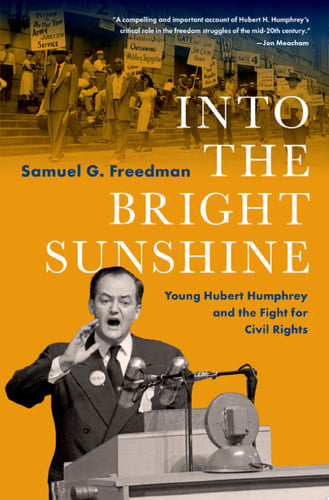
Into the bright sunshine: young Hubert Humphrey and the fight for civil rights

Freedman, Samuel G.
"Hubert Humphrey, a fallen hero and a dying man, rose on rickety legs to approach the podium of the Philadelphia Convention Hall, his pulpit for the commencement address at the University of Pennsylvania. He clutched a sheaf of paper with his speech for the occasion, typed and double-spaced by an assistant from his extemporaneous dictation, and then marked up in pencil by Humphrey himself. A note on the first page, circled to draw particular attention, read simply, "30 years ago--Here." In this place, at that time, twenty-nine years earlier to be precise, he had made history. From the dais now, Humphrey beheld five thousand impending graduates, an ebony sea of gowns and mortarboards, broken by one iconoclast in a homemade crown, two in ribboned bonnets, and another whose headgear bore the masking-tape message HI MA PA. In the horseshoe curve of the arena's double balcony loomed eight thousand parents and siblings, children, and friends. Wearing shirtsleeves and cotton shifts amid the stale heat, they looked like pale confetti from where Humphrey stood, and their flash cameras flickered away, a constellation of pinpricks"--
Oxford University Press 2023 488 pages

Lilah

Halter, Marek
Product Description Set in the magnificent culture of the Middle East more than four thousand years ago, Lilah is a rich and emotionally resonant story of faith, love, and courage. Living in exile, Lilah is in love with Antinoes, a Persian warrior. They have known each other since they were children, and Antinoes dearly wants to make Lilah his wife. Yet Lilah does not feel she can marry without the blessing of her brother, Ezra. She and Ezra are close, and Lilah knows her brother well—he does not want his sister to have a husband outside their faith. Ezra is a scholar of the laws of Moses, and Lilah believes it is her brother’s destiny to lead the Jewish people back to the Promised Land. While Antinoes pressures her to accept his proposal, Lilah realizes that before she can consider her own happiness, it is her duty to help her brother accomplish the seemingly impossible task that is before him. Putting herself in grave danger, and with the help of Antinoes, Lilah wins Ezra an audience with Artaxerxes II, the King of Kings, who grants permission to lead the exiles on their journey back to the Promised Land. After a hazardous trip across the desert, Lilah, Ezra, and the thousands who join them arrive in Jerusalem. But the hardship of rebuilding the Temple takes its toll, and the religious enthusiasm of some turns to extremism. Ezra, listening to the zealots, orders all non-Jewish wives and their children banished from Jerusalem. Lilah, whose love for Antinoes has never wavered, is horrified by this command. She knows she must now choose between her brother and her conscience, which tells her that the time has come to defy him. Lilah is a timeless story of one woman’s stand against intolerance; it will linger in the reader’s mind long after the last page has been turned. From Publishers Weekly In his final installment of the Canaan Trilogy ( Sarah; Zipporah), Halter ambitiously tackles portions of the complicated biblical book of Ezra, which centers on the rebuilding of the Jerusalem temple and calls Israel to ethnic and religious purity. In the Persian town of Susa, the beautiful Lilah dreams of marrying her Persian lover and childhood sweetheart, Antinoes. However, her beloved brother Ezra, who has immersed himself in studying the laws of God, refuses to approve of their union since Antinoes is not a Jew. As the story unfolds, with scenes full of rich detail, Lilah becomes the unlikely instrument of gaining royal approval for the Jewish people to return to Jerusalem and rebuild the holy city. However, once there, Ezra orders all non-Jewish wives and children driven away in what is surely one of the most heart-wrenching episodes directly from scripture. A horrified Lilah repudiates her brother and leaves with them. As the cast-off women wander unprotected outside the city, rape, murder and mayhem ensue. (It's confusing that Lilah narrates one violent scene, but readers are unsure how she survives it.) As in Sarah and Zipporah, there is plenty of highly charged sexuality and some imaginative storytelling. Unfortunately, as with its predecessors, the story trails off, and the ending is unsatisfactory. (June) Copyright © Reed Business Information, a division of Reed Elsevier Inc. All rights reserved. From AudioFile Ellen Reilly brings the story of Lilah, sister of Ezra, the biblical prophet, to life. Perhaps not many are familiar with the story of Ezra, which takes place more than four thousand years ago during a sad time in Israel's history. Lilah is torn between her love for her brother, Ezra, and her love for a Persian warrior. She must choose, and her choice will bring far-reaching consequences. All the emotion and turmoil in the story are made real by the talented Ellen Reilly. One can easily feel the heartache, passion, and drama of this book. Fascinating and well worth a listen. N.L. © AudioFile 2006, Portland, Maine-- Copyright © AudioFile, Portland, Maine About the Author Mar
Bantam 2006 284 pages

Valley Forge

MacKinlay Kantor
MACKINLAY KANTOR Pulitzer Prize-winning author of Andersonville VALLEY FORGE Poignant, tender, and powerful, VALLEY FORGE brings into sharp new focus one of the most tensely dramatic episodes of the American Revolution. With warmth and wit, compassion and sensitivity, MacKinlay Kantor evokes the flavor, pulse and texture of the last quarter of the eighteenth century, transporting the reader into the houses and workshops, kitchens and stables, parlors and bedrooms of ordinary citizens. Here are not only the soldiers of Valley Forge, but the panorama of the Revolution itself. George Washington, lamenting the remoteness and lack of valor in the Congress, anticipating new battle; the sprightly, good-humored Martha, always loyal and loving to a fault; the Marquis de Lafayette, whose poise and dignity belied his youth; Baron von Steuben whose halting English made the soldiers laugh, but whose fierce devotion won their respect. And the multitude-young Mum, a sixteen-year-old deserter savagely trampled by Tarleton's Raiders; Malachi Lennan whose gift of a horse gained him entry into Mad Anthony Wayne's Drovers; Billy, the turncoat, wailing for his mother as he was dragged to the gallows. Sons of farmers and tradesmen, trappers and teachers-some too young to fight, and some too old-surge through these pages, giving life, breath, scope and humanity to the American Revolution and the winter at Valley Forge. MacKINLAY KANTOR was born in Webster City, Iowa in 1904. He began to write seriously at sixteen, became a newspaper reporter at seventeen, and an author at twenty-three. Since his first-published novel in 1928, more than forty books have appeared in print, including verse, short stories, novellas, histories, and books for children. His best-selling, and Pulitzer Prize- winning Andersonville was published in 1955. MacKinlay Kantor's other than book accomplishments range from Hollywood screenwriting to police patrolling (N. Y. P. D.), to combat experience (RAF and U.SAF) in two wars. VALLEY FORGE is grandly conceived, but the quality is equal to the concept. The climate of the war, its taste and smell and the harsh texture of its life, are evoked with mystery. Neither souped-up nor toned-down under fashionable pressures, this is an extraordinarily honest and human book. I am greatly impressed.-MARY RENAULT
Speaking Volumes, LLC 2016-11-28 350 pages

Last impressions

Kertes, Joseph
"Zoltan Beck is dying. His devoted but long-suffering sons, Ben and Frank, are trying to prepare themselves and their families for Zoltan's eventual departure...but they can't quite bring themselves to believe that the end is really at hand, and neither can Zoltan himself. The head of a family marked by war and tragedy for decades, he "can't stand to be in a room with a miserable person" and has done his best to keep the pain of his refugee past from his beloved children. But as he faces the end of his life, he discovers a heartbreaking secret from the War that will ultimately bring the family together - or irrevocably disrupt it. Set in both mid-20th century Hungary and contemporary Toronto, this is a deeply moving novel that revels in the energy of its extraordinary characters. It is the story of lost love and newfound connections, of a father and his sons desperately reaching out to bridge an ever-widening gap...even as their time together ebbs away."--Provided by publisher.
Penguin Canada 2020-03-03 299 pages

Company C An AmericanS Life As a Citizen-Soldier in the Israeli Army

Haim Watzman
When American-born Haim Watzman immigrated to Israel, he was drafted into the army and, after eighteen months of compulsory service, was assigned to Company C, the reserve infantry unit that would define the next twenty years of his life. From 1984 until 2002, for at least a month a year, Watzman, who had never aspired to military adventure, was a soldier. Watzman was a soldier as he adjusted to his new country, raised his children, and pursued a career as a writer and translator. At times he defended his adopted country’s borders; at other times he patrolled beyond them, or that gray area, the occupied territories. A religiously observant Jew who opposed Israel’s presence in the West Bank and Gaza Strip, he served in uniform in conflicts that he demonstrated against in civilian clothes. Throughout, he developed a deep and abiding bond with the diverse men of Company C--a fellowship that cemented his commitment to reserve service even as he questioned the occupation he was enforcing. In this engrossing account of the first Intifada, the period of the Oslo Accords, and Israel’s reoccupation of the West Bank as lived by citizen-soldiers in the field, Watzman examines our obligations to country, friends, family, and God--and our duty to protect our institutions even as we fight to reform them.
Argo Navis 2012-10-20 328 pages

The hard way around: the passages of Joshua Slocum

Wolff, Geoffrey
A masterful biographer now offers a thrilling, definitive portrait of one of history’s most legendary icons of adventure. In 1860, sixteen-year-old Joshua Slocum escaped a hardscrabble childhood in Nova Scotia by signing on as an ordinary seaman to a merchant ship bound for Dublin. Despite having only a third-grade education, Slocum rose through the nautical ranks at a mercurial pace; just a decade later he was commander of his own ship. His subsequent journeys took him nearly everywhere: Liverpool, China, Japan, Cape Horn, the Dutch East Indies, Manila, Hong Kong, Saigon, Singapore, San Francisco, and Australia—where he met and married his first wife, Virginia, who would sail along with him for the rest of her life, bearing and raising their children at sea. He commanded eight vessels and owned four, enduring hurricanes, shipwrecks, pirate attacks, cholera, smallpox, a mutiny, and the death of his wife and three of his children. Yet his ultimate adventure and crowning glory was still to come. In 1895 Slocum set sail from Gloucester, Massachusetts—by himself—in the Spray, a small sloop of thirty-seven feet. More than three years and forty-six thousand miles later, he became the first man to circumnavigate the globe solo, a feat that wouldn’t be replicated until 1925. His account of that voyage, Sailing Alone Around the World , soon made him internationally famous. He met President Theodore Roosevelt on several occasions and became a presence on the lecture circuit, selling his sea-saga books whenever and wherever he could. But scandal soon followed, and a decade later, with his finances failing, he set off alone once more—and was never seen again. Geoffrey Wolff captures this singular life and its flamboyant times—from the Golden Age of Sail to a shockingly different new century—in vivid, fascinating detail.
Alfred A. Knopf 2010 218 pages

Albert and Victoria: the rise and fall of the house of Saxe-Coburg-Gotha

Feuchtwanger, E. J.
When Albert of Saxe-Coburg-Gotha married his cousin, the young Queen Victoria, in 1840, it was not only a match whose fertility and personal devotion provided a model for the queen's subjects, it was also a triumph of dynastic politics. It drew the couple deeply into European politics, where their personal and family relationships with many of the rulers often had repercussions at home. Despite the death of Albert in 1861, the marriage of Victoria's children into Europe's royal houses continued the dynastic theme. It was a tragedy for Germany and Europe that Vicky, Victoria's eldest daughter, and her husband, the heir to the German throne were unable to master Bismarck. Albert and Victoria is a portrait of a marriage. It also traces Albert to his unhappy family roots in Coburg and shows how important his attitudes, most of them shared by Victoria, were in their joint dynastic enterprise. >
Hambledon Continuum 2006-01-01 299 pages

Mosaic

Diane Armstrong
international praise for Diane Armstrong: 'Mosaic flows like a novel which, once started, is hard to put down. It is a compelling family history of extraordinary people played out against some of the most frightening events of our century. The depth of emotions evoked is stunning. I was thrilled and deeply moved.' Joseph Heller author of Catch-22 'Diane Armstrong's book is a source of delight to the reader. Written with fervor and talent, it will capture your attention and retain it to the last page.' Elie Wiesel Nobel Prize winner a family story you'll never forget ... This extraordinary true story begins in the Polish city of Krakow in 1890 and spans one hundred years and four continents. It is the story of a Jewish family whose patriarch, Daniel Baldinger, divorces the wife he loves because she is barren. He believes 'a man must have sons to say Kaddish for him when he dies.' To ensure having children, he marries a girl of eighteen. By 1913, Daniel has eleven children - including six sons to say Kaddish for him. Impatient for his God-given son to begin learning the sacred language of the Torah, Daniel sent Avner to cheder at Chevre Tilem when he was three years old. Most boys were enrolled at four or five, but Daniel couldn't wait for Avner's rabbinical training to begin. Cheder was the place where childhood ended. At this religious day school, Jewish boys learned Hebrew and studied the Torah. No coloured pictures, childish stories or lively games relieved the tedium of this dour classroom where Avner had to memorise words he didn't understand, learn hundreds of rules and write strange squiggles. But although God has answered Daniel's prayers, it is with a bitter twist: each of his six sons rebels against his religion, and not one of them says Kaddish for him when he dies. This richly textured portrait follows these eleven children from the 1890s, through the terrifying years of the Holocaust (when Diane and her parents assumed non-Jewish names and passed themselves off as Catholics in the little village of Piszczac), to the present. A long shadow fell across the little girl tracing patterns in the dirt with a stick. After watching her for a few minutes, the stranger asked, 'What's your name, little girl?' Without looking up, she replied, 'Danusia Boguslawska.' 'But what was your name before that?' he insisted. My father, Henek, who was standing by the open window, froze when he heard the last question. Instead of rushing outside and grabbing the child to prevent her from answering that insidious question, he was struck dumb and stood there helplessly awaiting her reply, on which all their lives depended. Mosaic is compelling storytelling at its best: from the fascinating detail of Polish Jewish culture at the turn of the century and the rivalries and dramas of family life, to its moving account of lives torn apart by war and prejudice, this is a remarkable story of a family, and of one woman's journey to reclaim her heritage. For centuries Poland has been a battleground whose fields, watered by more blood than rain, have nurtured ancient hatreds. Jews have not had a monopoly on suffering, grief and loss. Before we drive away from Szczakowa, I look back at the leafy street where the synagogue and mikveh stood, just a short stroll from the house on Parkowa Street. If I close my eyes, I can see a dapper white-haired gentleman in top hat and patent leather shoes like mirrors striding ahead of his wife in a flowered hat with feathers, her long full skirt rustling as she tries to keep up with him as they walk to the synagogue on Kilinskiego Street for the marriage of their daughter Lieba to Daniel Baldinger. In this forgotten country town, I've found important pieces of the mosaic.
Random House Australia 1999-09-24 592 pages

Going out: the rise and fall of public amusements

Nasaw, David
There was a time not very long ago when "going out" was only for the rich and the reckless. At the turn of the century, "going out" became part of everyday life as vaudeville halls, photograph parlors, penny arcades, nickelodeons, nightclubs, dance halls, world's fair midways, amusement parks, ballparks, and movie palaces opened their doors to the people of the city. The new amusement centers welcomed women, men, and children, native-born and immigrant, rich, poor, and middling. Only African Americans were excluded or segregated in the audience, though they were overrepresented on stage. Going Out chronicles the twentieth-century entertainment revolution that changed forever the ways we live, work, and play. In a matter of decades, a new public world of amusements was created where ethnic, class, and neighborhood differences were subordinated to the common pursuit of a good time. Clerks and bankers, sales girls and society ladies "turkey trotted" to ragtime in nightclubs and dance halls; "shot the chute" and clutched one another in "barrels of love"; visited "Darkest Africa" on the world's fair midways; and sat together in the dark watching pictures move on a screen. In Going Out, we meet the colorful characters who invented show business: Thomas Alva Edison, who was astonished when his phonograph made money playing music (he had designed it to take business dictation); Benjamin Franklin Keith, the circus grifter who opened a dime museum in Boston in the 1880s and within a decade owned the world's largest vaudeville theater circuit; Adolph Zukor and Marcus Loew, the New York furriers who made millions in the early picture-show business; and the dozens of small-time show businessmen who rode the rails with their "shows" in their trunks. And we hear the stories of the early black performers and their struggles to maintain their dignity and livelihood while audiences demanded their public humiliation. Going Out is a history of twentieth-century show business and of the new American public that assembled in the city's wondrous pleasure palaces, parks, and theaters. The book concludes with an account of the fall or relocation of this entertainment world, as central city amusement parks, movie palaces, and ballparks were uprooted and transported to the suburbs in the decades following World War II.
Harvard University Press 1999-04-15 312 pages

Joseph Goebbels: a biography

Riess, Curt
Coming generations will ask themselves how it was possible that millions of people, victims of an artificially induced enthusiasm, could be moved to do the very things which led to their own ruin. The answer could be given in hundreds of thousands of words, but, if it were expressed in one word alone, that word would be: Goebbels. Curt Riess, a Jewish Berliner who fled Germany upon Hitler's appointment as Chancellor in 1933, considered Goebbels to be 'the most outstanding man of the Nazi regime, not even barring Hitler himself.' Without Goebbels' genius for organization and propaganda, Nazism could never have amassed the support it needed to gain and keep power in Germany. From provincial obscurity, Goebbels scurried through the Nazi ranks to become one of the most dominant and trusted members of Hitler's inner circle. His career was marked by formidable powers of administration, his ruthless hatred of the Jews, his resourcefulness in promoting Nazi ideals, and his inflexible devotion to the Führer, asserted in his final morbid gesture of propaganda: the sacrifice of his wife, six children, and himself in Hitler's bunker in 1945. Riess' biography was first published in 1949 and benefitted greatly from the discovery of Goebbels' diaries in 1946. It explores the many fascinating and pertinent aspects of Goebbels' character: the insecurities brought on by his diminutive stature; his rejection by his family; his consuming jealousy of his rivals; and his obsession with sex. It remains a compelling and authoritative biography of the man whose manipulative genius steered the German nation to ruin.
Fonthill 2013 368 pages

The two-faced god

Lawrence, Caroline
Floridius the Soothsayer has been asked to read the omens for a wealthy man whose villa appears to be haunted. The pay is good but it means studying a sheep's liver and poor Floridius faints at the sight of blood! Can Threptus solve the mystery and save his friend from embarrassment? Join Threptus and Floridius on their hilarious and action-packed adventures among Rome's superstitious underclass, and don't miss this ruder, funnier and still historically accurate companion to The Roman Mysteries.
Orion Children's Books 2013-08-13 111 pages

The thunder omen

Lawrence, Caroline
Threptus the former beggar boy has teamed up with Floridius, a soothsayer and seller of sacred chickens. Together they earn a living helping people solve problems and mysteries. In this third book of the series, it is the time of Saturnalia - when all the rules are turned upside down and chaos ensues. Threptus is enjoying the mayhem but the thunder omens are disturbing. Can Threptus help his friend matchmake and avoid the disaster threatened by the thunder omen?
Orion Children's Books 2013-04-02 122 pages

The sewer demon

Lawrence, Caroline
At the end of book 17 of the Roman Mysteries, Caroline Lawrence introduced us to Threptus - a young beggar boy. In this fun and fabulous new series, Threptus starts work with his mentor - the soothsayer, Floridius - and together they must solve their first mystery ... Can they rid a rich woman's house of the demon that haunts it in the dead of night? What is the true nature of the demon? And is it really a supernatural being?
Orion Children's Book 2012-09-11 102 pages

The Saga Of The Jomsvikings

Lee Milton Hollander
The Saga Of The Jomsvikings is a book written by Lee Milton Hollander, which tells the story of the legendary Jomsvikings, a group of Viking warriors who lived in the 10th century. The book is a translation of the original Icelandic saga, which is one of the most famous and important sagas of the Viking Age.The Jomsvikings were a group of elite warriors who lived in a fortress on the island of Jomsborg, located in modern-day Poland. They were known for their bravery, skill in battle, and strict code of honor, which included loyalty to their leader and fellow warriors.The book follows the story of the Jomsvikings, from their origins as a group of mercenaries to their rise as one of the most feared and respected warrior groups in the Viking world. It also explores the relationships between the Jomsvikings and their allies and enemies, including the Danish king Harald Bluetooth and the Norwegian king Olaf Tryggvason.Throughout the book, the reader is taken on a journey through the Viking Age, with vivid descriptions of battles, raids, and political intrigue. The Saga Of The Jomsvikings is a fascinating and exciting read for anyone interested in Viking history and culture.This scarce antiquarian book is a facsimile reprint of the old original and may contain some imperfections such as library marks and notations. Because we believe this work is culturally important, we have made it available as part of our commitment for protecting, preserving, and promoting the world's literature in affordable, high quality, modern editions, that are true to their original work.
Literary Licensing, LLC 2011-08 116 pages