321 results for "Folklore"

A Fairy Went A-Marketing

Rose Fyleman
At a market, a fairy purchases riches found in nature. Then releases them for their own good or the good of others. A different season plays out with each stanza of Fyleman's verse. Visually exquisite, this is a story to be savored by both parents and children, and is a great book to be shared in preschool story time. "The artist has created a fairy-world of beauty with animals, plants, reptiles and small details making each double-page spread a breathtaking scene. . . luminous." -- Publishers Weekly "What makes this picture book exceptional are the exquisite illustrations." -- School Library Journal
Penguin Young Readers Group 1992-09 32 pages

Dead kings. Volume 1. Hard road home

Orlando, Steve (Comic book writer)
Sasha never saw his younger brother...until the secret police made him disappear. Sasha Vasnetsov left Thrice-Nine--the dirty folklore world that limps along in the wreckage of a Technomagic War--thirty years ago and never looked back. But word that the secret police have sent his brother Gena to a work camp for the socially degenerate drags him back, with a promise to free Gena and return him to their mother before her fiftieth birthday. The only problem? Sasha isn't a fraction of the tough guy he tries to be, so if he's going to break back into Thrice-Nine...he'll need help. Sasha's only hope is Maria Kamenaya, a former Technomagic Warrior with hundreds of enemy kills to her name, betrayed by the country that made her when her honor conflicted with their agenda. Thrice-Nine took Sasha's brother, and it took Maria's heart. This quest is how they get both of those things back, in the steaming, lawless land of decapitated states...the land of DEAD KINGS. Like True Grit set in the world of Final Fantasy, DEAD KINGS is unrelenting with its passion and thrills, massive in scale and unflinching as it peers into the underside of the obligations that drive us all: to family and country. It's a classic Wild West revenge cast against a haunting, awe-inspiring vision of a future where we've mortally wounded the world, and the prisoners are the only ones left to run the penitentiary. Written by Steve Orlando (Batman/Shadow, Crude, Midnighter, Virgil) and drawn by Matthew Dow Smith (October Girl, Suicide Squad, X-Files) DEAD KINGS continues Orlando's in-depth exploration of retribution in all its dark, complex forms. Having burst forth from the restrictions of the modern world's flesh and bone, Orlando and Smith create a whole new world of iron-and-oil fantasy, paths walked by a redemption-fueled older brother and the abandoned, rusted out, vindictive tool of a bygone war that protects him--this is us AFTER the World Wars of Mechs and Magic, broken hearts and busted fists included, a world you would ONLY find at AfterShock!
Aftershock 2019-05 120 pages

People of the book: (עם הספר) : a decade of Jewish science fiction & fantasy

Rachel Swirsky,Sean Wallace
From Sholom Aleichem to Avram Davidson, Isaac Bashevis Singer to Tony Kushner, the Jewish literary tradition has always been one rich in the supernatural and the fantastic. In these pages, gathered from the best short fiction of the last ten years, twenty authors prove that their heritage is alive and well -- in the spaces between stars that an alphabet can bridge, folklore come to life and histories become stories, and all the places where old worlds and new collide and change.
Prime Books 2010 318 pages

Prince of the ghetto

Samuel, Maurice
Maurice Samuel presents to the English-reading audience one of the richest spirits of the Yiddish language to appear at the beginning of the twentieth century. Through the writings of Isaac Loeb Peretz, he provides access to the lost and lamented world of Polish Jewry. Peretz's folk and Chassidic tales are here retold. The author has arranged them into a pattern that reveals both the life and work of the great writer as well as the basic folklore of the Jews of Poland. Originally published by Knopf in 1948, this edition includes a new introduction by Jacob Neusner.
University Press of America 1987-08-14 294 pages

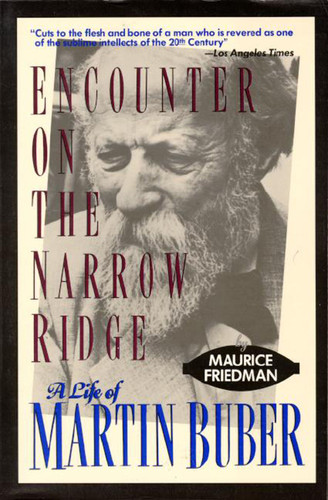
Encounter on the Narrow Ridge A Life of Martin Buber

Maurice Friedman
Martin Buber's stature as the most significant Jewish religious philosopher of the twentieth century is reinforced by his accomplishments and renown in areas as diverse as Hasidism, psychotherapy, education, folklore, and politics. His classic, I and Thou, is known and studied all over the world. In this complete and masterful biography, Maurice Friedman traces the interweaving of Buber's wholehearted engagement with world events and crises and the evolution of his unique and influential philosophy. We see the impact of World War I on the young thinker; his work in education, community, and politics between the wars; his leadership of the spiritual resistance to the Nazis in Hitler's Germany; and his more than forty years of fighting for Jewish-Arab understanding. In addition, we see Buber interact with Heidegger, Sartre, Jung, Ben Gurion, Hesse, Rosenzweig, and Hammarskjold. Through his close relationship with Buber and recent access to forty-five thousand unpublished letters, Maurice Friedman recreates Buber's vitality, his philosophy of dialogue, and his spirituality based on a personal relationship with God. Encounter on the Narrow Ridge delivers the essential spontaneity of a great man who saw in every encounter a focal point for human growth.
Paragon House 1998-06-15 496 pages

Promise and Fulfilment - Palestine 1917-1949

Arthur Koestler
PROMISE AND FULFILMENT Palestine TO ABRAM AND JASHA WEINSHALL CITIZENS OF ISRAEL AS A TOKEN OF A QUARTER-CENTURY OF FRIENDSHIP ACKNOWLEDGMENTS MY sincere thanks are due to R. H. S. Grossman, M. P., and Messrs. Hamish Hamilton, for permission to use the long extract pp. 102-7 from Grossmans Palestine Mission to a member of the Israeli Foreign Office, who wishes to remain anonymous, for per mission to print his Report from Jerusalem pp. 234-8 to Mr. George Pape, Librarian of the Public Information Office in Tel Aviv, and Dr. G. Pollack of the Israeli Ministry of Finance, for valuable research work and to Miss Daphne Wood ward, for helping with the proofs. A. K. PREFACE THIS book consists of three parts, Background, Close-up and Perspective . The first part is a survey of the develop ments which led to the foundation of the State of Israel. It lays no claim to historical completeness, and is written from a specific angle which stresses the part played by irrational forces and emotive bias in history. I am not sure whether this emphasis has not occasionally resulted in over-emphasis as is almost in evitable when one tries to redress a balance by spot-lighting aspects which are currently neglected. But it was certainly not my intention, by underlining the psychological factor, to deny or minimize the importance of the politico-economic forces. My aim was rather to present, if I may borrow a current medical term, a psycho-somatic view of one of the most curious episodes in modern history. The second part, Close-up, is meant to give the reader a close and coloured, but not I hope technicoloured, view of the Jewish war and of everyday life in the new State. It opens and ends with extracts fromthe diary of my last sojourn as a war correspondent in Israel. The emphasis here is on life in the towns, with only occasional glimpses of the collective settlements, since I have given a detailed description of these in an earlier book. The third part, Perspective, is an attempt to present to the reader a comprehensive survey of the social and political structure, the cultural trends and future prospects of the Jewish State. I have tried to show elsewhere that the creative processes of the artist and the scientist follow the same mental pattern, and that the sciences may legitimately be called neutral arts, separated from the emotive arts not by any distinct barrier but merely by the quality of our emotive reactions. In this sense vii Viii PROMISE AND FULFILMENT history, too, is a neutral art with mythology and bardic folklore as connecting links to the emotive arts of drama and fiction. But the emotive neutrality which should characterize the chronicler is not the same thing as indifference, and his object ivity can only be the result of a subjective passion for the pursuit of truth. It is a poor sort of impartiality which stands outside the parties, untouched by their emotions the good judge, like the playwright and historian, absorbs the subjective truth con tained in each of the conflicting pleas, and his verdict is a syn thesis of their part-truths, not their denial. In other words, r objectivity is a state of balanced emotions, not an emotive vacuum. This book, then, should be regarded as a subjective pursuit of the objective truth. I lived in Palestine from my twentieth to my twenty-third year, as a farmer, tramp, and on various odd jobs finally as a foreign correspondent. Ihave since revisited the country at fairly regular intervals, and each of these visits provided an occasion not only to study developments in the country, but also my personal attitude to it. The last phase of this pilgrims progress through a thicket of emotive and ideo logical entanglements is summed up in the Epilogue. It may also be read as a prologue, and serve as an indication of the point of view from which certain controversial problems are treated in this book...
Read Books 2008-11 356 pages

"With His Pistol in His Hand": A Border Ballad and Its Hero

Paredes, Américo
Review "To see why Gregorio became a folk hero, one only has to remember that in practice there was one law for Anglo-Texans, another for Texas Mexicans. The chase, capture, and imprisonment of Cortez are high drama.... This is an extraordinary book." (Tennessee Folklore Society Bulletin) Product Description Gregorio Cortez Lira, a ranchhand of Mexican parentage, was virtually unknown until one summer day in 1901 when he and a Texas sheriff, pistols in hand, blazed away at each other after a misunderstanding. The sheriff was killed and Gregorio fled immediately, realizing that in practice there was one law for Anglo-Texans, another for Texas-Mexicans. The chase, capture, and imprisonment of Cortez are high drama that cannot easily be forgotten. Even today, in the cantinas along both sides of the Rio Grande, Mexicans sing the praises of the great "sheriff-killer" in the ballad which they call "El Corrido de Gregorio Cortez." Américo Paredes tells the story of Cortez, the man and the legend, in vivid, fascinating detail in "With His Pistol in His Hand," which also presents a unique study of a ballad in the making. Deftly woven into the story are interpretations of the Border country, its history, its people, and their folkways.
University of Texas Press 1958 276 pages

The Day the Rabbi Disappeared Jewish Holiday Tales of Magic

Schwartz, Dr. Howard
Noted folklorist Howard Schwartz retells 12 Jewish tales from around the world. Each tale combines elements of magic with a link to a Jewish holiday, giving new perspectives on Rosh Hashanah, Yom Kippur, Hanukkah, Purim, and Passover--plus Shabbat, the weekly Sabbath. These memorable stories of holiday miracles and miraculous escapes have been passed down orally for thousands of years. Now the best of them--from "A Flock of Angels" to "The Enchanted Menorah" and "The Magic Winecup"--have been collected, and enriched by Monique Passicot's luminous illustrations.
Jewish Publication Society 2003 80 pages

The story of Lynx

Lévi-Strauss, Claude
"In olden days, in a village peopled by animal creatures, lived Wild Cat (another name for Lynx). He was old and mangy, and he was constantly scratching himself with his cane. From time to time, a young girl who lived in the same cabin would grab the cane, also to scratch herself. In vain Wild Cat kept trying to talk her out of it. One day the young lady found herself pregnant; she gave birth to a boy. Coyote, another inhabitant of the village, became indignant. He talked all of the population into going to live elsewhere and abandoning the old Wild Cat, his wife, and their child to their fate . . . " So begins the Nez Percé myth that lies at the heart of The Story of Lynx , Claude Lévi-Strauss's most accessible examination of the rich mythology of American Indians. In this wide-ranging work, the master of structural anthropology considers the many variations in a story that occurs in both North and South America, but especially among the Salish-speaking peoples of the Northwest Coast. He also shows how centuries of contact with Europeans have altered the tales. Lévi-Strauss focuses on the opposition between Wild Cat and Coyote to explore the meaning and uses of gemellarity , or twinness, in Native American culture. The concept of dual organization that these tales exemplify is one of non-equivalence: everything has an opposite or other, with which it coexists in unstable tension. In contrast, Lévi-Strauss argues, European notions of twinness—as in the myth of Castor and Pollux—stress the essential sameness of the twins. This fundamental cultural difference lay behind the fatal clash of European and Native American peoples. The Story of Lynx addresses and clarifies all the major issues that have occupied Lévi-Strauss for decades, and is the only one of his books in which he explicitly connects history and structuralism. The result is a work that will appeal to those interested in American Indian mythology.
University of Chicago Press 1995 276 pages