637 results for "Mathematics"

Nonnegative matrices

Minc, Henryk
This text/reference is the most up-to-date volume on nonnegative matrices in print and presents much material that was previously available only in research papers. It is the only book to cover the van der Waerden conjecture on permanents. There is also coverage of doubly stochastic matrices and inverse problems. The material has abundant connections to graph theory, incidence geometry, stochastic processes, functional analysis, and quadratic forms. Each chapter contains a comprehensive set of problems and a substantial list of references.
Wiley 1988-02-04 206 pages

Topics from the Theory of Numbers.

Emil Grosswald
Introduction, Historical Background, and Notations.- and Historical Background.- Introductory Remarks and Notations.- Elementary Number Theory.- Divisibility.- Congruences.- Quadratic Residues.- Arithmetical Functions.- The Theory of Partitions.- Topics from Analytic and Algebraic Number Theory.- The Distribution of Primes and the Riemann Zeta Function.- The Prime Number Theorem.- The Arithmetic of Number Fields.- Ideal Theory.- Primes in Arithmetic Progressions.- Diophantine Equations.- Fermat's Equation.
MACMILLAN 1966-01-01

Topics from the Theory of Numbers

Grosswald, Emil
Introduction, Historical Background, and Notations.- and Historical Background.- Introductory Remarks and Notations.- Elementary Number Theory.- Divisibility.- Congruences.- Quadratic Residues.- Arithmetical Functions.- The Theory of Partitions.- Topics from Analytic and Algebraic Number Theory.- The Distribution of Primes and the Riemann Zeta Function.- The Prime Number Theorem.- The Arithmetic of Number Fields.- Ideal Theory.- Primes in Arithmetic Progressions.- Diophantine Equations.- Fermat's Equation.
Macmillan 1966 299 pages

Chance A Guide to Gambling, Love,

Amir D. Aczel
CHANCE is an accessible study of Probability, Randomness, Coincidences, Uncertainty and Games. Mathematician Amir D Aczel leads you through simple explanations of each of these forces in life, and explains how you can use your new-found knowledge of these mathematical paradoxes to succeed (or at least have the best CHANCE of succeeding) in gambling, poker, love, who will win the next election and how to choose a housemate or puppy. Each of the chapters is short, self-contained and simple so readers can drop in and out, look up a problem or a theory and then go ahead and use it. For all the maths nerds, gamblers and curious people in your life.
Random House 2004 161 pages

Elementary cryptanalysis: a mathematical approach

Sinkov, Abraham
Originally published in the New Mathematical Library almost half a century ago, this charming book explains how to solve cryptograms based on elementary mathematical principles, starting with the Caesar cipher and building up to progressively more sophisticated substitution methods. Todd Feil has updated the book for the technological age by adding two new chapters covering RSA public-key cryptography, one-time pads, and pseudo-random-number generators. Exercises are given throughout the text that will help the reader understand the concepts and practice the techniques presented. Software to ease the drudgery of making the necessary calculations is made available. The book assumes minimal mathematical prerequisites and therefore explains from scratch such concepts as summation notation, matrix multiplication, and modular arithmetic. Even the mathematically sophisticated reader, however, will find some of the exercises challenging.
Mathematical Association of America 2009-08-06 212 pages

The jackknife, the bootstrap, and other resampling plans

Efron, Bradley
The jackknife and the bootstrap are nonparametric methods for assessing the errors in a statistical estimation problem. They provide several advantages over the traditional parametric approach: the methods are easy to describe and they apply to arbitrarily complicated situations; distribution assumptions, such as normality, are never made. This monograph connects the jackknife, the bootstrap, and many other related ideas such as cross-validation, random subsampling, and balanced repeated replications into a unified exposition. The theoretical development is at an easy mathematical level and is supplemented by a large number of numerical examples. The methods described in this monograph form a useful set of tools for the applied statistician. They are particularly useful in problem areas where complicated data structures are common, for example, in censoring, missing data, and highly multivariate situations.
Society for Industrial and Applied Mathematics 1982-01-31 92 pages

Internet of things: cases and studies

Fausto Pedro García Márquez,Benjamin Lev
This book provides relevant theoretical frameworks and the latest empirical research findings of Operations Research/Management Science applied to Internet of Things. This book identifies and describes ways in which OR and MS have been applied and influenced the development of IoT. Examples are from smart industry; city; transportation; home and smart devices. It discusses future applications, trends, and potential benefits of this new discipline. It is written for professionals who want to improve their understanding of the strategic role of IoT at various levels of the organization, that is, IoT at the global economy level, at networks and organizations level, at teams and work groups, at information systems and, finally, IoT at the level of individuals, as players in the networked environments.
Springer 2021-07-14 304 pages

Fun with Maths and Physics

Yakov Perelman
Fun with Maths and Physics details a large number of intriguing physics experiments, entertaining mathematics problems, and amazing optical illusions.The book's main objective is to arouse the reader's scientific imagination, teach him to think in a scientific manner, and create in his mind a variety of associations between physical knowledge and a large number of real daily life observations.Immensely instructive and entertaining, it has been one of the best sellers in Russia during the first part of last century.
Amazon Digital Services LLC - Kdp 2013-11 454 pages

Descartes: the renewal of philosophy

Nadler, Steven M.
Often called the father of modern philosophy, René Descartes set the intellectual agenda for seventeenth-century philosophy, mathematics, natural science, and beyond. In this critical biography, based on compelling new research, Steven Nadler follows Descartes from his early education in France to the Dutch Republic, where he lived most of his adult life, to his final months as a tutor to Queen Christina of Sweden. Along the way, Nadler shows how Descartes renewed philosophy by transforming fundamental assumptions about the cosmos, natural world, and human nature as well as how his work continues to generate new insights into many of the metaphysical and epistemological problems that engage philosophers today.
Reaktion books 2023-03-16 288 pages

Predicting the eclipse: a multimillennial tale of computation

Wolfram, Stephen
"Total eclipses of the Sun are rare and dramatic-and on April 8, 2024, one will cross the US. But when exactly will it happen? In this short but richly illustrated book, prominent scientist and computation pioneer Stephen Wolfram tells the triumphant and hard-won story-spanning more than two thousand years-of how science, mathematics and computation have brought us to the point where we can now predict the time of the eclipse to within one second. Learn how the problem of eclipses brought us some of the earliest exact science, the first known computer, contributions from many of the all-time greats of mathematics and physics, and critical technology for the space program. See how all this provides a clear, modern understanding of a phenomenon that has surprised and amazed throughout human history"--
Wolfram Media, Inc 2023 112 pages

Dynamic programming

Bellman, Richard
This classic book is an introduction to dynamic programming, presented by the scientist who coined the term and developed the theory in its early stages. In Dynamic Programming , Richard E. Bellman introduces his groundbreaking theory and furnishes a new and versatile mathematical tool for the treatment of many complex problems, both within and outside of the discipline. The book is written at a moderate mathematical level, requiring only a basic foundation in mathematics, including calculus. The applications formulated and analyzed in such diverse fields as mathematical economics, logistics, scheduling theory, communication theory, and control processes are as relevant today as they were when Bellman first presented them. A new introduction by Stuart Dreyfus reviews Bellman's later work on dynamic programming and identifies important research areas that have profited from the application of Bellman's theory.
Princeton University Press 2010-07-21 340 pages

The rise of scientific philosophy

Reichenbach, Hans
This book represents a new approach to philosophy. It treats philosophy as not a collection of systems, but as a study of problems. It recognizes in traditional philosophical systems the historical function of having asked questions rather than having given solutions. Professor Reichenbach traces the failures of the systems to psychological causes. Speculative philosophers offered answers at a time when science had not yet provided the means to give true answers. Their search for certainty and for moral directives led them to accept pseudo-solutions. Plato, Descartes, Spinoza, Kant, and many others are cited to illustrate the rationalist fallacy: reason, unaided by observation, was regarded as a source of knowledge, revealing the physical world and "moral truth." The empiricists could not disprove this thesis, for they could not give a valid account of mathematical knowledge. Mathematical discoveries in the early nineteenth century cleared the way for modern scientific philosophy. Its advance was furthered by discoveries in modern physics, chemistry, biology, and psychology. These findings have made possible a new conception of the universe and of the atom. The work of scientists thus altered philosophy completely and brought into being a philosopher with a new attitude and training. Instead of dictating so-called laws of reason to the scientist, this modern philosopher proceeds by analyzing scientific methods and results. He finds answers to the age-old questions of space, time, causality, and life; of the human observer and the external world. He tells us how to find our way through this world without resorting to unjustifiable beliefs or assuming a supernatural origin for moral standards. Philosophy thus is no longer a battleground of contradictory opinions, but a science discovering truth step by step. Professor Reichenbach, known for his many contributions to logic and the philosophy of science, addresses this book to a wider audience. He writes for those who do not have the leisure or preparation to read in the fields of mathematics, symbolic logic, or physics. Besides showing the principal foundations of the new philosophy, he has been careful to provide the necessary factual background. He has written a philosophical study, not a mere popularization. It contains within its chapters all the necessary scientific material in an understandable form—and, therefore, conveys all the information indispensable to a modern world-view. The late Hans Reichenbach was Professor of Philosophy at the University of California, Los Angeles. His previous books include
University of California Press 1951 333 pages

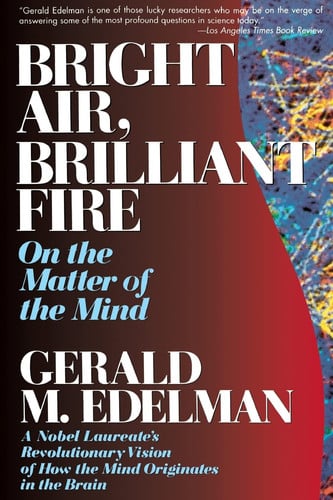
Bright air, brilliant fire: on the matter of the mind

Edelman, Gerald Maurice
We are on the brink of understanding ancient mysteries: how we know, what governs our nature, what makes a person different from a thing. In the last decade, more than twenty disciplines dealing with every aspect of the brain have contributed to a revolution in the neurosciences--a revolution as significant, in the view of many observers, as the Galilean and Copernican revolutions in mathematics and physics or the Darwinian revolution in biology. In this book, one of the world's foremost brain scientists gives us a glimpse into the workings of the human brain--the most complex material object in the universe. A match head's worth of the brain contains about a billion connections that can combine in ways which can only be described as hyperastronomical--on the order of ten followed by millions of zeros (there are only about ten followed by eighty zeros' worth of positively charged particles in the whole known universe).^
BasicBooks 1992 280 pages