546 results for "Medicine"

Bad Ideas? An Arresting History of Our Inventions

Robert Winston,Robert M. L. Winston
We are born with the instinct to create and invent. Indeed our ability to do so is what separates we humans from the rest of the animal world. The moment man first converted a stone to a useful tool set him on a relentless path toward greater control and power over his environment. But have our creative ideas always produced desirable results in line with their original good intention? How many ill-effects and dangers have they brought about along the way? And have they really served us well? Bad Ideas? traces the fascinating history of our attempts at self-improvement but also questions their value. The dubious consequences of the development of weaponry, for example, is self-evident from the primitive but lethal sling to the devastating nuclear bomb. But what of apparently more innocuous inventions such as farming, writing or medicine? All were initiated for the greater good but have nonetheless produced unforeseen fallout that continues to this day. What are their undesirable side-effects, how did they emerge over the years and where will they take us in the future? Written against a huge historical canvas, we join Robert Winston on a thrilling and inspiring journey from our earliest days to the present. We learn about the history of modern science, engineering, IT and much more, following the unexpected twists and turns of their progress. We meet the individuals who played a key role in their development, and share quirky anecdotes about their lives and brainwaves. Inspiring, unusual, and at times controversial, Bad Ideas? enables us by appreciating the past to look forward to the technological opportunities and ethical challenges of the future. In so doing it celebrates man's extraordinary capacity for achievement whilst warning us that his good intentions can sometimes end up as thoroughly bad ideas.
Bantam 2010 417 pages

The River of Consciousness

Oliver Sacks
From the bestselling author of Gratitude and Musicophilia , a collection of essays that displays Oliver Sacks's passionate engagement with the most compelling ideas of human endeavor: evolution, creativity, memory, time, consciousness, and experience. Oliver Sacks, scientist and storyteller, is beloved by readers for the extraordinary neurological case histories ( Awakenings , An Anthropologist on Mars ) in which he explored many now-familiar disorders--autism, Tourette syndrome, face blindness. He was also a memoirist who wrote with honesty and humor about the remarkable experiences that shaped him ( Uncle Tungsten , On the Move , Gratitude ). In the pieces that comprise The River of Consciousness (many first published in The New York Review of Books , among other places), Dr. Sacks takes on evolution, botany, chemistry, medicine, neuroscience, and the arts, and calls upon his great scientific and creative heroes--above all, Darwin, Freud, and William James. For Sacks, these thinkers were constant companions from an early age. The questions they explored--the meaning of evolution, the roots of creativity, and the nature of consciousness--lie at the heart of science and of this book. The River of Consciousness demonstrates Sacks's unparalleled ability to make unexpected connections, his sheer joy in knowledge, and his unceasing, timeless endeavor to understand what makes us human.
National Geographic Books 2018-10-09 256 pages

The Backyard Tribe

Neil B. Shulman
When Dr. Bud Payne of Mobile, Alabama, donates two weeks of his time to a Kenyan village hospital, it is the beginning of an astonishing adventure for him and his family.Bud offers to fly a young Maasai girl back to America for life-saving heart surgery. She comes - but not her entire tribe is with her, Maasai warriors carrying spears, mothers in tribal dress carrying babies, even a mysterious medicine man alight from the airplane.The girl goes to the hospital, but the tribe goes to the Paynes' backyard. Gone are Gail Payne's prized rose beds, gone is the lawn. In their place are the mud huts of the Maasai.As the suburban neighbors mingle with the tribesmen and the medicine man mingles with the surgeons, hilarious, harrowing, and even enlightening adventures result. The warriors rustle the nearest redneck's prime dairy cow for slaughter, and the Paynes' children swap their school clothes for war paint. Gail nearly loses her mind and Bud nearly loses his medical license.However, it all leads to a classic happy ending, heightened by a cultural exchange beyond anyone's original dreams.
RxHumor (1994) 1994-01-01

Why? what makes us curious

Livio, Mario
Astrophysicist and author Mario Livio investigates perhaps the most human of all our characteristics—curiosity—in this “lively, expert, and definitely not dumbed-down account” ( Kirkus Reviews ) as he explores our innate desire to know why . Experiments demonstrate that people are more distracted when they overhear a phone conversation—where they can know only one side of the dialogue—than when they overhear two people talking and know both sides. Why does half a conversation make us more curious than a whole conversation? “Have you ever wondered why we wonder why? Mario Livio has, and he takes you on a fascinating quest to understand the origin and mechanisms of our curiosity. I thoroughly recommend it.” (Adam Riess, Nobel Prize Winner in Physics, 2011). Curiosity is not only at the heart of mystery and suspense novels, it is also essential to other creative endeavors, from painting to sculpture to music. It is the principal driver of basic scientific research. Even so, there is still no definitive scientific consensus about why we humans are so curious, or about the mechanisms in our brain that are responsible for curiosity. In the ever-fascinating Why? Livio interviewed scientists in several fields to explore the nature of curiosity. He examined the lives of two of history’s most curious geniuses, Leonardo da Vinci and Richard Feynman. He also talked to people with boundless curiosity: a superstar rock guitarist who is also an astrophysicist; an astronaut with degrees in computer science, biology, literature, and medicine. What drives these people to be curious about so many subjects? An astrophysicist who has written about mathematics, biology, and now psychology and neuroscience, Livio has firsthand knowledge of his subject which he explores in a lucid, entertaining way that will captivate anyone who is curious about curiosity.
Simon & Schuster 2017 252 pages

The moral property of women: a history of birth control politics in America

Gordon, Linda
The only book to cover the entire history of birth control and the intense controversies about reproduction rights that have raged in the United States for more than 150 years, The Moral Property of Women is a thoroughly updated and revised version of the award-winning historian Linda Gordon's classic history Woman's Body, Woman's Right, originally published in 1976. Arguing that reproduction control has always been central to women's status, The Moral Property of Women shows how opposition to it has long been part of the conservative opposition to gender equality. From its roots in folk medicine and in a campaign so broad it constituted a grassroots social movement at some points in history, to its legitimization through public policy, the widespread acceptance of birth control has involved a major reorientation of sexual values. In three new chapters and updates throughout, Gordon addresses birth control and public policy, the intense abortion debates of the past thirty years, and a host of issues that extend from abortion controversies, including sterilization, teenage pregnancy and childbearing, and stem-cell research. Illuminating the conflicts and politics at the core of birth control issues through a historical lens, The Moral Property of Women places today's "choice" versus "right-to-life" movements in the context of the campaign that first prohibited abortion in the mid-nineteenth century and the campaign that legalized contraception in the early twentieth century. From the earliest attempts of women to organize for the legal control of their bodies to the effects of second-wave feminism, Gordon defines the role that birth control has played in society's attitudes towardwomen, sexuality, and gender equality. Highlighting the leaders of the struggle and their actions, The Moral Property of Women chronicles the contributions of notorious reproductive control activists such as Margaret Sanger as well as lesser-known pioneers including the utopian socialist Robert Dale Owen, the women's rights advocate Elizabeth Cady Stanton, the three doctors Foote -- Edward Bliss Foote, Edward Bond Foote, and Mary Bond Foote -- the anarchists Ezra Heywood and Emma Goldman, the civil libertarian Mary Ware Dennett, and abortion rights advocates of the 1970s.
University of Illinois Press 2002-11-06 446 pages

Biotechnology in the time of COVID-19: commentaries from the front line

Jeremy M. Levin
"A collection of diverse viewpoints from over 45 thought leaders in the biotechnology industry and their efforts going forward during the COVID-19 pandemic. Biotechnology in the Time of COVID-19 is the opening chapter of a story of how the biotechnology industry rose to battle the COVID-19 virus-told by the leaders of that industry in their own words. The industry has built over more than forty years, an ecosystem of scientists, entrepreneurs, doctors, investors, venture capitalists, analysts, media, and bankers, all committed to advancing global health. In two months, leaders and companies from this ecosystem pivoted from the work they were carrying on pre-COVID-19 to face the virus. Forty-six seven contributors offer historical, personal, and investor perspectives, views from inside the biotech companies, broad lessons, leadership, and a look to the future. COVID-19 was a crisis anticipated by many, but one for which we were inadequately prepared. That has led to an unnecessary catastrophe. Now is the time to shine a light on those who bring hope that we will push back the virus with science and medicine. This book is a collection of the voices from the front of that fight. All share the commitment to fight and the conviction that science and medicine will prevail. The editor royalties and a portion of publisher revenues will be donated to two nonprofits focused on rare disease research: Global Genes (globalgenes.org) and The Institute for Life Changing Medicines (lifechangingmedicines.org)"--
RosettaBooks 2020-05-31 285 pages

Unstuck: your guide to the seven-stage journey out of depression

Gordon, James S
“Extraordinary. . . . Both therapist and patient will benefit hugely from reading this book.” —Deepak Chopra “Exactly what this over-medicated country needs right now.” —Christine Northrup, M.D., author of The Wisdom of Menopause Despite the billions spent on prescription anti-depressant drugs and psychotherapy, people everywhere continue to grapple with depression. James Gordon, one of the nation's most respected psychiatrists, now offers a practical and effective way to get unstuck. Drawing on forty years of pioneering work, Unstuck is Gordon's seven-stage program for relief through food and nutritional supplements; Chinese medicine; movement, exercise, and dance; psychotherapy, meditation, and guided imagery; and spiritual practice. The result is a remarkable guide that puts the power to change in the hands of those ready to say "no" to suffering and drugs and "yes" to hope and happiness.
Penguin Books 2008 448 pages

Explorations in hypnosis

Elman, Dave
A classic in its field, EXPLORATIONS IN HYPNOSIS erases many of the misconceptions and superstitions that surround hypnosis. Techniques and principles are presented as they have been taught by Mr. Elman to over three thousand physicians and dentists. For many years hypnosis was strictly limited to stage and parlor performances but, with the help of Dave Elman, it has finally been allowed to take its place with the other medical sciences. The story of hypnosis is told here by the man who has been the world's greatest authority. He answers questions that have been in the mind of man for years, such as: CAN HYPNOSIS HELP SEXUAL PROBLEMS? CAN EVERYONE BE HYPNOTIZED? WHAT ABOUT SELF-HYPNOSIS? WHAT IS THE "ESDAILE" STATE? HOW DOES SELF-HYPNOSIS WORK? HOW CAN MEDICINE MAKE USE OF HYPNOSIS? WHEN WAS HYPNOSIS FIRST USED? WHAT IS SOMNAMBULISM? IS THERE DANGER OF NOT WAKING FROM HYPNOSIS? WILL A HYPNOTIC SUBJECT DO THINGS AGAINST HIS BELIEFS? For centuries hypnosis has been a mystery. Dave Elman, a true explorer in an unknown field, shows us that hypnosis is simply another tool to be used for man's benefit.
Nash Pub 1970 336 pages

The Waverly Gallery

Kenneth Lonergan
A powerful, poignant and often hilarious play, The Waverly Gallery follows the final years of a grandmother's battle against Alzheimer's disease. The play explores her fight to retain her independence and the subsequent effect of her decline on her family, especially her grandson. Inspired by Lonergan's own grandmother, it's an ode to an extraordinary woman, and to the humor and strength of a family in crisis.Kenneth Lonergan once again shows himself to have one of the keenest ears of any working playwright. Also the screenwirter of the deeply funny Analyze This, he's known for his incisive humor and brilliant knack for capturing the heart and soul of human interaction.
Grove Press 2000 108 pages

The best of the Bellevue literary review

Danielle Ofri
"A kaleidoscope of creativity . . . unsentimental and sometimes unpredictable."-- Journal of the American Medical Association Founded just six years ago, Bellevue Literary Review is already widely recognized as a rare forum for emerging and celebrated writers--among them Julia Alvarez, Raphael Campo, Rick Moody, and Abraham Verghese--on issues of health and healing. Gathered here are poignant and prizewinning stories, essays, and poems, the voices of patients and those who care for them, which form the journal's remarkable dialogue on "humanity and the human experience." Danielle Ofri, MD , author of Incidental Findings and Singular Intimacies , is the editor in chief of Bellevue Literary Review . She lives in New York City.
Bellevue Literary Press 2008 320 pages

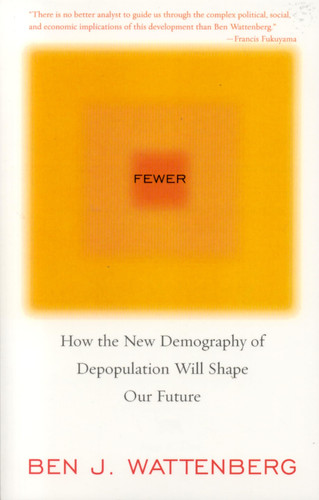
Fewer How the New Demography of Depopulation Will Shape Our Future

Ben J. Wattenberg
For at least 650 years, since the time of the Black Plague, the world's population has headed in only one direction: up. But within a few decades the number of people on earth will level off and then will likely decline over an extended period of time. In Fewer, the author explains how and why birthrates and fertility rates are now falling at an alarming rate in countries throughout the world--both modern and less developed. And he explores the major implications--for world politics, the environment, and the international economy--of this momentous shift. Illustrated with 23 clarifying charts.
Bloomsbury Academic 2004 241 pages