167 results for "Public Policy"

Weak courts, strong rights: judicial review and social welfare rights in comparative constitutional law

Tushnet, Mark V.
Unlike many other countries, the United States has few constitutional guarantees of social welfare rights such as income, housing, or healthcare. In part this is because many Americans believe that the courts cannot possibly enforce such guarantees. However, recent innovations in constitutional design in other countries suggest that such rights can be judicially enforced--not by increasing the power of the courts but by decreasing it. In Weak Courts, Strong Rights , Mark Tushnet uses a comparative legal perspective to show how creating weaker forms of judicial review may actually allow for stronger social welfare rights under American constitutional law. Under "strong-form" judicial review, as in the United States, judicial interpretations of the constitution are binding on other branches of government. In contrast, "weak-form" review allows the legislature and executive to reject constitutional rulings by the judiciary--as long as they do so publicly. Tushnet describes how weak-form review works in Great Britain and Canada and discusses the extent to which legislatures can be expected to enforce constitutional norms on their own. With that background, he turns to social welfare rights, explaining the connection between the "state action" or "horizontal effect" doctrine and the enforcement of social welfare rights. Tushnet then draws together the analysis of weak-form review and that of social welfare rights, explaining how weak-form review could be used to enforce those rights. He demonstrates that there is a clear judicial path--not an insurmountable judicial hurdle--to better enforcement of constitutional social welfare rights.
Princeton University Press 2009-08-09 272 pages

Racism, dissent, and Asian Americans from 1850 to the present: a documentary history

Foner,PhilipSheldon,1910-1994,Rosenberg,Daniel,1953-
Drawing from a broad range of articles, speeches, short stories, pamphlets, sermons, debates, laws, public statements, Supreme Court decisions and conventions, this documentary history demonstrates the persistence of a humanist, if not an anti-racist, pulse in American society in the face of discriminatory government policy and prevalent anti-Asian ideology and treatment. Focusing on support for the rights of Japanese and Chinese immigrants and their descendants, the book traces a 130-year period, culminating with the governmental redress for survivors of the Japanese evacuation and internment during WWII. Foner and Rosenberg highlight expressions from the clergy, the labor movement, the abolitionists, and public figures such as Wendell Phillips, Charles Sumner, Frederick Douglass, Mark Twain, John Stuart Mill, Norman Thomas and Carey McWilliams. It includes material never before published showing Black support for Asian rights and demonstrates the consistency of the Industrial Worker of the World's solidarity with Chinese and Japanese-American workers. It is also the first work to give serious treatment to clergymen's efforts against anti-Asian discrimination. After the introduction, Foner discusses law and dissent. The next four sections are devoted to statements by public figures, the views of the clergy, the labor movement and African-Americans. The final section covers relocation and protest. The book provides a valuable contribution to the debates on American dissent in general and against racism in particular, the meaning of American nationality, the criminality of the evacuation and internment of Japanese-Americans during World War II and the immigration policies of the United States government.
Greenwood Press 1993-04-30 311 pages

Left out: the politics of exclusion : essays, 1964-2002

Duberman, Martin B.
"One would be hard-pressed to name a more admirable contemporary American example of the intellectual engage than Martin Duberman. Historian, playwright, memoirist, biographer, social commentator, teacher, activist and assured podium performer, Duberman is an unapologetic, uncategorizable and nonsectarian radical whose constant questioning of conventional wisdoms - even on the left - has made him one of this country's pre-eminent participants in the political and cultural wars that have riven public life."â__In These Times"A marvelous collection of a lifetime of courageous writing by a deeply moral and reflective man who has engaged the greatest struggles of our times with an unflinching nerve, a wise heart and a brilliant intellect informed at all times by compassion."â__Jonathan KozolThe lives of â__outsidersâ__ have been the focus of Martin Duberman's work as a public intellectual for the past four decades. Best known for his biography of Paul Robeson, Duberman highlights the "banding together" of the excluded in Left Out. These identity-based movementsâ__black power, gay liberation, feminismâ__have created a vital and controversial change in American consciousness in recent decades. Duberman's collected essays trace this evolution of thought to the history of dissent from abolitionism through the New Left to today's organizing.Presenting summations of Duberman's views on such matters as race, foreign policy, gender and sexuality, Left Out offers incisive analyses of the split between class-based and identity-based politics on the Left. The "godfather" of the gay studies movement, Duberman has taken many brave and prescient stands. His writing shows why he is considered a deeply moral and wise man. For the first time available in paperback, this edition, updated through 2002, includes three new essays: "The State of Gay Studies," "Queer Economic Justice," and "Jewish Radicals, Effeminacy, and the Rise of Gay Chauvinism".
South End Press 2002 504 pages

Reasons to kill: why Americans choose war

Rubenstein, Richard E.
From the American Revolution to the end of World War II, the United States spent nineteen years at war against other nations. But since1950, the total is twenty-two years and counting. On four occasions, U.S. presidents elected as "peace candidates" have gone on to lead the nation into ferocious armed conflicts. Repeatedly, wars deemed necessary when they began have been seen in retrospect as avoidable‚ Äîandill-advised. Americans profess to be a peace-loving people and one wary of "foreign entanglements." Yet we have been drawn into wars in distant lands from Vietnam to Afghanistan. We cherish our middle-class comforts and our children. Yet we send our troops to Fallujah and Mogadishu. How is it that ordinary Americans with the most to lose are so easily convinced to follow hawkish leaders-of both parties-into war? In Reasons to Kill noted scholar Richard E. Rubenstein explores both the rhetoric that sells war to the public and the underlying cultural and social factors that make it so effective. With unmatched historical perspective and insightful commentary, Rubenstein offers citizens new ways to think for themselves about crucial issues of war and peace.
Bloomsbury Press 2010-09-28 238 pages

Security and sacrifice: isolation, intervention, and American foreign policy

Abrams, Elliott
Product Description The disintegration of the Soviet Union has once again brought to the fore the question that has preoccupied American foreign policy since our nation's founding: what role should America take in the World?In Security and Sacrifice: Isolation, Intervention, and American Foreign Policy, Elliott Abrams describes and analyzes the international political system that faces the U.S. in the aftermath of the Cold War. Abrams argues, that the United States must first create a domestic consensus on just what America's role should be in a rapidly changing international order. However, as he points, standing in the way of such agreement is a fundamental dispute over values and interests, and it turns on one crucial question: When should the United States risk the lives of American soldiers to solve problems in other countries?Through Abrams analysis, and the twists and turns of American Foreign policy during the Cold War, there becomes a clearer picture for the future. Offering insight and recommendation, Abrams explores not only the alternatives to today's current foreign policy issues, but intrigues his audience by his forecast into the Clinton Administration and the future of American foreign policy; as well as recent analysis of the Bush legacy and the context for peaceful relations in the Gulf region. About the Author Hudson Institute is an internationally recognized public policy research organization that forecasts trends and develops solutions for governments, businesses and the public. Founded in 1961 by the late Herman Kahn, the Indianapolis-based not-for-profit 501(c)(3) organization has more than 70 researchers and employees at its eight offices worldwide.
Hudson Institute 1995-01-01 150 pages

In Brown's wake: legacies of America's educational landmark

Minow, Martha
What is the legacy of Brown vs. Board of Education? Well known for establishing racial equality as a central commitment of American schools, the case also inspired social movements pursuing equality in education for students across all lines of difference, including language, gender, disability, immigration status, socio-economic status, religion, and sexual orientation. Yet, more than a half-century following Brown, schools, parents and policy makers still debate whether the ruling requires all-inclusive classrooms, and today American schools appear to be more segregated than ever. School choice, once a strategy for avoiding racial integration, has emerged as a method for racial mixing in some school systems, even as magnet and pilot schools, charter schools, and vouchers for private schools enable new forms of self-separation by language, gender, disability, and ethnicity. In In Brown's Wake, Martha Minow examines the way that Brown continues to reverberate over a wide-spectrum of equality issues in public and school choice programs. She argues that the terms placed on such initiatives carry serious consequences for both the character of American education and civil society itself. Though the original promise of Brown remains more symbolic than effective, Minow demonstrates the power of its vision in the struggles for equal education regardless of students' social identity, in the United States and internationally. Further, she urges renewed commitment to the project of social integration even while identifying the complex routes necessary to achieve it. A concise introduction to Brown and its aftermath, In Brown's Wake explores surprising and widespread effects of one of the most important Supreme Court decisions of the century with elegance and economy.
Oxford University Press 2010-08-19 304 pages

Deliberative democracy in America: a proposal for a popular branch of government

Leib, Ethan J.
We are taught in civics class that the Constitution provides for three basic branches of government: executive, judicial, and legislative. While the President and Congress as elected by popular vote are representative, can they really reflect accurately the will and sentiment of the populace? Or do money and power dominate everyday politics to the detriment of true self-governance? Is there a way to put "We the people" back into government? Ethan Leib thinks there is and offers this blueprint for a fourth branch of government as a way of giving the people a voice of their own. While drawing on the rich theoretical literature about deliberative democracy, Leib concentrates on designing an institutional scheme for embedding deliberation in the practice of American democratic government. At the heart of his scheme is a process for the adjudication of issues of public policy by assemblies of randomly selected citizens convened to debate and vote on the issues, resulting in the enactment of laws subject both to judicial review and to possible veto by the executive and legislative branches. The "popular" branch would fulfill a purpose similar to the ballot initiative and referendum but avoid the shortcomings associated with those forms of direct democracy. Leib takes special pains to show how this new branch would be integrated with the already existing governmental and political institutions of our society, including administrative agencies and political parties, and would thus complement rather than supplant them.
Pennsylvania State University Press 2004 156 pages

She took a village: the unauthorized biography of Hillary Rodham Clinton

Gottlieb, Alan M.
She Took A Village tears the lid off the secrets of Hillary Rodham Clinton in a probing investigation of America's power-grabbing First Lady. This unauthorized biography reveals a life-time of ruthless determination, skillful manipulation and artful denial unmatched in the long history of American presidential wives. She Took A Village puts it all together in a fast-paced, absorbing story you won't want to miss. With his latest book, Alan Gottlieb lobs another political grenade into the fray over public policy. Long recognized as a leading gun rights advocate and successful direct mail fund raiser for conservative causes, he has emerged as a media mogul through his chairmanship of the Talk America Radio Networks, which boast over 500 affiliate stations from coast to coast. Alan Gottlieb has achieved that most enviable position among writers, the insider status that lets him see the whole picture from the top of the pyramid. You get the advantage of his many years behind the Washington scenes and the crisp, informative, right-to-the-point style that made his earlier books best-sellers.
Merril Press 1998 169 pages

Lessons from deregulation: telecommunications and airlines after the crunch

Kahn, Alfred E.
Over the last several years, the value of stocks in both the airline and the telecommunications industries have dropped catastrophically. Since these industries were among the most important --and most visible --to have been unleashed from regulation in recent decades (albeit in widely differing degree), their difficulties have raised the question of whether their deregulation should be reconsidered or even reversed.Alfred E. Kahn, one of the foremost authorities on deregulation, argues in this book that every passing year demonstrates the superiority of the road chosen for the airlines. He contrasts the financial meltdowns of both the airline and telecommunications industries with others taking place at the same time, particularly in technology-related stocks and "dot.coms," pointing out that these sectors were also relatively free of direct economic regulation. Their experience provides a useful counter to the natural tendency to blame all the woes of aviation and telecommunications on government policy.This book provides a valuable and accessible guide to unraveling the complex world of network deregulation. It will serve as a reference point for practioners and policymakers, as well as an important introduction for the general public.
AEI-Brookings Joint Center for Regulatory Studies 2004 88 pages

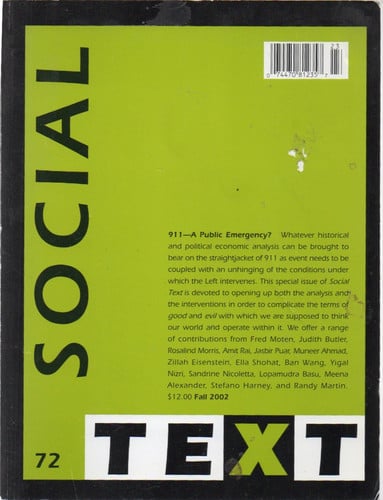
911 a Public Emergency?

Brent Hayes Edwards,Stefano Harney,Randy Martin,Ella Shohat,Timothy Mitchell,Fred Moten
Since September 11, public discourse has often been framed in terms of absolutes: an age of innocence gives way to a present under siege, while the United States and its allies face off against the Axis of Evil. This special issue of Social Text aims to move beyond these binaries toward thoughtful analysis. The editors argue that the challenge for the Left is to develop an antiterrorism stance that acknowledges the legacy of U.S. trade and foreign policy as well as the diversity of the Muslim faith and the dangers presented by fundamentalism of all kinds. Examining the strengths and shortcomings of area, race, and gender studies in the search for understanding, this issue considers cross-cultural feminism as a means of combating terrorism; racial profiling of Muslims in the context of other racist logics; and the homogenization of dissent. The issue includes poetry, photographic work, and an article by Judith Butler on the discursive space surrounding the attacks of September 11. This impressive range of contributions questions the meaning and implications of the events of September 11 and their aftermath. Contributors . Muneer Ahmad, Meena Alexander, Lopamudra Basu, Judith Butler, Zillah Eisenstein, Stefano Harney, Randy Martin, Rosalind C. Morris, Fred Moten, Sandrine Nicoletta, Yigal Nizri, Jasbir K. Puar, Amit S. Rai, Ella Shohat, Ban Wang
Duke University Press 2002-09-20 208 pages

Communists in closets: queering the history 1930s-1990s

Aptheker, Bettina
"Communists in Closets: Queering the History 1930s-1990s explores the history of gay, lesbian and non-heterosexual people in the Communist Party in the United States The Communist Party banned LGBT people from membership beginning in 1938 when it cast them off as "degenerates." It persisted in this policy until 1991 when the Party split apart in the wake of the collapse of the Soviet Union and the socialist countries of Eastern Europe. During this 60- year ban, gays and lesbians who did join the Communist Party were deeply closeted within it, as well as in their public lives as both queer and Communist. By the late 1930s the Communist Party had a membership approaching 100,000 and tens of thousands of more people moved in its orbit through the Popular Front against fascism, anti-racist organizing, especially in the south, and its widely read cultural magazine, The New Masses. Based on a decade of archival research, correspondence, and interviews, Bettina Aptheker explores this history, also pulling from her own experience as a closeted lesbian in the Communist Party in the 1960s and 70s. Ironically, and in spite of this homophobia individual Communists laid some of the political and theoretical foundations for lesbian and gay liberation, and contributed significantly to peace, social justice, civil rights, Black and Latinx liberation movements. This book will be of interest to students, scholars, and general readers in political history, gender studies and the history of sexuality"--
Routledge Taylor & Francis Group 2023 255 pages

Israel and the American national interest: a critical examination

Rubenberg, Cheryl A.
"Israel's special relationship with the united States has come under close public scrutiny in recent months following revelations about Israeli involvement in the Iran-Contra and Jonathan Pollard spy scandals. Cheryl Rubenberg's controversial new book traces the evolution of that relationship from the Truman through the Reagan administrations and challenges the widely held view that close ties between Tel Aviv and Washington have served U. S. interests well in the Middle East. Indeed, she makes a convincing case that, in the two decades since 1967, U.S. policymakers have tended to confuse what is best for Israel with what is best for the United States and to ignore what she regards as the most pressing problem in the Middle East, the quest for a Palestinian homeland." -- Douglas Little, International History Review
University of Illinois Press 1986 446 pages

Urban change in the United States and Western Europe: comparative analysis and policy

Summers, Anita A.
In this completely revised second edition, the authors explore what can be learned from a rigorous comparison of the patterns of urban concentrations of residents and employment in Western Europe and the United States. Using a wide range of methodological techniques, including economic theory, econometrics, regional science, and institutional historical analysis, the essays analyze the factors underlying urban economic development, with particular emphasis on the role and effectiveness of public policy.
Urban Institute Press 1999-08-15 621 pages

The politics of national security

Raskin, Marcus G.
The evolution of the national security state in the United States can be traced from the political, military, and economic dimensions of American power in the postwar world. In Raskin's view, the United States emerged from the Second World War with tremendously increased prestige and material power, and American leadership created a national security apparatus as a planning instrument to ensure national stability, to mute class conflicts, and to secure the domestic economy. This state then became the basis around the world for covert and overt imperialism.The consensus that developed served to maintain stability at home and to guide the modern empire abroad. This development required a state that was orderly and that was predicated on modern bureaucracy, which operated within the values and assumptions of the ruling elites.The national security state system was successful primarily in the economic sphere, with bipartisan foreign-policy decision making aimed at ensuring a stable business climate at home and abroad. Military involvement in Indochina evidenced the decline of American hegemony; the genocidal nature of the arms race and the questions raised by protestors of the sixties signaled the break up of the national security consensus.Raskin concludes the book with an examination of alternative directions, especially regarding the need and the possibilities for renewed public debate of national policy and purpose.
Transaction Books 1979 211 pages

Government and public health in America

Hamowy, Ronald
How involved should the government be in American healthcare? Ronald Hamowy argues that to answer this pressing question, we must understand the genesis of the five main federal agencies charged with responsibility for our health: the Public Health Service, the Food and Drug Administration, the Veterans Administration, the National Institutes of Health, and Medicare. In examining these, he traces the growth of federal influence from its tentative beginnings in 1798 through the ambitious infrastructures of today - and offers startling insights on the current debate. The author contends that until the twentieth century, governmental involvement in health care policy was nominal. With the sweeping food and drug reforms of 1906 and the Medicare amendments to Social Security in 1965, a whole new system of health care was brought to the American public. A careful analysis of the various programs generated by this legislation, however, shows a different picture of pet projects, budgetary lobbying, competitive bureaucracy and discord between the agencies and their opposition. Government and Public Health in America provides an illuminating look at the complicated forces that created these institutions and provokes discussion about their usefulness in the future. Hamowy's thoroughly researched analysis fills a substantial gap in the history of health policy. Economists, political scientists, historians, sociologists and health professionals concerned with the interface between government and health care will find much to recommend in this highly readable account of a fascinating topic.
Edward Elgar 2008 529 pages

Comparing cultural policy: a study of Japan and the United States

Joyce Zemans,Archie Kleingartner
There is among many nations a growing awareness that the arts and culture have an important role to play in forming the image that nations hold of themselves and that they convey in the international arena. At the same time, increased pressure on the public purse, new trade environments, and the revolution in communications technology are forcing the reexamination of cultural policy objectives and strategies for achieving those objectives in countries throughout the world. This book, based on the research and expertise of practitioners and scholars in the field of cultural policy, provides a broadly based cross-cultural analysis of policy in two countries with very different cultural traditions. The authors move beyond cultural boundaries to define 'art' and 'culture,' explore the role of cultural policies in a nation's cultural development, and evaluate policy effectiveness and relevance. Case studies of organizations in art, music, dance, and drama, in both the United States and Japan, examine the elements that contribute to effective arts management and policy-making. Arts managers, cultural policy-makers, researchers, practitioners, and educators will find this an excellent resource that provides valuable teaching materials in the field of cultural policy and facilitates cross-cultural learning about arts management.
AltaMira Press 1999-03-22 295 pages