192 results for "Trade"

Yankel's tavern: Jews, liquor, and life in the Kingdom of Poland

Dynner, Glenn
In nineteenth-century Eastern Europe, the Jewish-run tavern was often the center of leisure, hospitality, business, and even religious festivities. This unusual situation came about because the nobles who owned taverns throughout the formerly Polish lands believed that only Jews were sober enough to run taverns profitably, a belief so ingrained as to endure even the rise of Hasidisms robust drinking culture. As liquor became the regions boom industry, Jewish tavernkeepers became integral to both local economies and local social life, presiding over Christian celebrations and dispensing advice, medical remedies and loans. Nevertheless, reformers and government officials, blaming Jewish tavernkeepers for epidemic peasant drunkenness, sought to drive Jews out of the liquor trade. Their efforts were particularly intense and sustained in the Kingdom of Poland, a semi-autonomous province of the Russian empire that was often treated as a laboratory for social and political change. Historians have assumed that this spelled the end of the Polish Jewish liquor trade. However, newly discovered archival sources demonstrate that many nobles helped their Jewish tavernkeepers evade fees, bans and expulsions by installing Christians as fronts for their taverns. The resulta vast underground Jewish liquor tradereflects an impressive level of local Polish-Jewish co-existence that contrasts with the more familiar story of anti-Semitism and violence. By tapping into sources that reveal the lives of everyday Jews and Christians in the Kingdom of Poland, Yankels Tavern transforms our understanding of the region during the tumultuous period of Polish uprisings and Jewish mystical revival.
Oxford University Press 2014 249 pages

Class ideology and ancient political theory: Socrates, Plato, and Aristotle in social context

Wood, Ellen Meiksins
The political thought of Socrates, Plato and Aristotle defended and justified the values and way of life of the declining and decaying landed aristocracy in opposition to Athenian democracy and the craftsmen, traders and labourers upon which it increasingly rested. Although the Socratics recognized and condemned aristocratic regeneration, they hoped that the outlook and conduct of the nobility could be revitalized so as once more to become the foundation of civic life in order to stem the levelling tide of democracy, the tyranny of the mob, and the vulgarity that they felt were endangering Greece and especially Athens. To be understood and appreciated fully, the classics of political theory must be viewed as basically ideological and much more closely and rigorously related to their social contexts than has usually been the case. The point of departure for this critique of the Socratics is a particular conception of the Greek polis and its significance for Western social organization, an interpretation differing from most standard treatments. Besides casting new light upon the political thought of the Socratics, this study should help to illuminate the aristocratic myth about the character of the demos which, immortalized by the Socratics, has been a cornerstone of anti-democratic ideology and social theory in the West ever since the ancient philosophers first recorded their fears of the 'mob'.
Oxford University Press 1978 275 pages

Reading culture and writing practices in nineteenth-century France

Lyons, Martyn
Between about 1830 and the outbreak of the First World War, print culture, reading, and writing transformed cultural life in Western Europe in many significant ways. Book production and consumption increased dramatically, and practices such as letter- and diary-writing were widespread. This study demonstrates the importance of the nineteenth century in French cultural change and illustrates the changing priorities and concerns of l'histoire du livre since the 1970s. From the 1830s on, book production experienced an industrial revolution which led to the emergence of a mass literary culture by the close of the century. At the same time, the western world acquired mass literacy. New categories of readers became part of the reading public while western society also learned to write. Reading Culture and Writing Practices in Nineteenth-Century France examines how the concerns of historians have shifted from a search for statistical sources to more qualitative assessments of readers' responses. Martyn Lyons argues that autobiographical sources are vitally important to this investigation and he considers examples of the intimate and everyday writings of ordinary people. Featuring original and intriguing insights as well as references to material hitherto inaccessible to English readers, this study presents a form of 'history from below' with emphasis on the individual reader and writer, and his or her experiences and perceptions.
University of Toronto Press 2008-01-01 245 pages

The Other 1492 Jewish Settlement in the New World

Norman H. Finkelstein
Mention 1492 and most people conjure up images of three stout ships making their way west. But 1492 was the year in which the vibrant Jewish community of Spain came to an abrupt and tragic end. This book details the expulsion of the Jews from Spain and Portugal and their early immigration to the New World. European anti-Semitism followed the Jews but the newcomers persevered and made a home for themselves in the New World. Starred Review and Editor’s Choice, Booklist, NCCS/CBC Notable Children’s Trade Book and American Bookseller Pick of the Lists, 1990.
iUniverse 2001-01-11 116 pages

Tatra: the legacy of Hans Ledwinka

Margolius, Ivan,Henry, John G. (Writer on the automobile industry)
Tatra – The Legacy of Hans Ledwinka is the story of the Tatra company, which originated in the Central European country of Czechoslovakia. It is a tale of great innovation and avant-garde design in automobile engineering. It is also the story of one man – Hans Ledwinka – and his visionary concepts which have become highly influential, although often undervalued, contributions to the development of car technology. Until now, Hans Ledwinka's talent has hardly been recognised; in retrospect, he can be judged equal to car designers such as Benz, Daimler and Porsche, whose endeavours have been fully recorded many times over. With his revolutionary Tatra cars, Ledwinka consistently pushed back the frontiers of automobile construction, and it’s certain that without his inspiration, the Volkswagen in its air-cooled rear-engined form would perhaps never have been conceived. This book suggests that Ledwinka played a greater part in this development than has previously been appreciated. The authors have covered the full history of the Tatra company, which is one of the oldest factories in continuous automobile manufacture, dating back to the 19th century. By doing this, they have placed both Ledwinka and the Czechoslovak Tatra company in their rightful place in the history of car design, and provided a fully comprehensive assessment of the influence of Tatra car designs and their inspired creator. The text of this larger format 2nd edition has been fully revised and updated since the 1990 edition. This new edition also contains many additional illustrations. The book also has a new foreword, written by Norman Foster, the British architect, and proud owner of a Tatra T87, who pays tribute to the aesthetic qualities of this design classic and captures the fascination of both designers and motor historians with the development of Tatra.
Veloce Publishing Limited 2019-10 224 pages

My Life as German and Jew

Jakob Wassermann
This work has been selected by scholars as being culturally important and is part of the knowledge base of civilization as we know it. This work is in the public domain in the United States of America, and possibly other nations. Within the United States, you may freely copy and distribute this work, as no entity (individual or corporate) has a copyright on the body of the work. Scholars believe, and we concur, that this work is important enough to be preserved, reproduced, and made generally available to the public. To ensure a quality reading experience, this work has been proofread and republished using a format that seamlessly blends the original graphical elements with text in an easy-to-read typeface. We appreciate your support of the preservation process, and thank you for being an important part of keeping this knowledge alive and relevant.
Franklin Classics Trade Press 2018-11-11 290 pages

Basketball Belles How Stanford, Cal, and One Scrappy Player Put Womens Hoops on the Map

Sue Macy
Witness the birth of women's basketball in this illustrated introduction from renowned nonfiction author Sue Macy. Raised on a cattle ranch, Agnes Morley was sent to Stanford University to learn to be a lady. But she soon exchanged her breeches and spurs for bloomers and a basketball—and in April 1896, she made history. In a heart-pounding game against the University of California at Berkeley, Agnes led her team to victory in the first-ever inter-collegiate women's basketball game, earning national attention and putting women's basketball on the map. This fast-paced story of perseverance and success digs deep into the history of one of America's most popular sports, and how it came to be so big. Realistic illustrations by Matt Collins put readers in the middle of the action, and you'll want cheer along with the crowd. With comprehensive backmatter including a timeline, author's note, select bibliography, and recommended places to visit for more information, Basketball Belles is a perfect introduction to an intriguing moment in sports and women's history. A Junior Library Guild Selection Booklist Top 10 Sports Books for Youth Booklist Editors' Choice, Books for Youth, Nonfiction, Middler Readers NCSS Notable Social Studies Trade Books for Young People, History/Life & Culture in the Americas
Holiday House 2019-05-28 32 pages

The apothecary's daughter

Schonstein, Patricia
"A nobleman and his wife, an apothecary nun, an astronomer-mathematician, an inquisitor, a poet who is both lover and villain, a portraitist, a queen and loyal servants deftly act out a beautiful drama of tantalizing relationships. They take up their roles in castle and convent, some surrounded by ornate interiors, garbed in velvets and silks, garlanded with precious jewels; while others abide in simple space devoid of art or representation, and dressed in plain linens and dull calicos. THE APOTHECARY'S DAUGHTER is a wondrous tale, rendered in erotic prose and poetry, stitched through with rich imagery, humour and tenderness. It is also a story of trade and exotic travel, both across the surface of the earth and among the stars."
Bantam 2004 224 pages

Between the yeshiva world and modern orthodoxy: the life and works of Rabbi Jehiel Jacob Weinberg

Shapiro, Marc B.
A biography of the leading halakhic authority Jehiel Jacob Weinberg, born in Ciechanowiecz, Poland. He was the last rector of the Berlin Rabbinical Seminary. Ch. 5 (pp. 110-134), "Response to the New Nazi Government (1933-1934), " characterizes the early reaction of Weinberg to the Nazis as naive and apologetic. Weinberg helped the Orthodox Jews deal with problems of daily life under the Nazis (e.g. the ban on ritual slaughter). Ch. 6 (pp. 135-171), "The Nazi Era (1933-1945), " notes that Orthodox German Jews first adopted a policy of appeasement with the regime. With Jews excluded from general education and other aspects of German life, the role of the Seminary became more important. Weinberg had opposed Jewish emigration, and the "Kristallnacht" pogrom came as a tremendous shock to him; the Seminary was closed and most of the students and faculty emigrated. At the outbreak of the war he was in Warsaw, where he helped with communal affairs. As a Soviet citizen, Weinberg suffered less than others; in October 1941 he was transferred from the Warsaw ghetto to a detention camp in Wuelzburg, Germany, possibly in order to trade him for German citizens held captive in the USSR. He remained there until April 1945. Most of his family was murdered in the Holocaust. After the war he became head of a yeshiva in Montreux, Switzerland.
Littman Library 1999 283 pages

Discourses of the Ecclesiastical and Civil Polity of the Jews. ... Written by Isaac Abendana,

Isaac Abendana
The 18th century was a wealth of knowledge, exploration and rapidly growing technology and expanding record-keeping made possible by advances in the printing press. In its determination to preserve the century of revolution, Gale initiated a revolution of its own: digitization of epic proportions to preserve these invaluable works in the largest archive of its kind. Now for the first time these high-quality digital copies of original 18th century manuscripts are available in print, making them highly accessible to libraries, undergraduate students, and independent scholars. The Age of Enlightenment profoundly enriched religious and philosophical understanding and continues to influence present-day thinking. Works collected here include masterpieces by David Hume, Immanuel Kant, and Jean-Jacques Rousseau, as well as religious sermons and moral debates on the issues of the day, such as the slave trade. The Age of Reason saw conflict between Protestantism and Catholicism transformed into one between faith and logic -- a debate that continues in the twenty-first century. ++++ The below data was compiled from various identification fields in the bibliographic record of this title. This data is provided as an additional tool in helping to insure edition identification: ++++ British Library T032014 P.200 misnumbered 100. London: printed for Samuel Ballard, 1706. [8],100[i.e.200]p.; 8°
Creative Media Partners, LLC 2018-04-19 212 pages

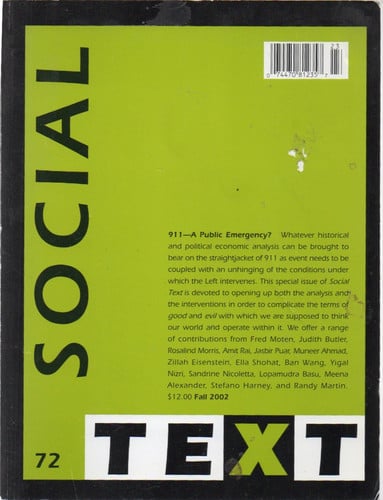
911 a Public Emergency?

Brent Hayes Edwards,Stefano Harney,Randy Martin,Ella Shohat,Timothy Mitchell,Fred Moten
Since September 11, public discourse has often been framed in terms of absolutes: an age of innocence gives way to a present under siege, while the United States and its allies face off against the Axis of Evil. This special issue of Social Text aims to move beyond these binaries toward thoughtful analysis. The editors argue that the challenge for the Left is to develop an antiterrorism stance that acknowledges the legacy of U.S. trade and foreign policy as well as the diversity of the Muslim faith and the dangers presented by fundamentalism of all kinds. Examining the strengths and shortcomings of area, race, and gender studies in the search for understanding, this issue considers cross-cultural feminism as a means of combating terrorism; racial profiling of Muslims in the context of other racist logics; and the homogenization of dissent. The issue includes poetry, photographic work, and an article by Judith Butler on the discursive space surrounding the attacks of September 11. This impressive range of contributions questions the meaning and implications of the events of September 11 and their aftermath. Contributors . Muneer Ahmad, Meena Alexander, Lopamudra Basu, Judith Butler, Zillah Eisenstein, Stefano Harney, Randy Martin, Rosalind C. Morris, Fred Moten, Sandrine Nicoletta, Yigal Nizri, Jasbir K. Puar, Amit S. Rai, Ella Shohat, Ban Wang
Duke University Press 2002-09-20 208 pages

The assassination of Hole in the Day

Treuer, Anton
On June 27, 1868, Hole in the Day (Bagonegiizhig) the Younger left Crow Wing, Minnesota, for Washington, DC, to fight the planned removal of the Mississippi Ojibwe to a reservation at White Earth. Several miles from his home, the self-styled leader of all the Ojibwe was stopped by at least twelve Ojibwe men and fatally shot. Hole in the Day's death was national news, and rumors of its cause were many: personal jealousy, retribution for his claiming to be head chief of the Ojibwe, retaliation for the attacks he fomented in 1862, or retribution for his attempts to keep mixed-blood Ojibwe off the White Earth Reservation. Still later, investigators found evidence of a more disturbing plot involving some of his closest colleagues: the business elite at Crow Wing. While most historians concentrate on the Ojibwe relationship with whites to explain this story, Anton Treuer focuses on interactions with other tribes, the role of Ojibwe culture and tradition, and interviews with more than fifty elders to further explain the events leading up to the death of Hole in the Day. The Assassination of Hole in the Day is not only the biography of a powerful leader but an extraordinarily insightful analysis of a pivotal time in the history of the Ojibwe people. " An essential study of nineteenth-century Ojibwe leadership and an important contribution to the field of American Indian Studies by an author of extraordinary knowledge and talent. Treuer's work is infused with a powerful command over Ojibwe culture and linguistics." --Ned Blackhawk, author of Violence Over the Land: Indians and Empires in the Early American West "The Assassination of Hole in the Day is a masterful history, and more. Anton Treuer illuminates the character of a controversial and charismatic Ojibwe leader from within Ojibwe culture, and tells a powerful story of loss that reverberates in the present." --Louise Erdrich "This is more than a murder mystery. It provides insights into the evolution of clan structure, tribal governance and relations with the Dakota and other tribes since the time a century and a half ago when white pressure, the declining fur trade and other factors led to the cession of great tracts of land and the people's removal to reservations." --Star Tribune "This highly recommended work provides insights into the challenges faced by native peoples during an era when they were under intense pressure by the federal government to move to reservations." --Library Journal "Treuer explores the life and death of this brash young leader, and delves into tribal history and the intricate machinations of Ojibwa politics." --Booklist Anton Treuer, professor of Ojibwe at Bemidji State University, is the author of Ojibwe in Minnesota and several books on the Ojibwe language. He is also the editor of Oshkaabewis Native Journal, the only academic journal of the Ojibwe language.
Borealis Books 2011 295 pages

Rachel's promise

Sanders, Shelly
It is late 1903, and Rachel and her family are leaving Russia to escape the murderous riots against Jews. They travel cross country on the Trans-Siberian Railway to the coast and board a ship for Shanghai. China offers refuge, but life for them there is difficult and strange. The opportunity to write for a Jewish newspaper may help Rachel ensure her family's survival while not giving up her dreams for her future. Still in Russia, Rachel's friend Sergei leaves home for a factory job in St. Petersburg, soon joining the rebelling workers, but realizing he has traded one source of danger for another. Separated by so much, the two teenagers try to make their way in the turbulent political times of the early twentieth century--their only connection the letters they write, and their fierce hope for the future.
Second Story Press 2013 278 pages

East End underworld: chapters in the life of Arthur Harding

Raphael Samuel
First published in 1981, this book examines the life of Arthur Harding, a well-known figure in the East End underworld during the first half of the twentieth century. The first five chapters survey his life in the 'Jago' slum between 1887 and 1896, offering a different view of an often vilified district. The subsequent phases of his life as a cabinet-maker, street trader and wardrobe dealer reflect the changing fortunes of the East End from hand-to-mouth conditions in the late-nineteenth century to comparative security in the 1930s. The reader is introduced to some of the major features of East End life -- back-street enterprise, neighbourhood solidarity, politics and popular culture. Among the many themes that can be traced are the relationship between the underworld and the local working-class community; the collusive understanding established between villains and the police; the effects of the criminalisation of street betting; and the relationship between Jews, non-Jews and what the author terms 'half-jews' in a district of high immigration. Drawn from transcripts of recorded reminiscences, this book provides an important text for understanding the political economy of crime -- extended by the authors extensive footnotes and a preface discussing the peculiar moral complexion of south-west Bethnal Green.
Routledge 2016-08-11 355 pages

Apogee of empire: Spain and New Spain in the age of Charles III, 1759-1789

Stein, Stanley J.
"In Apogee of Empire, the authors argue that the inability to renovate the Hapsburg legacies reflected reluctance to undertake radical changes first at home, then in Spain's relationship with its colonies." "The Steins trace in detail efforts to reform the Spanish establishment in the early 1760s, initially under the leadership of the marques de Esquilache, who accompanied Charles from Naples. Reformers had to determine which adjustments could be made without risking radical innovation. The ensuring seven-year conflict between reformers and traditionalists ended in a coup that outsted Esquilache. The authors then analyze the shift in focus to the colonies and the emphasis on incrementally modifying a key element of Spanish colonialism, transatlantic trade, via so-called free trade within the imperial system. Comercio libre, like most Bourbon reformism in general, neither realized a colonial pact nor improved Spain's competitive position in the Atlantic trading system. At the time of Charles III's death, the authors conclude, Spain had only made superficial changes, rather than the profound transformation the situation demanded, and by 1789 Spain and its wealthiest colony, New Spain, would be ill-prepared for the coming decades of upheaval in Europe and America."--Jacket
Johns Hopkins University Press 2003-11-04 464 pages

Jewish subjects and their tribal chieftains in Kurdistan: a study in survival

Zaken, Mordechai
"Based on new oral sources, carefully analyzed, this book explores the relationships between Jewish subjects and their tribal chieftains in Kurdistan, focusing on the patronage and justice provided by the chieftains and the financial support provided by the Jews to endure troubles and caprices of chieftains. New reports and vivid tales unveil the status of Jews in the tribal setting; the slavery of rural Jews; the conversion to Islam and the defense mechanisms adopted by Jewish leaders to annul conversion of abducted women. Other topics are the trade and occupations of the Jews and their financial exploitation by chieftains. The last part explores the experience of Jewish communities in Iraqi Kurdistan between World War I and the mass-migration to Israel (1951-52)."--Jacket.
Brill 2007-01-01 375 pages

After abolition: Britain and the slave trade since 1807

Sherwood, Marika
With the abolition of the slave trade in 1807 and the Emancipation Act of 1833, Britain seemed to wash its hands of slavery. Not so, according to Marika Sherwood, who sets the record straight in this provocative new book. In fact, Sherwood demonstrates that Britain continued to contribute to the slave trade well after 1807, even into the twentieth century. Drawing on government documents and contemporary reports as well as published sources, she describes how slavery remained very much a part of British investment, commerce and empire, especially in funding and supplying goods for the trade in slaves and in the use of slave-grown produce. The nancial world of the City in London also depended on slavery, which - directly and indirectly - provided employment for millions of people. "After Abolition" also examines some of the causes and repercussions of continued British involvement in slavery and describes many of the apparently respectable villains, as well as the heroes, connected with the trade - at all levels of society. It contains important revelations about a darker side of British history, previously unexplored, which will provoke real questions about Britain's perceptions of its past
I. B. Tauris 2007 246 pages