183 results for "World History"

God and politics in Esther

Hazony, Yoram
A political crisis erupts when the Persian government falls to fanatics, and a Jewish insider goes rogue, determined to save her people at all costs. God and Politics in Esther explores politics and faith. It is about an era in which the prophets have been silenced and miracles have ceased, and Jewish politics has come to depend not on commands from on high, but on the boldness and belief of each woman and man. Esther takes radical action to win friends and allies, reverse terrifying decrees, and bring God's justice into the world with her own hands. Hazony's The Dawn has long been a cult classic, read at Purim each year the world over. Twenty years on, this revised edition brings the book to much wider attention. Three controversial new chapters address the astonishingly radical theology that emerges from amid the political intrigues of the book.
Cambridge University Press 2016 262 pages

People vs. profits: columns of Victor Perlo, 1961-1999

Perlo, Victor
In addition to producing much other literature, Marxist economist Perlo (1912-99) wrote more than 3,000 People vs. Profits columns over 39 years for the Communist Party paper People's Weekly World . Survivors and colleagues reprint a selection based on their portrayal of conditions at the time. Presumably a second volume will consider foreign matters. Annotation (c) Book News, Inc., Portland, OR (booknews.com)
International Publishers 2003 372 pages

In search of Germany

Michael Mertes,Steven Muller,Heinrich August Winkler
Much that has happened in the world since 1989 gives cause for elation, but there is also much that gives reason for alarm. The euphoria that attended the dismantling of the Berlin Wall and the collapse of communism has been compromised by tragic events in recent years, such as the bitter ethnic rivalries in Yugoslavia, the civil war in Rwanda, and the terrorist bombings in New York City and Oklahoma City. In Search of Germany seeks to accomplish three purposes: to initiate a review of the whole of the post-World War II period and consider what actually happened in the Federal Republic and in the German Democratic Republic during those forty years; to acknowledge that the present "age of anxiety" did not originate in 1989; and to see that Europe today is indeed in trouble and the difficulties that the world is experiencing have social, political, and intellectual roots. In Search of Germany is an augmented and enlarged collection derived from a special issue of Daedalus. Additions that have been made to the book include a chapter by Timothy Garton Ash entitled "Germany's Choice," a concluding section by the editors, and an index. While the book focuses on Germany, it serves a wider purpose as well by also studying Europe, democracy, and modernity. The prejudices and fears of Germany, precisely because they are specific to and yet not peculiar to Germany, tell a great deal of why an earlier European (and American) optimism has been lost, and why so much contemporary political discourse avoids explicit consideration of really sensitive issues. Half a century after the end of World War II, there is interest not only in the policies pursued by the Nazi regime, the crimes it perpetrated throughout Europe, and the suffering it inflicted on hundreds of millions, but also on what preceded that unprecedented tragedy and what has followed it. In Search of Germany is a timely and significant analysis of contemporary world politics and will be necessary reading for political scientists, historians, and scholars of international studies.
Routledge 2018 319 pages

German social democracy, 1905-1917: the development of the great schism

Schorske, Carl E.
No political parties of present-day Germany are separated by a wider gulf than the two parties of labor, one democratic and reformist, the other totalitarian and socialist-revolutionary. Social Democrats and Communists today face each other as bitter political enemies across the front lines of the Cold War; yet they share a common origin in the Social Democratic Party of Imperial Germany. How did they come to go separate ways? By what process did the old party break apart? How did the prewar party prepare the ground for the dissolution of the labor movement in World War I, and for the subsequent extension of Leninism into Germany? To answer these questions is the purpose of Carl Schorske's study.
Harvard University Press 1983 358 pages

Inside the Nixon administration: the secret diary of Arthur Burns, 1969-1974

Burns, Arthur F.
As chairman of the Federal Reserve Board in the seventies, Arthur Burns had a unique view of the Nixon administration. Burns first joined the Nixon administration as an advisor in 1969 and was privy to the dynamics of the president's coterie over the course of six tumultuous years. Now the recently released secret diary of this top-level economist offers a surprisingly candid inside look at Richard Nixon's fall. The diary tracks Burns's growing awareness of Nixon's behind-the-scenes maneuverings and worrisome behavior (such as "insane shouting") and reveals how such things undermined his respect and enthusiasm for the president. Perhaps even more telling, Burns's evaluations of his colleagues provide piercing insights into the president's inner circle, including Henry Kissinger ("a brilliant political analyst, but admittedly ignorant of economics"), George Schultz ("a no less confused amateur economist"), John Connally ("a thoroughly confused politician"), and the "vulgarians" H. R. Haldeman and John Ehrlichman-the only people he thought Nixon felt relaxed around. The Burns diary also offers rare and telling glimpses into the era's economy--particularly an account of how Nixon exerted political pressure to shape monetary policies that helped to fuel the stagflation of the 1970s. The administration sought to close the so-called gold window, an approximate valuation of dollars with gold bullion, by floating the dollar, and the consensus over many years has been that Nixon himself arranged this-speculation now confirmed by Burns's diary. It also underscores the growing pressure Burns felt to serve the needs of Nixon's reelection bid rather than the economic welfare of the nation. Sequestered for decades and unavailable until 2008, this document reveals an honest and relatively apolitical man surrounded by partisans in top administrative positions who were dishonest, inept-or both. "The President has many shortcomings," wrote Burns. "He has few convictions, but now and then he gets into a euphoric mood where he wants to persuade himself that he's a statesman. But his sycophantic advisers cannot even recognize that." Deftly annotated by distinguished historian Robert Ferrell, who provides effective historical context and perspective, the Burns diary is a potent-and poignant-testament to the Machiavellian and often Byzantine world of American presidential politics.
University Press of Kansas 2010-10-28 140 pages

Conservative at the Core: a new history of American conservatism

Lichtman, Allan J.
"Allan J. Lichtman investigates the foundations and history of conservative thought to identify and reveal the central crisis that lies at the heart of conservative principles and today's politics. He explores a century of American conservative politics to demonstrate that professed conservative principles-free enterprise, limited government, fiscal responsibility, states' rights, law and order, personal morality, and American sovereignty-are dispensable notions for public appeal only. Instead, conservatives have only consistently advanced their version of traditional Christian values and support for private (not free) enterprise. Lichtman provides a sweeping history of the American conservative movement from the end of World War I to the present day. He draws on leaders like Calvin Coolidge, Herbert Hoover, Richard Nixon, Ronald Reagan, George W. Bush, Donald J. Trump, and the conservative Democrats responsible for Jim Crow discrimination in the South. Contrary to those who have described Trump as a deviation from professed core principles, Conservative at the Core ultimately argues that Trump and his allies represents the culmination of the American conservative tradition, consistently upholding and fulfilling conservative nationalist values"-- Provided by publisher.
University of Notre Dame Press 2025-09 364 pages

A life with history

Blum, John Morton
The author of such classic works as The Republican Roosevelt, V Was for Victory, and Years of Discord, John Morton Blum is one of a small group of intellectuals who for more than a quarter of a century dominated the writing of American political history. Writing now of his own career, Blum provides a behind-the-scenes look at Ivy League education and political power from the 1940s to the 1980s. Blum insightfully recounts a long and distinguished journey that began at Phillips Academy, where he first realized he could make a career of teaching and writing history. He tells how young men were socialized to the values of the Northeastern establishment in those years before World War II, and how as a non-practicing Jew he learned to overcome bigotry both at Andover and at Harvard, which then had no Jewish professors. In 1957 Blum joined the faculty of Yale University's history department, widely regarded as the nation's best, where he became both influential and popular and where his students included one future U.S. president as well as others who aspired to the office. He reveals much about the inner workings of Ivy League education and tells of controversies over the Vietnam War and the Black Panthers, his role in Eugene McCarthy's presidential campaign, and how he searched for common ground between reactionary faculty and radical students. More than a recounting of a singular life, Blum's story explains how political history was researched and written during the second half of the twentieth century, describing how the discipline evolved, gained ascendancy, and was challenged as historical fashions changed. It also offers revealing glimpses of such prominent academics as Kingman Brewster, Arthur Schlesinger, Jr., C. Vann Woodward, and William Sloan Coffin. Over a distinguished career, Blum witnessed considerable change in elite educational institutions, where minorities and women were grossly underrepresented when he first entered academia. In a memoir brimming with insight and laced with humor, he looks back at the academy—"not a refuge from reality but an alternative reality"—as he reflects upon his intellectual journey and his contributions to the study and writing of twentieth-century American history.
University Press of Kansas 2004 283 pages

Year of fire, year of ash: the Soweto revolt

Hirson, Baruch
'We can say without fear of being contradicted by history, that June 16, 1976 heralded the beginning of the end of the centuries-old white rule in this country.' Nelson Mandela Originally banned on publication by the apartheid government, Year of Fire, Year of Ash is an eye-opening account of how, in June 1976, 20,000 school students faced down the tanks and guns of a vicious racist regime, in a revolt that galvanized the black working-class and became a pivotal turning point for the anti-apartheid movement. More than this, the book overturns much of the conventional logic that served to explain the event at the time, showing it was not simply a student protest, but part of a wider uprising. Released in this new edition to mark the fortieth anniversary, Year of Fire, Year of Ash provides an unparalleled insight into the origins and events of the uprising, from its antecedents in the 1920s to its role in inspiring global solidarity against apartheid. As South Africa experiences a new wave of popular discontent, and as new forms of black consciousness come to the fore in movements around the world, Baruch Hirson's book provides a timely reminder of the Soweto revolt's continued significance to struggles against oppression today.
Zed Books 2016-08-15 350 pages

Democracies and tyrannies of the Caribbean

Krehm, William
William Krehm was a correspondent for Time magazine in the 1940s and during this period he wrote a day-by-day account of what he saw and learned on this assignment. The countries he covered included El Salvador, Guatemala, Costa Rica, Venezuela, Panama, Honduras, the Dominican Republic and Haiti. Very little of what he wrote ever appeared in Time, due to the unwillingness of the magazine's editors at the time to offend the large corporations which had investments in the region, but Krehm's research eventually became a book that vividly describes the tyrannical and corrupt forces that controlled most of the Central American countries, with American support. At the time, no U.S. publisher was willing to issue such a controversial book, but it was translated into Spanish and widely distributed throughout Central and South America. Now it is being published for the first time in English, and it will prove invaluable to those who are closely following historical developments in that very volatile part of the world. Gregorio Selser, the well-known Mexican journalist, introduces each chapter with notes bringing the history of the countries covered up to date and tracing the changes that have taken place. An essential background work.
Lawrence Hill & Co 1984 244 pages

Fascist in the family: the tragedy of John Beckett M.P.

Beckett, Francis
John Beckett was a rising political star. Elected as Labour's youngest M.P. in 1924, he was constantly in the news and tipped for greatness. But ten years later he was propaganda chief for Mosley's fascists, and one of Britain's three best known anti-Semites. Yet his mother, whom he loved, was a Jew. Her ancestors were Solomons, Isaacs and Jacobsons, originally from Prussia. He successfully hid his Jewish ancestry all his life - he said his mother's family were "fisher folk from the east coast." His son, the author of this book, acclaimed political biographer and journalist Francis Beckett, did not discover the truth until John Beckett had been dead for years. He left Mosley and founded the National Socialist League with William Joyce, later Lord Haw Haw, and spent the war years in prison, considered a danger to the war effort. For the rest of his life, and all of Francis Beckett's childhood, John Beckett and his family were closely watched by the security services. Their devious machinations, traced in records only recently released, damaged chiefly his young family. This is a fascinating and brutally honest account of a troubled man in turbulent times.
Routledge, an imprint of the Taylor & Francis Group 2017 388 pages

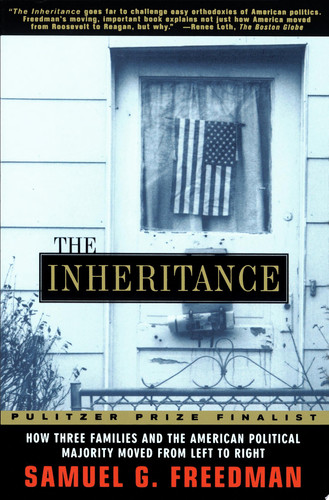
The inheritance: how three families and America moved from Roosevelt to Reagan and beyond

Freedman, Samuel G.
Orphan in the new world (Silvio Burigo) -- Liverpool on the Hudson (Lizzie Sanford Garrett) -- The dreamer and his son (Joseph Obrycki) -- The sewing room (Lizzie Garrett) -- The physics of cynicism (Joseph Obrycki) -- Worth two (Silvio Burigo) -- Voices from downstairs (Richie Garrett) -- Recessive genes (Silvio Burigo/Lorraine and Frank Trotta) -- Address as destiny (Vilma and Jack Maeby) -- Fence and basement (Silvio Burigo/Lorraine and Frank Trotta) -- Senator Clearwater (Richie Garrett) -- Uncle Paulie's Porch (Frank Trotta Jr.) -- The State Street Gang (Leslie Maeby) -- Poor snob (Tim Carey) -- Enchantment and its opposite (Frank Trotta Jr.) -- Incumbent protection (Leslie Maeby) -- Red suspenders (Tim Carey).
Simon & Schuster 1996 464 pages

As night falls: eighteenth century Ottoman cities after dark

Wishnitzer, Avner
"In a world that is constantly awake, illuminated and exposed, there is much to gain from looking into the darkness of times past. This fascinating and vivid picture of nocturnal life in Middle Eastern cities shows that the night in the eighteenth-century Ottoman Empire created unique conditions for economic, criminal, political, devotional and leisurely pursuits that were hardly possible during the day. Offering the possibility of livelihood and brotherhood, pleasure and refuge; the darkness allowed confiding, hiding and conspiring - activities which had far-reaching consequences on Ottoman state and society in the early modern period. Instead of dismissing the night as merely a dark corridor between days, As Night Falls demonstrates how fundamental these nocturnal hours have been in shaping the major social, cultural and political processes in the early modern Middle East"--
Cambridge University Press 2021 376 pages

The distortion of America

Handlin, Oscar
Oscar Handlin is best known as America's leading historian of ethnicity and the immigrant experience in the new nation. In 1961 he produced what was perhaps the first critique of anti-Americanism as an ideological expression of Marxism-Leninismin the schools of higher learning. In his new opening essay to this second edition, he both tells how he was able to perceive the cancer of communist ideology early, and why this new edition is needed now. The Distortion of America is a handbook on avoiding error, a methodological primer on how historians gather evidence, presume witnesses to be reliable or not, and develop forms of verification in the conduct of analysis and research. As such this work is an introduction to the study of history, as well as an examination of specific instances of ideology and mindless passion as ruinous ways to look at America. Handlin shows how social history kept his vision close to the experiences of ordinary people, whose heritage of freedom and dedication to individual liberty was the necessary antidote to academic exaggeration. Six additional chapters supplement those gathered in the earlier collection. Two written in the 1950s describe the forces that later created the economic strength of the United States, while a third treats the problem of race which long contributed to the distortions of America. An account of Yugoslavia before its collapse describes the class divisions responsible for present troubles. By contrast, no inkling of the tensions that would erupt in bloody civil war caught the attention of hundreds of journalists who crowded Sarajevo in 1984. A brief article shows the relevance to China of democracy in the United States. The final new entry is a memorable piece on how the career of Arthur Koestler exemplifies the difficulties of the ex-communist in an unsympathetic environment. These essays illustrate Handlin's working philosophy: "the study of the human past persuades me that, despite the frequent risks of failure, man has the capacity to make order an find purpose in the world in which he lives when he uses the power of his reason to do so."
Transaction Publishers 1996 232 pages

The long night of dark intent: a half century of Cuban communism

Horowitz, Irving Louis
The Cuban Revolution of 1959 was a benchmark of triumph and a harbinger of tragedy to come. Rather than herald a new era of Cuba joining the world community of nations as a paragon of democracy as many fervently hoped and believed it would, it became instead a new stage in authoritarian rule in the Western hemisphere. For more than a half century since then Cuba has been defined by the capacity of a single family to command and determine the fate of a nation--and to do so with a minimum of opposition. Incredibly, even those professing adhesion to democratic norms have been ready to forgive the dictator his excesses. This volume explains the theory and practice of this absence of internal opposition and the persistence of external support for the Castro family and its entourage. "The Long Night of Dark Intent" is chronological in order, with the author indicating major points in each of the five decades covered. The volume covers five centers of system analysis: economics, politics, society, military, and ideology. Who or what "determines" events and decisions is the stuff of real history. It is precisely due to variability in causal chains in society that we have huge variance in levels of predictability. The course of the Cuban Revolution gives strong support for such an approach to the Castro Era. This is a unique, unflinching account with a strong emphasis on the importance of U.S. policy decisions over time.
Transaction Publishers 2008-01-01 599 pages

Revolution in central Europe 1918-1919

Carsten, F. L.
FROM THE AMAZON "This is a (maybe even THE) classic work about the revolutionary events in Central Europe at the end of the First World War. Centred mainly in Germany and Austria, it also covers the upheavals in the some of the Hapsburg's and Hohenzollern's lands, namely Poland, Hungary, and Bohemia. The extraordinarily complex and troubled history of that period of crumbling age old institutions and venerable empires certainly have here a panoramic overview deserving repeated readings. Indispensable in order to understand the origins of the dramatic years ahead culminating in an even more terrible World War...." "This is the best study in the revolutionary events of 1918–1919 in Austria, Germany and Hungary. I cannot reccommend it highly enough...."
Wildwood House 1988 360 pages

Small nations and great powers: a study of ethnopolitical conflict in the Caucasus

Cornell, Svante E.
"Small Nations and Great Powers: A Study of Ethnopolitical Conflict in the Caucasus" by Svante E. Cornell offers a comprehensive analysis of the Caucasus region's complex conflicts. The book examines the geographical, historical, and ethno-linguistic factors that have shaped the area, focusing on the Russian incorporation of the region and the resulting conflicts. Cornell delves into individual conflicts, tracing their origins and efforts toward resolution, and assesses the roles of regional powers such as Turkey, Iran, and Russia. The work concludes with a synthesis of the Caucasian conflicts and discusses the region's significance in global affairs. Published in 2001 by Curzon, the book spans 480 pages and is part of the Caucasus World series.
Curzon 2001-01 480 pages

Revolutions thwarted: Poland, South Africa, Iran, Brazil, and the legacies of communism

Rose, John
"In 1917, a band of communist revolutionaries stormed the Winter Palace of Tsar Nicholas II, a dramatic and explosive act marking that Vladimir Lenin's communist revolution was now underway. But Lenin would not be satisfied with overthrowing the Tsar. His goal was a global revolt that would topple all Western capitalist regimes starting with the British Empire. This book tells the story of the British spies in revolutionary Russia and their mission to stop Lenin's red tide from washing across the free world. They were an eccentric cast of characters, led by Mansfield Cumming, a one-legged, monocle-wearing former sea captain, and included novelist W. Somerset Maugham, beloved children's author Arthur Ransome, and the dashing, ice-cool Sidney Reilly, the legendary Ace of Spies and a model for Ian Fleming's James Bond. Cumming's network would pioneer the field of covert action and would one day become Britain's Military Intelligence 6 (MI -6) -- book jacket.
Bookmarks Publications 2025 408 pages

Henryk Grossman works. Volume 2. Political writings

Grossmann, Henryk
Henryk Grossman is best-known as a Marxist economist but he also wrote valuable political texts as a leader of the revolutionary organisation of Jewish workers in the Polish province of Austria, before the First World War, as a member of the Communist Workers Party of Poland, during the early 1920s, and as a Marxist academic during the early 1930s. These writings dealt with the political situation, tactics and strategy of Jewish Social Democratic Party of Galicia, the initial reception of Marxism in Poland and then substantial entries on left wing movements, organisations and individuals in a multi-volume reference work.
Brill 2021 499 pages