3040 results for "Biography"

Boris Johnson: the gambler
With his trademark access, insight and candour, Britain's leading investigative biographer tackles his most fascinating subject yet: Alexander Boris de Pfeffel Johnson, the UK's Prime Minister. As divisive as he is beguiling, as misunderstood as he is scrutinised, Boris Johnson is a singular figure. Many of us think we know his story well. His ruthless ambition was evident from his insistence, as a three-year-old, that he would one day be 'world king'. Eton and Oxford prepared him well for a frantic career straddling the dog-eat-dog worlds of journalism and politics. His transformation from bumbling stooge on Have I Got New for You to a triumphant Mayor of London was overshadowed only by his colourful personal life, brimming with affairs, scandals and transgressions. His ascent to Number 10 in the wake of the acrimonious, era-defining Brexit referendum would prove to be only the first act in an epic drama that saw him play both hero and villain - from proroguing parliament to his controversial leadership of the Covid-19 Crisis, all against the backdrop of divorce, marriage, the birth of his sixth child, revolts among Tory MPs and the countdown to Brexit. Yet despite his celebrity, decades of media scrutiny, the endless vitriol of his critics and the enduring adoration of his supporters, there is so much we've never understood about Boris - until now. Previous biographies have either dismissed him as a lazy, deceitful opportunist or been transfixed by his charm, wit and drive. Both approaches fall short, and so many questions about Boris remain unanswered. What seismic events of his childhood have evaded scrutiny? How has he so consistently defied the odds, proved his critics wrong, and got away with increasingly reckless gambles? What were his real achievements and failures as Mayor of London, what was really going on during his time as Foreign Secretary, and why did he write two articles for the Telegraph, one in favour of Leave and the other for Remain? How have the women in his life exerted more influence than any of us realise, and why is his story ultimately one overshadowed by family secrets? Based on a wealth of new interviews and research, this is the deepest, most rounded and most comprehensive portrait to date of the man, the mind, the politics, the affairs, the family - of a loner, a lover, a leader. Revelatory, unsettling and compulsively readable, it is the most timely and indispensable book yet from Britain's leading investigative biographer

Wild Man
I have always lusted after the Wild Man of Borneo. Tobias Schneebaum relates his insights on culture, society and relationships between men in the far reaches of the Westerner's notion of the world, while simultaneously relating a journey into the self. An enlightened trail for anyone to explore. Wild Man by Tobias Schneebaum, part autobiographical journal, part social-historical novel, tracks Schneebaum's fascinating and almost epic life story from his earliest contemplations of homoerotic desire and his first exposure to what he would later term The Wild Man of Borneo to his travels through Borneo, Southeast Asia and beyond. The author offers his first hand experiences in an exposed and often almost awkwardly honest recounting of his travels, insights and relationships in the cultures and communities that he became so immediately a part of.

Out of line: growing up Soviet
A rabbi remembers her life as a child in Kiev, Ukraine, where her family lived under Soviet rule until they moved to the United States when she was fifteen.

The investigator: fifty years of uncovering the truth
The Los Angeles Times once called investigative lawyer Terry Lenzner “one of the most powerful and dreaded private investigators in the world.” In his fifty-year career, Lenzner has worked with politicians, celebrities, governments, and corporations worldwide; with a steadfast commitment to the truth, he has uncovered facts that have shaped policy and influenced major legal battles. In this captivating memoir, Lenzner speaks about his varied career and high-profile cases for the first time. At the Justice Department in 1964, he investigated the murder of three civil rights workers—an infamous event that inspired the film Mississippi Burning . He led the national Legal Services Program for the poor, prosecuted organized crime in New York, defended peace activist Philip Berrigan, and represented CIA operative Sid Gottlieb. As a counsel to the Senate Watergate Committee, Lenzner investigated Nixon’s dirty tricks and followed the money trail that led to the Watergate burglary and cover-up. He was the first person to deliver a congressional subpoena to a sitting U.S. president. He uncovered cost overruns of the Alaska oil pipeline, helped identify the Unabomber, investigated the circumstances of Princess Diana’s death, and cleared Hugo Chavez of false corruption charges. Lenzner also worked with President Clinton’s defense team during the impeachment hearings. The Investigator is a riveting personal account: Lenzner astounds with anecdotes of scandal and intrigue, offers lessons in investigative methods, and provides an eye-opening look behind some of the most talked-about media stories and world events of our time.

The camera my mother gave me
Kaysen's search for a diagnosis and cure for excruciating and incessant personal physical pain.

Desperately seeking something: a memoir about movies, mothers, and material girls
"The funny and insightful first-person story of the trailblazing movie director of the 80s and 90s whose fearless punk drama, "Smithereens" became the first American indie film to compete at Cannes, and smash hit "Desperately Seeking Susan" led to a four-decade career in film. Starting out in the mid-70s, a time when few women were directing movies, Susan was determined to become a filmmaker. She longed to tell stories about the unrepresented characters she wanted to see on screen: unconventional women in unusual circumstances, needing to express themselves and maintain their autonomy. Her genre-blending films reflect a passion for classic Hollywood storytelling, mixed with a playful New Wave spirit, informed by her years living in downtown NYC. Seidelman continued to shape American pop culture well into the nineties, directing the pilot of the iconic TV series "Sex And The City," focusing her sharp lens on the changing place of women in American society and helping to fundamentally reshape our self-image in ways that are still felt today. Raised in the safe cocoon of 1960s suburbia, Susan Seidelman wasn't a misfit, an oddball, or an outlier. She was a "good-girl" with a little bit of "bad" hidden inside. A restless teenager, she dreamed of escape and reinvention, a theme that would play out in her films as well as in her own life. Because she loved stories, a high school guidance counselor suggested she become a librarian, but she had her sights set further afield. In 1973, she left the Philly suburbs, enrolled at NYU's burgeoning graduate film school and moved to NYC's Lower East Side. There, she found herself in the right place at the right time. New York City was falling apart, but out of that chaos came a burst of creative energy whose effects are still felt in American pop culture today. Downtown became a vibrant playground where film, music, performance and graffiti art cross-pollinated and where Seidelman chronicled the lives of the colorful misfits, oddballs, dreamers and schemers she met there. It's all in DESPERATELY SEEKING SOMETHING. Seidelman not only has a keen perspective on the times she's lived through -- from her Twiggy-obsessed girlhood, through the Women's Lib movement of the early 70s, the punk scene of the late 70s, Madonna-mania of the 80s, to the dot-com "greed is good" 90s, and beyond--she tells great stories"--

Mary Queen of Scots: an illustrated life
"Royal lives are invariably packed with incident, but few can match the drama and intrigue that marked out Mary Queen of Scots. Forced to flee Scotland at the age of five, she grew up without her mother, was married at fifteen and widowed just a few days before her eighteenth birthday - a pattern of upheaval that was to characterize the rest of her life.

My racing life
In this very personal book, Stirling Moss guides the reader through his motor racing life with a fascinating, insightful and often amusing commentary to an unrivalled collection of over 300 photographs, many of which will be unfamiliar to even his most ardent fans. He takes us from his childhood to the height of his fame as 'Mr Motor Racing' and then to the sudden end of his career with that crash at Goodwood in 1962. Along the way we dwell on his finest moments as well as the setbacks, and delight in the sheer variety of machinery - almost 100 different cars - in which he competed during his rollercoaster racing life. This is a book that all motor racing enthusiasts will treasure. - Starting in 1948, he made his name in little 500cc Coopers, moving towards stardom in HWM, ERA and Cooper F2 cars, then his own F1 Maserati 250F. - The 1955 Mercedes season and its twin highlights – winning the Mille Miglia and the British Grand Prix. - His longing to win in British cars was rewarded with two fine F1 seasons at Vanwall (1957–58), with whom he came very close to winning the F1 World Championship, and sports car successes with Aston Martin. - Rear-engined Cooper and Lotus F1 cars with Rob Walker (1958–62), including two celebrated Monaco GP wins. - Two-seater variety: the amazing range of sports cars he drove included Jaguars (XK120, C-type and D-type), Maseratis (150S to 450S), Ferraris (250 GT SWB and Testa Rossa) and Porsches (550 Spyder to RS61), plus Frazer Nash Le Mans Replica, Osca, Healey 100S, Cooper ‘Bobtail' and more. - Ever busy and versatile: rallying with Sunbeams, trialling a Harford special, Bonneville record-breaking with MG EX181, saloon car racing in a humble Standard Ten – and even a kart race. - Published to mark the 60th anniversary of Moss's famous win in the 1955 Mille Miglia road race in a Mercedes 300SLR. Foreword by 2014 Formula One World Champion Lewis Hamilton.

Stefanie Powers: one From the Hart

Happy chaos: from Punky to parenting and my perfectly imperfect adventures in between
The child actress best known for her performances as television character Punky Brewster traces her journey from child star to entrepreneur and mother of two, describing how her unconventional upbringing in Los Angeles enabled her approaches to parenting.

Nostalgia isn't what it used to be

Cecil B. DeMille and the golden calf
Cecil B. DeMille is Hollywood's most enduring legend, remembered, and often reviled, for his grandiose Biblical sagas, such as Samson and Delilah and his 1956 version of The Ten Commandments , with its cast of tens of thousands before computer graphics made the modern epic mundane. Simon Louvish tells the tale of Cecil B. DeMille through his work: a major re-examination of Hollywood's most monumental founder.

Herzl: Theodor Herzl and the foundation of the Jewish State
Theodor Herzl was born in 1860 in Budapest. He developed a successful career in journalism. As the Paris correspondent for Neue Freie Presse, Herzl followed the Dreyfus Affair, a notorious anti-Semitic incident in France in which a French Jewish army captain was falsely convicted of spying for Germany. Herzl came to reject his early ideas regarding Jewish emancipation and assimilation, and to believe that the Jews must remove themselves from Europe and create their own state. In 1896, he published 'Der Judenstaat' to immediate acclaim, attracting international attention. As a result, he met Kaiser Wilhelm II on several occasions, once in Jerusalem, attempted and failed to obtain support for a Jewish homeland from Pope Pius X, secured an offer from the British government to facilitate a large Jewish settlement in East Africa, and visited St Petersburg to confront the Russian threat to the Zionist movement. Herzl died suddenly in 1904, over 40 years before the creation of a Jewish state in Israel.

Moshe Dayan

Sarge: the life and times of Sargent Shriver

You're welcome, Cleveland: how I helped Lebron James win a championship and save a city
"Scott Raab's big-hearted companion to his darkly comic "sports-jeremiad-slash-memoir" The Whore of Akron follows the first two years of LeBron James's return to Cleveland, where everybody just loves a good story of forgiveness--especially when you fulfill your promise and bring home an NBA Championship, the first major title for a Cleveland team since 1964. "If I had a chance to return to Cleveland, and those fans welcomed me back, that'd be a great story." --LeBron James in 2010, days after "The Decision" In 2010, when LeBron James announced to the world that he was leaving for Miami, he broke the collective heart of his native city and destroyed the hopes of an entire tortured generation. As LeBron headed south, unofficial spokesman Scott Raab sent him off with a middle-finger salute of his own--a deliciously obscene aria of sports fandom, Jewishness, and weight gain that became infamous as The Whore of Akron. Four years--and two NBA championships later--LeBron came home to the Rust Belt faithful who had vilified him mercilessly, none more so than Raab. You're Welcome, Cleveland is the story of both LeBron's and Scott's redemption as they pursue the one thing they crave more than anything in life--an NBA title for the city that made them men. LeBron is back. So is Scott Raab. It's a great story. You're Welcome, Cleveland"--

Communist Poland: a Jewish woman's experience
"This annotated edition of Holocaust survivor Sara Nomberg-Przytyk's postwar memoir follows her life as an investigative journalist during the emergence and deterioration of the communist state in Poland. Once a devoted communist herself, Nomberg-Przytyk recounts how antisemitism and government corruption shattered her illusions"--

In the world of Sumer: an autobiography
Samuel Noah Kramer is the leading authority on the interpretation and reading of civilization's oldest literature. His life and life's work are so thoroughly intertwined that his autobiography is also the story of the recovery of the language and literature of the Sumerians. From young Talmudist to the patriarch of Sumerology, Kramer recountshis long and distinguished career. Writing for the non-specialist, he paints a panoramic view of Sumerian literature and provides thumbnail sketches of the individuals with whom he collaborated.

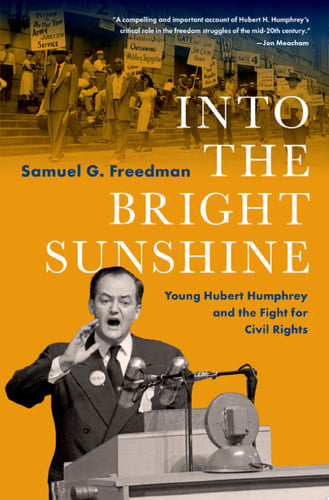
Into the bright sunshine: young Hubert Humphrey and the fight for civil rights
"Hubert Humphrey, a fallen hero and a dying man, rose on rickety legs to approach the podium of the Philadelphia Convention Hall, his pulpit for the commencement address at the University of Pennsylvania. He clutched a sheaf of paper with his speech for the occasion, typed and double-spaced by an assistant from his extemporaneous dictation, and then marked up in pencil by Humphrey himself. A note on the first page, circled to draw particular attention, read simply, "30 years ago--Here." In this place, at that time, twenty-nine years earlier to be precise, he had made history. From the dais now, Humphrey beheld five thousand impending graduates, an ebony sea of gowns and mortarboards, broken by one iconoclast in a homemade crown, two in ribboned bonnets, and another whose headgear bore the masking-tape message HI MA PA. In the horseshoe curve of the arena's double balcony loomed eight thousand parents and siblings, children, and friends. Wearing shirtsleeves and cotton shifts amid the stale heat, they looked like pale confetti from where Humphrey stood, and their flash cameras flickered away, a constellation of pinpricks"--