58,196 results in 0.07 seconds

Things A Story of the Sixties with a Man Asleep

Georges Perec
Things: A Story of the Sixties is the story of a young couple who want to enjoy life, but the only way they know how to do so is through ownership of 'things'. Perec's first novel won the Prix Renaudot and became the cult book for a generation.In A Man Asleep, a young student embarks upon a disturbing and exhaustive pursuit of indifference, following his experience in non-existence with relentless logic.
Penguin Random House 2009-12 224 pages

Self-ownership, freedom, and equality

Cohen, G. A.
Defenders of capitalism claim that its inequality is the necessary price of the freedom that it guarantees. In that defense of capitalist inequality, freedom is self-ownership, the right of each person to do as he wishes with himself. The author shows that self-ownership fails to deliver the freedom it promises to secure. He thereby undermines the idea that lovers of freedom should embrace capitalism and the inequality that comes with it.
Cambridge University Press 1995 277 pages

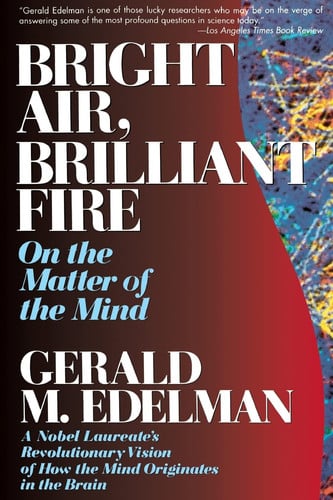
Bright air, brilliant fire: on the matter of the mind

Edelman, Gerald Maurice
We are on the brink of understanding ancient mysteries: how we know, what governs our nature, what makes a person different from a thing. In the last decade, more than twenty disciplines dealing with every aspect of the brain have contributed to a revolution in the neurosciences--a revolution as significant, in the view of many observers, as the Galilean and Copernican revolutions in mathematics and physics or the Darwinian revolution in biology. In this book, one of the world's foremost brain scientists gives us a glimpse into the workings of the human brain--the most complex material object in the universe. A match head's worth of the brain contains about a billion connections that can combine in ways which can only be described as hyperastronomical--on the order of ten followed by millions of zeros (there are only about ten followed by eighty zeros' worth of positively charged particles in the whole known universe).^
BasicBooks 1992 280 pages

Right here on our stage tonight! Ed Sullivan's America

Nachman, Gerald
Before the advent of cable and its hundreds of channels, before iPods and the Internet, three television networks ruled America's evenings. And for twenty-three years, Ed Sullivan, the Broadway gossip columnist turned awkward emcee, ruled Sunday nights. It was Sullivan's genius to take a worn-out stage genre-vaudeville-and transform it into the TV variety show, a format that was to dominate for decades. Right Here on Our Stage Tonight! tells the complete saga of The Ed Sullivan Show and, through the voices of some 60 stars interviewed for the book, brings to life the most beloved, diverse, multi-cultural, and influential variety hour ever to air. Gerald Nachman takes us through those years, from the earliest dog acts and jugglers to Elvis Presley, the Beatles, and beyond. Sullivan was the first TV impresario to feature black performers on a regular basis-including Nat King Cole, Pearl Bailey, James Brown, and Richard Pryor-challenging his conservative audience and his own traditional tastes, and changing the face of American popular culture along the way. No other TV show ever cut such a broad swath through our national life or cast such a long shadow, nor has there ever been another show like it. Nachman's compulsively readable history, illustrated with classic photographs and chocked with colorful anecdotes, reanimates The Ed Sullivan Show for a new generation.
University of California Press 2009 455 pages

Hispanic: why Americans fear Hispanics in the U.S.

Rivera, Geraldo
Journalist Rivera examines the growth of the Hispanic population in the U.S., fueled partly by what may be the single most divisive issue in America today: illegal immigration. With objective clarity and personal conviction, Rivera sheds light on an issue that is muddled with confusion and prejudice--and too often blamed for everything from terrorism to welfare. Examining the past--his own parents' struggle to be "real" Americans, as well as the plight of other ethnic groups in their quest for that dream--Rivera places the issue of illegal immigration in a historic context, dispelling the myth that we are facing an unprecedented crisis.--From publisher description.
Celebra 2008 262 pages

The creation of feminist consciousness: from the Middle Ages to eighteen-seventy

Lerner, Gerda
A pioneer in women's studies and long-term activist for women's issues, and a past president of the Organization of American Historians, Gerda Lerner is one of the founders and foremost scholars of Women's History. The Creation of Patriarchy, the first book in her two-volume magnum opus Women and History (1986) received wide review attention and much acclaim, winning the prestigious Joan Kelly Prize of the American Historical Association for the best work on Women's History that year. Ms hailed the book for providing "a grand historical framework that was impossible even to imagine before the enlightenment about women's place in the world provided by her earlier work and that of other feminist scholars." New Directions for Women said it "may well be the most important work in feminist theory to appear in our generation." Patriarchy traced the development of the ideas, symbols, and metaphors by which men institutionalized their domination of women. Now, in The Creation of Feminist Consciousness, the eagerly awaited concluding volume of Women and History, Lerner documents the twelve-hundred-year struggle of women to free their minds from patriarchal thought, to create Women's History, and to achieve a feminist consciousness. In a richly documented narrative filled with inspiring portraits of women, Lerner ranges from the Middle Ages to the late 19th century, tracing several important ways by which women strove for autonomy and equality. One of the most remarkable sections examines over twelve hundred years of feminist Bible criticism. Since objections to women's thinking, teaching, and speaking in public were based on biblical authority--most notably, passages from Genesis and the writings of St. Paul--women returned again and again to these texts, in an attempt to subvert patriarchal dominance and establish their equality with men. This survey of biblical criticism allows Lerner to illustrate her most important insight--the discontinuity of women's history. She describes how women's history was not passed on from generation to generation, forcing women in effect to reinvent the wheel over and over again. In a series of fascinating portraits of individual women who resisted patriarchal indoctrination, Lerner discusses women mystics such as Hildegard of Bingen, Julian of Norwich and later Protestant mystics, and brings to life the many women of great literary talent, from Christine de Pisan to Louise Labe to Emily Dickinson, who simply bypassed patriarchal thought and created alternate worlds for themselves. Documenting the 1,200 year struggle of women to free their minds from patriarchal thought, create a women's history, and achieve a feminist consciousness, this brilliant work charts new ground for feminist theory, the history of ideas, and the development of women's place in our intellectual tradition.
Oxford University Press 1993 395 pages

U.S.S. Seawolf: Submarine Raider of the Pacific

Gerold Frank,James D. Horan,J. M. Eckberg
U.S.S. Seawolf: Submarine Raider of the Pacific is the famous first-hand account of the legendary U.S. Navy submarine Seawolf a.k.a. the Wolf which patrolled the Pacific during the conflict with Japan in World War 2. Shoving off the day of Pearl Harbor, Chief Radioman J. (Joseph) M. (Melvin) Eckberg gives the reader a tense and detailed account of his initial 24-month stint aboard the Seawolf and beyond.
Lulu.com 2017-07-24 146 pages

The chronology of the kings of Israel and Judah

Galil, Gershon
This pioneering study wrestles with the perpetual problem of chronology in the Books of Kings. Starting from the conservative assumptions that the courts of Israel and Judah maintained regnal records, and that these for the most part accurately reflect regnal length, the author arrives at a new and persuasive dating for the reigns and their synchronisms. In addition, his chronological scheme includes all points of contact between Israel and Judah and external powers, especially Assyria. The result is one of the most responsible and yet most critical chronologies proposed to date, and will be the standard chronological reference for the next decade, if not longer.
E.J. Brill 1996-01-01 180 pages

Shmuel Yosef Agnon: a revolutionary traditionalist

Shaked, Gershon
The last two decades have seen a resurgence of critical and popular attention to Virginia Woolf's life and work. Such traditional institutions as "The New York Review of Books" now pair her with William Shakespeare in promotional advertisements; her face is used to sell everything from Barnes & Noble books to Bass Ale. Virginia Woolf: Lesbian Readings represents the first book devoted to Woolf's lesbianism. Divided into two sections, Lesbian Intersections and Lesbian Readings of Woolf's Novels, these essays focus on how Woolf's private and public experience and knowledge of same-sex love influences her shorter fiction and novels. Lesbian Intersections includes personal narratives that trace the experience of reading Woolf through the 60s, 70s, 80s, and 90s. Lesbian Readings of Woolf's Novels provides lesbian interpretations of the individual novels, including "Orlando, The Waves," and "The Years." Breaking new ground in our understanding of the role Woolf's love for women plays in her major writing, these essays shift the emphasis of lesbian interpretations from Woolf's life to her work.
New York University Press 1989 293 pages

My gaze is turned inward: letters, 1934-1943

Kolmar, Gertrud
"Event of the time are a bit like Impressionist paintings . . . which combine into a recognizable whole only when observed from a distance." —Gertrude Kolmar in a letter to her sister, October 22, 1939 So a picture of Gertrud Kolmar, a gifted Jewish writer struggling to sustain her art and family, emerges from these eloquent and allusive letters. Written in the stolen moments before her day as a forced laborer in a munitions factory began, the letters tell of Kolmar's move from the family home in Finkenkrug to a three-room flat in Berlin, which she and her father must soon share with other displaced Jews. They describe her factory work as a learning experience and assert, in the face of ever worsening conditions, that true art, never dependent on comfort or peace, is "capable of triumphing over . . . time and place." These letters are a triumph of art, proclaiming the freedom of the human will amidst oppression. Though prevented by Nazi censorship from saying too much too directly, Kolmar still conveys the intensity and determination of her inner world, as well as the relentlessness of the outer world bent on crushing her. For its insight into the mind and soul of a poet submitting to and denying fate, and for its interior vision of one of history's darkest moments, My Gaze Is Turned Inward is a unique document of literary, historical, and spiritual power.
Northwestern University Press 2004-08-26 214 pages