2180 results for "Business"

Essays on Marx's Theory of Value: Conceived as a Variorum Edition (Historical Materialism)

Rubin, Isaak Illich
A new English translation of Isaak Illich Rubin’s classic Essays on Marx’s Theory of Value. First published in the Soviet Union in 1923, Rubin’s book sparked a fierce value controversy with contemporary Soviet economists during the late 1920s. As such, the present translation is conceived as a variorum edition, including all the essential supplementary materials related to this foundational work in Marx’s value theory, published here in English for the first time. In addition to Rubin’s main work, this edition includes his four most important related publications, as well as ten debate articles written and published by his contemporary proponents and opponents.
Haymarket Books 2026-03-17 991 pages

The Great Mutual Fund Trap An Investment Recovery Plan

Gregory Arthur Baer,Gary S. Gensler
Convinced that your star mutual fund manager will help you beat the market? Eager to hear the latest stock picking advice on CNBC? FORGET ABOUT IT! "The" "Great Mutual Fund Trap "shows that the average mutual fund consistently underperforms the market, and that strategies for picking "above-average" funds -- everything from past performance to expert rankings -- are useless. Picking individual stocks on the advice of brokers and analysts works no better. The only sure things are the fees and commissions you'll pay. Fortunately, the news is not all bad. Investors willing to ignore the constant drumbeat of "trade frequently," "trust the experts," and "beat the market" now have the opportunity to do better. Using new investing products investors can earn higher returns with lower risks. Drawing on their years of Wall Street, Treasury and Federal Reserve experience, Gary Gensler and Gregory Baer offer a fresh and realistic look at how money is managed in America. From new indexing strategies to risk-managed stock selection, "The" "Great Mutual Fund Trap" offers investors an escape from high costs and immunity from seductive marketing messages. "From the Hardcover edition."
Broadway Books 2004-01-06 352 pages

Latin America in a New Era of Globalization Essays in Honor of Enrique V. Iglesias

Enrique V. Iglesias,Guillermo Calvo,Alicia Barsena,Oscar A. Echevarria,Gabriel Porcile,Nora Lustig,Luis Lopez-Calva,Eduardo Ortiz-Juarez,Jose Ocampo,Nancy Birdsall,Michel Camdessus,L. Enrique Garcia,Luis Moreno,Gert Rosenthal,Julio Sanguinetti,Ricardo Lagos
Latin America in a New Era of Globalization: Essays in Honor of Enrique V. Iglesias is the tribute a group of friends pays to Enrique Iglesias. By virtue of his roles and his actions, Enrique became, decades ago, a recognized and highly valued Latin American citizen who, throughout his career, he has made important contributions to development and democracy of the region, in addition to being a bridge between it and the rest of the world.His career has been one of prominence Chairman of the Central Bank, and then Minister of Foreign Affairs of Uruguay, Executive Secretary of the Economic Commission for Latin America and the Caribbean, President of the Inter-American Development Bank and, until a few months ago, Secretary General of the Ibero-American General Secretariat.As rightly pointed out by Enrique Garcia in Madrid on May 20th, 2014 at the presentation of the preliminary edition published by the CAF- Bank of Development in Latin America:The book project Latin America in a New Era of Globalization, Essays in Honor of Enrique V. Iglesias which we present in this document, is a well-deserved tribute to a Latin American citizen who has put his life and ideas at the service of the region, defending the dream that has guided generations and is synthesized in the virtuous trilogy: democracy, sustainable development and integration...There is no doubt that his thinking, his contributions to development and democracy are legacies that set examples for those people of Latin America -yesterday, today and tomorrow- who have deep convictions in free, equitable and prosperous societies, the need for greater regional integration and intelligent articulation internationally and, above all, in the capacity to forge their own destiny.
CreateSpace Independent Publishing Platform 2015-10-29 332 pages

The Shifting and Incidence of Taxation

Edwin Robert Anderson Seligman
This work has been selected by scholars as being culturally important, and is part of the knowledge base of civilization as we know it. This work is in the "public domain in the United States of America, and possibly other nations. Within the United States, you may freely copy and distribute this work, as no entity (individual or corporate) has a copyright on the body of the work. Scholars believe, and we concur, that this work is important enough to be preserved, reproduced, and made generally available to the public. We appreciate your support of the preservation process, and thank you for being an important part of keeping this knowledge alive and relevant.
Creative Media Partners, LLC 2022-10-27 348 pages

The Origins of Jeffersonian Commercial Policy and Diplomacy

Doron S. Ben-Atar
Very few Americans regretted seeing Thomas Jefferson leave the White House in the winter of 1809. The man who led the Republican party from opposition to power and who overwhelmingly defeated Charles C. Pinckney in 1804 had had a disastrous second term. The military stalemate in Europe with Napoleon controlling the continent and the Royal Navy ruling the seas ushered the Franco-British war into a new phase of blockades and counter-blockades with both sides raiding neutral American shipping. The administration responded by prohibiting all American exports to the belligerents. The Embargo brought the booming American economy to a screeching halt, and as economic distress grew resentment over the measure spread from merchants to farmers and mechanics.The Origins of Jeffersonian Commercial Policy and Diplomacy examines the evolution of Jefferson's commercial ideas and policies from his days as a young revolutionary to his presidency. It analyzes the way in which Jefferson worked out his conflicting approaches to commerce not only as a thinker but also as a policy maker. It examines the tensions between rejecting commerce altogether as a threat to republican virtue, and promoting commerce as a necessary vehicle for the maintenance of American prosperity. It traces Jefferson's life-long commitment to the policy of commercial coercion and places American policy in the context of the global competition between England and France. Without deviating from the narrative format, Professor Ben-Atar reflects on a variety of contested issues in early American historiography, from the debate over eighteenth-century republicanism to the birth of American foreign policy.
Palgrave Macmillan UK 1993-01-01 261 pages

Lead by greatness: how character can power your success

Lapin, David
Corporations with identity and soul build unparalleled cultures, satisfying their customers in ways no one else quite can. Every company and team has its own identity--a soul waiting to be discovered and used to unlock human energy and unleash new economic value. Doing this demands a new leadership outlook. Lead By Greatness , written by leadership consultant, rabbi, and speaker, David Lapin, provides this new outlook. Lapin clearly describes the step-by-step methods with which his international clients have translated this leadership philosophy into unrivaled economic growth. Drawing both on ancient wisdom and cutting-edge strategic thinking, Lead By Greatness will help you think about opportunities in ways you never have... and your competitors never will.
Avoda Books 2012 338 pages

Schumpeter's Vision

Arnold Heertje
The contributors to the book were asked to give their assessment of how the messages of Schumpeter's famous tract "Capitalism, Socialism, and Democracy" have stood the test of time. Much as happened in the forty years since Schumpeter wrote the book. Is it possible to say that events have tended to confirm or refute the author's provocative prognoses? Each contributor provides a different and nuanced answer to these questions. The continued importance of those questions has ensured that a century after Schumpeter's birth, scholars take his writings seriously, treating them as living contributions to contemporary debates.
Bloomsbury Academic 1981-10-15 208 pages

Master of the return

Reich, Tova
Product Description Once a notorious hippie, Sammuel Himmelhoch joins a Hassidic sect of penitents in Jerusalem and becomes a Master of the Return, guiding fellow converts to the teachings of Rabbi Nahman of Bratslay From Publishers Weekly In Mara, Reich, herself the scion of a rabbinical family, took aim at the mores of American Orthodox Jewry. Here, she casts her sly, sardonic eye upon those at the opposite end of the spectrum, so to speakIsraeli penitents. With vigor, irreverence and devastating accuracy, she limns a flock of zany zealots, intoxicated by the rarefied Hassidism of Rabbi Nahman of Bratslav. These cultists, former hippies who are now "high on the One Above," are at once delightfully absurd in their revival, even invention, of bizarre customs (such as the paramount pilgrimage to Rabbi Nahman's Ukranian grave to terminate "nocturnal emissions"); poignant in their misguided, miseducated search for identity and redemption; as self-indulgent in their expiation as they once were in their passions; and alarming in their patent misogyny, racism, deceit, self-righteousness and extreme messianic political agenda. In Reich's hands, plot and character development are sacrificed to an extravagant religious and social parody cum cautionary tale. The penitents remain symbolic figuresas exemplified by an elderly midwife, whose name, Shifra-Puah, evokes her righteous colleagues from the biblical book of Exodus who disobeyed the pharaonic decree to murder male newborns, and Avraham Ger, whose surname, Hebrew for convert, proclaims his adoption of Judaism. Copyright 1988 Reed Business Information, Inc. From Library Journal Samuel Himmelhoch was once lighting effects man for notorious rock groups, his wife Ivriya rode horses bare-breasted in Rosh Pina, and Sora Katz was the former Pam Buck of Macon, Georgia, but now they are all members of an extreme Hassidic sect, living together in the Moslem quarter of the Old City of Jerusalem. Described with affection and great insight, the riotous adventures of these sincere but sometimes misguided penitents easily mix the supernatural with human events. Reich pinpoints absurdity and self-righteousness beautifully, as when Reb Lev Luria pontificates in gematria (talmudic numeric equivalents) derived from his newly donated computer. An arrestingly comtemporary treatment of Jewish spirituality and renewal. Highly recommended. Molly Abramowitz, Silver Spring, Md.Copyright 1988 Reed Business Information, Inc.
Harcourt Brace Jovanovich 1988 240 pages

The rabbi of Lud

Elkin, Stanley
Surrounded by cemeteries in the flatlands of New Jersey, the small town of Lud is sustained by the business of death. In fact, with no synagogue and no congregation, Rabbi Jerry Goldkorn has only one true responsibility: to preside over burial services for Jews who pass away in the surrounding cities. But after the Arctic misadventures that led him to Lud, he wouldn't want to live (or die) anywhere else. As the only living child in Lud, his daughter Connie has a different opinion of this grisly city, and she will do anything to get away from it--or at least liven it up a bit. Things get lively indeed when Connie testifies to meeting the Virgin Mary for a late-night romp through the local graveyards.
Dalkey Archive Press 2001 277 pages

Belshazzar Court Or Village Life in New York City

Simeon Strunsky
We have been called a nation of villagers, and Mr. Strunsky in these sketches discourses in a friendly way on some of our village characteristics. He writes from the point of view of the man who has an uptown apartment, with rent just a trifle higher than he can afford, in Belshazzar court, and who travels daily to his place of business in Park Row via the subway. Occasionally the point of view of Emmeline is called in by way of reinforcement or contrast. In general it is with the street, the show, the game, and the night life of the city that he is concerned, but now and again it is the young son Harold who offers a fruitful subject for meditation.* * * * *"His book has that quality which is becoming rare: it is companionable." --Bookman"By his very lightness of style and his gentle grace of humor he makes 'Belshazzar court' a genuine interpretation of a place, a people and a life whose spirit has been utterly missed by many an ultra serious and portentous analyst. --Boston Transcript"Few have the power or the inclination to see In the complexities of modern city life the simplicity and kindliness of human nature, essentially the same everywhere, but that is the chief charm of these essays." --Dial"The rare quality of the book Is not so much the humor as the suggestive quality of the thought." --Nation"Delightful essays about New York City." --Library Bulletin
Amazon Digital Services LLC - KDP Print US 2019-05-12 195 pages

All the world's a stage

Harwood, Ronald
From Library Journal Harwood, author of The Dresser , led the production for BBC-TV of a 13-hour history of the theater. His book is a by-product of that venture. An extremely attractive, well-illustrated volume, it sets forth in dazzlingly rapid fashion the highlights of theater history from tribal rite to A Chorus Line , making the argument that theater grew and changed by answering the immediate needs of its audience. The book is accurate as far as it goes, and the argument is sound, but it is not a piece of serious scholarship. It is intended for a popular audience. If the book lacks weight, it can certainly be recommended as an introduction to theater history. Wickham's substantial, short theater history is written by a major scholar and is the result of years of reading, thinking, and teaching about theater. It surveys world drama from its origins in dance and ritual through the advent of television and places special emphasis on the role of actors and audiences in shaping that history. The text is detailed, thoughtful, and subtle; the generous illustrations are well chosen; each section contains a useful comparative chronology; the bibliography is very selective, but good. This is a serious text that has a lavish quality. Unlike Harwood's book, it is suited to the serious student or scholar of theater. Recommended. Thomas E. Luddy, English Dept., Salem State Coll., Mass. Copyright 1986 Reed Business Information, Inc.
Little, Brown 1984 320 pages

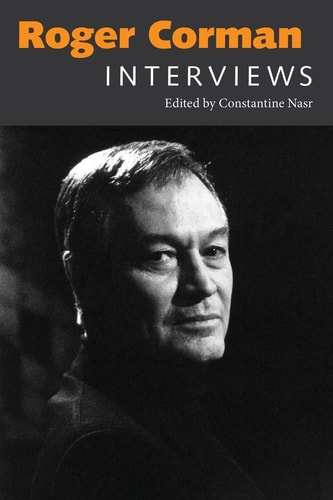
Roger Corman: interviews

Corman, Roger
Roger Corman (b. 1926) is known by many names-craftsman, artist, maverick, schlock-meister, mini-mogul, mentor, cheapskate, and King of the B's. Yet his commitment to filmmaking remains inspired. He learned his craft at the end of the studio system, only to rebel against Hollywood and define himself as the true independent. And the list of directors and producers who learned under his tutelage--Francis Ford Coppola, Martin Scorsese, James Cameron, Jonathan Demme, and many more--is astonishing. Collected here are many of the most honest and revealing interviews of his epic career, several of which have never been seen in print. Roger Corman: Interviews brings into focus a life committed to the entertaining art of motion pictures. Corman's rare talent combined artistic drive with business savvy, ensuring a successful career that was constantly in motion. At a remarkable pace more akin to silent movies than modern Hollywood, he directed over fifty films in less than fifteen years, some entertaining ( Not of This Earth ), trendsetting ( The Wild Angels ), daring ( The Intruder ), workmanlike ( Apache Woman ), stylized ( The Masque of the Red Death ) and even profound ( X: The Man with the X-Ray Eyes ). In a single year, Corman famously shot a cult classic in two and a half days ( The Little Shop of Horrors ), reinvigorated the American horror film with a dash of Poe and Price ( House of Usher )--and still turned out a few more films shot across the globe. Recently awarded an honorary Oscar for his lifetime contribution to cinema, the self-made Corman has created a legacy as a defining filmmaker.
University Press of Mississippi 2011 228 pages

Town and gown: the fight for social justice, urban rebirth, and higher education

Parmet, Robert D.
Town and Gown is the story of the birth in the 1960s and survival through the 1970s of an inner city college, York College of the City University of New York, in Jamaica, Queens. Created as a liberal arts college to provide increased access to minority students, it was placed in a mainly minority neighborhood, where it received exceptionally strong support from a middle class African American community seeking access to quality higher education for its children and a business community striving to overcome the effects of “white flight.” Operating in rented quarters without a permanent campus and regarded as academically illegitimate owing to its location, the college was regarded as expendable in hard times. From 1971 to 1979 critics both inside and outside of the City University, such as Governor Nelson Rockefeller and Mayor Edward Koch, questioned the school’s right to exist, especially during the New York City and State Fiscal Crisis of 1975 and 1976. Undaunted, the college and its diverse supporters rallied and won. An amazing groundswell of support from Southeast Queens, and intense political pressure, saved it. Though the fight was often bitter, York College and Jamaica would not be denied. The college moved onto its permanent campus as a new Jamaica Center emerged.
Fairleigh Dickinson University Press 2011-11-23 169 pages

Hatless Jack: the president, the fedora and the death of the hat

Steinberg, Neil
John F. Kennedy was the first American president to go bareheaded and he ruined the hat business. Or so it is popularly believed. In Hatless Jack, Neil Steinberg examines why Kennedy was so reluctant to wear a hat in public - was it really because Khrushchev always did? He charts the attempts of the hat-makers of America to persuade their new, charismatic leader to save their declining industry. Along the way, he uncovers the now nearly-forgotten rituals of hat-wearing, with hat-check girls, straw-hat riots and ways of stopping the wind from blowing your hat off. Hats were tipped, raised, checked, waved and eaten (metaphorically, at least) and then they disappeared for ever. Hatless Jack is a fascinating and funny explanation of why hats went and what we all lost when they did.
Granta 2005 342 pages

Martereau

Sarraute, Nathalie
Martereau is narrated by a tubercular young man driven by a compulsion to discover what lies behind faades, especially in relation to the adults around him. He's particularly interested in Martereau, his uncle's devoted friend and business associate. All in all, Martereau seems like a trustworthy, benign, self-sufficient man, but under the narrator's intense scrutiny--and Martereau's suspect behavior concerning a shady real-estate deal--his motives seem much more complex and seedy. In a subtle, skillful way, Nathalie Sarraute explores the difference between those who are wealthy and those who pretend to be so, and the manipulative way in which some people get ahead in the world.
John Calder 1964