58,196 results in 0.08 seconds

Arguing about war

Walzer, Michael
Michael Walzer is one of the world's most eminent philosophers on the subject of war and ethics. Now, for the first time since his classic Just and Unjust Wars was published almost three decades ago, this volume brings together his most provocative arguments about contemporary military conflicts and the ethical issues they raise. The essays in the book are divided into three sections. The first deals with issues such as humanitarian intervention, emergency ethics, and terrorism. The second consists of Walzer's responses to particular wars, including the first Gulf War, Kosovo, Afghanistan, and Iraq. And the third presents an essay in which Walzer imagines a future in which war might play a less significant part in our lives. In his introduction, Walzer reveals how his thinking has changed over time. Written during a period of intense debate over the proper use of armed force, this book gets to the heart of difficult problems and argues persuasively for a moral perspective on war.
Yale University Press 2004 208 pages

Just say nu: Yiddish for every occasion (when English just won't do)

Wex, Michael
A practical guide to using Yiddish words and expressions in day-to-day situations, along with enough grammar to enable readers to put together a comprehensible sentence and avoid embarrassing mistakes. Wex also explains the five most useful Yiddish words--shoyn, nu, epes, takeh, and nebakh--what they mean, how and when to use them, and how they can be used to conduct an entire conversation without anybody ever suspecting that the reader doesn't have the vaguest idea of what anyone is actually saying. Readers will learn how to shmooze their way through such activities as meeting and greeting; eating and drinking; praising and finding fault; maintaining personal hygiene; going to the doctor; driving; parenting; getting horoscopes; committing crimes; going to singles bars; having sex; talking politics and talking trash. There's nothing in the world that can't be improved by translating it into Yiddish, and this book shows you how.--From publisher description.
Harper Perennial 2008 16 pages

The goddess pose

Goldberg, Michelle
When the woman who would become Indra Devi was born in Russia in 1899, yoga was virtually unknown outside of India. By the time of her death, in 2002, it was being practiced everywhere, from Brooklyn to Berlin to Ulaanbaatar. In The Goddess Pose, New York Times best-selling author Michelle Goldberg traces the life of the incredible woman who brought yoga to the West and in so doing paints a sweeping picture of the twentieth century. Born into the minor aristocracy (as Eugenia Peterson), Devi grew up in the midst of one of the most turbulent times in human history. Forced to flee the Russian Revolution as a teenager, she joined a famous Berlin cabaret troupe, dove into the vibrant prewar spiritualist movement, and, at a time when it was nearly unthinkable for a young European woman to travel alone, followed the charismatic Theosophical leader Jiddu Krishnamurti to India. Once on the subcontinent, she performed in Indian silent cinema and hobnobbed with the leaders of the independence movement. But her greatest coup was convincing a recalcitrant master yogi to train her in the secrets of his art. Devi would go on to share what she learned with people around the world, teaching in Shanghai during World War II, then in Hollywood, where her students included Gloria Swanson and Greta Garbo. She ran a yoga school in Mexico during the height of the counterculture, served as spiritual adviser to the colonel who tried to overthrow Panamanian strongman Manuel Noriega, and, in her eighties, moved to Buenos Aires at the invitation of a besotted rock star. Everywhere she went, Indra Devi evangelized for yoga, ushering in a global craze that continues unabated.
Corsair 2017-04-06 336 pages

Get out of town: an original novel

Ostow, Micol
"Betty, Veronica, and Jughead all know that Archie is being framed by Hiram Lodge, but the evidence is stacked against him. So the gang comes up with a last-ditch plan to prove Archie's innocence: they have to go back to the scene of the crime. They have to go back to Shadow Lake. Threats are around every corner deep in the woods at the Lodge family cabin. Will the kids find the evidence they need to clear Archie's name? And, more importantly, will they make it back to Riverdale alive? Told from alternating points of view, this novel set in the Riverdale universe is an original story not seen on the show!"--Page [4] of cover.
Scholastic Inc 2019 283 pages

My Father's Wives

Mike Greenberg
Jonathan Sweetwater has been blessed with money, a fulfilling career, great kids and Claire, his smart, gorgeous, sophisticated wife. But there is one thing Jonathan never had: a relationship with his father. Percival Sweetwater III has been absent from his son's life since Jonathan was nine years old. A five-term U.S. senator, now dead, Percy was beloved by presidents, his constituents, and women alike, especially the five women who married him after Jonathan's mother. Jonathan hasn't thought about Percy or the hole he left in his life for years. Dedicated to Claire and his family, he's nothing like his serial monogamist father. But then Jonathan discovers evidence that everything in his marriage may not be as perfect as he thought. Hurt and uncertain what to do, he knows that the only way to move forward is to go back. On this quest for understanding -- about himself, about manhood, about marriage -- Jonathan decides to track down his father's five ex-wives. His journey will take him from cosmopolitan cities to the mile-high mountains to a tropical island -- and ultimately back to confront the one thing Jonathan has that his father never did: home.
Thorndike Press 2015 375 pages

You're only as good as your next one

Medavoy, Mike,Young, Josh
“An under-read and engaging show-biz memoir.” – The New Yorker "If I had a talent for anything, it was a talent for knowing who was talented." Mike Medavoy is a Hollywood rarity: a studio executive who, though never far from controversy, has remained well loved and respected through four decades of moviemaking. What further sets him apart is his role in bringing to the screen some of the most acclaimed Oscar-winning films of our time: Apocalypse Now, One Flew Over the Cuckoo's Nest, Amadeus, The Silence of the Lambs, Philadelphia, and Sleepless in Seattle are just some of the projects he green-lighted at United Artists, Orion, TriStar, his own Phoenix Pictures. "The ultimate lose-lose situation for a studio executive: to wind up with a commercial bomb and a bad movie." Of course, there are the box office disasters, and the films, as Medavoy says, "for which I should be shot." They, too, have a place in his fascinating memoir -- a pull-no-punches account of financial and political maneuvering, and of working with the industry's brightest star power, including Steven Spielberg, Martin Scorsese, Francis Ford Coppola, Kevin Costner, Robert De Niro, Jodie Foster, Sharon Stone, Michael Douglas, Meg Ryan, and countless others. "Putting together the elements of a film is a succession of best guesses." Medavoy speaks out on how movie studio buyouts have stymied the creative process and brought an end to the "hands-off" golden age of filmmaking. An eyewitness to Hollywood history in the making, he gives a powerful and poignant view of the past and future of a world he knows intimately.
Atria Books 2003-01-07 380 pages

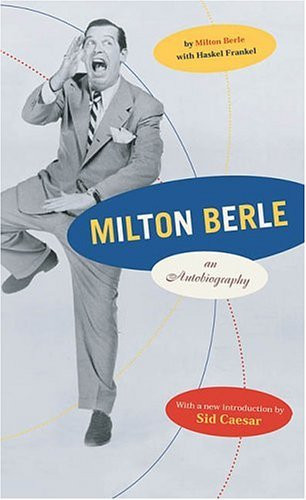
Milton Berle: an autobiography

Berle, Milton
(Applause Books). When Milton Berle died in the Spring of 2002, THE NEW YORK TIMES declared that the legendary comic "may have had a more profound influence on our way of life than some presidents or Nobel Prize winners." This landmark memoir, as startling today as it was when it was first published, reveals the life and times of the man known affectionately to millions as Uncle Miltie. Told with unflinching candor, here is one of the most fabled and influential show business careers of all time: from performing as a child in Vaudeville and making silent movies with Charlie Chaplin and Mary Pickford, to nightclub performances for Al Capone, working on radio during World War II, performing in Broadway musicals, and, finally, superstardom on television. Perhaps even more fascinating is Berle's scandal-ridden private life: his star-crossed love affair with a 1930's movie queen and the child they had out of wedlock, his numerous affairs with women ranging from evangelist Aimee Semple McPherson to Marilyn Monroe, and his stormy relationship with beautiful showgirl Joyce Mathews, whom Berle married twice. It is Berle's unsparing account of his life and his determination to show the world his real face that led Frank Sinatra, at the time, to call this "the gutsiest book I've read in years." Told with equal amounts of comedy and pathos, and featuring colorful appearancesby all the major stars of his day, MILTON BERLE is simply one of the best show business memoirs ever written.
Applause Theatre & Cinema Books 2002-09-01 337 pages

A Theory of the Consumption Function

Milton Friedman
What is the exact nature of the consumption function? Can this term be defined so that it will be consistent with empirical evidence and a valid instrument in the hands of future economic researchers and policy makers? In this volume a distinguished American economist presents a new theory of the consumption function, tests it against extensive statistical J material and suggests some of its significant implications. Central to the new theory is its sharp distinction between two concepts of income, measured income, or that which is recorded for a particular period, and permanent income, a longer-period concept in terms of which consumers decide how much to spend and how much to save. Milton Friedman suggests that the total amount spent on consumption is on the average the same fraction of permanent income, regardless of the size of permanent income. The magnitude of the fraction depends on variables such as interest rate, degree of uncertainty relating to occupation, ratio of wealth to income, family size, and so on. The hypothesis is shown to be consistent with budget studies and time series data, and some of its far-reaching implications are explored in the final chapter.
Must Have Books 2022-03-15 254 pages

Fundamental liberties of a free people: religion, speech, press, assembly

Konvitz, Milton R.
Of the American Bill of Rights, perhaps the forty-five words that comprise the First Amendment-allowing freedom of religion, speech, press, and assembly, and the guaranty of the writ of habeas corpus-are the most precious. Only a legal expert could lay claim to truly understanding the meaning and intention of those basic freedoms. Yet it is precisely the expert, knowing the complexity of the subject, who would be the first to hesitate to claim to possess such a thorough understanding. In analyzing such freedoms basic to American society, Milton Konvitz helps make comprehending our fundamental liberties easier. The book is divided into three parts: I. Freedom of Religion; II. Freedom of Speech, Press, and Assembly; III. Freedom of Speech, Press, and Assembly: The Clear and Present Danger Doctrine. The reader will find included such topics as the debate over the scope of the separation of Church and State, whether or not freedom of religion is an absolute right, religious freedom prior to 1776, the liberty of private schools, heresy, the right for a religious group to seek converts, the freedoms not to speak and listen, obscene literature, picketing in labor disputes, the freedom to think and believe, abridgments of speech and press, and loyalty oaths and guilt by association. Konvitz's work includes an important chapter on the history of the adoption of the Bill of Rights. His careful tracing of the development of constitutional attitudes to the freedoms protected by the First Amendment is a scholarly benchmark, and is still an archetype for students doing research and writing about these issues. It is of critical importance to anyone seeking an authoritative statement on the basic liberties guaranteed by the First Amendment to the United States Constitution. Fundamental Liberties of a Free People is a relevant and practical guide to understanding the liberties so fundamental to a free society. In his new introduction and afterword, author Milton Konvitz brings First Amendment developments up to 2002. It will be welcomed by students and scholars of constitutional law, government, politics, religion, and American history.
Transaction Publishers 2003 452 pages

World of Our Fathers: The Jews of Eastern Europe

Meltzer, Milton
Here is a panoramic view of Jewish life in Eastern Europe up to the time millions of Jews emigrated the the US. Using eyewitness accounts, Milton Meltzer helps restore a world almost unknown to today's American Jews, most of whom can find their roots in that past. It was a world that knew great joys--in family and community, in learning and religious life--as well as the deep sorrows of persecution and pogrom. Word portraits bring to life rabbi and revolutionary, Hasid and Haskalist, shochet and poet, Zionist and Bundist, millionaire and luftmensch. Just as vividly portrayed, and often in their own words, are the people of the shtetl, struggling to make a living, remarkable for their endurance and their refusal to let hope die. The author uses diaries, letters, documents, newspaper accounts, songs, maps, poems, memoirs, weaving them into a historical narrative that details what led Jews to abandon their old world and venture to the new.
Dell Publishing 1976-03

The bialy eaters: the story of a bread and a lost world

Sheraton, Mimi
"A passion for bialys, those chewy, crusty rolls with the toasted onion center, drew Mimi Sheraton to the Polish town of Bialystok to explore the history of this Jewish staple. Carefully wrapping, drying, and packing a dozen American bialys to ward off translation problems, she set out from New York in search of the people who invented this marvelous bread. Instead, she found a place of utter desolation, where turn-of-the-century massacres, followed by the Holocaust, had reduced the number of Jewish residents from fifty thousand to five. Sheraton became a woman with a mission, traveling to Israel, Paris, Austin, Chicago, Buenos Aires, and New York's Lower East Side to rescue the stories of the scattered Bialystokers. In a bittersweet mix of humor and pathos, she tells of their once-vibrant culture and iconic bread, reviving the exiled memories of those who escaped to the corners of the earth with only their recollections and one very important recipe to cherish"--Publisher description.
Broadway Books 2000 160 pages

Ancient Egyptian literature: a book of readings

Lichtheim, Miriam
First published in 1973 – and followed by Volume II in 1976 and Volume III in 1980 – this anthology has assumed classic status in the field of Egyptology and portrays the remarkable evolution of the literary forms of one of the world’s earliest civilizations. Volume I outlines the early and gradual evolution of Egyptian literary genres, including biographical and historical inscriptions carved on stone, the various classes of literary works written with pen on papyrus, and the mortuary literature that focuses on life after death. Introduced with a new foreword by Antonio Loprieno. Volume II shows the culmination of these literary genres within the single period known as the New Kingdom (1550-1080 B.C.). With a new foreword by Hans-W. Fischer-Elfert. Volume III spans the last millennium of Pharaonic civilization, from the tenth century B.C. to the beginning of the Christian era. With a new foreword by Joseph G. Manning.
University of California Press 2006-04-03 264 pages