4260 results for "World History"

Hope lies in the proles: George Orwell and the left

Newsinger, John
George Orwell was one of the most significant literary figures on the left in the twentieth century. While books such as Nineteen Eighty-Four, Animal Farm, and Homage to Catalonia are regarded as modern classics, his own politics are less well understood. The author offers a sympathetic yet critical account of Orwell's political thinking and its continued significance. The book details Orwell's attempts to change working-class consciousness, and considers if his attitude towards the working class was romantic, realistic, or patronizing--or all three at different times. The author asks whether Orwell's anti-fascism was eclipsed by his criticism of the Soviet Union, and explores his ambivalent relationship with the Labour Party. The book also examines Orwell's changing views on the Second World War--from opposition to Britain entering the war to his later condemnations of pacifism. Focusing on the enduring interest in Orwell today, this is a unique, nuanced account which demonstrates that Orwell remained a committed socialist up until his death.
PlutoPress 2018 186 pages

Steamboats Come True American Inventors

Flexner, James Thoma
Who was the inventor of the steamboat? James Thomas Flexner is frankly more interested in personalities than in mechanics. Exploring the fascinating byways of early America, he has packed his book with personal histories: John Fitch, the driven genius; Fulton, the brilliant schemer; Ramsey, the charming backwoods tavern-keeper, playing for Washington's political favor--and many others, no less alive and interesting. He tells their stories as a race for success, and he does not award the verdict until the last page. He completely satisfies those who want to know the mechanical facts; but his emphasis is on the nature of inventive genius, and its effect on the world of men.
VIKING PRESS 1944

Out of the ghetto: the social background of Jewish emancipation, 1770-1870

Katz, Jacob
Out of the Ghetto is an account of the developing interrelationship between the Jews and their Gentile environment unique in its breadth and objectivity. He presents the story of Jewish emancipation as a whole, from both Jewish and non-Jewish points of view. If the results of the Jewish emancipation process differed from country to country, the forces effecting the changes were identical—the upheaval of the French Revolution, the loosening of bonds between church and state, and the ideas of the Enlightenment. It was those humanistic ideas which made possible the Jew's transition from the ghetto to partial inclusion in society at large and which attracted Jewish intellectuals to the "secular knowledge" of languages, mathematics, philosophy, and the wider world beyond their ancient learning.
Syracuse University Press 1998-11-01 271 pages

Swiss banks and Jewish souls

Rickman, Gregg J.
With the release of hundreds of damaging documents, a dark side of Switzerland's democracy has been unveiled. Switzerland is now seen as a nation of greedy bankers, collaborators with the Nazis, and robbers of the wealth of the victims of the Holocaust. Swiss Banks and Jewish Souls is a powerfully enlightening account of how a small and determined group of people from divergent backgrounds humbled the legendary Swiss financial empire to achieve a measure of justice for Holocaust survivors and their heirs, while shattering the myth of Swiss wartime neutrality. Rickman tells how a small group of people, none of them professional historians, pieced together a puzzle of unknown proportions and proceeded to dismantle the myth of Swiss innocence and victimization at the hands of the Nazis, and expose a fifty-year cover-up. Untold numbers of European Jews and others placed their funds in Swiss banks because they believed they offered a safe haven for funds which the Nazis were trying to control. What better place to put their money than in Switzerland? Swiss Banks and Jewish Souls discusses how investigative groups proved that Switzerland stole the money of the Jews and helped the Nazis to do the same. No one began with evidence and no one had a source of knowledge upon which to fall back. All they shared was a feeling that something was terribly wrong and that a great injustice had occurred. Propelled by this instinct, a U.S. Senator, the World Jewish Congress, a British Parliamentarian, the U.S. Holocaust Memorial Museum, and a handful of Holocaust survivors accomplished what the U.S., British, and French governments and a group of feuding Jewish organizations could not or would not do. As a result of this effort, how the world views Switzerland and how Switzerland views itself has been redefined. Most importantly, those who survived the Nazi horrors, only to be victimized again by the Swiss bankers, have now achieved some measure of justice, or at least financial compensation after more than fifty years.
Routledge 2018-01-24 320 pages

Jewish Salonica: between the Ottoman Empire and modern Greece

Naar, Devin E.
Touted as the "Jerusalem of the Balkans," the Mediterranean port city of Salonica (Thessaloniki) was once home to the largest Sephardic Jewish community in the world. The collapse of the Ottoman Empire and the city's incorporation into Greece in 1912 provoked a major upheaval that compelled Salonica's Jews to reimagine their community and status as citizens of a nation-state. Jewish Salonica is the first book to tell the story of this tumultuous transition through the voices and perspectives of Salonican Jews as they forged a new place for themselves in Greek society. Devin E. Naar traveled the globe, from New York to Salonica, Jerusalem, and Moscow, to excavate archives once confiscated by the Nazis. Written in Ladino, Greek, French, and Hebrew, these archives, combined with local newspapers, reveal how Salonica's Jews fashioned a new hybrid identity as Hellenic Jews during a period marked by rising nationalism and economic crisis as well as unprecedented Jewish cultural and political vibrancy. Salonica's Jews—Zionists, assimilationists, and socialists—reinvigorated their connection to the city and claimed it as their own until the Holocaust. Through the case of Salonica's Jews, Naar recovers the diverse experiences of a lost religious, linguistic, and national minority at the crossroads of Europe and the Middle East.
Stanford University Press 2016 366 pages

The Beatles Magical Mystery Tour and Yellow Submarine

Bruce Spizer
The Beatles Magical Mystery Tour and Yellow Submarine is the latest installment in the Beatles Album Series by Beatles historian Bruce Spizer. The book covers the songs and projects undertaken by the Beatles shortly after completion of their album Sgt. Pepper's Lonely Hearts Club Band in April 1967. In following ten months, the group wrote and recorded the song "All You Need Is Love" for the Our World TV program that was broadcast by satellite throughout the world, wrote the songs for and filmed the TV spectacular Magical Mystery Tour , wrote the songs for their feature length cartoon film Yellow Submarine , and recorded the songs "Lady Madonna" and "Across The Universe" before heading to India to study transcendental meditation in mid-February 1968. The book covers these remarkable achievements from the British, American, and Canadian perspectives, and includes chapters on the packaging of the albums and the writing and recording of the songs. It also has chapters on how the Beatles influenced our world, the friendly rivalry between the Beatles and the Rolling Stones, the Beatles Saturday morning cartoons, dozens of fan recollections, and more. The book has over 150 images.
498 Productions, LLC 2021-10-12 208 pages

Britain and the Jews of Europe, 1939-1945

Wasserstein, Bernard
Examines British policy towards the "Jewish problem" during World War II. Based on archival sources, the book explores the reasons for the near-total ban on Jewish refugee immigration into Britain, the restrictive immigration policy in Palestine, the failure to aid Jewish resistance in Europe and the rejection of the scheme for the Allied bombing of Auschwitz. The author presents a story of bureaucratic complacency, inhumanity and blindness to the Jewish catastrophe in Europe. This revised edition takes into account papers opened since the first edition, including intelligence materials, and subsequent scholarship.
Leicester University Press 1999 352 pages

Token of Darkness

Amelia Atwater-Rhodes
Cooper Blake has everything going for him—until he wakes from a car accident with his football career in ruins and a mysterious, attractive girl by his side. Cooper doesn’t know how Samantha got there or why he can see her; all he knows is that she’s a ghost, and the shadows that surround her seem intent on destroying her. No one from Cooper’s old life would understand what he can barely grasp himself. . . . But Delilah, the captain of the cheerleading squad, has secrets of her own, like her ability to see beyond the physical world, and her tangled history with Brent, a loner from a neighboring school who can hear strangers’ most intimate thoughts. Delilah and Brent know that Cooper is in more trouble than he realizes, and that Samantha may not be as innocent as she has led Cooper to believe. But the only way to figure out where Samantha came from will put them all in more danger than they ever dreamed possible.
Random House Children's Books 2011-07-12 208 pages

The Muslim discovery of Europe

Lewis, Bernard
"Full of rare and exact information…A distinguished work." —New York Review of Books The eleventh-century Muslim world was a great civilization while Europe lay slumbering in the Dark Ages. Slowly, inevitably, Europe and Islam came together, through trade and war, crusade and diplomacy. The ebb and flow between these two worlds for seven hundred years, illuminated here by a brilliant historian, is one of the great sagas of world history.
W.W. Norton 2001-10-17 350 pages

World spectators

Silverman, Kaja
Combining phenomenology and psychoanalysis in highly innovative ways, this book seeks to undo the binary opposition between appearance and Being that has been in place since Plato’s parable of the cave. It is, essentially, an essay on what could be called “world love,” the possibility and necessity for psychic survival of a profound and vital erotic investment by a human being in the cosmic surround. Here, the author takes her cue from Freud’s assertion that the “loss of reality” associated with psychosis is a function of a disturbance not in the capacity to reason or perceive, but rather in the capacity for world love, the libidinal and semiotic circuity by means of which such love actualizes itself. In an implicit challenge to poststructuralist thought, the author claims that this love is always in response to a call issued by the world―that the world has, as it were, a vocation: its beauty ought to be seen. We must think of our own being-in-the world as a response to a primordial calling out to respond to this beauty. We are, the author suggests, at the very core of our being, summoned to what she terms world spectatorship. Drawing on Heidegger’s phenomenological elaboration of care as the being distinctive of human being and the primarily Lacanian conceptualization of the language of desire specific to each human subject, this metapsychology of love attempts to integrate issues in the fields of psychoanalysis, philosophy, visual culture, art history, and literary and film studies.
Stanford University Press 2000-08-01 177 pages

When Sonia met Boris: an oral history of Jewish life under Stalin

Shternshis, Anna
Russian-speaking Jews from the former Soviet Union are a peculiarity in the Jewish world. After decades living in a repressive, nominally atheistic state, these Jews did manage to retain a strong sense of Jewish identity - but one that was almost completely divorced from Judaism. Today, more than ten percent of Jews speak or understand Russian, signaling the importance of an ever-vexing question: why are Russian Jews the way they are? In pursuit of an answer, Anna Shternshis's groundbreaking When Sonia Met Boris: An Oral History of Jewish Life under Stalin draws on nearly 500 oral history interviews on the Soviet Jewish experience with Soviet citizens who were adults by the 1940s. Soviet Jews lived through tumultuous times: the Great Terror, World War II, the anti-Semitic policies of the postwar period, and the collapse of the Soviet Union. But, like millions of other Soviet citizens, they married, raised children, and built careers, pursuing life as best they could in a profoundly hostile environment. One of the first scholars to record and analyze oral testimonies of Soviet Jews, Shternshis unearths heartbreaking, deeply poignant, and often funny stories of the everyday choices Jews were forced to navigate as a repressed minority living in a totalitarian regime. Shternshis reveals how ethnicity rapidly transformed into a disability, as well as a negative characteristic, for Soviet Jews in the postwar period, and shows how it was something they needed desperately to overcome in order to succeed. That sense of self has persisted well into the twenty-first century, and has impacted the Jewish identities of the children and grandchildren of Shternshis's subjects, the foundational generation of contemporary Russian Jewish culture. An illuminating work of social and cultural history, When Sonia Met Boris traces the fascinating contours of contemporary Russian Jewish identity back to their very roots.
Oxford University Press 2021 247 pages

Witness: one of the great correspondents of the twentienth century tells her story

Gruber, Ruth
With her perfect memory (and plenty of zip), ninety-five-year-old Ruth Gruber - adventurer, international correspondent, photographer, maker of (and witness to) history, responsible for rescuing hundreds of thousands of Jewish refugees during World War II and after - tells her story in her own words and photographs. In Witness, Gruber writes about what she saw and shows us, through her photographs - taken on each of her assignments - the worlds, the people, the landscapes, the courage, the hope, the life she witnessed up close and firsthand: the Siberian gulag of the 1930s and the new cities being built there (Gruber, then untrained as a photographer, brought her first Rolleicord with her) ... the Alaska highway of 1943, built by 11,000 soldiers, mostly black men from the South (the highway went from Dawson Creek, British Columbia, 1,500 miles to Fairbanks) ... her thirteen-day voyage on the army-troop transport Henry Gibbins with refugees and wounded American soldiers, escorting and then photographing the refugees as they arrived in Oregon, New York (they arrived in upstate New York as Adolf Eichmann was sending 750,000 Jews from Hungary to Auschwitz).
Schocken Books 2007-04-24 255 pages

On the eve: the Jews of Europe before the Second World War

Wasserstein, Bernard
Bernard Wasserstein presents a disturbing interpretation of the collapse of European Jewish civilization even before the Nazi onslaught. Wasserstein shows how the harsh realities of the age devastated the lives of communities and individuals. By 1939, the Jews faced an existential crisis that was as much the result of internal decay as of external attack.
Simon & Schuster 2012-05 552 pages

The occupation trilogy

Modiano, Patrick
'Brisk, smart, witty, elliptical ... Recalls the directors of the New Wave ... Bracing and brilliant' Independent When Patrick Modiano was awarded the 2014 Nobel Prize for Literature he was praised for using the 'art of memory' to bring to life the Occupation of Paris during the Second World War. Born in 1945, Modiano's brilliant, angry writings burst onto the Parisian literary scene and caused a storm. His first, ferociously satirical novel, La Place de l'Étoile , was remarkable in seriously questioning both Nazi collaboration in France and the myths of the Gaullist era. The Night Watch tells the story of a man caught between his work for the French Gestapo and for a Resistance cell. Ring Roads recounts a son's search for his Jewish father, who disappeared ten years previously. These brilliant, almost hallucinatory, evocations of the Occupation attempt to exorcise the past by exploring the morally ambiguous worlds of collaboration and resistance.
Bloomsbury 2017-05-18 336 pages

Scapegoat: the Jews, Israel and women's liberation

Dworkin, Andrea
Explores the psychology of victims and oppressors. Discusses the victimization of Jews, especially Jewish women. Ch. 2 (pp. 16-34), "Jew-Hate/Woman-Hate", discusses hatred of Jews in general, and that of women, including Jewish women specifically; Jewish self-hatred is included. Ch. 3 (pp. 35-58), "Pogrom/Rape", discusses some of the main pogroms in modern history, elucidating psychological aspects of both victim and perpetrator, and how rape was often a feature of anti-Jewish pogroms. Ch. 7 (pp. 133-170), "Hate Literature/Pornography", discusses antisemitic writings throughout history, but mainly in the 19th-20th centuries, and the dehumanization of Jews, including by the Nazis, who abused Jewish and non-Jewish women sexually, both bodily and via language and images. Argues, also, that Israeli men oppress Palestinians as a reaction to the history of oppression of Jews.
Virago 2001-01-01 434 pages

The Silence of Colonel Bramble

André Maurois
This book has been considered by academicians and scholars of great significance and value to literature. This forms a part of the knowledge base for future generations. So that the book is never forgotten we have represented this book in a print format as the same form as it was originally first published. Hence any marks or annotations seen are left intentionally to preserve its true nature.
Alpha Editions 2020-10-19 204 pages

Brazil Land of the Future

Stefan Zweig
This work has been selected by scholars as being culturally important, and is part of the knowledge base of civilization as we know it. This work was reproduced from the original artifact, and remains as true to the original work as possible. Therefore, you will see the original copyright references, library stamps (as most of these works have been housed in our most important libraries around the world), and other notations in the work. This work is in the public domain in the United States of America, and possibly other nations. Within the United States, you may freely copy and distribute this work, as no entity (individual or corporate) has a copyright on the body of the work. As a reproduction of a historical artifact, this work may contain missing or blurred pages, poor pictures, errant marks, etc. Scholars believe, and we concur, that this work is important enough to be preserved, reproduced, and made generally available to the public. We appreciate your support of the preservation process, and thank you for being an important part of keeping this knowledge alive and relevant.
Creative Media Partners, LLC 2015-08-08 298 pages

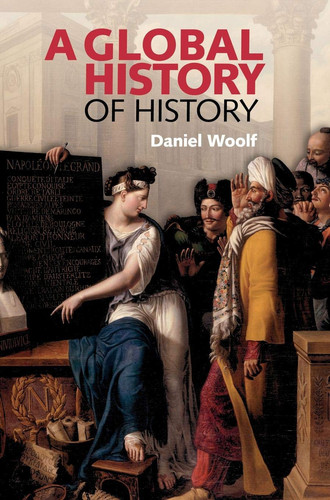
A global history of history

Woolf, D. R.
A global history of historical writing, thought and the development of the historical discipline from the ancient world to the present. This is a definitive guide to human efforts to recover, understand and represent the past, bringing together different historical traditions and their social, economic, political and cultural contexts. Daniel Woolf offers clear definitions of different genres and forms of history and addresses key themes such as the interactions between West and East, the conflict of oral, pictographic, and written accounts of the past and the place of history in society and in politics. Numerous textual extracts and illustrations in every chapter capture the historical cultures of past civilizations and demonstrate the different forms that historical consciousness has taken around the world. The book offers unique insights into the interconnections between different historical cultures over 3000 years and relates the rise of history to key themes in world history. --
Cambridge University Press 2011-02-17 568 pages