58,196 results in 0.07 seconds

Remarks on the phonological evolution of Russian in comparison with the other Slavic languages

Jakobson, Roman
The first English translation of a classic and groundbreaking work in historical phonology. This is the first English translation of a groundbreaking 1929 work in historical phonology by the renowned linguist Roman Jakobson, considered the founder of modern structural linguistics. A revolutionary treatment of Russian and Slavic linguistics, the book introduced a new type of historical linguistics that focused on the systematic reasons behind phonological change. Rather than treating such changes as haphazard, Jakobson here presents a “teleological,” purposeful approach to language evolution. He concludes by placing his book in the context of the exciting structural developments of the era, including Einstein's theories, Cezanne's art, and Lev Berg's nomogenesis. The original Russian version of the book was lost during the 1939 German invasion of Brno, Czechoslovakia, and the only edition available until now has been the French translation by Louis Brun. Thus this first English translation offers many linguists their first opportunity to read a major early work of Jakobson. Ronald Feldstein, a leading Slavicist and phonologist in his own right, has not only translated the text from French to English, he has also worked to reconstruct something as close to the missing original as possible. Feldstein's end-of-chapter annotations provide explanatory context for particularly difficult passages.
The MIT Press 2023-10-31 240 pages

Confidence Men

Ron Suskind
In this gripping book, Pulitzer Prize–winning journalist Ron Suskind tells the complete story of the financial meltdown in the United States and an untested new president charged with commanding Washington, taming Wall Street, rescuing an economy on the verge of collapse and restoring the confidence of a shaken nation. Suskind moves from the frenzied trading floors of lower Manhattan to the power corridors inside the Beltway and introduces a larger-than-life cast of politicians and advisors, titans of high finance, reformers, lobbyists and others who faced a crisis that threatened not only a nation, but the entire world. Based on hundreds of hours of interviews and exhaustive research, filled with piercing insight and startling disclosures, Suskind’s eye-opening book goes beyond the headlines and previous accounts, bringing into focus the unprecedented struggle between Wall Street and Washington, between hope and fear, that continues to roil the country.
HarperCollins 2012-06-19 528 pages

Sovereign virtue: the theory and practice of equality

Dworkin, Ronald
Equality is the endangered species of political ideals. Even left-of-center politicians reject equality as an ideal: government must combat poverty, they say, but need not strive that its citizens be equal in any dimension. In his new book Ronald Dworkin insists, to the contrary, that equality is the indispensable virtue of democratic sovereignty. A legitimate government must treat all its citizens as equals, that is, with equal respect and concern, and, since the economic distribution that any society achieves is mainly the consequence of its system of law and policy, that requirement imposes serious egalitarian constraints on that distribution. What distribution of a nation's wealth is demanded by equal concern for all? Dworkin draws upon two fundamental humanist principles--first, it is of equal objective importance that all human lives flourish, and second, each person is responsible for defining and achieving the flourishing of his or her own life--to ground his well-known thesis that true equality means equality in the value of the resources that each person commands, not in the success he or she achieves. Equality, freedom, and individual responsibility are therefore not in conflict, but flow from and into one another as facets of the same humanist conception of life and politics. Since no abstract political theory can be understood except in the context of actual and complex political issues, Dworkin develops his thesis by applying it to heated contemporary controversies about the distribution of health care, unemployment benefits, campaign finance reform, affirmative action, assisted suicide, and genetic engineering.
Harvard University Press 2000-05-26 511 pages

The Rosa Luxemburg reader

Luxemburg, Rosa
Among the major Marxist thinkers of the Russian Revolution era, Rosa Luxemburg stands out as one who speaks to our own time. Her legacy grows in relevance as the global character of the capitalist market becomes more apparent and the critique of bureaucratic power is more widely accepted within the movement for human liberation. The Rosa Luxemburg Reader is the definitive one-volume collection of Luxemburg's writings in English translation. Unlike previous publications of her work from the early 1970s, this volume includes substantial extracts from her major economic writings—above all, The Accumulation of Capital (1913)—and from her political writings, including Reform or Revolution (1898), the Junius Pamphlet (1916), and The Russian Revolution (1918). The Reader also includes a number of important texts that have never before been published in English translation, including substantial extracts from her Introduction to Political Economy (1916), and a recently-discovered piece on slavery. With a substantial introduction assessing Luxemburg's work in the light of recent research, The Rosa Luxemburg Reader is an indispensable resource for scholarship and an inspiration for a new generation of activists.
Monthly Review Press 2004 447 pages

Honey from the rock: sixteen Jews find the sweetness of Christ

Roy Schoeman
Schoeman, a Jewish convert to Catholicism, and best-selling author of Salvation Is From The Jews, once again shows the clear links between Judaism and Catholicism in these inspiring stories of sixteen Jews who became fulfilled Jews, as Schoeman says, through their spritual journeys to the Catholic Church. Using the rich image in Psalm 81 for the book's title, the author shows how God gave the Jews at Meribah refreshing water from the rock struck by Moses, but He promised ever so much more when they turn their whole hearts to Him - he will give them honey, sweetness itself, from the rock . The sweetness of Christ.
Ignatius Press 2007 289 pages

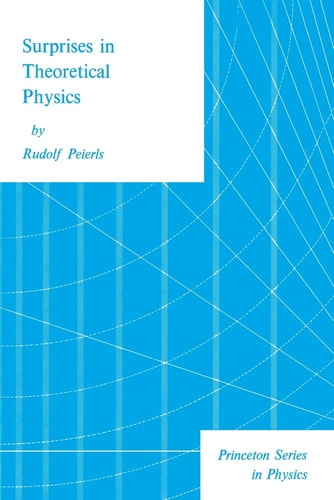
Surprises in theoretical physics

Peierls, Rudolf Ernst Sir
Problems in theoretical physics often lead to paradoxical answers; yet closer reasoning and a more complete analysis invariably lead to the resolution of the paradox and to a deeper understanding of the physics involved. Drawing primarily from his own experience and that of his collaborators, Sir Rudolf Peierls selects examples of such "surprises" from a wide range of physical theory, from quantum mechanical scattering theory to the theory of relativity, from irreversibility in statistical mechanics to the behavior of electrons in solids. By studying such surprises and learning what kind of possibilities to look for, he suggests, scientists may be able to avoid errors in future problems. In some cases the surprise is that the outcome of a calculation is contrary to what physical intuition seems to demand. In other instances an approximation that looks convincing turns out to be unjustified, or one that looks unreasonable turns out to be adequate. Professor Peierls does not suggest, however, that theoretical physics is a hazardous game in which one can never foresee the surprises a detailed calculation might reveal. Rather, he contends, all the surprises discussed have rational explanations, most of which are very simple, at least in principle. This book is based on the author's lectures at the University of Washington in the spring of 1977 and at the Institut de Physique Nucleaire, University de Paris-Sud, Orsay, during the winter of 1977-1978.
Princeton University Press 1979-11-21 166 pages

Surprises in theoretical physics

Peierls, Rudolf Ernst Sir
Problems in theoretical physics often lead to paradoxical answers; yet closer reasoning and a more complete analysis invariably lead to the resolution of the paradox and to a deeper understanding of the physics involved. Drawing primarily from his own experience and that of his collaborators, Sir Rudolf Peierls selects examples of such "surprises" from a wide range of physical theory, from quantum mechanical scattering theory to the theory of relativity, from irreversibility in statistical mechanics to the behavior of electrons in solids. By studying such surprises and learning what kind of possibilities to look for, he suggests, scientists may be able to avoid errors in future problems. In some cases the surprise is that the outcome of a calculation is contrary to what physical intuition seems to demand. In other instances an approximation that looks convincing turns out to be unjustified, or one that looks unreasonable turns out to be adequate. Professor Peierls does not suggest, however, that theoretical physics is a hazardous game in which one can never foresee the surprises a detailed calculation might reveal. Rather, he contends, all the surprises discussed have rational explanations, most of which are very simple, at least in principle. This book is based on the author's lectures at the University of Washington in the spring of 1977 and at the Institut de Physique Nucleaire, University de Paris-Sud, Orsay, during the winter of 1977-1978.
Princeton University Press 1979 166 pages

I escaped from Auschwitz

Vrba, Rudolf
"At 6 P.M. on April 7th, 1944 sirens shrieked continuously as two prisoners escaped from Auschwitz. Once free, Rudolf Vrba and Alfred Wetzler wrote a report that detailed -- for the first time -- the mechanics of the Nazi Death Factory. The report -- known now as the Vrba-Wetzler Report on the Auschwitz Protocols -- warned the world that the Nazis were preparing to kill nearly 800,000 Hungarian Jews. The report was smuggled to Switzerland and eventually reached the U.S. State Department, the Vatican, and the British Embassy in Berlin. I Escaped from Auschwitz is the first-hand account of his daring escape. It also includes the full text of the Auschwitz Protocols which is considered by many to be one of the most important documents of the twentieth century. The subsequent handling and mishandling of the report contained in this book has marred history forever." --
Barricade Books 2002 447 pages

The Stone Doll of Sister Brute

Russell Hoban,Lillian Hoban
The companion book to The Little Brute Family, which introduced a grumbling but always lovable cast of creatures--to rave reviews. Sister Brute has nothing to love, and when she asks for a doll, Mama Brute gives her a stone. Sister Brute turns the stone into a doll, and one day an ugly dog follows Sister Brute and her doll home. Now she has two things to love! 3-color illustrations.
Random House Children's Books 1992-07 32 pages