58,196 results in 0.07 seconds

The oath

Wiesel, Elie
When a Christian boy disappears in a fictional Eastern European town in the 1920s, the local Jews are quickly accused of ritual murder. There is tension in the air and a pogrom threatens to erupt. Suddenly, an extraordinary man—Moshe the dreamer, a madman and mystic—steps forward and confesses to a crime he did not commit, in a vain attempt to save his people from certain death. The community gathers to hear his last words—a plea for silence—and everyone present takes an oath: whoever survives the impending tragedy must never speak of the town’s last days and nights of terror. For fifty years the sole survivor keeps his oath—until he meets a man whose life depends on hearing the story, and one man’s loyalty to the dead confronts head-on another’s reason to go on living. One of Wiesel’s strongest early novels, this timeless parable about the Jews and their enemies, about hate, family, friendship, and silence, is as powerful, haunting, and significant as it was when first published in 1973.
Schocken Books 1986-05-12 283 pages

The Park Chung Hee era: the transformation of South Korea

Pyŏng-guk Kim,Ezra F. Vogel
In 1961 South Korea was mired in poverty. By 1979 it had a powerful industrial economy and a vibrant civil society in the making, which would lead to a democratic breakthrough eight years later. The transformation took place during the years of Park Chung Hee's presidency. Park seized power in a coup in 1961 and ruled as a virtual dictator until his assassination in October 1979. He is credited with modernizing South Korea, but at a huge political and social cost. South Korea's political landscape under Park defies easy categorization. The state was predatory yet technocratic, reform-minded yet quick to crack down on dissidents in the name of political order. The nation was balanced uneasily between opposition forces calling for democratic reforms and the Park government's obsession with economic growth. The chaebol (a powerful conglomerate of multinationals based in South Korea) received massive government support to pioneer new growth industries, even as a nationwide campaign of economic shock therapy-interest hikes, devaluation, and wage cuts-met strong public resistance and caused considerable hardship. This landmark volume examines South Korea's era of development as a study in the complex politics of modernization. Drawing on an extraordinary range of sources in both English and Korean, these essays recover and contextualize many of the ambiguities in South Korea's trajectory from poverty to a sustainable high rate of economic growth.
Harvard University Press 2011-04 744 pages

˜Theœ Great Wall of China and other short works

Kafka, Franz
"Malcolm Pasley's translations, together with those in a forthcoming companion volume, The Transformation ('Metamorphosis') and Other Stories, are distinctive in that they illuminate Kafka's life as well as his art by presenting the works in the sequence in which they were written. Unlike other editions popularly available, this one has been prepared directly from the author's manuscripts. In its fidelity to the text it vastly alters our received versions of many of Kafka's greatest works, besides correcting numerous errors of detail. This volume contains the major short works left by Kafka, including Blumfeld, an Elderly Bachelor, The Great Wall of China and Investigations of a Dog, together with The Collected Aphorisms and He: Aphorisms from the 1920 Diary."--Publisher.
Penguin Books 1991 218 pages

Minnesota rag: corruption, yellow journalism, and the case that saved freedom of the press

Friendly, Fred W.
Minnesota Rag takes the reader on an exhilarating tour of the seamy underside of a dark period in Minnesota's past, one rife with crooked public officials, vengeful gangsters, and yellow journalists. Featuring notorious characters such as Jay M. Near, racist and antilabor publisher of Minneapolis's Saturday Press, pioneering newsman Fred W. Friendly weaves the tale of a court case that molded our understanding of freedom of the press and set a precedent for the publication of the Pentagon Papers. "Friendly moves us from the ore-dusted brothels of Duluth, Minnesota, to the gothic top of the Chicago Tribune Tower, to the cloistered conference room of the Supreme Court.... Rich and bizarre."
University of Minnesota Press 2003 243 pages

What is this thing called love?

Wilder, Gene
For a romantic, it's life's ultimate question: What is This Thing Called Love? Actor and novelist Gene Wilder explores twelve possible answers in this emotionally involving book about different kinds of love: star-crossed, intense, needy, eternal, unrequited and even comical. With delicacy of feeling and a simple style that adds to the power of his fiction, Wilder creates memorable lovers and silly suitors, unexpected attraction and careful courting. What is This Thing Called Love? is for anyone who has ever yearned for a deep connection, made a study of love, and spent their life trying to find the real thing. "A lighthearted reminder of love's potential (requited, even unrequited) to make a life worthwhile."—Los Angeles Times
St. Martin's Griffin 2011-04-26 176 pages

Gershwin! (Medley) Featuring "Fascinating Rhythm," "Embraceable You," "Somebody Loves Me," "Someone to Watch Over Me," and "I Got Rhythm"

The Music Of George Gershwin / Arr. Warren Barker
To celebrate the centennial of the great American composing team George and Ira Gershwin, we proudly present a resplendent Warren Barker treatment of some of the Gershwin's fabulous hits, including Fascinating Rhythm, Embraceable You, Somebody Loves Me, Someone To Watch Over Me and I Got Rhythm. Splashes of color, charismatic textures, and all of the Barker 'trademarks' are here. A stunning rendition! (duration 6: 40)
Alfred Publishing Company, Incorporated 1997-06 258 pages

Shut up, I'm talking: and other diplomacy lessons I learned in the Israeli government : a memoir

Levey, Gregory
"Shut Up, I'm Talking" is a smart, hilarious insider take on Israeli politics that reads like the bastard child of Thomas Friedman and David Sedaris. Now a political writer for Salon, Gregory Levey stumbled into a job as speechwriter for the Israeli delegation to the United Nations at age twenty-five and suddenly found himself, like a latter-day Zelig, in the company of foreign ministers, U.S. senators, and heads of state. Much to his surprise, he was soon attending U.N. sessions and drafting official government statements. The situation got stranger still when he was transferred to Jerusalem to write speeches for Prime Minister Ariel Sharon. "Shut Up, I'm Talking" is a startling account of Levey's journey into the nerve center of Middle Eastern politics at one of the most turbulent times in Israeli history. During his three years in the Israeli government, the Second Intifada continued on in fits and starts, Yasser Arafat died, Hamas came to power, and Ariel Sharon fell into a coma. Levey was repeatedly thrust into highly improbable situations -- from being the sole "Israeli" delegate (even though he's Canadian) at the U.N. General Assembly, with no idea how "his" country wanted to vote; to nearly inciting an international incident with his high school French translation of an Arab diplomat's anti-Israel remarks; to communicating with Israeli intelligence about the suspected perpetrators of suicide bombings; to being offered leftover salami from Ariel Sharon's lunch. As Levey got better acquainted with the personalities in the government's inner sanctum, he witnessed firsthand the improvisational and ridiculously casual nature of the country's behind-the-scenes leadership -- and realized that he wasn't the only one faking his way through politics. With sharp insight and great appreciation for the absurd, Levey offers the first-ever look inside Israel's politics from the perspective of a complete outsider, ultimately concluding that the Israeli government is no place for a nice Jewish boy.
Free Press 2008-04-22 267 pages

Janner on meetings

Janner, Greville
In this new edition of the "Janner on Meetings", author Greville Janner presents a complete guide to success with meetings. Whether you organize, address or chair meetings, this book offers guidelines to propel you to mastery. The author illuminates every aspect of this important subject, from coping with nerves to using visual aids, handling hecklers and preparing minutes. He reveals the secrets of thinking on your feet, the skills of self-presentation and the special touches that make occasions memorable. The revised edition contains fresh material, including a new section summarizing key points in checklist form. Greville Janner's advice applies to meetings large and small, public and private, business, professional and personal. The book is a distillation of his unique experience as a public speaker and committee chair.
Wildwood House 1987 180 pages

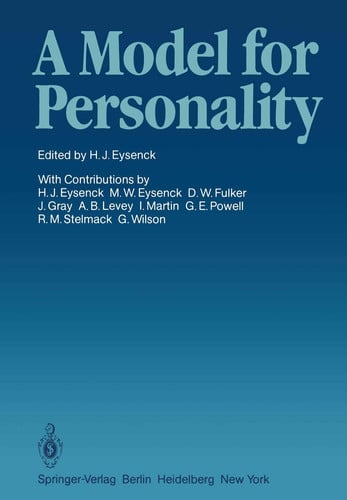
A Model for Personality

H.J. Eysenck
H. J. Eysenck This book is not an introduction to personality research, it is not a textbook, and above all it is not a model of personality. The title, A Modelfor Personality, was chosen on purpose to indicate that we are here concerned with a discussion of how models in this field ought to be constructed, what their functions were, and whether such models or paradigms could with advantage be produced at this stage of development. One particular aspect of personality, extraversion introversion (E), has been chosen to exemplify the desiderata which emerge from such a discussion. It is not suggested that personality and E are synonymous - merely that this particular dimension is perhaps better known than any other, has had more experimental work done on it than any other and has acquired a better theoretical substructure, and more links with genetics and physiology, than any other. Hence it seems most likely to serve as an example of how a satisfactory model of personality might ultimately be constructed, i. e. by analogy with E. Other dimensions of personality, such as neuroticism-stability or psycho tic ism-superego functioning, are mentioned in the discussion, but only when they overlap or interrelate with E. The book uses E as an example to illustrate the way in which a model of personality can be constructed, but it is in no way a summary of all that is known about E.
Springer Berlin Heidelberg 2011-10-26 287 pages

The Measurement of Intelligence

Hans J. Eysenck
This book deals with one aspect of the modern, proof, and the deductions to which they give rise, and scientific study of intelligence, namely its measurement. the social aspect, which is concerned with the "good" or The term, measurement, has difficulties attached to it "evil" consequences which follow from the scientific which rival those attached to the term, intelligence; discovery or invention. Thus IQ testing would appear to many psychologists have little idea of what the word many people to give rise to desirable and "good" conse means, and what are the requirements which must be quences when it enables us to pick out bright "dis fulfilled in order to enable "measurement" to take advantaged" children for higher educational and place. Krantz, Luce, Suppes and Tversky (1971) have university training who would otherwise not have been tried to provide us with an introduction to the "Founda educated up to the level of their ability. On the other tions of Measurement"; these two volumes outline the hand, IQ testing would appear to many people to give background against which attempts to measure intelli rise to undesirable and "bad" consequences when it gence must be evaluated. * No short excerpt or set of enables trade unions to exclude coloured workers by the readings could suffice to bring home to the "innum imposition of unrealistic and irrelevant intellectual erate" reader the implications of scientific measurement, requirements for membership.
Springer Netherlands 2012-02-22 488 pages