214 results for "American History"

Old Whigs: Burke, Lincoln, and the politics of prudence

Weiner, Greg
"The virtue of prudence suffuses the writings of Edmund Burke and Abraham Lincoln, yet the demands of statecraft compelled both to take daring positions against long odds: Burke against the seemingly inexorable march of the French Revolution, Lincoln against disunion at a moment when the Northern situation appeared untenable. Placing their statesmanship and writings in relief helps to illuminate prudence in its full dimensions: inflected with caution but not confined to it, bound to circumstance, and finding expression in the particular but grounded in the absolute. This comparative study of two thinkers and statesmen who described themselves as "Old Whigs" argues for a recovery of prudence as the political virtue par excellence by viewing it through the eyes, words and deeds of two of its foremost exemplars. Both statesmen deeply informed by the life of the mind, Burke and Lincoln illustrate prudence in its universal but also contrasting dimensions. Burke emphasized the primacy of feeling, Lincoln the axioms of logic. Burke saw British prudence emanating from the mists of ancient history; for Lincoln, America's soul lay in a discrete moment of founding in 1776. Yet both were moved by a respect for the mysterious and customary. Each maintained the virtue of compromise while adhering to immovable commitments. At a time when American politics, and American conservatism in particular, teems with a desire for boldness but also an innate resistance to schemes of social or political transformation, this book answers with a fuller and richer account of prudence as it emerges in the thought and action of two of the great statesmen and thinkers of modern times"--
Encounter Books 2019 170 pages

The decline and fall of the American republic

Ackerman, Bruce A.
Constitutional thought is currently dominated by heroic tales of the Founding Fathers — who built an Enlightenment machine that can tick-tock its way into the twenty-first century, with a little fine-tuning by the Supreme Court. However, according to Bruce Ackerman, the modern presidency is far more dangerous today than it was when Arthur Schlesinger published the Imperial Presidency in 1973. In this book, he explores how the interaction of changes in the party system, mass communications, the bureaucracy, and the military have made the modern presidency too powerful and a threat to liberal constitutionalism and democracy. Ackerman argues that the principles of constitutional legitimacy have been undermined by both political and legal factors. On the political level, by “government by emergency” and “government by public-opinion poll”; on the legal, by two rising institutions: The Office of Legal Counsel in the Department of Justice and the Office of the Presidential Counsel in the White House. Both institutions came out of the New Deal, but have gained prominence only in the last generation. Lastly, Ackerman kicks off a reform debate that aims to adapt the Founding ideal of checks-and-balances to twenty-first century realities. His aim is not to propose definitive solutions but to provoke a national debate on American democracy in its time of trouble.
Harvard University Press 2013-09-02 280 pages

Fortunate sons: the 120 Chinese boys who came to America, went to school, and revolutionized an ancient civilization

Leibovitz, Liel
In 1872, the Qing Empire sent 120 boys to America in the hope that they would unlock the mysteries of Western innovation. They studied at New England's finest schools, befriended luminaries such as Mark Twain and Ulysses S. Grant, and exchanged ideas with their American peers that would change the course of both nations. But when anti-Chinese fervor forced them back home, the young men faced a new set of obstacles, having to overcome a suspicious imperial court and a culture deeply resistant to change. Filled with colorful characters and vivid historical detail, this book unearths the dramatic stories of these young men who led China at the pivotal moment when it teetered between modernity and tradition.--From publisher description.
W.W. Norton 2011 319 pages

The American democracy: a commentary and an interpretation

Laski, Harold J.
This is Laski's most important book after A Grammar of Politics . It discusses, on a grand scale, every aspect of American public life. Laski surveys American traditions and the American spirit, political institutions, the entire educational, religious, economic and social scene, America as a world power, and Americanism as a principle of civilisation. Laski's unsurpassed knowledge of American constitutional, social and cultural history is set in the perspective of his deep study of comparative constitutional history and political theory. He was one of very few people to see U.S. politics from the inside, as a result of his friendships with Roosevelt, Brandeis and Oliver Wendell Holmes.
Routledge 2014-10-29 794 pages

The unfinished election of 2000

Rakove, Jack N.
The Unfinished Election of 2000 gathers an outstanding group of constitutional and political scholars to address key facets of the most recent election and to show how the events of 2000 fit into a larger historical narrative of American politics and law. Perhaps no other election in U.S. history has left so many disturbing questions about how our political system works--from the very basic mechanics of vote casting to the conclusion, which many believe to have been the result of a politicized U.S. Supreme Court. The Unfinished Election of 2000 is the first book to attempt a true historical judgement and to give readers a better understanding of the election that confused and infuriated the country.
BasicBooks 2001-10-17 266 pages

Living in the eighties

Gil Troy,Vincent J. Cannato
Some see the 1980s as a Golden Age, a "Morning in America" when Ronald Reagan revived America's economy, reoriented American politics, and restored Americans' faith in their country and in themselves. Others see the 1980s as a new "Gilded Age," an era that was selfish, superficial, glitzy, greedy, divisive, and destructive. This multifaceted exploration of the 1980s brings together a variety of voices from different political persuasions, generations, and vantage points. The volume features work by Reagan critics and Reagan fans (including one of President Reagan's closest aides, Ed Meese), by historians who think the 1980s were a disastrous time, those who think it was a glorious time, and those who see both the blessings and the curses of the decade. Their essays examine everything from multiculturalism, Southern conservatism, and Reaganomics, to music culture, religion, crime, AIDS, and the city. A complex, thoughtful account of a watershed in our recent history, this volume will engage anyone interested in this pivotal decade.
Oxford University Press 2009-10-22 212 pages

Public matters: essays on politics, policy and religion

Galston, William A.
Product Description After preparing to lead a quiet life as a teacher and scholar of political theory, William Galston has spent the past quarter century crossing the boundaries between academia and public life, including a two-year stint as Deputy Assistant for Domestic Policy under President Clinton. Reflecting these boundary-crossings, Public Matters contains a selection of Galston's essays on politics, policy, and religion. Each is viewed through the prisms of history, theory, and ethical concerns. The essays on politics tell the story of Galston's efforts to help redirect the Democratic Party so that it speaks more clearly to the concerns of 21st century Americans. The essays in the policy section reflect the range of issues with which Galston has grappled as a political activist and public official. Finally, the essays on religion try to come to grips with the challenges that religion, taken seriously (as it should be) poses for the governance of constitutional democracies. Review "William Galston is a unique and indispensable voice, because he's a first-rate political theorist who is also active in the political arena. In this book he offers illuminating and wise comments on a wide range of topics ― the rise of New Democrats, the 2004 elections, preemptive war, the role of religion, and human embryo research. Written with style and panache, Public Matters is highly instructive ― and also a lot of fun." -- Cass Sunstein, University of Chicago Law School An excellent introduction to Galston's thinking on divisive policy questions (stem-cell research, the war in Iraq), the role of religion in public life, and the future of the Democratic Party. ― Commonweal Magazine There is no better example in America today of someone who is both a practical politician and a serious moral thinker than William Galston. His reflections on subjects from domestic politics to war and peace deserve the widest possible audience. -- Alan Wolfe, Director of the Boisi Center for Religion & American Public Life at Boston College About the Author William A. Galston is director of the Institute for Philosophy and Public Policy, Saul I. Stern Professor of Civic Engagement at the School of Public Policy at the University of Maryland, and director of the Center for Information & Research on Civic Learning & Engagement (CIRCLE). Galston is the author of five books and nearly one hundred articles in moral and political theory, American politics, and public policy.
Rowman & Littlefield Publishers 2005-09-20 183 pages

The folly of empire: what George W. Bush could learn from Theodore Roosevelt and Woodrow Wilson

Judis, John B.
The New York Times hailed John B. Judis's The Emerging Democratic Majority as "indispensable." Now this brilliant political writer compares the failure of American imperialism a century ago with the potential failure of the current administration's imperialistic policies. One hundred years ago, Theodore Roosevelt believed that the only way the United States could achieve peace, prosperity, and national greatness was by joining Europe in a struggle to add colonies. But Roosevelt became disillusioned with this imperialist strategy after a long war in the Philippines. Woodrow Wilson, shocked by nationalist backlash to American intervention in Mexico and by the outbreak of World War I, began to see imperialism not as an instrument of peace and democracy, but of war and tyranny. Wilson advocated that the United States lead the nations of the world in eliminating colonialism and by creating a "community of power" to replace the unstable "balance of power." Wilson's efforts were frustrated, but decades later they led to the creation of the United Nations, NATO, the IMF, and the World Bank. The prosperity and relative peace in the United States of the past fifty years confirmed the wisdom of Wilson's approach. Despite the proven success of Wilson's strategy, George W. Bush has repudiated it. He has revived the narrow nationalism of the Republicans who rejected the League of Nations in the 1920s. And at the urging of his neoconservative supporters, he has revived the old, discredited imperialist strategy of attempting to unilaterally overthrow regimes deemed unfriendly by his administration. Bush rejects the role of international institutions and agreements in curbing terrorists, slowing global pollution, and containing potential threats. In The Folly of Empire, John B. Judis convincingly pits Wilson's arguments against those of George W. Bush and the neoconservatives. Judis draws sharp contrasts between the Bush administration's policies, especially with regard to Iraq, and those of every administration from Franklin Roosevelt and Harry Truman through George H. W. Bush and Bill Clinton. The result is a concise, thought-provoking look at America's position in the world -- then and now -- and how it has been formed, that will spark debate and controversy in Washington and beyond. The Folly of Empire raises crucial questions about why the Bush administration has embarked on a foreign policy that has been proven unsuccessful and presents damning evidence that its failure is already imminent. The final message is a sobering one: Leaders ignore history's lessons at their peril.
Scribner 2004 245 pages

The perils of empire: America and its imperial predecessors

Laxer, James
Some empires endure for thousands of years, while others flash and fail quickly. This thoughtful study compares the American Empire to those of the past, finding that much can be learned from the fates of the British, Roman, Chinese, Incan, and Aztec empires. Deeply researched and full of historical insights, The Perils of Empire sounds a warning about the challenges facing the American Empire and its repercussions around the globe.
Viking Canada 2008 248 pages

Visitors: an American feminist in East Central Europe

Snitow, Ann Barr
"Visitors tells the story of feminist activist Ann Snitow's work as an organizer in East Central Europe after the fall of the Berlin Wall in 1989. Over a period of 20 years, Snitow captures the changes and struggles in the new political landscape of post-communism as they unfold, and presents insight into the origins and development of the multi-faceted internationalist feminism that is evolving today"--
New Village Press 2020-03-24 301 pages

The future of the European past

Kramer, Hilton
It is no longer news that the history of the European past and its role in shaping American cultural life is under severe attack. In virtually every university that offers a liberal arts curriculum, in every arts institution that deals with European classics, in the offices of every publication that engages in intellectual pursuits, the discussion of the past has become the principal battleground for mapping out the future of our culture. In this provocative and insightful collection of essays first published in The New Criterion, ten distinguished critics reflect on the fate of Europe’s cultural and political legacy as we approach the turn of the century. On subjects ranging from the collapse of communism and its implications for European society, to the study of the classics, to the prospects for serious music and art, these essays offer analyses marked by wit, independence, and commanding intelligence. The contributors include David Pryce-Jones, Anne Applebaum, Roger Scruton, John Gross, Ferdinand Mount, John Herington, Keith Windschuttle, Mark Steyn, Hilton Kramer, and Roger Kimball. The Future of the European Past is a major contribution to the debate over some of the most pressing cultural issues of our time.
I.R. Dee 1997-08-01 233 pages

1929: mapping the Jewish world

Hasia R. Diner,Gennady Estraikh
Winner of the 2013 National Jewish Book Award, Anthologies and Collections The year 1929 represents a major turning point in interwar Jewish society, proving to be a year when Jews, regardless of where they lived, saw themselves affected by developments that took place around the world, as the crises endured by other Jews became part of the transnational Jewish consciousness. In the United States, the stock market crash brought lasting economic, social, and ideological changes to the Jewish community and limited its ability to support humanitarian and nationalist projects in other countries. In Palestine, the anti-Jewish riots in Hebron and other towns underscored the vulnerability of the Zionist enterprise and ignited heated discussions among various Jewish political groups about the wisdom of establishing a Jewish state on its historical site. At the same time, in the Soviet Union, the consolidation of power in the hands of Stalin created a much more dogmatic climate in the international Communist movement, including its Jewish branches. Featuring a sparkling array of scholars of Jewish history, 1929 surveys the Jewish world in one year offering clear examples of the transnational connections which linked Jews to each other—from politics, diplomacy, and philanthropy to literature, culture, and the fate of Yiddish—regardless of where they lived. Taken together, the essays in 1929 argue that, whether American, Soviet, German, Polish, or Palestinian, Jews throughout the world lived in a global context.
New York University Press 2013-08-12 244 pages

Jews and the American public square: debating religion and republic

Mittleman, Alan
Jews and the American Public Square is a study of how Jews have grappled with the presence of religion, both their own and others, in American public life. It surveys historical Jewish approaches to church-state relations and analyzes Jewish responses to the religion clauses of the First Amendment. The book also explores how the contemporary sociological and political characteristics of American Jews bear on their understanding of the public dimensions of American religion. In addition to a descriptive and analytic approach. the volume is also critical and polemical. Its contributors attack and defend prevailing views, raise critical questions about the political and intellectual positions favored by American Jews, and propose new syntheses. This book captures the current mood of the Jewish community: both committed to the separation of church and state and perplexed about its scope and application. It provides the necessary background for a principled reconsideration of the problem of religion in the public square.
Rowman & Littlefield 2002 375 pages

Defining the common good: empire, religion and philosophy in eighteenth-century Britain

Miller, Peter N.
This book discusses the crisis of the early modern state in eighteenth-century Britain and sets it in its European context. The American Revolution and the simultaneous demand for wider religious toleration at home challenged the principles of sovereignty and obligation that underpinned arguments about the character of the state. At stake was a fundamental challenge to the way in which politics was described. The Americans and their British supporters argued that individuals, by voting and thinking freely, ought to determine the "common good." These influential ideas continue to resonate today in the principles of "one man, one vote" and "freedom of thought."
Cambridge University Press 2004-12-16 472 pages

Historical dictionary of Reconstruction

Trefousse, Hans L.
This reference book by well-known Reconstruction expert Trefousse will be of great use to scholars and general readers. Pithy, readable articles, spanning the years 1862-96, reflect current scholarship on the period and thus focus heavily on race relations, the freed slaves, and restoration of the states. There are entries on court cases, terms (blacks, labor, etc.), organziations, states, laws, miscellaneous events, and major individuals. . . . As the only reference work of its type, it should find widespread applicability in libraries of any size. Library Journal This new reference book reflects the latest scholarship regarding the Reconstruction of the American South following the Civil War. In the past four decades, the guidelines set forth by William D. Dunning and his students, which portrayed the period as a time of horror for suffering Southerners over whom radicals, scalawags, and carpetbaggers rode roughshod, has been amended. Since World War II, the appearance of revised versions of the period, as well as favorable biographies of such major figures as Charles Sumner, Thaddeus Stevens, Benjamin F. Wade, Edwin M. Stanton, and George W. Julian, have transformed the historiography of Reconstruction. While many unresolved issues still remain, the field has benefited greatly from this reassessment. Hence, this outstanding single-volume reference, containing the most recent thinking on the period, will be of great help to scholars and the general public. No other reference focusing exclusively on Reconstruction exists. The dictionary stresses race relations, emancipation, the main participants in the struggle, and the restoration of the Southern states into the Union. Those states involved in some way or other in the process, including the border commonwealths, will be found here, as are the major Supreme Court decisions handed down during Reconstruction. Readable articles at each entry convey the principle information in an economical style and are followed in each case by a listing of the latest available literature, principally monographs and books rather than articles, in order to facilitate further research. Covering a time period from 1862 to 1896, the dictionary focuses on matters pertaining to the integration of freedmen and the restoration of the states. The preface and chronology of events preceed the conveniently organized dictionary section, which contains entries whose lengths vary depending on the relative importance of the concept or personality treated. Generally, the importance of individuals in reference to Reconstruction, rather than their general significance, has determined their inclusion. Each entry is followed by its own bibliography. The volume closes with a select bibliography and index. This outstanding reference belongs in every college and university library as well as in public libraries, and is eminently suitable for courses dealing with the Civil War and Reconstruction and for Civil War Roundtables. Civil War buffs and historians interested in nineteenth-century America will refer to it again and again.
Greenwood Press 1991 284 pages

The failure of the founding fathers: Jefferson, Marshall, and the rise of presidential democracy

Ackerman, Bruce A.
Describes previously unknown aspects of the electoral college crisis of 1800, presenting a revised understanding ofthe early days of two great institutions that continue to have a major impact on American history: the plebiscitarian presidency and a Supreme Court that struggles to put the presidency's claims of a popular mandate into constitutional perspective. Through close studies of two Supreme Court cases, Ackerman shows how the court integrated Federalist and Republican themes into the living Constitution of the early republic. The ink was barely dry on the Constitution when it was almost destroyed by the rise of political parties in the United States. As Bruce Ackerman shows, the Framers had not anticipated the two-party system, and when Republicans battled Federalists for the presidency in1800, the rules laid down by the Constitution exacerbated the crisis. [Publisher web site].
Belknap Press of Harvard University Press 2005-10-28 384 pages

Against the grain: a historian's journey

Auerbach, Jerold S.
Against the Grain is a collection of challenging and insightful essays from a reflective historian. Jerold Auerbach, Professor Emeritus at Wellesley College (where he taught for 40 years), writes in the Foreword how his academic career and his time in Israel "each in its own distinctive way converged to liberate me from my past as a non-Jewish Jew." He adds: "Regardless of the subject-law, modern American history, Pueblo Indians, American Judaism, Israel-deference to the conventional wisdom never had been my style. I always enjoyed the stimulation of writing against the grain: discovering hidden meanings, challenging historical and political pieties, and exposing the self-serving ideology that often lurked beneath self-evident truths. Providing intellectual catnip, it also enabled me to reach readers far beyond the narrow confines of academic journals. "My creative work always was done in the solitude of my study, my sanctum within my home. Enclosed within the treasured artifacts, maps, photographs, prints, and books accumulated during decades of research and travel, I explored the historical past that both inspired and reflected my own intellectual trajectory. Virtually every book I have written, to my genuine surprise, contained within it the seed of its successor. That, of course, is discernible only with hindsight-which, after all, is the distinctive attribute of a historian. I invite my family, friends, and interested readers to accompany me to some favorite destinations during my journey." A new book in Quid Pro's Journeys & Memoirs Series, Against the Grain presents this distinctive hindsight in essays and excerpts targeted to a general audience interested in such issues, in addition to historians and college students. Many of the essays were first published in non-academic periodicals and are accessible to this broader audience, though they are nonetheless supported with the prodigious research, evocative prose, and candor of a widely published writer.
Quid Pro Books 2012 256 pages

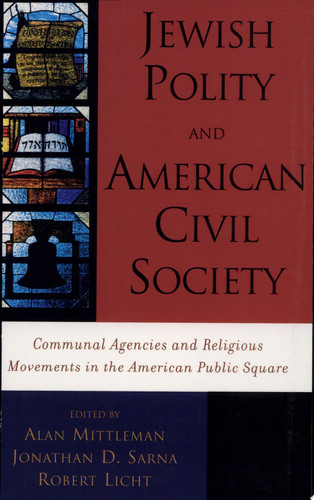
Jewish polity and American civil society: communal agencies and religious movements in the American public sphere

Alan Mittleman,Robert Licht,Jonathan D. Sarna
Jewish Polity and American Civil Society is a study of the civic and political engagements of American Jews as mediated by their communal and denominational institutions. The book explores how the various branches of the organized Jewish community seek to influence public affairs. Over the course of the last century, Jewish agencies and religious movements have tried to shape public debate and public policy on such issues as civil rights, church-state relations, and American foreign policy. The book sets the history of Jewish engagement in these areas into historical context; analyzes the motives, strategies, and tactics of various Jewish groups, and evaluates their successes and failures. The book also explores the underlying idea-the public philosophy-that informs American Jews' understanding of civic and political engagement.
Rowman & Littlefield 2002-07-23 420 pages

Between the lines: readings on Israel, the Palestinians, and the U.S. "war on terror"

Honig-Parnass, Tikva
This compilation of essays, edited by a Palestinian writer and an Israeli journalist, constitutes a challenge to critically rethink the Israeli-Palestinian conflict. Between the Lines presents a groundbreaking study that brings together insights from across the lines of conflict to put the latest chapter of Israeli apartheid and Palestinian resistance into context. Contributors include: Marwan Bargouti, Dr. Azmi Bishara, Dr. Sami Shalom Chetrit, Dr. Saleh Abdel Jawwad, Husam Khader, Eileen Kuttab, Dr. Yitzhak Laor, Dr. Adi Ophir, Dr. Ilan Pappe, Linda Tabar, Graham Usher and Dr. Jamal Zahalqa. "The destruction of a nation is not an everyday event in history. It is being carried out before our eyes, systematically and consciously, with cruelty and self-righteousness, and with the backing of the global superpower. These acute and informed essays develop a perspective on the background and unfolding of these events that is remote from anything likely to be heard in the West. They merit close attention and thoughtful consideration." --Noam Chomsky "This collection provides a lucid and critical analysis of the Israeli and American policies in the Middle East. The disastrous repercussions of this unholy alliance are presented in this collection through incisive and timely contributions. In the best tradition of [the journal] Between the Lines, readers will be rewarded by this collection that unmasks and exposes what the mainstream media refuses to report or admit." --Ilan Pappe, Israeli historian and author of A History of Modern Palestine Toufic Haddad is a Palestinian American activist who was formerly co-editor with Tikva Honig-Parnass of the Jerusalem-based magazine Between the Lines. Tikva Honig-Parnass is a Jewish Israeli active in radical anti-occupation movements.
Haymarket Books 2007 405 pages

Wounded titans: American presidents and the perils of power

Lerner, Max
Max Lerner taught generations of Americans about their government: who rules, why, and how. For almost half a century, the office of the presidency preoccupied his prodigious energies and unparalleled expertise. Lerner not only wrote about the men who inhabited the Oval Office during that time, he knew them personally, from Franklin D. Roosevelt to Bill Clinton - and he knew what made them tick. Here, collected for the first time, are Lerner's complete writings on the presidency and American presidents. Wounded Titans contains Lerner's classic essays on the presidency and its development. Here, too, are his most famous presidential portraits of Jefferson and Lincoln - the presidents he believed most significantly shaped both the office and our perception of it - as well as of the men who inherited the modern-day office created by Roosevelt. Each portrait combines a rigorous and unblinking analysis of its subject's place in history with a sympathetic appreciation of his humanity. Everything about the office of the presidency fascinated Lerner, including how someone ran for it. This volume also contains the best of Lerner's campaign journalism, written for his widely syndicated column, which appeared in the New York Post for over four decades.
Arcade Pub 1996 437 pages