

3040 results for "Biography"

A conspiracy so immense: the world of Joe McCarthy
Describes the internal and external forces that launched Joseph McCarthy on his political career and carried him to national prominence.

Things that make white people uncomfortable
"Defensive lineman Michael Bennett adds his voice to discussions of racism and police violence, Black athletes and their relationship to powerful institutions like the NCAA and the NFL, the role of protest in history, and the responsibilities of athletes as role models to speak out against injustice. Following in the footsteps of activist-athletes from Muhammad Ali to Colin Kaepernick, Bennett demonstrates his outspoken leadership both on and off the field."--Provided by publisher.

Coreyography: a memoir
"A deeply personal and revealing memoir and Hollywood-survival story by The Lost Boys and Stand By Me star We all know Corey Feldman from such iconic movies as Stand by Me, Gremlins, The Goonies, and The Lost Boys. Growing up onscreen, he exuded tough guy edge with a heart of gold. And he lived the life that went along with his success: he palled around with Michael Jackson, dated Drew Barrymore, and was best friends with Corey Haim (aka "the other Corey"). But now that two of those close friends--Haim and Jackson--have passed away, along with others, Corey has decided that it's time to come clean about his past, a past that included physical, drug, and sexual abuse, a dysfunctional family from whom he was emancipated at age fifteen, and a stint in rehab. He will zone in on his close friendship with Haim: the two actors shared a darker story of abuse, which led to Haim's lifelong battle with various addictions and his eventual death. Through it all, Corey has overcome the worst traps that have ensnared so many others of his generation, others who have not made it to where he is today--still acting, a touring musician, and a loving father. At the same time, he still fights for his career and his health, every single day. Coreyography is a tale of survival and redemption"--

CHASING HISTORY : A KID IN THE NEWSROOM

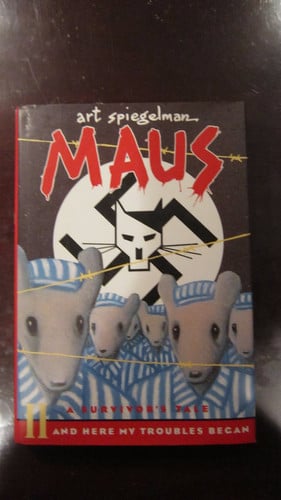
Maus II: a survivor's tale : and here my troubles began
The author-illustrator traces his father's imprisonment in a Nazi concentration camp through a series of disarming and unusual cartoons arranged to tell the story as a novel.
Taking the stand: my life in the law
#1 New York Times bestselling author Alan Dershowitz recounts his extraordinary coming of age in this legal autobiography, as well as the cases that have changed American jurisprudence over the past fifty years, most of which he has personally been involved in. “Overflowing with fascinating and funny vignettes involving his cases and clients, and probing and provocative insights into contemporary legal controversies.”— The Boston Globe Alan Dershowitz, the preeminent defense lawyer in America today, has been called the “winningest appellate criminal defense lawyer in history.” A professor at Harvard Law School since the age of twenty-five, he has led or been part of the defense team for such storied clients as Bill Clinton, Julian Assange, O. J. Simpson, Claus von Bülow, Mia Farrow, Jeffrey MacDonald, Patty Hearst, Mike Tyson, and countless others. In Taking the Stand, Dershowitz describes his evolution as a lawyer—from a C-minus student in Yeshiva High School to the youngest full professor in the history of Harvard Law School. In his #1 New York Times bestselling book Chutzpah, Alan described his Jewish life. In Taking the Stand, he looks at the people and events that have helped to shape his ideas about the law. He describes his formative years as a clerk for the United States Court of Appeals and the Supreme Court. In the course of his career, he confronts the challenges of First Amendment law, the ongoing tension between individual freedom and national security, the questionable science often employed to prosecute accused murderers, the evolution of civil rights—and why the abortion rights debate in society hasn’t moved forward since Roe v. Wade . Filled with unforgettable cases and inside legal “baseball,” Taking the Stand is a deeply personal account of one of the legendary legal minds of our time.

Beautiful country: a memoir of an undocumented childhood
"Beautiful Country is the real deal. Heartrending, unvarnished, and powerfully courageous, this account of growing up undocumented in America will never leave you."--Gish Jen, author of The Resisters Ba Ba told me this and I in turn carried it in my heart: so long as we didn't stake claim to what wasn't ours--the things, our rooms, America, this beautiful country--we would be okay. An incandescent and heartrending memoir about Qian Julie Wang's five years living undocumented after immigrating with her parents from China to New York City in 1994. In Chinese the word for the United States, Mei Guo, translates directly to "beautiful country," but when seven-year-old Qian is plucked from her warm and happy childhood surrounded by extended family in China, she finds a world of crushing fear and poverty instead. Unable to speak English at first, Qian is isolated and disregarded, put into special education classes because she doesn't speak the language and humiliated by teachers and classmates when she struggles to pay attention because of hunger or exhaustion. She encounters racism, and people of other races, for the first time, shocked at where her family fits in comparison to their status as educated elites in China. After school she works shifts alongside her mother in Chinatown sweatshops. There is so much about Qian's new home that doesn't make sense, but the rules of survival are drilled into her head: If you see a policeman, you must run in the other direction. If anyone asks--or even if they don't--you tell them you were born here. Do as you're told or we could be separated forever. Understanding impliclity the toll this has taken on her parents, Qian tries desperately to cheer them up and mediate their increasingly heated arguments, certain that if she is good enough, she can hold the family together. In remarkable, unsentimental prose Wang channels her childhood perspective, illuminating the cruelty and indignity of America's immigration system, while also crafting a narrative of resilience from her family's small moments of joy: their first slice of pizza, "shopping days" when the family would unearth unlikely treasures in Brooklyn's trash, and the necessary escape she found in books at the local library. Searing and unforgettable, Beautiful Country is an essential book about the cost of making a home in a hostile land from an astonishing new talent"--

Hank Greenberg: the hero who didn't want to be one
The remarkable life story of the first Jewish superstar athlete, by New York Times best-selling author Mark Kurlansky One of the reasons baseball fans so love the sport is that it involves certain physical acts of beauty. And one of the most beautiful sights in the history of baseball was Hank Greenberg's swing. His calmly poised body seemed to have some special set of springs with a trigger release that snapped his arms and swept the bat through the air with the clean speed and strength of a propeller. But what is even more extraordinary than his grace and his power is that in Detroit of 1934, his swing--or its absence--became entwined with American Jewish history. Though Hank Greenberg was one of the first players to challenge Babe Ruth's single-season record of sixty home runs, it was the game Greenberg did not play for which he is best remembered. With his decision to sit out a 1934 game between his Tigers and the New York Yankees because it fell on Yom Kippur, Hank Greenberg became a hero to Jews throughout America. Yet, as Kurlansky writes, he was the quintessential secular Jew, and to celebrate him for his loyalty to religious observance is to ignore who this man was. In Hank Greenberg Mark Kurlansky explores the truth behind the slugger's legend: his Bronx boyhood, his spectacular discipline as an aspiring ballplayer, the complexity of his decision not to play on Yom Kippur, and the cultural context of virulent anti-Semitism in which his career played out. What Kurlansky discovers is a man of immense dignity and restraint with a passion for sport who became a great reader--a man, too, who was an inspiration to the young Jackie Robinson, who said, "Class tells. It sticks out all over Mr. Greenberg."

Being Jazz: my life as a (transgender teen)
Teen activist and trailblazer Jazz Jennings--named one of "The 25 most influential teens" of the year by Time--shares her very public transgender journey, as she inspires people to accept the differences in others while they embrace their own truths.

The last victim: a true-life journey into the mind of the serial killer
DEAR MR. MANSON... It started with a college course assignment, then escalated into a dangerous obsession. Eighteen-year-old honor student Jason Moss wrote to men whose body counts had made criminal history: men named Dahmer, Manson, Ramirez, and Gacy. DEAR MR. DAHMER... Posing as their ideal victim, Jason seduced them with his words. One by one they wrote him back, showering him with their madness and violent fantasies. Then the game spun out of control. John Wayne Gacy revealed all to Jason -- and invited his pen pal to visit him in prison... DEAR MR. GACY... It was an offer Jason couldn't turn down. Even if it made him... The book that has riveted the attention of the national media, this may be the most revealing look at serial killers ever recorded and the most illuminating study of the dark places of the human mind ever attempted.

The last boy: Mickey Mantle and the end of America's childhood
Drawing on interviews with friends and family, as well as teammates and opponents, "New York Times"-bestselling author Leavy delivers the definitive account of one of the biggest talents and most tragic figures ever to play baseball--Mickey Mantle.

Sinatra: the chairman
Presents a behind-the-scenes examination of the life and career of the legendary performer that offers insight into his prolific accomplishments, multidimensional character, and complex relationships.

The education of a value investor: my transformative quest for wealth, wisdom, and enlightenment
"What happens when a young Wall Street investment banker spends a small fortune to have lunch with Warren Buffett? He becomes a real value investor. In this fascinating inside story, Guy Spier details his career from Harvard MBA to hedge fund manager. But the path was not so straightforward. Spier reveals his transformation from a Gordon Gekko wannabe, driven by greed, to a sophisticated investor who enjoys success without selling his soul to the highest bidder. Spier's journey is similar to the thousands that flock to Wall Street every year with their shiny new diplomas, aiming to be King of Wall Street. Yet what Guy realized just in the nick of time was that the King really lived 1,500 miles away in Omaha, Nebraska. Spier determinedly set out to create a new career in his own way. Along the way he learned some powerful lessons which include: why the right mentors and partners are critical to long term success on Wall Street; why a topnotch education can sometimes get in the way of your success; that real learning doesn't begin until you are on your own; and how the best lessons from Warren Buffett have less to do with investing and more to do with being true to yourself. Spier also reveals some of his own winning investment strategies, detailing deals that were winners but also what he learned from deals that went south. Part memoir, part Wall Street advice, and part how-to, Guy Spier takes readers on a ride through Wall Street but more importantly provides those that want to take a different path with the insight, guidance, and inspiration they need to carve out their own definition of success"--

The dressmaker of Khair Khana: five sisters, one remarkable family, and the woman who risked everything to keep them safe
The incredible true account of Kamila Sidiqi who, when her father and brother were forced to flee Kabul, became the sole breadwinner for her five siblings. Armed only with grit and determination, she picked up a needle and thread and created a thriving business of her own and held her family together.

Deng Xiaoping and the transformation of China
Winner of the Lionel Gelber Prize National Book Critics Circle Award Finalist An Economist Best Book of the Year | A Financial Times Book of the Year | A Wall Street Journal Book of the Year | A Washington Post Book of the Year | A Bloomberg News Book of the Year | An Esquire China Book of the Year | A Gates Notes Top Read of the Year Perhaps no one in the twentieth century had a greater long-term impact on world history than Deng Xiaoping. And no scholar of contemporary East Asian history and culture is better qualified than Ezra Vogel to disentangle the many contradictions embodied in the life and legacy of China’s boldest strategist. Once described by Mao Zedong as a “needle inside a ball of cotton,” Deng was the pragmatic yet disciplined driving force behind China’s radical transformation in the late twentieth century. He confronted the damage wrought by the Cultural Revolution, dissolved Mao’s cult of personality, and loosened the economic and social policies that had stunted China’s growth. Obsessed with modernization and technology, Deng opened trade relations with the West, which lifted hundreds of millions of his countrymen out of poverty. Yet at the same time he answered to his authoritarian roots, most notably when he ordered the crackdown in June 1989 at Tiananmen Square. Deng’s youthful commitment to the Communist Party was cemented in Paris in the early 1920s, among a group of Chinese student-workers that also included Zhou Enlai. Deng returned home in 1927 to join the Chinese Revolution on the ground floor. In the fifty years of his tumultuous rise to power, he endured accusations, purges, and even exile before becoming China’s preeminent leader from 1978 to 1989 and again in 1992. When he reached the top, Deng saw an opportunity to creatively destroy much of the economic system he had helped build for five decades as a loyal follower of Mao—and he did not hesitate.

The Nazi officer's wife: how one Jewish woman survived the Holocaust
Edith Hahn was an outspoken young woman studying law in Vienna when the Gestapo forced her and her mother into a ghetto, issuing them papers branded with a J. Soon Edith was taken away to a labour camp and when she returned home after months away she found her mother had been deported. Her boyfriend, Pepi, proved too terrified to help her, but a Christian friend was not. Using the woman's identity papers, she fled to Munich. There she met Werner Vetter, a Nazi party member who fell in love with her and, despite her protests and even her eventual confession that she was Jewish, he married her and kept her identity secret.

The kidnapping of Edgardo Mortara
Discusses the cause célèbre of Edgardo Mortara, who in 1858, at the age of six, was taken by force from his Jewish home in Bologna by the pontifical police on the grounds that he had been baptized as an infant by a family servant. Despite the efforts of his family, Jews in Italy and abroad, and foreign ambassadors and rulers, he was never returned to his family. Pope Pius IX defended the Church's policy of remaining true to its salvationist ideology, and refused to surrender the boy. Edgardo ultimately chose not to return to Judaism but to become a priest. (He died in a Belgian abbey in March 1940.) The case is shown to be pivotal in terms of the unification of Italy and the loss of papal power. Describes the various ways Jews attempted, unsuccessfully, to free Mortara: quiet diplomacy, legal means, the involvement of influential Jews, the Jewish and non-Jewish press, and self-defense organizations (the Alliance Israélite Universelle was founded in reaction to the kidnapping). Reveals much about Christian-Jewish relations on the political and social level, one aspect of which was relations between Jewish employers and Christian servants.

Hunger makes me a modern girl: a memoir
Before Carrie Brownstein co-developed and starred in the TV comedy Portlandia, she was an icon to young women for her role as a musician in the feminist punk band Sleater-Kinney. The band was a key part of the early riot- grrrl and indie rock scenes in the Pacific Northwest, known for their prodigious guitar shredding and their leftist lyrics against war, traditionalism, and gender roles. Hunger Makes Me a Modern Girl is the deeply personal and revealing narrative of Brownstein's life in music, from ardent fan to pioneering female guitarist to comedic performer and luminary in the independent rock world. Though Brownstein struggled against the music industry's sexist double standards, by 2006 she was the only woman to earn a spot on Rolling Stone readers' list of the "25 Most Underrated Guitarists of All-Time." This book captures what it feels like to be a young woman in a rock-and-roll band, from her days at the dawn of the underground feminist punk-rock movement that would define music and pop culture in the 1990s through today.

Stalin
"A magnificent new biography that revolutionizes our understanding of Stalin and his world. It has the quality of myth: a poor cobbler's son, a seminarian from an oppressed outer province of the Russian empire, reinvents himself as a top leader in a band of revolutionary zealots. When the band seizes control of the country in the aftermath of total world war, the former seminarian ruthlessly dominates the new regime until he stands as absolute ruler of a vast and terrible state apparatus, with dominion over Eurasia. While still building his power base within the Bolshevik dictatorship, he embarks upon the greatest gamble of his political life and the largest program of social reengineering ever attempted: the collectivization of all agriculture and industry across one sixth of the earth. Millions will die, and many more millions will suffer, but the man will push through to the end against all resistance and doubts. Where did such power come from? In Stalin, Stephen Kotkin offers a biography that, at long last, is equal to this shrewd, sociopathic, charismatic dictator in all his dimensions. The character of Stalin emerges as both astute and blinkered, cynical and true believing, people oriented and vicious, canny enough to see through people but prone to nonsensical beliefs. We see a man inclined to despotism who could be utterly charming, a pragmatic ideologue, a leader who obsessed over slights yet was a precocious geostrategic thinker--unique among Bolsheviks--and yet who made egregious strategic blunders. Through it all, we see Stalin's unflinching persistence, his sheer force of will--perhaps the ultimate key to understanding his indelible mark on history. Stalin gives an intimate view of the Bolshevik regime's inner geography of power, bringing to the fore fresh materials from Soviet military intelligence and the secret police. Kotkin rejects the inherited wisdom about Stalin's psychological makeup, showing us instead how Stalin's near paranoia was fundamentally political, and closely tracks the Bolshevik revolution's structural paranoia, the predicament of a Communist regime in an overwhelmingly capitalist world, surrounded and penetrated by enemies. At the same time, Kotkin demonstrates the impossibility of understanding Stalin's momentous decisions outside of the context of the tragic history of imperial Russia. The product of a decade of intrepid research, Stalin is a landmark achievement, a work that recasts the way we think about the Soviet Union, revolution, dictatorship, the twentieth century, and indeed the art of history itself"--Provided by publisher.
