

333 results for "Biography"

Friends, voters, countrymen: jottings from the stump
A lively, idiosyncratic, witty look at the heart of our political process by a man who has crossed over from observer to activist, to become one of our newest members of parliament. Boris Johnson, celebrated for his blonde thatch of hair as well as for his brilliant writing in the newspapers, and much liked for his appearances on television and radio, took notes throughout his period as prospective candidate and the election campaign. The result is a book that is lovely and fascinating, outspoken and funny, and yet raises real questions about the democratic process. Have you ever wondered about becoming a Member of Parliament? Or why other people do? Or considered what the prospective parliamentary candidates do as they stump around the constituency - making speeches, kissing babies, knocking on front doors, providing newspaper copy? Or what difference it makes to us? Boris Johnson has been a candidate in two elections. As a journalist, he is used to writing about politicians. Now he is himself being interviewed. So what does it feel like, with the tables turned? In his own inimitable style, Boris Johnson writes about his views on the role of MPs and what they can achieve today. He comments on life on the stump, and the pleasure (mostly) of meeting voters, on political parties, current issues, and how to persuade people to vote - all interwoven with stories of what happened to him on his way to a meeting...

Blair unbound
Blair Unbound, written with Peter Snowdon and Daniel Ceilings, takes the Prime Minister's story from 2001 until his final day in power on 27 June 2007. It recounts how Blair matures as a political leader, finds his voice and personal agenda at home and abroad, and divests himself of the figures who had helped him rise to power but then held him back. Critical in this transformation is 9/11, firing him with the vision of becoming a world leader.

Blair
Focuses on the twenty key episodes of Blair's life and career, and the twenty key personalities with whom he has surrounded himnself. A gripping and revelatory book about the man who has shaped modern Britain.

Part of my life
Excellent Book

Kings over the Water: The saga of the Stuart Pretenders (Theo Aronson Royal History)
Of all royal lost causes, none has a stronger fascination than that of the Stuart Pretenders to the British throne. For well over a century, four successive Stuart kings laid claim to the crown. The first was James II, deposed in 1688 by his daughter, Mary, and her husband, William of Orange; then came James III the Old Pretender and his son, Bonnie Prince Charlie; finally, there was Henry IX who died in 1807, the last descendant in direct and legitimate line from James II. This book tells the story of these four men, and of their families. It is an account of their public and private lives, their personalities, their relationships with others, and the extraordinary hold which they never ceased to exercise over their adherents. It is a book about people and the twilight of one of the world's most romantic, colourful and ill-fated dynasties. Theo Aronson is the author of over twenty works of royal historical biography, published in eleven languages. Among the widely read are Grandmama of Europe, The King in Love, Napoleon and Josephine and a biography of Princess Margaret.

Flourishing: letters 1928-1946
'Life is not worth living unless one can be indiscreet to intimate friends,' wrote Isaiah Berlin to a correspondent. Flourishing inaugurates a keenly awaited edition of Berlin's letters that might well adopt this remark as an epigraph. Berlin's life was enormously worth living, both for himself and for us; and fortunately he said a great deal to his friends on paper as well as in person. The indiscretions - only part of the story, of course - are not those of Everyman. Berlin is one of the towering intellectual figures of the twentieth century, the most famous English thinker of the post-war era, and the focus of growing interest and discussion. Above all, he is one of the best modern exponents of the disappearing art of letter-writing. When this volume opens Berlin is eighteen, a pupil at St Paul's School, London. He becomes an undergraduate at Oxford, then a Fellow of All Souls, where he writes his famous biography of Karl Marx. He then moves to New College to teach philosophy, and after the outbreak of the World War 2 sails to America in somewhat mysterious circumstances with Guy Burgess. He stays in the USA, working for the British Government, until July 1946, when he returns to Oxford. Berlin's letters are marvellously accessible, and as entertaining as a novel. During the two decades covered here we see his personality and career growing and blooming. In America he writes a regular telegram to his anxious parents, often saying just 'Flourishing'; the word is entirely apt, not only for his wartime experience, but for the whole of his early life, vividly displayed in this book in all its multi-faceted delightfulness.

Enlightening: letters, 1946-1960
First volume of letters inaugurates a keenly awaited edition of Berlin's letters. Berlin's life was enormously worth living, both for himself and for us; and fortunately he said a great deal to his friends on paper as well as in person. When this volume opens Berlin is eighteen, a pupil at St Paul's School in London. He becomes an undergraduate at Oxford, then a Fellow at All Souls, where he writes his famous biography of Karl Marx. When that is complete he moves to New College to teach philosophy, and after the outbreak of the Second World War sails to America in somewhat mysterious circumstances with Guy Burgess. He stays in the USA, working for the British Government (apart from visits home and his famous trip to the Soviet Union in 1945-6) until July 1946, when he returns to Oxford, and the volume closes. The second volume of his letters, published to coincide with the 100th anniversary of his birth. Touches on the creation of Israel, the Cold War, McCarthyism and Greta Garbo

Voltaire's coconuts: or Anglomania in Europe
"Voltaire's Coconuts is a wonderfully engaging and witty combination of history and biography which looks at how Europeans have been fascinated by all that it means to be English. Dutch by birth, Buruma came to live in England in 1990 for the third time in his life and noticed a new mood of introspection. Englishness was a subject of endless discussion. Fox hunting was debated, loyalty to English cricket a hot issue, and the future of the monarchy rarely out of the news. This worrying over Englishness resulted, in Buruma's words, 'in great balls of intellectual wool', obscuring the more practical reasons why Europeans have admired (or hated) Britain in the past: its liberal institutions, its civil liberties, its delicate balance between social order and the free pursuit of self-interest. In this brilliant and elegantly written book Buruma examines these ideas about Englishness and what Europeans admired or loathed about Britain. Voltaire wondered why British laws could not be planted in France, or even Serbia, like the precious seeds of coconut trees. Karl Marx thought the English were too stupid to start a revolution; Goethe worshipped Shakespeare; Baron de Coubertin's idea of the modern Olympic Games was inspired by Tom Brown's Schooldays; Theodor Herzl's dream of the Jewish state was fuelled by his love of British aristocracy; and the German Kaiser was convinced that Britain was run by Jews. Combining biographical stories of these European Anglophiles and Anglophobes with memories of his own Anglo-Dutch-German-Jewish family, Ian Buruma has found a wholly original way of describing the relationship between Britain and Europe. This is a dazzlingly clever book which through its exploration of anglomania shows how much Englishness and people's view of it has shaped modern Europe." --Descripción del editor.

Gordon Brown
Gordon Brown was the Chancellor of the Exchequer for over a decade and his influence over domestic policy has been unprecedented in British political history. Francis Beckett examines Brown's past and his record in government.

Tony Robinson's kings and queens
Kings and Queens have always provided their subjects with a great deal to talk about. But how much do we really know about them? For instance, who became king when he was only nine months old? Which king invented the handkerchief? Which king died on the toilet? And who is England's longest reigning monarch? In this fascinating and witty look at kings and queens of England, Tony Robinson provides all the answers to these questions and many, many more.

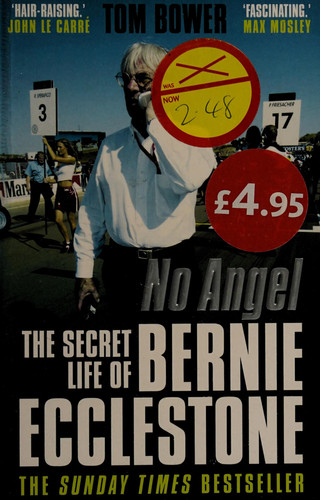
No angel: the secret life of Bernie Ecclestone
'I'm no angel.' Bernie Ecclestone Born into poverty, Bernie Ecclestone has made himself a billionaire by developing the world's second most popular sport - Formula One racing. Private, mysterious and some say sinister, the eighty-year-old criss-crosses the globe in his private jet, mixing with celebrities, statesmen and sporting heroes. His success is not just in creating a multibillion-pound global business but in resisting repeated attempts to snatch the glittering prize from his control. Ecclestone has never before revealed how he graduated from selling second-hand cars in London's notorious Warren Street to become the major player he is today. He has finally decided to reveal his secrets: the deals, the marriages, the disasters and the successes in Formula One racing, in Downing Street, in casinos, on yachts and in the air. Surprisingly, he has granted access to his inner circle to Tom Bower, described by Ecclestone as 'The Undertaker' - the man who buries reputations - and has given him access to all his friends and enemies. All have been told by Ecclestone, 'Tell him the truth, good or bad.' No Angel is a classic rags-to-riches story, the unique portrayal of a unique man and an intriguing insight into Formula One racing, business and the human spirit. Tom Bower is the author of nineteen books, including biographies of Robert Maxwell, Mohamed Fayed, Gordon Brown, Richard Branson, Conrad Black and more recently, Simon Cowell.
The third man
The number one bestselling memoir of one of New Labour's three founding architects, now with a revealing new chapter updating this paperback edition. Peter Mandelson is one of the most influential politicians of modern times. The Third Man is his story - of a life played out in the backroom and then on the frontline of the Labour Party during its unprecedented three terms in government. Much of the book is devoted to the defining political relationships of Peter Mandelson's life - with Tony Blair and Gordon Brown. Charting what he terms the 'soap-opera' years of the Labour government, his book continues to ruffle feathers with an updated preface bringing the story up to the tempestuous present.

Black by design: a 2-tone memoir
"The best voice that ever graced 2-Tone."-- Rolling Stone "The iconic queen of ska. . . . It's gritty, witty, and compelling."-- Elle Lead singer for platinum-selling 2-Tone band The Selecter, Pauline Black has been in the music business for over thirty years. The only woman in a movement dominated by men, she was very much the Queen of British Ska. She saw The Specials, Madness, Dexy's Midnight Runners, and all the other top bands of that generation at their very best . . . and worst. Black was born in 1953 of Anglo-Jewish/Nigerian parents. Adopted by a white, working class family in the fifties, Pauline was always made to feel different, both by the local community and members of her extended family, who saw her at best as a curiosity, at worst as an embarrassing inconvenience. Weaving her rise to fame and recollections of the 2-Tone phenomenon with her moving search for her birth parents, Black By Design is a funny and enlightening memoir of music and roots. Pauline Black is a singer and actress who gained fame as the lead singer of seminal 2-Tone band The Selecter. The band's new album was released in September 2011.

Diaries 1987-1992
In the late 1980s, Edwina Currie was the second most prominent woman in British politics - after Margaret Thatcher. This second volume of her diaries begins in 1992 with her refusal to serve in John Major's government and covers her life in Parliament up to the election of Tony Blair's Labour government. It also covers her emergence as a bestselling author, commentator, broadcaster and performer.

The plot: a biography of an English acre
On a remote edge of the North York moors, where a grassy hillside overlooks the Vale of York, there is a secluded acre of land, edged by woods, called Scotch Corner. A mysterious war memorial chapel stands there, a simple stone building, decorated with bold carvings. Madeleine Bunting's father erected the chapel in his youth.

Maxwell, the outsider
Robert Maxwell was driven by an obsession to be remembered by posterity, to create and re-create his own life in order to become part of the Establishment. Tom Bower's compelling portrait, the subject of numerous libel suits brought by Maxwell in Britain before his death, is now published for the first time--in a thoroughly updated edition--in the United States. It provides a fascinating look at the man who was relentless in his attempts to obtain media power and respectability, attempts that would eventually destroy him. Born into a life of poverty, an outsider forever trying to get in, Robert Maxwell was plagued by a deep sense of alienation. His career as publisher, printer, politician, financier, industrialist, and tycoon extraordinary was charged with both magnificent coups and controversial setbacks. He built his fortune on a mixture of engineered leaks and secrecy at the expense of long-term stability. Accused of everything from creative bookkeeping to outright fraud, Maxwell withstood each debacle until the end, surviving troubles that would have felled a less determined personality. Bower describes the many suspect strategies of Maxwell's business dealings while he was alive and the disintegration of his empire after his death, focusing along the way on Maxwell's often nebulous business dealings and his immense skills at bullying and deception. Beginning with Maxwell's early years, Bower describes in depth the period after World War II during which Maxwell made a fortune out of barter deals and the export of scientific journals from Germany, which became the basis for his Pergamon Press flagship; the Pergamon-Leasco affair in the late 1960s (involving two millionaires, Maxwelland Saul Steinberg), an ill-fated takeover deal that fell apart with Maxwell declared unfit to hold office in a public company; and his revival of the loss-making British Printing Corporation. The author explains Maxwell's numerous acquisitions and his competitive obsession with Rupert Murdoch. We learn of the mysteries surrounding Maxwell's private banking in Liechtenstein, his strange links with the Soviet Union and Eastern Europe, the notorious "Mirrorgate" affair and Maxwell's close relationship with Israel. Going beyond recent media coverage, the author provides up-to-the-minute facts on missing corporate assets and pension funds as well as the nefarious share-support schemes. In this powerful biography, Tom Bower comes as close as anyone ever will to understanding Robert Maxwell and his demons.

Bonnie Prince Charlie: the life and times of Charles Edward Stuart
This biography looks at the man, the period and its significance in Scottish history by brushing away the dust of legend that blurs the image of the young pretender. The author makes clear how Charles Edward became the Bonnie Prince Charlie of legend and folk memory. As the biography is based almost entirely on contemporary sources, Charles emerges directly from 18th century Europe with all its political and dynastic intrigue and the insights into familiar and unfamiliar events which emerge explain the unwavering appeal that the prince has exerted for so long.

Queen Victoria
In this engaging study, Walter L. Arnstein explores both the private life and the public role of the young princess who inherited Britain's throne as a teenager and who became the octogenarian symbolic head of the largest empire in the history of the world. Arnstein incorporates the findings of past studies and recent research (including articles of his own based on previously unpublished letters and journals) to shed light on often-neglected aspects of Victoria's life and reign: her concern with gender roles, religion, politics, and Ireland; as well as her involvement with both the controversial domestic issues and the great international conflicts of the era. Wherever the historical evidence allows, Arnstein enables the monarch to speak in her own words, demonstrating that Victoria was not only the queen who became an adjective, but also a highly-quotable, multi-dimensional human being. Concise, authoritative and attractively illustrated, Queen Victoria provides the economic, social, cultural and political background knowledge to make the life of this fascinating monarch intelligible even to readers unfamiliar with her now distant world.

For richer, for poorer: confessions of a player
Miserable at an elegant day school for girls, Victoria Coren finds an escape in the mysterious world of poker. Twenty years later, she has won a million dollars and forgotten to have children. What price adventure? This is a true story of happiness and heartbreak, smoke and mirrors, bright lights and shady characters. It is a memoir of friendship and belonging, love and loss. It might also teach you how to win a million . . .
