262 results for "Jewish History"

Movie-made Jews: an American tradition

Meyers, Helene
"Movie-Made Jews focuses on a rich, usable American Jewish cinematic tradition. This tradition includes fiction and documentary films that make Jews through antisemitism, Holocaust indirection, and discontent with assimilation, as well as through the unapologetic assertion of Jewishness, queerness, and alliances across race and religion. By selectively revisiting canonical pre-1990 films and amply representing films of the new millennium, Movie-Made Jews illuminates an American Jewish film tradition that includes jazz singers, pawnbrokers, and serious men. It also features those who tremble before G-d, who commit crimes and misdemeanors, who declare Hineini, Here I Am, who do whatever works, who leave and then return to Delancey Street and Liberty Heights. In these pages, those who might be identified as "just Jews" reside alongside those who are traditionally-and sometimes untraditionally-observant. Helene Meyers shows that as we go to our local theater, attend a Jewish film festival, play a DVD, watch streaming videos, Jewishness becomes part of the multicultural mosaic rather than collapsing into a generic whiteness or being represented as a life apart. This engagingly-written book demonstrates that a Jewish movie is neither just a movie nor for Jews only. With incisive analysis of what appears onscreen as well as what happens behind the scenes during production and how audiences respond to what they view, Movie-Made Jews challenges the assumption that American Jewish cinema is a cinema of impoverishment and assimilation. While it's a truism that Jews make movies, this book brings into focus the diverse ways movies make Jews"--
Rutgers University Press 2021-09-17 224 pages

1929: mapping the Jewish world

Hasia R. Diner,Gennady Estraikh
Winner of the 2013 National Jewish Book Award, Anthologies and Collections The year 1929 represents a major turning point in interwar Jewish society, proving to be a year when Jews, regardless of where they lived, saw themselves affected by developments that took place around the world, as the crises endured by other Jews became part of the transnational Jewish consciousness. In the United States, the stock market crash brought lasting economic, social, and ideological changes to the Jewish community and limited its ability to support humanitarian and nationalist projects in other countries. In Palestine, the anti-Jewish riots in Hebron and other towns underscored the vulnerability of the Zionist enterprise and ignited heated discussions among various Jewish political groups about the wisdom of establishing a Jewish state on its historical site. At the same time, in the Soviet Union, the consolidation of power in the hands of Stalin created a much more dogmatic climate in the international Communist movement, including its Jewish branches. Featuring a sparkling array of scholars of Jewish history, 1929 surveys the Jewish world in one year offering clear examples of the transnational connections which linked Jews to each other—from politics, diplomacy, and philanthropy to literature, culture, and the fate of Yiddish—regardless of where they lived. Taken together, the essays in 1929 argue that, whether American, Soviet, German, Polish, or Palestinian, Jews throughout the world lived in a global context.
New York University Press 2013-08-12 244 pages

A spiritual life: a Jewish feminist journey

Feld, Merle
A unique memoir that interweaves poetry, narrative, meditation, and social history, A Spiritual Life explores the complex facets of a Jewish woman's spiritual coming-of-age, capturing the emotional and spiritual reality of contemporary Jews as well as religious seekers of all types. From the experiences of early childhood, to the spiritual awakening of a secular adolescent encountering Jewish tradition, to the alternately funny and searing tales of new-found independence, early married life, young motherhood, and midlife, Feld comments with remarkable honesty and clarity on the many stages of spiritual and artistic exploration and growth. Overarching all these accounts is the picture of how the cycle of the Jewish calendar year comes to provide an ever-renewing source of sustenance for the author's deepening spiritual expression.
State University of New York Press 1999-01-01 264 pages

Nine American Jewish thinkers

Konvitz, Milton R.
The nine American Jews of whom Milton Konvitz writes are philosophers, jurists, or rabbis, widely known and readily accepted as American Jewish thinkers. Their work reflects all essential Jewish values. Each person in his own way has dedicated his work to the betterment of life and the advancement of human ideals. In this sense, their Jewishness is not defined by religion alone. Americanism permeated all they thought and all they did. Konvitz argues that in the complex modern world, secularists often serve God more handsomely than do members of synagogues or churches. For example, when the Supreme Court in 1954 (with Felix Frankfurter playing a key role behind the scenes) agreed to outlaw segregation of the races in public schools, was the Court's action secular or religious? When Congress passed the statute known as the Americans with Disabilities Act, requiring equal treatment of handicapped persons, was the action secular or religious? Is a minimum wage act secular or religious? Is Medicaid a secular or a religious act? Konvitz believes the distinction is not useful, or even possible. The book is divided into three parts, reflecting Konvitz's range of intellectual interests. The nine essays offer concise intellectual biographies of three American Jewish philosophers, three Supreme Court Justices, and three rabbis. The philosophers-Horace M. Kallen, Morris Raphael Cohen, and Sidney Hook-are world-renowned. The jurists-Louis D. Brandeis, Benjamin N. Cardozo, and Felix Frankfurter-hold prominent places in American legal history. And the three rabbis-Leo Jung, Robert Gordis, and Jacob Agus-are known wherever Jewish thought is studied. By treating with equal seriousness the lives and writings of both religious and secularist thinkers, the author intentionally minimizes the conventional antagonism and frequent conflict between religion and secularism. An unusual feature of the book is the fact that the author was a close friend of six of the persons whose lives and work are examined, allowing him a perceptive insight into their character and thought. Although the book is about serious subjects, its graceful style makes the contents easily accessible to lay persons as well as scholars and students of Judaica.
Transaction Publishers 2000 173 pages

The United States and the Nazi Holocaust: race, refuge, and remembrance

Trachtenberg, Barry
"The United States and the Nazi Holocaust is an invaluable synthesis of United States policies and attitudes towards the Nazi persecution of European Jewry from 1933 right up to the modern day. The book, which includes 20 illustrations, weaves together a vast body of scholarly literature to bring students of the Holocaust a balanced, readable overview of this complex and often controversial topic. It demonstrates that the United States' response to the rise of Nazism, the refugee crisis it provoked, the Holocaust itself, and its aftermath were--and remain to this day--intricately linked to the ever-shifting racial, economic, and social status of American Jewry. Using a broad chronological framework, Barry Trachtenberg navigates us through the major themes and events of this period. He discusses the complicated history of the Roosevelt administration's response to the worsening situation of European Jewry in the context of the ambiguous racial status of Jews in Depression and World War II-era America. He examines the post-war decades in America, and discusses, over a series of chapters, how the Holocaust, like American Jewry itself, came to move from the margins to the very center of American awareness. The United States and the Nazi Holocaust considers the reception of Holocaust survivors, post-war trials, film, memoirs, memorials, and the growing field of Holocaust Studies. The reactions of the United States government, the general public, and the Jewish communities of America are all accounted for in this integrated, detailed survey"--
Bloomsbury Academic 2018-02-08 244 pages

Jewish girls coming of age in America, 1860-1920

Klapper, Melissa R.
Jewish Girls Coming of Age in America, 1860—1920 draws on a wealth of archival material, much of which has never been published—or even read—to illuminate the ways in which Jewish girls’ adolescent experiences reflected larger issues relating to gender, ethnicity, religion, and education. Klapper explores the dual roles girls played as agents of acculturation and guardians of tradition. Their search for an identity as American girls that would not require the abandonment of Jewish tradition and culture mirrored the struggle of their families and communities for integration into American society. While focusing on their lives as girls, not the adults they would later become, Klapper draws on the papers of such figures as Henrietta Szold, founder of Hadassah; Edna Ferber, Pulitzer Prize-winning author of Showboat ; and Marie Syrkin, literary critic and Zionist. Klapper also analyzes the diaries, memoirs, and letters of hundreds of other girls whose later lives and experiences have been lost to history. Told in an engaging style and filled with colorful quotes, the book brings to life a neglected group of fascinating historical figures during a pivotal moment in the development of gender roles, adolescence, and the modern American Jewish community.
New York University Press 2005 310 pages

We set the night on fire: igniting the gay revolution

Shelley, Martha
"Martha Shelley didn't start out in life wanting to become a gay activist, or an activist of any kind. The daughter of Jewish refugees and undocumented immigrants in New York City, she grew up during the Red Scare of the late 1940s and 1950s, was inspired by the civil rights and anti-Vietnam War movements that followed, and struggled with coming out as a lesbian at a time when being gay made her a criminal. Shelley rose to become a public speaker for the New York chapter of the lesbian rights group the Daughters of Bilitis, organized the first gay march in response to the Stonewall Riots of 1969, and then cofounded the Gay Liberation Front. She coproduced the newspaper Come Out!, worked on the women's takeover of the RAT Subterranean News, and took a central role in the Lavender Menace action to confront homophobia in the women's movement. Martha Shelley's story is a feminist and lesbian document that gives context and adds necessary humanity to the historical record"--Dust jacket flap.
Chicago Review Press 2023 211 pages

The Jew accused: three anti-Semitic affairs (Dreyfus, Beilis, Frank), 1894-1915

Lindemann, Albert S.
Discusses social and political conditions bearing on antisemitism and philosemitism in France, Russia, and the American South as background for the Dreyfus Affair, the Beilis ritual murder trial, and the trial and lynching of Leo Frank. Declares that comparison helps to understand each of these affairs. Antisemitism is based on realities enhanced by fantasy: in the 19th century it increased because of the growth in the number and influence of Jews, as well as domestic and international political conditions. In all three trials, official antisemitism played little part either in directing suspicion at the particular defendants or in the prosecution: in all three, there was circumstantial evidence that at first seemed credible. Public debate, however, turned on antisemitism and philosemitism. also describes massive Jewish defense efforts, especially in the USA, in connection with all three trials.
Cambridge University Press 1991 301 pages

Jews and the American public square: debating religion and republic

Mittleman, Alan
Jews and the American Public Square is a study of how Jews have grappled with the presence of religion, both their own and others, in American public life. It surveys historical Jewish approaches to church-state relations and analyzes Jewish responses to the religion clauses of the First Amendment. The book also explores how the contemporary sociological and political characteristics of American Jews bear on their understanding of the public dimensions of American religion. In addition to a descriptive and analytic approach. the volume is also critical and polemical. Its contributors attack and defend prevailing views, raise critical questions about the political and intellectual positions favored by American Jews, and propose new syntheses. This book captures the current mood of the Jewish community: both committed to the separation of church and state and perplexed about its scope and application. It provides the necessary background for a principled reconsideration of the problem of religion in the public square.
Rowman & Littlefield 2002 375 pages

American Jewish history

Finkelstein, Norman H.
This JPS Guide chronicles the extraordinary history of American Jewry. Finkelstein tells the dramatic 350-year story of the people and events that shaped the lives of today's American Jews. Divided into six time periods, American Jewish History describes Jewish life from the time of the early settlers, to the period of massive immigration that flooded the cities, to the incredible growth of Jews in positions of influence in business, politics, and the arts. This is a story of a people who affected not only the lives of Jews in the U.S. today, but also the course of American history itself. There are over 70 black and white photographs, maps, and charts and more than 120 feature boxes and biographies throughout, as well as timelines, notes, a bibliography, and index. Finkelstein has made the saga of American Jewry much more than a compilation of historical facts. This is wonderfully stimulating journey--a worthwhile adventure for readers of all ages.
Jewish Publication Society 2007 221 pages

American Jewish women and the Zionist enterprise

Reinharz, Shulamit,Raider, Mark A.
Product Description Despite a historical record that shows sustained involvement of American Jewish women with early Zionism and Palestine, this topic has received scant scholarly attention. A major contribution to Zionist history, women’s history, and American history, American Jewish Women and Zionism offers a much needed clarification to the historical record. Divided thematically, American Jewish Women deals with representative figures, events, and themes of the pre-state era. The essays in the book have three different foci: Several are concerned with significant personalities, such as Golda Meir, Marie Syrkin, Emma Lazarus, and Henrietta Szold, while others are concerned with the pivotal role played by American Zionist women’s organizations including Hadassah, the Pioneer Women’s Organization (later Naamat), the Mizrachi Women’s Organization (later Amit Women), and others. The remaining essays address broad themes and reveal the multidimensionality of the relationship of American Jewish women and Zionism, which includes agricultural and vocational training, religion, ideology, geography, and feminism and femininity. American Jewish Women and Zionism also includes several eyewitness documents and personal testimonies. No less significant than the corpus of memoirs and literature produced by male Zionist leaders, such data throws light on hitherto neglected facets of American Jewish and Zionist history, including the variety of roles played by Zionist women and their self-awareness as participants in one of the most dramatic and consequential episodes in the history of Jewish civilization. The volume includes a glossary of terms, a map of the principal locations referred to in the text, illustrations, and a timeline of American Jewish women and their relationship to Zionism. Each section opens with a prefactory note that places the essays in historical context. It concludes with a bibliographic note and suggestions for further readings. Review "Anyone interested in the significant role of women and Zionism should definitely find this book a must read."--The National Jewish Post & Opinion "Shulamit Reinharz and Mark Raider's magnificent study... challenges us to understand how faith in Zionism and in the American dream nourished and changed both projects. This is a story not of ideologies or, for the most part, of ideologues, but rather of the creators of a new tradition. The essays in this collection bring some of the leaders of Hadassah, Pioneer Women, and of Mizrahi beautifully to life and show how a dedication to the Zionist cause deepened a commitment to American values, and enlarged the Zionist perspective, to preserve a set of liberal principles reaching across the ethnic and national divide in Palestine...In this book Reinharz and Raider assemble essays that chart the rich profusion of movements, institutions, and activities - including aliyah - that Zionism inspired in Jewish women living in the United States."--Israel Studies "The organizations that women created as an expression of their goal are deftly analyzed. There is valuable and intriguing material here which calls for the attention of scholars in the fields of American history, women's history, feminism, and Zionism."--Jewish Book World From the Publisher 6 x 9 trim. 12 illus, 1 map, 3 tables About the Author Mark A. Raider is professor of modern Jewish history in the Department of History and director of the Center for Studies in Jewish Education and Culture at the University of Cincinnati. He is the author, most recently, of The Essential Hayim Greenberg: Essays and Addresses on Jewish Culture, Socialism, and Zionism.
Brandeis University Press 2005 393 pages

History of the Jews in America

Peter Wiernik
"History of the Jews in America: From the Period of the Discovery of the New World to the Present Time" by Peter Wiernik offers a comprehensive chronicle of Jewish life in America, tracing their journey from the earliest days of exploration to the present. This meticulously researched volume illuminates the rich tapestry of Jewish American history, documenting their contributions, challenges, and evolving identity within the broader American narrative. Explore the waves of immigration, the establishment of communities, and the impact of Jewish culture on American society. Wiernik's work delves into the complexities of navigating religious freedom, economic opportunities, and the persistent threat of antisemitism. A vital resource for understanding the intertwined narratives of Jewish history and American history, this book provides invaluable insights into the experiences of Jewish Americans and their enduring legacy. This historical account remains a significant contribution to the study of both Jewish and American experiences. This work has been selected by scholars as being culturally important, and is part of the knowledge base of civilization as we know it. This work is in the public domain in the United States of America, and possibly other nations. Within the United States, you may freely copy and distribute this work, as no entity (individual or corporate) has a copyright on the body of the work. Scholars believe, and we concur, that this work is important enough to be preserved, reproduced, and made generally available to the public. We appreciate your support of the preservation process, and thank you for being an important part of keeping this knowledge alive and relevant.
Creative Media Partners, LLC 2025-03-29 408 pages

If I am not for myself: journey of an anti-Zionist Jew

Marqusee, Mike
This is an eloquent and deeply felt memoir exploring the author's complex relationship with his Jewish identity. "If I Am Not Myself" is a passionate, thought-provoking exploration of what it means to be Jewish in the twenty-first century. It traces the author's upbringing in 1960s Jewish-American suburbia, his anti-war and pro-Palestinian activism on the British Left, and life as a Jew among Muslims in Pakistan, Morocco, and Britain. Interwoven with this are the experiences of his grandfather's life in Jewish New York of the 1930s and '40s, his struggles with anti-Semitism and the twists and turns that led him from anti-Fascism to Militant Zionism. In the course of this deeply personal story, Marqusee refutes the claims of Israel and Zionism on Jewish loyalty and laments their impact on the Jewish Diaspora. Rather, he argues for a richer, more multi-dimensional understanding of Jewish history and identity, and reclaims vital political and personal space for those castigated as self-haters by the Jewish establishment.
Verso 2008 307 pages

Beyond patriarchy: Jewish fathers and families

Fuchs, Lawrence H.
Is patriarchy necessary to ensure responsible fathering? Lawrence H. Fuchs, author of Family Matters, argues that the link between male dominance and fatherhood is no longer iron-clad. Analyzing the universality of patriarchy and its incentives for cultural fatherhood, Fuchs concedes that the importance of biological differences between the sexes was a possible, even plausible, basis for the evolution of patriarchy. But in this timely work he imagines a new paradigm of fatherhood for a post-patriarchal age, one inspired by the history of Jewish patriarchy. Two millennia ago the rabbis established the strategies to curb the extreme abuses of patriarchy found in all civilizations. They did so by according wives significant sexual and economic rights. In the last two centuries as Jews became more integrated into the societies in which they lived, their unique variation of patriarchy was disrupted. Fuchs argues that the Jewish story sets the precedent for fundamental change in the nature of patriarchy today, thus breaking what may have been the evolutionary connection between male dominance and incentives for fatherhood. It is Fuchs's startling conclusion that the Jewish precedent points to the next step in evolution: fathers without patriarchy.
Published by University Press of New England, Brandeis University Press 2000 216 pages

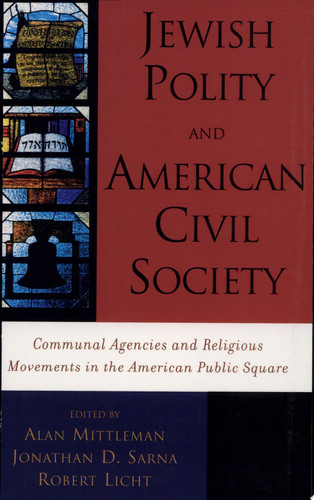
Jewish polity and American civil society: communal agencies and religious movements in the American public sphere

Alan Mittleman,Robert Licht,Jonathan D. Sarna
Jewish Polity and American Civil Society is a study of the civic and political engagements of American Jews as mediated by their communal and denominational institutions. The book explores how the various branches of the organized Jewish community seek to influence public affairs. Over the course of the last century, Jewish agencies and religious movements have tried to shape public debate and public policy on such issues as civil rights, church-state relations, and American foreign policy. The book sets the history of Jewish engagement in these areas into historical context; analyzes the motives, strategies, and tactics of various Jewish groups, and evaluates their successes and failures. The book also explores the underlying idea-the public philosophy-that informs American Jews' understanding of civic and political engagement.
Rowman & Littlefield 2002-07-23 420 pages

The emergence of American Zionism

Raider, Mark A.
The images of Zionist pioneers in the late nineteenth and early twentieth centuries--hard working, brawny, and living off the land--sprang from the ascendent socialist Zionist movement in Palestine known as "Labor Zionism." The building of the Yishuv, a new Jewish society in Palestine, was accompanied by the rapid growth of Zionism worldwide. How did Zionism take shape in the United States? How did Labor Zionism and the Yishuv influence American Jews? Zionism and Labor Zionism had a much more substantial impact on the American Jewish scene than has been recognized. Drawing on meticulous research, Mark A. Raider describes Labor Zionism's dramatic transformation in the American context from a marginal immigrant party into a significant political force. The Emergence of American Zionism challenges many of the prevailing assumptions of Jewish and Zionist history that have held sway for a full generation. It shows how and why American Labor Zionism--"the voice of Labor Palestine on American soil"--played such an important role in formulating the program and outlook of American Zionism. It also examines more generally the impact of Zionism on American Jews, making the case that Zionism's cultural vitality, intellectual diversity, and unparalleled ability to rally public opinion in times of crisis were central to the American Jewish experience.
New York University Press 1998 296 pages

Only in America: Al Jolson and The Jazz Singer

Bernstein, Richard
"Al Jolson, born Asa Yoelson, immigrated from his shtetl in Lithuania to the United States in 1894 after his father secured a job as a rabbi in Washington, D.C. A poor, Yiddish-speaking newcomer navigating a racially segregated and antisemitic America, young Jolson dreamed of becoming a star, and he did. Thanks to his immense talent and his knack for assimilating into new environments, by the time he reached his twenties he was the most famous and highly paid entertainer in America, making almost $5,000 a week at a time when the average American made $800 a year. Jolson's public adoration and widespread acceptance as a star marked the beginning of an enriching cultural transformation, a moment when the American mind opened up to ethnic and racial differences, widening the gap of acceptability. And yet Jolson himself, despite being ferociously ambitious and gigantically talented, was crippled by insecurity, often nervous to the point of collapse, prisoner to his many vices. Through Jolson, Bernstein simultaneously breaks open the history and legacy of the cultural sensation The Jazz Singer. Not only was The Jazz Singer the first feature length film with synchronized music and dialogue, but it was also taboo smashing in its content: The Jazz Singer is all about Jews, Orthodox and otherwise. Bernstein expounds on the making of The Jazz Singer, what the film meant then and now, introducing the many individuals involved in its production, including Samson Raphaelson, a young Jewish writer whose short story was the basis for the movie; the four Warner brothers who made a fortune off it; and George Jessel, Jolson's rival and the star of Raphaelson's stage adaptation of his short story. In the background emerges a picture of old Hollywood in the Roaring Twenties: cutthroat and greedy yet visionary and progressive. And while The Jazz Singer represented the future in many ways, it also dredged up the worst of the past, including Jolson's use of blackface, common at the time. At once a tale of the Judaizing of American culture and an acknowledgment of the challenges to come, Only in America is a glistening examination of a man at the center of a watershed moment in the arts"--
Schocken Books 2024 252 pages

The Vienna paradox: a memoir

Perloff, Marjorie
The Vienna Paradox is Marjorie Perloff's memoir of growing up in pre-World War II Vienna, her escape to America in 1938 with her upper-middle-class, highly cultured, and largely assimilated Jewish family, and her self-transformation from the German-speaking Gabriele Mintz to the English-speaking Marjorie--who also happened to be the granddaughter of Richard Schüller, the Austrian foreign minister under Chancellor Dollfuss and a special delegate to the League of Nations. Compelling as the story is, this is hardly a conventional memoir. Rather, it interweaves biographical anecdote and family history with speculations on the historical development of early 20th-century Vienna as it was experienced by her parents' generation, and how the loss of their "high" culture affected the lives of these cultivated refugees in a democratic United States that was, and remains, deeply suspicious of perceived "elitism." This is, in other words, an intellectual memoir, both elegant and heartfelt, by one of America's leading critics, a narrative in which literary and philosophical reference is as central as the personal.
New Directions Books 2004 283 pages