560 results for "Physics"

Atom An Odyssey from the Big Bang to Life on Earth . . . And Beyond

Lawrence M. Krauss
This is both the story of life and the history of the cosmos, but not as you have ever read before. Best-selling science writer Lawrence Krauss takes as his narrative the twisted and improbable tale of a single atom of oxygen, a history that starts at the dawn of time, and journeys beyond the death of stars and people to the death of all matter itself. The atom at the center of this book travels a dangerous and extraordinary path: exploding supernovas, solar winds and collapsing stars preceded the rise of life on earth and one day may foretell its end. Throughout this astonishing work, Krauss manages to stoke our wonder at the powers and unlikely events that conspired to create our solar system, our ecosystem and us.
DIANE Publishing Company 2004-03 394 pages

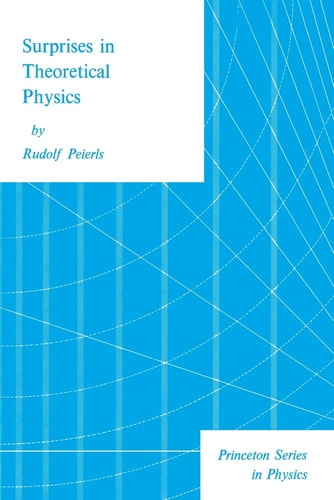
Surprises in theoretical physics

Peierls, Rudolf Ernst Sir
Problems in theoretical physics often lead to paradoxical answers; yet closer reasoning and a more complete analysis invariably lead to the resolution of the paradox and to a deeper understanding of the physics involved. Drawing primarily from his own experience and that of his collaborators, Sir Rudolf Peierls selects examples of such "surprises" from a wide range of physical theory, from quantum mechanical scattering theory to the theory of relativity, from irreversibility in statistical mechanics to the behavior of electrons in solids. By studying such surprises and learning what kind of possibilities to look for, he suggests, scientists may be able to avoid errors in future problems. In some cases the surprise is that the outcome of a calculation is contrary to what physical intuition seems to demand. In other instances an approximation that looks convincing turns out to be unjustified, or one that looks unreasonable turns out to be adequate. Professor Peierls does not suggest, however, that theoretical physics is a hazardous game in which one can never foresee the surprises a detailed calculation might reveal. Rather, he contends, all the surprises discussed have rational explanations, most of which are very simple, at least in principle. This book is based on the author's lectures at the University of Washington in the spring of 1977 and at the Institut de Physique Nucleaire, University de Paris-Sud, Orsay, during the winter of 1977-1978.
Princeton University Press 1979 166 pages

Surprises in theoretical physics

Peierls, Rudolf Ernst Sir
Problems in theoretical physics often lead to paradoxical answers; yet closer reasoning and a more complete analysis invariably lead to the resolution of the paradox and to a deeper understanding of the physics involved. Drawing primarily from his own experience and that of his collaborators, Sir Rudolf Peierls selects examples of such "surprises" from a wide range of physical theory, from quantum mechanical scattering theory to the theory of relativity, from irreversibility in statistical mechanics to the behavior of electrons in solids. By studying such surprises and learning what kind of possibilities to look for, he suggests, scientists may be able to avoid errors in future problems. In some cases the surprise is that the outcome of a calculation is contrary to what physical intuition seems to demand. In other instances an approximation that looks convincing turns out to be unjustified, or one that looks unreasonable turns out to be adequate. Professor Peierls does not suggest, however, that theoretical physics is a hazardous game in which one can never foresee the surprises a detailed calculation might reveal. Rather, he contends, all the surprises discussed have rational explanations, most of which are very simple, at least in principle. This book is based on the author's lectures at the University of Washington in the spring of 1977 and at the Institut de Physique Nucleaire, University de Paris-Sud, Orsay, during the winter of 1977-1978.
Princeton University Press 1979-11-21 166 pages

Time reborn: from the crisis in physics to the future of the universe

Smolin, Lee
"From one of our foremost thinkers and public intellectuals, a radical new view of the nature of time and the cosmos What is time? This deceptively simple question is the single most important problem facing science as we probe more deeply into the fundamentals of the universe. All of the mysteries physicists and cosmologists face--from the Big Bang to the future of the universe, from the puzzles of quantum physics to the unification of forces and particles--come down to the nature of time. The fact that time is real may seem obvious. You experience it passing every day when you watch clocks tick, bread toast, and children grow. But most physicists, from Newton to Einstein to today's quantum theorists, have seen things differently. The scientific case for time being an illusion is formidable. That is why the consequences of adopting the view that time is real are revolutionary. Lee Smolin, author of the controversial bestseller The Trouble with Physics, argues that a limited notion of time is holding physics back. It's time for a major revolution in scientific thought. The reality of time could be the key to the next big breakthrough in theoretical physics. What if the laws of physics themselves were not timeless? What if they could evolve? Time Reborn offers a radical new approach to cosmology that embraces the reality of time and opens up a whole new universe of possibilities. There are few ideas that, like our notion of time, shape our thinking about literally everything, with huge implications for physics and beyond--from climate change to the economic crisis. Smolin explains in lively and lucid prose how the true nature of time impacts our world"--
Houghton Mifflin Harcourt 2013 319 pages

Fun with Maths and Physics

Yakov Perelman
Fun with Maths and Physics details a large number of intriguing physics experiments, entertaining mathematics problems, and amazing optical illusions.The book's main objective is to arouse the reader's scientific imagination, teach him to think in a scientific manner, and create in his mind a variety of associations between physical knowledge and a large number of real daily life observations.Immensely instructive and entertaining, it has been one of the best sellers in Russia during the first part of last century.
Amazon Digital Services LLC - Kdp 2013-11 454 pages

Atom and archetype: the Pauli/Jung letters, 1932-1958

Pauli, Wolfgang,Jung, C. G.,Meier, C. A.
In 1932, world-renowned physicist Wolfgang Pauli had already done the work that would win him the 1945 Nobel Prize. He was also suffering after a series of troubling personal events. He was drinking heavily, quarrelling frequently, and experiencing powerful, disturbing dreams. Pauli turned to C. G. Jung for help, forging an extraordinary intellectual conjunction not just between a physicist and a psychologist but between physics and psychology. As their acquaintance developed, Jung and Pauli discussed the nature of dreams and their relation to reality, finding surprising common ground between depth psychology and quantum physics and profoundly influencing each other's work. This portrait of an incredible friendship will fascinate readers interested in psychology, science, creativity, and genius.
Princeton University Press 2014-07-21 320 pages

Gravitation and cosmology: principles and applications of the general theory of relativity

Weinberg, Steven
Weinberg's 1972 work, in his description, had two purposes. The first was practical to bring together and assess the wealth of data provided over the previous decade while realizing that newer data would come in even as the book was being printed. He hoped the comprehensive picture would prepare the reader and himself to that new data as it emerged. The second was to produce a textbook about general relativity in which geometric ideas were not given a starring role for (in his words) too great an emphasis on geometry can only obscure the deep connections between gravitation and the rest of physics
John Wiley & Sons 2000 657 pages

Predicting the eclipse: a multimillennial tale of computation

Wolfram, Stephen
"Total eclipses of the Sun are rare and dramatic-and on April 8, 2024, one will cross the US. But when exactly will it happen? In this short but richly illustrated book, prominent scientist and computation pioneer Stephen Wolfram tells the triumphant and hard-won story-spanning more than two thousand years-of how science, mathematics and computation have brought us to the point where we can now predict the time of the eclipse to within one second. Learn how the problem of eclipses brought us some of the earliest exact science, the first known computer, contributions from many of the all-time greats of mathematics and physics, and critical technology for the space program. See how all this provides a clear, modern understanding of a phenomenon that has surprised and amazed throughout human history"--
Wolfram Media, Inc 2023 112 pages

The DIM Hypothesis Why the Lights of the West Are Going Out

Leonard Peikoff
With his groundbreaking and controversial DIM hypothesis, Dr. Leonard Peikoff casts a penetrating new light on the process of human thought, and thereby on Western culture and history. In this far-reaching study, Peikoff identifies the three methods people use to integrate concrete data into a whole, as when connecting diverse experiments by a scientific theory, or separate laws into a Constitution, or single events into a story. The first method, in which data is integrated through rational means, he calls Integration. The second, which employs non-rational means, he calls Misintegration. The third is Disintegration—which is nihilism, the desire to tear things apart. In The DIM Hypothesis Peikoff demonstrates the power of these three methods in shaping the West, by using the categories to examine the culturally representative fields of literature, physics, education, and politics. His analysis illustrates how the historical trends in each field have been dominated by one of these three categories, not only today but during the whole progression of Western culture from its beginning in Ancient Greece. Extrapolating from the historical pattern he identifies, Peikoff concludes by explaining why the lights of the West are going out—and predicts the most likely future for the United States.
Penguin 2013-12-03 400 pages

True to life: twenty-five years of conversations with David Hockney

Weschler, Lawrence
Soon after the book's publication in 1982, artist David Hockney read Lawrence Weschler's Seeing Is Forgetting the Name of the Thing One Sees: A Life of Contemporary Artist Robert Irwin and invited Weschler to his studio to discuss it, initiating a series of engrossing dialogues, gathered here for the first time. Weschler chronicles Hockney's protean production and speculations, including his scenic designs for opera, his homemade xerographic prints, his exploration of physics in relation to Chinese landscape painting, his investigations into optical devices, his taking up of watercolor—and then his spectacular return to oil painting, around 2005, with a series of landscapes of the East Yorkshire countryside of his youth. These conversations provide an astonishing record of what has been Hockney's grand endeavor, nothing less than an exploration of "the structure of seeing" itself.
University of California Press 2008 249 pages

The rise of scientific philosophy

Reichenbach, Hans
This book represents a new approach to philosophy. It treats philosophy as not a collection of systems, but as a study of problems. It recognizes in traditional philosophical systems the historical function of having asked questions rather than having given solutions. Professor Reichenbach traces the failures of the systems to psychological causes. Speculative philosophers offered answers at a time when science had not yet provided the means to give true answers. Their search for certainty and for moral directives led them to accept pseudo-solutions. Plato, Descartes, Spinoza, Kant, and many others are cited to illustrate the rationalist fallacy: reason, unaided by observation, was regarded as a source of knowledge, revealing the physical world and "moral truth." The empiricists could not disprove this thesis, for they could not give a valid account of mathematical knowledge. Mathematical discoveries in the early nineteenth century cleared the way for modern scientific philosophy. Its advance was furthered by discoveries in modern physics, chemistry, biology, and psychology. These findings have made possible a new conception of the universe and of the atom. The work of scientists thus altered philosophy completely and brought into being a philosopher with a new attitude and training. Instead of dictating so-called laws of reason to the scientist, this modern philosopher proceeds by analyzing scientific methods and results. He finds answers to the age-old questions of space, time, causality, and life; of the human observer and the external world. He tells us how to find our way through this world without resorting to unjustifiable beliefs or assuming a supernatural origin for moral standards. Philosophy thus is no longer a battleground of contradictory opinions, but a science discovering truth step by step. Professor Reichenbach, known for his many contributions to logic and the philosophy of science, addresses this book to a wider audience. He writes for those who do not have the leisure or preparation to read in the fields of mathematics, symbolic logic, or physics. Besides showing the principal foundations of the new philosophy, he has been careful to provide the necessary factual background. He has written a philosophical study, not a mere popularization. It contains within its chapters all the necessary scientific material in an understandable form—and, therefore, conveys all the information indispensable to a modern world-view. The late Hans Reichenbach was Professor of Philosophy at the University of California, Los Angeles. His previous books include
University of California Press 1951 333 pages

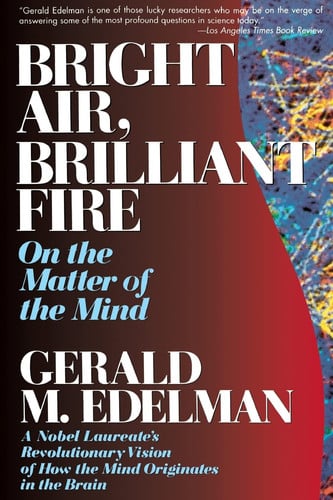
Bright air, brilliant fire: on the matter of the mind

Edelman, Gerald Maurice
We are on the brink of understanding ancient mysteries: how we know, what governs our nature, what makes a person different from a thing. In the last decade, more than twenty disciplines dealing with every aspect of the brain have contributed to a revolution in the neurosciences--a revolution as significant, in the view of many observers, as the Galilean and Copernican revolutions in mathematics and physics or the Darwinian revolution in biology. In this book, one of the world's foremost brain scientists gives us a glimpse into the workings of the human brain--the most complex material object in the universe. A match head's worth of the brain contains about a billion connections that can combine in ways which can only be described as hyperastronomical--on the order of ten followed by millions of zeros (there are only about ten followed by eighty zeros' worth of positively charged particles in the whole known universe).^
BasicBooks 1992 280 pages

Uncountable: a philosophical history of number and humanity from antiquity to the present

Nirenberg, David,Nirenberg, Ricardo L.
"From the time of Pythagoras, we have been tempted to treat numbers as the ultimate or only truth. This book tells the history of that habit of thought. But more, it argues that the logic of counting sacrifices much of what makes us human, and that we have a responsibility to match the objects of our attention to the forms of knowledge that do them justice. Humans have extended the insights and methods of number and mathematics to more and more aspects of the world, even to their gods and their religions.Today those powers are greater than ever, as computation is applied to virtually every aspect of human activity.But the rules of mathematics do not strictly apply to many things-from elementary particles to people-in the world.By subjecting such things to the laws of logic and mathematics, we gain some kinds of knowledge, but we also lose others. How do our choices about what parts of the world to subject to the logics of mathematics affect how we live and how we die?This question is rarely asked, but it is urgent, because the sciences built upon those laws now govern so much of our knowledge, from physics to psychology.Number and Knowledge sets out to ask it. In chapters proceeding chronologically from Ancient Greek philosophy and the rise of monotheistic religions to the emergence of modern physics and economics, the book traces how ideals, practices, and habits of thought formed over millennia have turned number into the foundation-stone of human claims to knowledge and certainty.But the book is also a philosophical and poetic exhortation to take responsibility for that history, for the knowledge it has produced, and for the many aspects of the world and of humanity that it ignores or endangers.To understand what can be counted and what can't is to embrace the ethics of purposeful knowing"--
University of Chicago Press 2021-10-20 420 pages

The Biblical clock: the untold secrets linking the universe and humanity with God's plan

Friedmann, Daniel
Science and religion have two seemingly opposing views of the universe's biggest questions. But what if the real story told you they were both right? Vancouver, 2009. Physics engineer and CEO Daniel Friedmann loves solving problems. When the avid scientist dives deep into scripture, he's faced with questions he feels compelled to answer: Is it possible to harmonize the scientific timeline for the development of the universe with the biblical timeline described in Genesis 1? How do the evolution of human history and prophecies surrounding the End of Days fit in?His quest for answers takes him and his nephew Seb on an incredible journey through the ages, discovering the lives and works of mystics, prophets, sages, philosophers, scientists and biblical commentators.Follow Dan and Seb as they discover answers to some of the biggest questions in science and religion, including: -Does the six-day creation account actually link with science's 13.8 billion-year timeline?- How do world history, Genesis, and the End of Days fit within the context of God's Plan in heaven?- How can the appearance of life on Earth, as depicted by the fossil record, match the sequence and timing of life on Earth described in Genesis 1?- Do Genesis and the evolution of human history reveal the events and timing for the End of Days?- Are there texts predating modern science that describe the Big Bang and contain the scientifically calculated age of the universe?- And finally, is there a secret harmony resolving the creation-versus-evolution debate?The Biblical Clock is a fascinating and entertaining read, digging deep into the universe and solving its well-kept mysteries. Order your copy today
Daniel Friedmann and Dania Sheldon 2019-04-09 382 pages

Ada: a life and a legacy

Stein, Dorothy
Augusta Ada Byron, Countess of Lovelace, was the daughter of Lord Byron and a close friend to many of the leading figures of the Victorian era; based on her report on Charles Babbage's Analytical Engine she is also generally known as the inventor of the science of computer programming. In this engrossing biography, Dorothy Stein strips away the many layers of myth to reveal a story far more dramatic and fascinating than previous accounts have indicated. Dorothy Stein is a psychologist with a special interest in thought and language and a background in physics and computer programming. She has taught courses in nineteenth-century women's history and in the biology and psychology of sex differences, and is particularly concerned with the use of myth in science.
The MIT Press 1985 321 pages

Thematic origins of scientific thought: Kepler to Einstein

Holton, Gerald James
The highly acclaimed first edition of this major work convincingly established Gerald Holton’s analysis of the ways scientific ideas evolve. His concept of “themata,” induced from case studies with special attention to the work of Einstein, has become one of the chief tools for understanding scientific progress. It is now one of the main approaches in the study of the initiation and acceptance of individual scientific insights. Three principal consequences of this perspective extend beyond the study of the history of science itself. It provides philosophers of science with the kind of raw material on which some of the best work in their field is based. It helps intellectual historians to redefine the place of modern science in contemporary culture by identifying influences on the scientific imagination. And it prompts educators to reexamine the conventional concepts of education in science. In this new edition, Holton has masterfully reshaped the contents and widened the coverage. Significant new material has been added, including a penetrating account of the advent of quantum physics in the United States, and a broad consideration of the integrity of science, as exemplified in the work of Niels Bohr. In addition, a revised introduction and a new postscript provide an updated perspective on the role of themata. The result of this thoroughgoing revision is an indispensable volume for scholars and students of scientific thought and intellectual history.
Harvard University Press 1988-05-25 499 pages

More surprises in theoretical physics

Peierls, Rudolf E.
Like its predecessor, this book by the renowned physicist Sir Rudolf Peierls draws from many diverse fields of theoretical physics to present problems in which the answer differs from what our intuition had led us to expect. In some cases an apparently convincing approximation turns out to be misleading; in others a seemingly unmanageable problem turns out to have a simple answer. Peierls's intention, however, is not to treat theoretical physics as an unpredictable game in which such surprises happen at random. Instead he shows how in each case careful thought could have prepared us for the outcome. Peierls has chosen mainly problems from his own experience or that of his collaborators, often showing how classic problems can lend themselves to new insights. His book is aimed at both graduate students and their teachers. Praise for Surprises in Theoretical Physics: "A beautiful piece of stimulating scholarship and a delight to read. Physicists of all kinds will learn a great deal from it."--R. J. Blin-Stoyle, Contemporary Physics
Princeton University Press 1991-09 106 pages