457 results for "Science"

The Treason of the Intellectuals

Benda, Julien
Julien Benda's classic study of 1920s Europe resonates today. The "treason of the intellectuals" is a phrase that evokes much but is inherently ambiguous. The book bearing this title is well known but little understood. This edition is introduced by Roger Kimball. From the time of the pre-Socratics, intellectuals were a breed apart. They were non-materialistic knowledge-seekers who believed in a universal humanism and represented a cornerstone of civilized society. According to Benda, this all began to change in the early twentieth century. In Europe in the 1920s, intellectuals began abandoning their attachment to traditional philosophical and scholarly ideals, and instead glorified particularisms and moral relativism. The "treason" of which Benda writes is the betrayal by the intellectuals of their unique vocation. He criticizes European intellectuals for allowing political commitment to insinuate itself into their understanding of the intellectual vocation, ushering the world into "the age of the intellectual organization of political hatreds." From the savage flowering of ethnic and religious hatreds in the Middle East and throughout Europe today to the mendacious demand for political correctness and multiculturalism on college campuses everywhere in the West, the treason of the intellectuals continues to play out its unedifying drama.
[distributor] Taylor & Francis, c/o Bookpoint 2017-10-27 202 pages

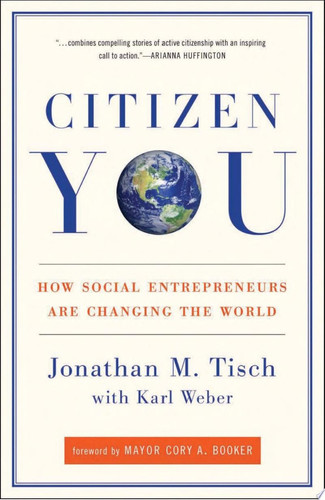
Citizen You How Social Entrepreneurs Are Changing the World

Jonathan Tisch,Karl Weber
Just when the world needs it most, a new style of social engagement is emerging: Active Citizenship. A key member of one of New York’s most civic-minded families—one that has supported many of America’s notable institutions and deserving programs—Jonathan Tisch has devoted a lifetime to “active citizenship.” It’s an idea that uses the power of practical creativity and grassroots participation to solve seemingly intractable problems. In Citizen You , Tisch challenges readers to join this movement and points the way toward making our world a better place, one person and one neighborhood at a time. Tisch has filled Citizen You with accounts of people who you’ll meet, such inspirational individuals as: Scott Harrison, who has used the networking and marketing skills he developed as a night club promoter to help over a million people in the developing world get access for the first time to clean, safe drinking water. Steffi Coplan, whose Broadway2Broadway project brought out the hidden musical talents of kids at an inner city school. Eric Schwarz, who decided to do something about America’s under-performing schools, and parlayed a single classroom mentoring project into the nationwide Citizens Schools movement. Chris Swan, who is training a new generation of “citizen engineers” to make sure that the projects they build aren’t just structurally sound but also environmentally and socially sustainable. Dave Nelson, who traded his role as an executive at IBM for a job at a struggling nonprofit that teaches kids about the power of entrepreneurship—and discovered a host of new challenges and rewards in the process. Through these and many other remarkable stories, you’ll learn how today’s active citizens are transforming thinking about social change. Rather than short-term fixes and hand-me-down charity, they’re striving to build sustainable, systemic solutions to our most challenging problems, building and empowering communities rather than fostering dependency. And they’re using a host of new tools, from online networking and private-public partnerships to corporate engagement and social entrepreneurship, to redefine how change can happen. Citizen You is a potent antidote to pessimism. At a time of unprecedented challenges on the national and world stage, when active citizenship is not a choice but a necessity, Citizen You dares us to reshape the social, political, and intellectual structures that have long confined us, and offers fresh thinking that redefines the very concept of activism. For more information and ideas about how to be an active citizen go to www.citizenyou.org
Crown 2011-05-03 288 pages

Depends What You Mean by Extremist

John Safran
No one turns up where they're not wanted quite like John Safran. In this hilarious and disorienting adventure he gets among our diverse community of white nationalists, ISIS supporters, anarchists and more, digging away at the contradictions that many would prefer be left unexamined. Who is this black puppet-master among the white nationalists? And this Muslim fundamentalist who geeks out on Monty Python? Is there a secret radicalisation network operating in John's own Jewish suburb? And ultimately - is hanging with all these radicals washing off on John himself? Populated by an extraordinary cast of 'ordinary' Australians, Depends What You Mean by Extremist is a startling, confronting portrait of contemporary Australia. We all think we know what's going on in our own country, but this larger-than-life, timely, and alarmingly insightful true story will make you think again . . . Drinking shots with nationalists and gobbling falafel with radicals, John Safran was there the year the extreme became the mainstream. 'Totes recommend John Safran's latest. Deplorable in the best sense.' Louis Theroux 'An original, insightful, frequently deadpan-funny read . . . John Safran confirms that he's a major writing talent with his second book . . . Like his professional doppelgangers, Jon Ronson and Louis Theroux, Safran has a gift for eliciting information from his subjects by way of his unthreatening yet relentlessly unquestioning persona.' Jo Case, Readings Monthly 'Safran has always had an unusually receptive antenna for the fraught collision of racial, cultural and religious difference . . . This is an Australia where as soon as you draw a cultural, racial or religious battle line somebody strolls up to smudge it.' James Robert Douglas, The Guardian (Australia)
Penguin Random House 2018-08-20 304 pages

For Your Own Good The Anti-Smoking Crusade and the Tyranny of Public Health

Jacob Sullum
The tobacco controversy is usually portrayed as a battle between selfless defenders of public health and greedy merchants of death. In For Your Own Good, journalist Jacob Sullum argues that such a view conceals the true nature of the crusade for a smoke-free society. As Sullum demonstrates, this struggle is not about the behavior of corporations; it's about the behavior of individuals. It is an attempt by one group of people to impose their tastes and preferences on another. For Your Own Good shows that long before Philip Morris or R.J. Reynolds existed, tobacco's opponents condemned smoking as disgusting, immoral, addictive, unhealthy, and inconsiderate. In recent decades, they have used scientific evidence that smoking is hazardous to enlist the state in their crusade, arguing that the government has an obligation to discourage behavior that might lead to disease or injury. Given this country's tradition of limited government, however, Americans tend to be skeptical of this argument. Sullum justifies their misgivings, noting that achieving a "smoke-free society" in a nation where tens of millions choose to smoke is necessarily an exercise in tyranny.
Simon and Schuster 1998 338 pages

A boy from Georgia: coming of age in the segregated south

Hamilton Jordan
When Hamilton Jordan died of peritoneal mesothelioma in 2008, he left behind amostly finished memoir, a book on which he had been working for the last decade. Jordan's daughter, Kathleen-with the help of her brothers and mother-took up the task of editing and completing the book. A Boy from Georgia -the result of this posthumous father-daughter collaboration-chronicles Hamilton Jordan's childhood in Albany, Georgia, charting his moral and intellectual development as he gradually discovers the complicated legacies of racism, religious intolerance, and southern politics, and affords his readers an intimate view of the state's wheelers and dealers. Jordan's middle-class childhood was bucolic in some ways and traumatizing in others. As Georgia politicians battled civil rights leaders, a young Hamilton straddled the uncomfortable line between the southern establishment to which he belonged and the movement in which he believed. Fortunate enough to grow up in a family that had considerable political clout within Georgia, Jordan went into politics to put his ideals to work. Eventually he became a key aide to Jimmy Carter and was the architect of Carter's stunning victory in the presidential campaign of 1976; Jordan later served as Carter's chief of staff. Clear eyed about the triumphs and tragedies of Jordan's beloved home state and region, A Boy from Georgia tells the story of a remarkable life in a voice that is witty, vivid, and honest.
The University of Georgia Press 2015 228 pages

Letters to Camondo

Edmund de Waal
A tragic family history told in a collection of imaginary letters to a famed collector, Moïse de Camondo. 63 rue de Monceau, Paris Dear friend, As you may have guessed by now, I am not in your house by accident. I know your street rather well. Count Moïse de Camondo lived a few doors away from Edmund de Waal’s forebears, the Ephrussi, first encountered in his bestselling memoir, The Hare with Amber Eyes . Like the Ephrussi, the Camondos were part of belle epoque high society. They were also targets of antisemitism. Camondo created a spectacular house and filled it with the greatest private collection of French eighteenth-century art for his son, Nissim, to inherit. But when Nissim was killed in the First World War, it became a memorial and, upon the Count’s death, was bequeathed to France. The Musée Nissim de Camondo has remained unchanged since 1936. De Waal explores the lavish rooms and detailed archives and uncovers new layers to the family story. In a series of haunting letters addressed to the Count, he tells us what happened next.
Picador 2022-06-07 192 pages

Antebellum American Culture An Interpretive Anthology

David Brion Davis
First published in 1979, this volume offers students and teachers a unique view of American history prior to the Civil War. Distinguished historian David Brion Davis has chosen a diverse array of primary sources that show the actual concerns, hopes, fears, and understandings of ordinary antebellum Americans. He places these sources within a clear interpretive narrative that brings the documents to life and highlights themes that social and cultural historians have brought to our attention in recent years. Beginning with the family and the issue of socialization and influence, the units move on to struggles over access to wealth and power; the plight of "outsiders" in an "open" society; and ideals of progress, perfection, and mission. The reader of this volume hears a great diversity of voices but also grasps the unities that survived even the Civil War.
Pennsylvania State University Press 2007-09-04 496 pages

Reinventing womanhood

Heilbrun, Carolyn G.
"Men have monopolized human experience, leaving women unable to imagine themselves as both ambitious and female. If I imagine myself (woman has always asked) whole, active, a self, will I not cease, in some profound way, to be a woman? The answer must be: imagine, and the old idea of womanhood be damned. . . . Let us imagine ourselves as selves, as at once striving and female. Womanhood can be what we say it is, not what they have always told us it was."
W.W. Norton 1979 244 pages

Why Faith Matters

David J. Wolpe
Judging by today's bestseller lists, one would think that religion is either irrational or extreme. What's missing is a genuine debate between the atheists and fanatics; someone to point out that religion has value in the modern world. "Why Faith Matters" is an articulate defense of religion in America. It makes the case for faith and shows its relationship to history and science. Refuting the cold reason of the atheists and the hatred of the fanatics with a vision of religion informed by faith, love, and understanding, Rabbi David J. Wolpe follows in a literary tradition that stretches from Cardinal Newman to C. S. Lewis to Thomas Merton--all individuals of faith who brought religion and culture together in their own works. Drawing on the personal and powerful story of his battle with cancer, Wolpe offers a moving statement in support of religion today. In a poignant response to the new atheists, Wolpe takes readers through the origins and nature of faith, the role of the Bible in modern life, and the compatibility of God and science. He concludes with a powerful argument for the place of God, faith, and religion in today's world.
Harper One 2008 208 pages

Protestant, Catholic, Jew: an essay in American religious sociology

Herberg, Will
"The most honored discussion of American religion in mid-twentieth century times is Will Herberg's Protestant-Catholic-Jew . . . . [It] spoke precisely to the mid-century condition and speaks in still applicable ways to the American condition and, at its best, the human condition."—Martin E. Marty, from the Introduction "In Protestant-Catholic-Jew Will Herberg has written the most fascinating essay on the religious sociology of America that has appeared in decades. He has digested all the relevant historical, sociological and other analytical studies, but the product is no mere summary of previous findings. He has made these findings the basis of a new and creative approach to the American scene. It throws as much light on American society as a whole as it does on the peculiarly religious aspects of American life. Mr. Herberg. . . illumines many facets of the American reality, and each chapter presents surprising, and yet very compelling, theses about the religious life of this country. Of all these perhaps the most telling is his thesis that America is not so much a melting pot as three fairly separate melting pots."—Reinhold Niebuhr, New Yorks Times Book Review
University of Chicago Press 1983-10-15 309 pages

The craftsman

Sennett, Richard
Defining craftsmanship far more broadly than "skilled manual labor," Richard Sennett maintains that the computer programmer, the doctor, the artist, and even the parent and citizen engage in a craftsman's work. Craftsmanship names the basic human impulse to do a job well for its own sake, says the author, and good craftsmanship involves developing skills and focusing on the work rather than ourselves. In this thought-provoking book, one of our most distinguished public intellectuals explores the work of craftsmen past and present, identifies deep connections between material consciousness and ethical values, and challenges received ideas about what constitutes good work in today's world. The Craftsman engages the many dimensions of skill--from the technical demands to the obsessive energy required to do good work. Craftsmanship leads Sennett across time and space, from ancient Roman brickmakers to Renaissance goldsmiths to the printing presses of Enlightenment Paris and the factories of industrial London; in the modern world he explores what experiences of good work are shared by computer programmers, nurses and doctors, musicians, glassblowers, and cooks. Unique in the scope of his thinking, Sennett expands previous notions of crafts and craftsmen and apprises us of the surprising extent to which we can learn about ourselves through the labor of making physical things --
Yale University Press 2008 326 pages

Kings or people: Power and the mandate to rule..

Bendix, Reinhard
From the Preface: The world in which we live has its roots far back in history, and as a world power America must come to terms with countries which were formed in their present mold long before the American, revolution. All those to whom an exploration of this historical background will appeal probably share with me an immediate empathy with the anguish of nation-building around the world. This book is a study of what that anguish meant in times past when countries were first developing their political institutions and when they turned more recently from royal authority to a popular mandate. The problems of developing such institutions are formidable, then as well as now. A scholarly concern with these problems must touch on many subjects in social stratification, religion, political sociology, and the history of ideas, and the book treats these and related themes in their specific historical contexts. This interpretive work is addressed not only to students of political development but also to the general reader who is interested in a large view of history. That reader is provided with sufficient detail and annotation so that the many diverse contexts with which this study deals can be understood. A thematic outline of the book is presented on the first pages of the introduction, which deals as well with the reasons for my approach to historical sociology.
University of California Press 1980-04-08 692 pages

French modern: norms and forms of the social environment

Rabinow, Paul
In this study of space and power and knowledge in France from the 1830s through the 1930s, Rabinow uses the tools of anthropology, philosophy, and cultural criticism to examine how social environment was perceived and described. Ranging from epidemiology to the layout of colonial cities, he shows how modernity was revealed in urban planning, architecture, health and welfare administration, and social legislation.
University of Chicago Press 1995-12-01 454 pages