270 results for "World History"

Rebellion

Roth, Joseph
Joseph Roth is one of the least-known, yet easily the most accessible of the great twentieth-century writers. His deceptively light, massively concentrated fables of modern history evoke a world of catastrophic change, of disastrous belief and extreme loss. As the century ends, his stature is increasingly appreciated. And British readers, in particular, will find in his stories of a great empire's fall deep echoes of their own experience. ..Granta Books' major programme of republication of Roth's work continues with his last untranslated novel, Rebellion - the story of a Great War veteran, Andreas Pum, who loses a leg and gains a medal. He marries, plays a barrel-organ, and is happy. But when he is imprisoned after a fight life seems unbearably altered. Then a chance encounter with an old comrade who has made his fortune brings Pum to a world where he has a transfiguring experience of justice . . .
Granta 1999 146 pages

After the Downfall

Harry Turtledove
From Harry Turtledove, the master of alternate history, comes After the Downfall, a novel of magic, epic warfare, and desperate choices. 1945: Russian troops have entered Berlin, and are engaged in a violent orgy of robbery, rape, and revenge. Wehrmacht officer Hasso Pemsel, a career soldier on the losing end of the greatest war in history, flees from a sniper's bullet, finding himself hurled into a mysterious, fantastic world of wizards, dragons, and unicorns. There he allies himself with the blond-haired, blue-eyed Lenelli, and Velona, their goddess in human form, offering them his knowledge of warfare and weaponry in their genocidal struggle against a race of diminutive, swarthy barbarians known as Grenye. But soon, the savagery of the Lenelli begins to eat at Hasso Pemsel's soul, causing him to question everything he has long believed about race and Reich, right and wrong, Ubermenschen and Untermenschen. Hasso Pemsel will learn the difference between following orders... and following his conscience. Skyhorse Publishing, under our Night Shade and Talos imprints, is proud to publish a broad range of titles for readers interested in science fiction (space opera, time travel, hard SF, alien invasion, near-future dystopia), fantasy (grimdark, sword and sorcery, contemporary urban fantasy, steampunk, alternative history), and horror (zombies, vampires, and the occult and supernatural), and much more. While not every title we publish becomes a New York Times bestseller, a national bestseller, or a Hugo or Nebula award-winner, we are committed to publishing quality books from a diverse group of authors.
Night Shade 2009-06-01 400 pages

The Old Bunch

Meyer Levin,David Rolfe
Meyer Levin was a Chicago-born Jewish author. His best-known book is "Compulsion", which is a novelization of the notorious Loeb and Leopold murder case of 1924. Levin was in a special position to tell the story, because he was personally acquainted with the perpetrators. Levin is also famous for bringing Anne Frank's diary to light. But "The Old Bunch" may be his greatest work. "The Old Bunch" was written in the mid-1930's, and it tells the tales of the kids of a Chicago Jewish ghetto coming of age and stepping out into the world. It's presumably something of a fantasy autobiography, echoing Levin's own adventures -- Levin was born in 1905, and the events in this book take place beginning in the year 1921 (when the "bunch" is graduating from school), and running through to 1934. The book is compelling for its individual stories and for its living window into times past. Because it was written prior to the horrors of WWII, it's a very pure view of the pre-war era. (Anything written later will necessarily be done with hindsight, and will likely de-emphasize "unimportant" details in favor of those that connect to major war events.) But the history is merely a fascinating byproduct of the vivid human stories that fill the pages. "The Old Bunch" is surprisingly unknown today, which is a shame. This really is one of the great novels, in a class with Tolstoy and Steinbeck. It conveys the entirety of the era: The people, the culture, the economics, Chicago politics (very dirty!), with a global perspective as well (some characters travel to Europe and Palestine). It covers the Roaring Twenties, Prohibition, the Great Depression, and the New Deal. To read the book is to live and breathe in these bygone days. Most importantly, Meyer Levin depicts events without agenda or judgment. Characters may be Democrats or Republicans or workers or bosses or religionists or atheists or many other things, but all are portrayed with depth, and none are simple heroes or villains or symbols. These are, in the end, tales about the very personal and individual transitions to adulthood, and the elusive quest for wisdom. It is the same challenge that every generation must face. "The Old Bunch" was critically acclaimed and went through numerous print editions, but it eventually passed into the public domain and was temporarily forgotten. A Wall Street Journal article in 2012 ("Destiny's Children", by Joseph Epstein) sparked a revival of interest, and Rancho Lazarus Publications is proud to present a new edition, accurately rendered and true to the original text, and with the addition of occasional footnotes to clarify details of historical accuracy that the modern reader may not have on tap. With almost 700 pages of text (the original hardback book ran to almost 1000 pages), this is an epic novel. But far from being overlong, it's the sort of reading that leaves you wishing there was more. "Written in good hard-driving colloquial prose, full of sharp characterizations. . . A very fine novel." -- New Republic "A landmark -- vivid and exciting reading. It brilliantly succeeds in taking the reader on a memorable tour of the world in which the old bunch lived." -- The New York Times
Rancho Lazarus Publications 2014-07-31 674 pages

Imaginary Lives

Marcel Schwob
Marcel Schwob (18671905) was one of the key symbolist writers, standing in French literature alongside such names as Stphane Mallarm, Octave Mirbeau, Andr Gide, Lon Bloy, Jules Renard, Rmy de Gourmont, and Alfred Jarry. His best-known works are Double Heart (1891), The King In The Gold Mask (1892), and Imaginary Lives (1896). Imaginary Lives contains twenty-two mythopoeic literary portraits of figures from ancient history, art history, and the history of crime and punishment. From demi-gods, sorcerers, incendiaries, wantons and philosophers of the ancient world, to the "poet of hate" Cecco Angiolieri and the painter Paolo Uccello, through to the pirates William Kidd and Major Stede-Bonnet, and finally Burke and Hare, the serial killers; Schwob presents a vivid array of characters who display all that is macabre, deviant and magnificently terrifying in human beings and in life. In Imaginary Lives, Schwob has created a "secret" masterpiece that joins other biographical glossaries such as Jorge Luis Borges' A Universal History Of Infamy and Alfonso Reyes' Real And Imagined Portraits in the pantheon of classic speculative fiction, of which Schwob's book is the dark progenitor. Livid with decadent imagery, Imaginary Lives resonates loudly today with its themes of temporality, myth, violence and sexuality, and stands as a major work of the fin-de-si]cle. Solar Nocturnal presents classic literature and art by key forerunners of modernism.
Solar Books 2009-04 141 pages

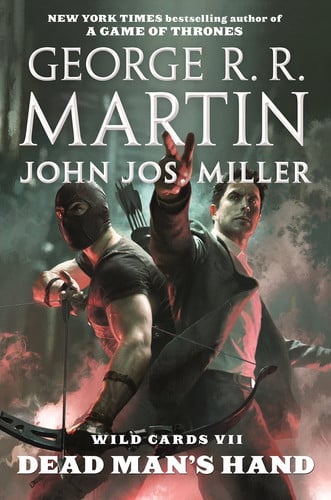
Wild Cards VII: Dead Man's Hand Book Four of the Puppetman Quartet

George R. R. Martin,John Jos. Miller,Wild Cards Trust
Dead Man's Hand combines the writing talents of George R. R. Martin & John Jos. Miller Chrysalis, the glass-skinned queen of the Joker underworld, has been found brutally murdered in her popular restaurant, the Crystal Palace. New two men are out to find her killer: Jay Ackroyd, the Ace private investigator who discovered her ruined body, and the vigilante archer known as the Yeoman, who has been framed for the crime. Their quest leads them on a nightmare odyssey of madness, violence, passion, and political intrigue that will forever alter the fates of Aces and Jokers everywhere. Experience this gripping tale of mystery and suspense, brought to you from the incredible imaginations of George R. R. Martin and John Jos. Miller in their first collaborative novel. EXPLORE THE WILD CARDS UNIVERSE An alien virus has changed the course of history, and the surviving population of Manhattan struggles to understand the new world left in its wake. Natural humans share the rough city with those given extraordinary—and sometimes terrifying—traits. While most manage to coexist in an uneasy peace, not everyone is willing to adapt. The Wild Cards Universe The Original Triad #1 Wild Cards #2 Aces High #3 Jokers Wild The Puppetman Quartet #4: Aces Abroad #5: Down and Dirty #6: Ace in the Hole #7: Dead Man’s Hand The Rox Triad #8: One-Eyed Jacks #9: Jokertown Shuffle #10: Dealer’s Choice #11: Double Solitaire #12: Turn of the Cards The Card Sharks Triad #13: Card Sharks #14: Marked Cards #15: Black Trump #16: Deuces Down #17: Death Draws Five The Committee Triad #18: Inside Straight #19: Busted Flush #20: Suicide Kings The Fort Freak Triad #21: Fort Freak #22: Lowball #23: High Stakes The American Triad #24: Mississippi Roll #25: Low Chicago #26: Texas Hold 'Em
Tor Publishing Group 2017-06-13 352 pages

The Street Sweeper

Elliot Perlman
How breathtakingly close we are to lives that at first seem so far away. From the civil rights struggle in the United States to the Nazi crimes against humanity in Europe, there are more stories than people passing one another every day on the bustling streets of every crowded city. Only some stories survive to become history. Recently released from prison, Lamont Williams, an African American probationary janitor in a Manhattan hospital and father of a little girl he can’t locate, strikes up an unlikely friendship with an elderly patient, a Holocaust survivor who was a prisoner in Auschwitz-Birkenau. A few blocks uptown, historian Adam Zignelik, an untenured Columbia professor, finds both his career and his long-term romantic relationship falling apart. Emerging from the depths of his own personal history, Adam sees, in a promising research topic suggested by an American World War II veteran, the beginnings of something that might just save him professionally, and perhaps even personally. As these men try to survive in early-twenty-first-century New York, history comes to life in ways neither of them could have foreseen. Two very different paths—Lamont’s and Adam’s—lead to one greater story as The Street Sweeper , in dealing with memory, love, guilt, heroism, the extremes of racism and unexpected kindness, spans the twentieth century to the present, and spans the globe from New York to Chicago to Auschwitz. Epic in scope, this is a remarkable feat of storytelling.
Penguin Publishing Group 2012-12-04 640 pages

Hill of beans: a novel of war and celluloid

Epstein, Leslie
"The film Casablanca opens with the words, "With the coming of the Second World War, many eyes in imprisoned Europe turned hopefully, or desperately, toward the freedom of the Americas." Leslie Epstein's Hill of Beans is the story of how one nation, one industry, and in particular one man responded to that desperate hope. That man is Jack Warner. His impossible goal is to make world events--most importantly, the invasion of North Africa by British and American forces in 1942--coincide with the release of his new film about a group of refugees marooned in Morocco. Arrayed against him are Stalin and Hitler, as well as Josef Goebbels, Franklin Roosevelt, a powerful gossip columnist, and above all a beautiful young woman with a terrible secret. His only weapons are his hutzpah and his heroism as he struggles to bring cinema and city, conflict and conference together in an epic command performance. Hill of Beans is the novel that Leslie Epstein--the son and nephew of Philip and Julius Epstein, the screenwriters of Casablanca--was born to write"--
High Road Books, an imprint of the University of New Mexico Press 2021 335 pages

Beyond the Gap

Harry Turtledove
Count Hamnet Thyssen is a minor noble of the drowsy old Raumsdalian Empire. Its capital city, Nidaros, began as a mammoth hunters’ camp at the edge of the great Glacier. But that was centuries ago, and as everyone knows, it’s the nature of the great Glacier to withdraw a few feet every year. Now Nidaros is an old and many-spired city; and though they still feel the breath of the great Glacier in every winter’s winds, the ice cap itself has retreated beyond the horizon. Trasamund, a clan chief of the mammoth-herding Bizogots, the next tribe north, has come to town with strange news. A narrow gap has opened in what they'd always thought was an endless and impregnable wall of ice. The great Glacier does not go on forever--and on its other side are new lands, new animals, and possibly new people. Ancient legend says that on the other side is the Golden Shrine, put there by the gods to guard the people of their world. Now, perhaps, the road to the legendary Golden Shrine is open. Who could resist the urge to go see? For Count Hamnet and his several companions, the glacier has always been the boundary of the world. Now they'll be traveling beyond it into a world that's bigger than anyone knew. Adventures will surely be had...
Macmillan 2008-04 432 pages

The night watch

Modiano, Patrick
When Patrick Modiano was awarded the 2014 Nobel Prize for LIterature he was praised for using the 'art of memory' to bring to life the Occupation of Paris during the Second World War. The Night Watch is his second novel and tells the story of a young man of limited means, caught between his work for the French Gestapo informing on the Resistance, and his work for a Resistance cell informing on the police and the black market dealers whose seedy milieu of nightclubs, prostitutes and spivs he shares. Under pressure from both sides to inform and bring things to a crisis, he finds himself driven towards an act of self-sacrifice as the only way to escape an impossible situation and the question that haunts him - how to be a traitor without being a traitor. In this astonishing, cruel and tender book, Modiano attempts to exorcise the past by leading his characters out on a fantasmagoric patrol during one fatal night of the Occupation.
Bloomsbury 2015 130 pages

The Union Jack

Kertész, Imre
"It was...unnecessary for me to fret about who the murderer was: Everybody was." A haunting, never-before-translated, autobiographical novella by the 2002 Nobel Prize winner. An unnamed narrator recounts a simple anecdote, his sighting of the Union Jack—the British Flag—during the Hungarian Revolution of 1956, in the few days preceding the uprising's brutal repression by the Soviet army. In the telling, partly a digressive meditation on "the absurd order of chance," he recalls his youthful self, and the epiphanies of his intellectual and spiritual awakening—an awakening to a kind of radical subjectivity. In his Nobel address Kertesz remembered: "I, on a lovely spring day in 1955, suddenly came to the realization that there exists only one reality, and that is me, my own life, this fragile gift bestowed for an uncertain time, which had been seized, expropriated by alien forces, and circumscribed, marked up, branded—and which I had to take back from 'History', this dreadful Moloch, because it was mine and mine alone..." The Contemporary Art of the Novella series is designed to highlight work by major authors from around the world. In most instances, as with Imre Kertész, it showcases work never before published; in others, books are reprised that should never have gone out of print. It is intended that the series feature many well-known authors and some exciting new discoveries. And as with the original series, The Art of the Novella, each book is a beautifully packaged and inexpensive volume meant to celebrate the form and its practitioners.
Melville House 2009 76 pages

Lies and sorcery

Morante, Elsa
Elisa - orphaned as a child, raised by a 'fallen woman', fed by fairy tales - has lived in an outlandish imaginary world for years. When her guardian dies, she feels compelled to confront her family's tortured and dramatic past, weaving the tale of her mother and grandmother through a history of intrigue, treachery, deception and desire. But as her saga of three generations of Sicilian women proceeds, it becomes something else entirely, taking in a whole legacy of oppression and injustice. By turns flamboyant and intense, raging and funny, Lies and Sorcery is a celebration of the female imagination, and the power of storytelling itself. First published in 1948, Elsa Morante's debut novel won the Viareggio Prize and earned her the lasting admiration of generations of writers from Italo Calvino and Natalia Ginzburg to Elena Ferrante. Translated by Jenny McPhee
Penguin Classics 2024 800 pages

Skin

Hill, Tobias
In an isolated trailer home in the far north of Japan, an old criminal scrutinizes his tattooed skin while he waits for the past to catch up with him. A year later, the life of a young policeman breaks down as he investigates a tattooed corpse and the history of death and guilt embedded in its skin. From the Japanese underworld to midnight in the London Zoo aquarium, Skin charts the lives of people in a world made stark and fantastical. The grief of a young computer programmer who cannot erase the ghostly memories of his twins. The vicious logic of the games played by children while their parents sip drinks under parasols. And London Zoo, where the disappearance of dead animals is blamed on the 'Featherman', an eerie bodysnatcher who passes through London's wastelands and derelict spaces, leaving no trace for the feathers of green humming-birds.
Bloomsbury 2015-01-29 200 pages

The architects

Heym, Stefan
Written between 1963 and 1966, when its publication would have proved to be political dynamite—and its author's undoing— The Architects of political intrigue and personal betrayal takes readers into the German Democratic Republic in the late 1950s, shortly after Khruschev's "secret speech" denouncing Stalin and his methods brought about a "thaw" in the Soviet bloc and, with it, the release of many victims of Stalinist brutality. Among these is Daniel, a Communist exile from Hitler who has been accused of treachery while in Moscow and who now returns to Germany after years of imprisonment. A brilliant architect, he is taken on by his former colleague, Arnold Sundstrom, who was in exile in Moscow as well but somehow fared better. He is now in fact the chief architect for the World Peace Road being built by the GDR. In Daniel, Arnold's young wife Julia finds the key that will unlock the dark secret of her husband's success and of her own parents' deaths in Moscow-and will undermine the very foundation on which she has built her life. A novel of exquisite suspense, romance, and drama, The Architects is also a window on a harrowing period of history that its author experienced firsthand-and that readers would do well to remember today.
Northwestern University Press 2006-01-06 327 pages