1222 results for "World Literature"

A Walker in the City

Alfred Kazin
Alfred Kazin burst onto the American literary scene in 1942, when his first book, "On Native Grounds," announced the arrival of an important new literary critic. "A Walker in the City," his second, signaled the other direction his career would follow: author of several intense, intimate, and lyrical memoirs. Years later he would admit how he struggled writing it. He thought he wanted to concentrate on New York itself, describing a series of walks around the city. But what emerged was the story of his own boyhood encounters with it, starting from Brownsville, the Brooklyn Jewish neighborhood of his birth, then stretching out to alluring, mysterious Manhattan and from there to the world. Each walk is simultaneously a journey out and a journey in: outward, from the neighborhood to the land beyond, the great, electric, canyoned streets of the city; inward, into his own soul, as it grows and falls in love with books and language and literature, with music and metaphysics and politics, with the city and the country and the world and rapturously tries to take them all in.
Fine Communications 1997 176 pages

Ecstasy and Me My Life as a Woman

Hedy Lamarr,J. Lewis Bruce,Philip Lambert
This is the autobiography of Hedy Lamarr, who is famous for two things: First: Her movie career, as she was regarded as the most beautiful woman in Hollywood. She was also the first woman ever to appear nude in a movie. Second: She is famous as an inventor, a scientist and a researcher, especially during the Second World War, as she developed and patented a method to defend against torpedoes and missiles. She also developed an anti-aircraft system where the anti-aircraft fire would not hit the aircraft but would explode nearby. Nowadays, in the aftermath of the shooting down of Malaysian Airline 17 over Eastern Ukraine, killing 298 passengers, a new look is being taken at the process developed by Hedy Lamarr. The missile that shot down the Malaysian Airplane used a system similar to the one developed by Hedy Lamarr, and the defense against torpedoes she developed might have applications to prevent future commercial aircraft from being knocked down.
Ishi Press International 2014 346 pages

Nowhere in Africa: an autobiographical novel

Zweig, Stefanie
Nowhere in Africa is the extraordinary tale of a Jewish family who flees the Nazi regime in 1938 for a remote farm in Kenya. Abandoning their once-comfortable existence in Germany, Walter Redlich, his wife Jettel, and their five-year-old daughter, Regina, each deal with the harsh realities of their new life in different ways. Attorney Walter is resigned to working the farm as a caretaker; pampered Jettel resists adjustment at every turn; while the shy yet curious Regina immediately embraces the country—learning the local language and customs, and finding a friend in Owuor, the farm's cook. As the war rages on the other side of the world, the family’s relationships with their strange environment become increasingly complicated as Jettel grows more self-assured and Walter more haunted by the life they left behind. In 1946, with the war over, Regina's fondest dream comes true when her brother Max is born. Walter's decision, however, to return to his homeland to help rebuild a new Germany puts his family into turmoil again. Visit the Web site for the film at www.nowhereinafrica.com
Terrace Books 2004 291 pages

Iron Man

Peter David
THE ORIGINAL HEAVY METAL HERO Millionaire industrialist Tony Stark’s genius for designing and building high-tech, ultradestructive weapons for America’s armed forces has inspired critics to dub him the modern-day Leonardo da Vinci–as well as “merchant of death,” a moniker he embraces with cool arrogance. But when he’s ambushed and kidnapped in the middle of a war zone, Stark comes face-to-face with his own mortality . . . and his true destiny. Now, thanks to him, enemy forces are about to meet their maker. And the world of warfare is about to meet its future–a weapon of mass destruction that walks and talks. When man and machine unite, it can only mean one thing: It’s time to stand ready or stand back–but don’t stand in the way, or else risk the mighty metallic fury of . . .
Random House Publishing Group 2008-04-04 320 pages

What Charlie Heard

Gerstein, Mordicai
The extraordinary story of the composer Charles Ives. "Sometimes little Charlie lay in his crib just listening. He heard his motherâ s long dress as she moved around his room. He heard big clocks and little clocks. He heard wagons and horse hooves. He heard dogs and crickets and the church bell next door." Charlie listened all through his boyhood, and as he grew into a man, he found he wanted to re-create in music the sounds that he heard every day. But others couldnâ t hear what Charlie heard. They didnâ t hear it as music â only as noise. In this daring and original book, Mordicai Gerstein graphically translates the audible into the visible â filling his pictures with noise â to tell the story of Charles Ives (1874â 1954), a great musical innovator who let neither criticism nor public scorn keep him from composing music that expressed all that he heard in the world. He was finally recognized with a Pulitzer Prize in 1947. What Charlie Heard is a 2003 Bank Street - Best Children's Book of the Year.
Live Oak Media 2004

Closing Time

Heller, Joseph
n a novel as darkly comic and audaciously ambitious as was Catch-22, Joseph Heller has dared to write the sequel to his American classic, using many of Catch-22's characters, now older if not wiser, to deftly satirize the realities and the myths of America in the half century since they fought World War II. In 1961, Joseph Heller's remarkable first novel made its way immediately into the American psyche and came to symbolize the absurdity of war and of life. Catch-22 was recognized overnight as a classic and has sold nearly ten million copies in the United States alone. It remains perhaps the funniest - and the most serious - novel ever written about war, "an apocalyptic masterpiece, " in the words of one reviewer. Now, thirty-three years later, Joseph Heller has written the sequel. You don't have to have read Catch-22 (But then, who on earth hasn't?) to enjoy Closing Time, which is a fully independent companion work, a comic masterpiece in its own right, in which Heller spears the inflated balloons of our national consciousness - the absurdity of our politics, the decline of society and our great cities, the greed and hypocrisy of our business and culture - with the same ferocious humor that he used against the conventional view of warfare. His characters are those of Catch-22, coming to the end of their lives and the century, as is the entire generation that fought in World War II: Yossarian, and Milo Minderbinder, the chaplain, and such newcomers as little Sammy Singer and giant Lew, all linked, this time in uneasy peace and old age, fighting, not the Germans this time, but The End. Closing Time is outrageously funny and totally serious, and as brilliant and successful as Catch-22itself, a fun-house mirror that captures, at once grotesquely and accurately, the truth about ourselves.
Simon and Schuster, NY 1994

Dead Heat

Joel C. Rosenberg
For Jon and Erin Bennett, the world seems to be spinning dangerously out of control. A new dictator is rising in Iraq. China is making threatening new moves toward Taiwan. North Korean forces appear ready to strike south. Israel is feverishly trying to complete the Third Temple. Oil prices are surging. And in the wake of an horrific war in the Middle East, President James MacPherson's second term is coming to an end. Now the battle to succeed him is heating up into one of the most fiercely contested presidential elections in American history, and the Bennetts realize the stakes could not be higher. Who will lead a bitterly divided country over the next four years? What can the U.S. do to shape the new world order? And just what role--if any--does the U.S. play in the last days? As the presidential campaign narrows into a dead heat, the Secret Service learns of a catastrophic plot to assassinate one of the candidates--but which one, and can the terrorists be stopped in time?
Tyndale House 2007

Son of Rosemary

Nicholas Levin,Ira Levin
Return to the dark and haunting world of Rosemary's Baby in Ira Levin's beguiling sequel, Son of Rosemary. This edition features a revelatory new afterword from the author's son, Nicholas Levin. Levin's Rosemary's Baby, one of the bestselling books of all time, is the iconic classic that ushered in the era of modern horror. This shocking and darkly comic sequel is set well after the harrowing events of the first book, and is just as compelling and suspenseful. It is now 1999, and Rosemary Woodhouse awakens from a decades-long coma to find herself in a drastically changed world. She soon discovers her son is already thirty-three years old, and a charismatic spiritual leader worshipped the world over, preaching a message of tolerance and peace. But is "Andy" the savior the troubled world so desperately needs, or is he his father's son--the Antichrist? Master of suspense Ira Levin's sardonic, thought-provoking exploration of good and evil, Son of Rosemary, finds Rosemary and her child reunited in a battle of wills that could determine not just the course of the new millennium--but the very fate of humankind.
Blackstone Publishing 2024-09-17 240 pages

Effingers

Tergit, Gabriele
"Three generations of German Jewish family undergo the tumult, upheaval, and brutality of nineteenth- and twentieth-century history in this panoramic and skillfully nuanced family drama, rich with gossip and incident, capturing a Germany now lost to time. Gabriele Tergit's Effingers is a novel both epic and intimate as it chronicles the lives and fates of three generations of a German Jewish family. Beginning from 1878-the year after the narrative of Buddenbrooks ends-and ending in 1948, we follow the Effingers, a family of modest craftsmen from southern Germany, who are joined through marriage to two families of high-society financiers in Berlin, the Goldschmidts and the Oppners. The Effingers soon rise to prominence as one of the most important German industrialist families in Berlin, but with the outbreak of World War I, they fall on hard times, and must then navigate the tumultuous changes of the Weimar Republic. Full of parties and drama and the most delicious gossip, and featuring a kaleidoscopic cast of unforgettable characters, Effingers is a vibrant and keenly observed account of German Jewish life in all its richness and complexity. Tergit's journalistic precision and limpid prose dazzle in Sophie Duvernoy's elegant, fluid translation. Criminally underrated when it first came out in 1951, and only in recent years undergoing rediscovery, Effingers is a searching meditation on identity and nationality that establishes Tergit as one of the most significant writers of the twentieth century"-- Provided by publisher.
New York Review Books 2025-11-11 853 pages

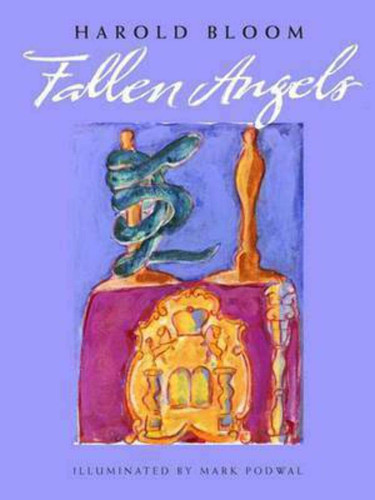
Fallen angels

Bloom, Harold
Harold Bloom, our preeminent literary critic, essays to explain the meaning of angels in world literature In this lovely gift book published for the holiday season, Harold Bloom again combines his lifelong interests in religion and literature. He begins by observing our present-day obsession with angels, which reached its greatest intensity as the current millennium approached. For the most part, these popular angels are banal, even insipid. Bloom is especially concerned with a particular subspecies of angels: fallen angels. He proceeds to examine representations of fallen angels from Zoroastrian texts and the Bible to Milton's Paradise Lost to Tony Kushner's Angels in America, arguing that familiarity with this rich literary tradition improves our reading and spiritual lives. Bloom's text is accompanied by more than a dozen original watercolors, line drawings, and illuminated letters by award-winning artist Mark Podwal. Every angel is terrifying, Rilke wrote. For Bloom, too, this is true in one sense, since he maintains that all angels are fallen angels. The image of Satan, the greatest of fallen angels, retains the ability to fascinate and frighten us, he argues, because we share a close kinship with him. Indeed, from a human perspective, we must agree that we are fallen angels. Fallenness is ultimately a human condition: the recognition of our own mortality. Throughout world literature angels have always served as metaphors for death. We may take consolation, however, in our double awareness that angels also represent love and the celebration of human possibilities.
Yale University Press 2007-10-30 71 pages

Gabriële

Berest, Anne,Berest, Claire
"The year is 1908, the height of the Belle Époque, and a brilliant, young French woman named Gabriële, newly graduated from the most elite music school in Europe, meets a volcanic Spanish artist named Francis. Following a whirlwind romance, they marry and fall headlong into a Paris that is experimenting with new forms of living, thinking, and creating. Soon after marrying Francis, Gabriële meets Marcel, another young artist, five years her junior. Soon, Francis, Marcel, and Gabriële are all involved in a fervent affair that will change the course of art history and redefine the avant-garde. As the Belle Époque gives way to rebellion and revolution, and the world descends into the devastation of World War I, Francis Picabia, Marcel Duchamp, and Gabriële Buffet revolutionize art and open up new ways of seeing and thinking, along the way posing a vital question for their age and ours: what is the connection between new ways of loving and new ways of creating? Moving between Paris, New York, Berlin, Zurich, Barcelona, London, and Saint-Tropez, Gabriële is as audacious, uninhibited, intimate, and unforgettable as its central character, the mercurial, pioneering Gabriële Buffet."--
Europa Editions 2025-04-22 350 pages

Autocorrect - Stories

Etgar Keret
From one of the preeminent literary voices in Israel comes a darkly funny collection of surrealist stories exploring the increasingly complex relationship between humans and technology. Set in our world, alternate realities, distant futures, and the immortal realm, the stories in Autocorrect traverse the wide range of human experience. With wit and creativity, Keret blends the absurd and the profound, juxtaposing life's smallest details with weighty existential questions. A man names an asteroid after his wife only to find that it's on a collision course with Earth in "For the Woman Who Has Everything." In "Squirrels," a widower's husband reincarnates as a rodent, and "Eating Olives at the End of the World" considers proper social etiquette in the face of destruction. Keret's collection speaks to the uncertainty and fragility of our time, expertly capturing its misunderstandings and miscommunications. His stories probe society's uncomfortable truths, searching for meaning in our ever-changing world.
Penguin Group 2026-05-26 208 pages

The complete Dead Sea scrolls in English

Vermès, Géza
A newly updated edition of the landmark translation by one of our greatest religious scholars Since its publication in 1962, esteemed biblical expert Géza Vermes's translation of the Dead Sea Scrolls has established itself as the authoritative standard. The original manuscripts, discovered in the Judean Desert between 1947 and 1956, completely transformed our understanding of the Hebrew Bible, early Judaism, and the origin of Christianity. Now in its seventh edition, The Complete Dead Sea Scrolls in English has been updated with a number of previously unpublished texts, as well as extensive new introductory material and notes. Some sixty years after the Scrolls' discovery, this revised and expanded volume crowns a lifetime of research by Vermes. For more than sixty-five years, Penguin has been the leading publisher of classic literature in the English-speaking world. With more than 1,500 titles, Penguin Classics represents a global bookshelf of the best works throughout history and across genres and disciplines. Readers trust the series to provide authoritative texts enhanced by introductions and notes by distinguished scholars and contemporary authors, as well as up-to-date translations by award-winning translators.
Penguin 2011 698 pages

American scream: Allen Ginsberg's Howl and the making of the Beat Generation

Raskin, Jonah
Written as a cultural weapon and a call to arms, Howl touched a raw nerve in Cold War America and has been controversial from the day it was first read aloud nearly fifty years ago. This first full critical and historical study of Howl brilliantly elucidates the nexus of politics and literature in which it was written and gives striking new portraits of Allen Ginsberg, Jack Kerouac, and William Burroughs. Drawing from newly released psychiatric reports on Ginsberg, from interviews with his psychiatrist, Dr. Philip Hicks, and from the poet's journals, American Scream shows how Howl brought Ginsberg and the world out of the closet of a repressive society. It also gives the first full accounting of the literary figures―Eliot, Rimbaud, and Whitman―who influenced Howl, definitively placing it in the tradition of twentieth-century American poetry for the first time. As he follows the genesis and the evolution of Howl, Jonah Raskin constructs a vivid picture of a poet and an era. He illuminates the development of Beat poetry in New York and San Francisco in the 1950s--focusing on historic occasions such as the first reading of Howl at Six Gallery in San Francisco in 1955 and the obscenity trial over the poem's publication. He looks closely at Ginsberg's life, including his relationships with his parents, friends, and mentors, while he was writing the poem and uses this material to illuminate the themes of madness, nakedness, and secrecy that pervade Howl. A captivating look at the cultural climate of the Cold War and at a great American poet, American Scream finally tells the full story of Howl―a rousing manifesto for a generation and a classic of twentieth-century literature.
University of California Press 2004-04-07 295 pages

The Final solution: origins and implementation

Cesarani,David
Although there is an immense amount of literature on the 'Final Solution' - the Nazis' attempt to exterminate the Jews of Europe during the Second World War - many critical questions still remain unresolved. The authoritative essays in The Final Solution set out to clarify the origins of the attempted genocide of the Jews, and to provide new answers to this period of history which often seems inexplicable." "The book draws on important new evidence, much of it from archives in Eastern Europe which have only recently become accessible. Contributors are among the leading experts in the field. The essays focus on the preconditions and antecedents for the 'Final Solution' and the immediate origins of the decision to murder Europe's Jewish population. They consider, too, the impact of the German invasion of Russia in June 1941 on the evolution of a genocidal policy and the response of the peoples and governments in Germany, occupied Europe, the Free World and the Jewish communities under the Nazis and in the West." "The results of this study are often controversial. The essays challenge many accepted notions about the behaviour of the German Army, how much the Germans knew, and the response of the non-Jewish population in Occupied Europe and the West." "The Final Solution will be of great interest to students of modern European history. It will also make invaluable reading for anyone seeking to understand further this most tragic chapter of recent history.
Routledge 1994-01 318 pages

Israel: a history

Shapira, Anita
"Written by one of Israel's most notable scholars, this volume provides a breathtaking history of Israel from the origins of the Zionist movement in the late 19th century to the present day. Organized chronologically, the volume explores the emergence of Zionism in Europe against the backdrop of relations among Jews, Arabs, and Turks, and the earliest pioneer settlements in Palestine under Ottoman rule. Weaving together political, social, and cultural developments in Palestine under the British mandate, Shapira creates a tapestry through which to understand the challenges of Israeli nation building, including mass immigration, shifting cultural norms, the politics of war and world diplomacy, and the creation of democratic institutions and a civil society. References to contemporary diaries, memoirs, and literature bring a human dimension to this narrative history of Israel from its declaration of independence in 1948 through successive decade of waging war, negotiating peace, and building a modern state with a vibrant society and culture. Based on archival sources and the most up-to-date scholarly research, this authoritative history is ideal for course adoption and a must-read for anyone with a passionate interest in Israel. Israel: A History will be the gold standard in the field for years to come." --Publisher description.
Brandeis University Press 2012-12-11 502 pages

A Place of My Own

Pollan, Michael
"A room of one's own: is there anybody who hasn't at one time or another wished for such a place, hasn't turned those soft words over until they'd assumed a habitable shape?" When writer Michael Pollan decided to plant a garden, the result was an award-winning treatise on the borders between nature and contemporary life, the acclaimed bestseller Second Nature. Now Pollan turns his sharp insight to the craft of building, as he recounts the process of designing and constructing a small one-room structure on his rural Connecticut property--a place in which he hoped to read, write and daydream, built with his two own unhandy hands. Invoking the titans of architecture, literature and philosophy, from Vitrivius to Thoreau, from the Chinese masters of feng shui to the revolutionary Frank Lloyd Wright, Pollan brilliantly chronicles a realm of blueprints, joints and trusses as he peers into the ephemeral nature of "houseness" itself. From the spark of an idea to the search for a perfect site to the raising of a ridgepole, Pollan revels in the infinitely detailed, complex process of creating a finished structure. At once superbly written, informative and enormously entertaining, A Place of My Own is for anyone who has ever wondered how the walls around us take shape--and how we might shape them ourselves. A Place of My Own recounts his two-and-a-half-year journey of discovery in an absorbing narrative that deftly weaves the day-to-day work of design and building--from siting to blueprint, from the pouring of foundations to finish carpentry--with reflections on everything form the power of place to shape our lives to the question of what constitutes "real work" in a technological society. A book about craft that is itself beautifully crafted, linking the world of the body and material things with the realm of mind, heart, and spirit, A Place of My Own has received extraordinary praise: --> From the Trade Paperback edition.
Random House Value Publishing 1999-05-11