2220 results for "History"

Nothing like sunshine: a story in the aftermath of the MLK assassination

Kamin, Ben
Rabbi Ben Kamin has written a definitive personal expression about race, coming of age in the 1960s, a forbidden friendship, and his personal love for Dr. Martin Luther King Jr. This is a story that spans a four-decade search for a lost high school chum, a deep misunderstanding, and a coming to terms with an America painfully evolving from the blood of MLK to the promise of Barack Obama. The book is a remembrance of Kamin's life at Cincinnati's notorious Woodward High School, a microcosm of the 1960s and of America itself.
Michigan State University Press 2010 138 pages

Russian writings on Hollywood

Rand, Ayn
Reproduces and translates from the Russian two booklets in which the 20-year-old later known in the US as Ayn Rand records her admiration for Hollywood movies and stars. Pola Negri, about her favorite actress, was published without byline in 1925. Hollywood: American City of Movies, her description of early Hollywood, was pirated by a Soviet publisher. They were rediscovered separately during the middle 1990s. Accompanying them is a detailed log of the films she watched and a ranking of her favorite actors. There is no index. Annotation c. Book News, Inc., Portland, OR (booknews.com)
Ayn Rand Institute Press 1999 223 pages

Inside the Nixon administration: the secret diary of Arthur Burns, 1969-1974

Burns, Arthur F.
As chairman of the Federal Reserve Board in the seventies, Arthur Burns had a unique view of the Nixon administration. Burns first joined the Nixon administration as an advisor in 1969 and was privy to the dynamics of the president's coterie over the course of six tumultuous years. Now the recently released secret diary of this top-level economist offers a surprisingly candid inside look at Richard Nixon's fall. The diary tracks Burns's growing awareness of Nixon's behind-the-scenes maneuverings and worrisome behavior (such as "insane shouting") and reveals how such things undermined his respect and enthusiasm for the president. Perhaps even more telling, Burns's evaluations of his colleagues provide piercing insights into the president's inner circle, including Henry Kissinger ("a brilliant political analyst, but admittedly ignorant of economics"), George Schultz ("a no less confused amateur economist"), John Connally ("a thoroughly confused politician"), and the "vulgarians" H. R. Haldeman and John Ehrlichman-the only people he thought Nixon felt relaxed around. The Burns diary also offers rare and telling glimpses into the era's economy--particularly an account of how Nixon exerted political pressure to shape monetary policies that helped to fuel the stagflation of the 1970s. The administration sought to close the so-called gold window, an approximate valuation of dollars with gold bullion, by floating the dollar, and the consensus over many years has been that Nixon himself arranged this-speculation now confirmed by Burns's diary. It also underscores the growing pressure Burns felt to serve the needs of Nixon's reelection bid rather than the economic welfare of the nation. Sequestered for decades and unavailable until 2008, this document reveals an honest and relatively apolitical man surrounded by partisans in top administrative positions who were dishonest, inept-or both. "The President has many shortcomings," wrote Burns. "He has few convictions, but now and then he gets into a euphoric mood where he wants to persuade himself that he's a statesman. But his sycophantic advisers cannot even recognize that." Deftly annotated by distinguished historian Robert Ferrell, who provides effective historical context and perspective, the Burns diary is a potent-and poignant-testament to the Machiavellian and often Byzantine world of American presidential politics.
University Press of Kansas 2010-10-28 140 pages

The Muse Is Always Half-Dressed in New Orleans And Other Essays

Andrei Codrescu
In twenty-six essays, Codrescu turns his skeptical, amused gaze to such topics as Plato's effect on American sex, the cultural meaning of Ed McMahon, baseball's literary underpinnings, his own conception in a Romanian darkroom, an cuisine under the Ceausescu dictatorship, as well as to larger subjects, including the suicide of communism, American culture and politics, and his adopted city of New Orleans.
Macmillan 1995-05-15 208 pages

Facing Black and Jew: literature as public space in twentieth-century America

Newton, Adam Zachary
A reading of African American and Jewish American writers from Henry Roth and Ralph Ellison to Philip Roth and David Bradley. Reading the work of such writers alongside and through one another, Newton's book offers an original way of juxtaposing two major traditions in modern American literature, and rethinking the sometimes vexed relationship between two constituencies ordinarily confined to sociopolitical or media commentary alone. Newton combines Emmanuel Levinas's ethical philosophy and Walter Benjamin's theory of allegory in shaping an innovative kind of ethical-political criticism. Through artful, dialogical readings of Saul Bellow and Chester Himes, David Mamet and Anna Deavere Smith, and others, Newton seeks to represent American Blacks and Jews outside the distorting mirror of 'Black-Jewish Relations', and restrictive literary histories alike. A final chapter addresses the Black/Jewish dimension of the O. J. Simpson trial.
Cambridge University Press 1999-07-15 218 pages

Badass teachers unite! writing on education, history, and youth activism

Naison, Mark D.
In this incisive collection of essays, educator and activist Mark Naison draws on years of research on Bronx history and his own experience on the front lines of the education wars to unapologetically defend teachers and students from education "reform" policies that undermine their power and creativity. Naison shows how dominant education policy systematically hurts the very children it claims to support and instead forces them to "race to the top." He exposes the Duncans, Rhees, and Gateses for schemes that intensify racial and economic inequality. And he refocuses the conversation on teaching and organizing strategies that should be implemented in communities everywhere.
Haymarket Books 2014 197 pages

Beyond the pale: new essays for a new era

Aronson, Marc
For nearly a decade Marc Aronson ran an imprint dedicated to international and multicultural literature for teens. He was known in the industry for publishing "edgy" books, and for his commitment to bringing the experiences of non-dominant authors and illustrators to the world. Yet in the summer of 2001 he wrote an essay that argued against awards, such as the Pure Belpre and Coretta Scott King prizes, for which you must be a member of a given ethnic group to win. Not surprisingly, his article was very controversial; and the author and publisher Andrea Davis Pinkney who had created an imprint specifically designed to be of, by, and for African Americans, published a thoughtful reply. Here, in Beyond the Pale , Aronson explains the passionate convictions that led him to write his essay, and outlines objections made by others; then reprints the original alongside Pinkney's response. As Aronson prepared a formal response to his critics, the attacks of September 11th took place. This tragedy simultaneously made a squabble among authors seem petty, and the issues around art, society, and cultural diversity all the more important. Throughout 2001 and 2002, Aronson wrote essays in which he weighed out how art, history, and books for younger readers could respond to the altered world. As in his previous collection, Exploding the Myths, the Truth About Teenagers and Reading , he exposes the mythologies and false beliefs that distort our understanding of books and their readers. Provocative and informative, this collection of essays will challenge those who know children's literature well to think in new ways, while linking the debates within that industry to the wider intellectual currents of our time.
Scarecrow Press 2003-02-25 145 pages

Miles Davis and David Liebman: jazz connections

Liebman, Dave
An oral history based on converstaions with David Liebman about his musical career and his association with Miles Davis. Chapter one of the text examines Liebman's background and early influences (Elvin Jones and Miles Davis). Chapter two provides information about Liebman and his band, their artistic objectives, interaction with an audience, and teaching and aesthetics. Liebman's place in the jazz spectrum, including performance style, and musical and language communication are explored in the third chapter, while chapter four looks more generally at lifestyles and attitudes of jazz musicians. The final two chapters of the book have comments by David Liebman shortly before and shortly after the death of Miles Davis in May 1991.
Edwin Mellen Press 1996 206 pages

People vs. profits: columns of Victor Perlo, 1961-1999

Perlo, Victor
In addition to producing much other literature, Marxist economist Perlo (1912-99) wrote more than 3,000 People vs. Profits columns over 39 years for the Communist Party paper People's Weekly World . Survivors and colleagues reprint a selection based on their portrayal of conditions at the time. Presumably a second volume will consider foreign matters. Annotation (c) Book News, Inc., Portland, OR (booknews.com)
International Publishers 2003 372 pages

Thousands of Broadways: dreams and nightmares of the American small town

Pinsky, Robert
Broadway, the main street that runs through Robert Pinsky’s home town of Long Branch, New Jersey, was once like thousands of other main streets in small towns across the country. But for Pinsky, one of America’s most admired poets and its former Poet Laureate, this Broadway is the point of departure for a lively journey through the small towns of the American imagination. Thousands of Broadways explores the dreams and nightmares of such small towns—their welcoming yet suffocating, warm yet prejudicial character during their heyday, from the early nineteenth century through World War II. The citizens of quintessential small towns know one another extensively and even intimately, but fail to recognize the geniuses and criminal minds in their midst. Bringing the works of such figures as Mark Twain, William Faulkner, Alfred Hitchcock, Thornton Wilder, Willa Cather, and Preston Sturges to bear on this paradox, as well as reflections on his own time growing up in a small town, Pinsky explores how such imperfect knowledge shields communities from the anonymity and alienation of modern life. Along the way, he also considers how small towns can be small minded—in some cases viciously judgmental and oppressively provincial. Ultimately, Pinsky examines the uneasy regard that creative talents like him often have toward the small towns that either nurtured or thwarted their artistic impulses. Of living in a small town, Sherwood Anderson once wrote that "the sensation is one never to be forgotten. On all sides are ghosts, not of the dead, but of living people." Passionate, lyrical, and intensely moving, Thousands of Broadways is a rich exploration of this crucial theme in American literature by one of its most distinguished figures.
University of Chicago Press 2009-05-15 98 pages

Barry Hannah

Charney, Mark J.
Born in Clinton, Mississippi, Barry Hannah has been a major force in southern literature since the 1970 publication of his first novel, Geronimo Rex, which won the Bellman Foundation Award in fiction. It was followed by his first collection of stories, Airships (1978), winner of the prestigious Arnold Gringrich Short Fiction Award, and the acclaimed novel Ray (1980). The honesty of Hannah's vision and his varied narrative voices have won him comparison to Walker Percy, William Faulkner, Eudora Welty, and Flannery O'Connor. One of the South's most original writers, Hannah explores the human psyche; he may write primarily about his experiences in the South, but his experiments with prose are not restricted to region. In this first full-length critical study of Hannah's works--six novels and two volumes of short stories--Mark Jay Charney deftly explores Hannah's connections with southern writers like Faulkner and Welty by examining both his progression as a fiction writer and his experiments with language, voice, and form. Expertly combining biographical information with critical analysis, Charney correlates Hannah's literary themes and techniques with the influences shaping his life. The book is organized chronologically to illustrate Hannah's growing preoccupation with unconventional narrative form and to delineate the thematic shift from violence and isolation to peaceful alternatives and community acceptance. This book is a most welcome introduction to the works of a writer who promises to remain one of South's most startling and iconoclastic voices.
Twayne Publishers 1992 115 pages

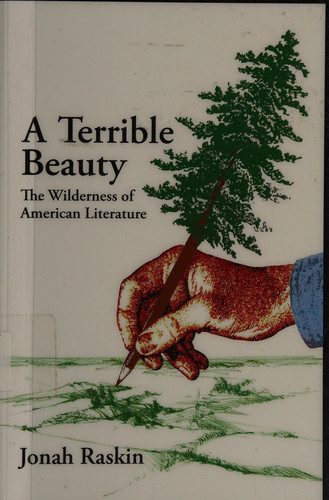
A terrible beauty: the wilderness of American literature

Raskin, Jonah
ABOUT THE BOOK Shortly before he published Walden; or Life in the Woods, Henry David Thoreau called ¿The library a wilderness of books.¿ He also noted that while Americans were ¿clearing the forest in our westward progress, we are accumulating a forest of books in our rear, as wild and unexplored as any of nature¿s primitive wildernesses.¿ In "A Terrible Beauty: the Wilderness of American Literature," Jonah Raskin takes a long close look at the forest of books that poets, novelists and essayists mapped and explored before and after Thoreau. The first work of cultural criticism to look back at writing in the United States from the perspective of the contemporary environmental crisis, Raskin offers insights for students, teachers and lovers of literature as well as for backpackers and hikers who have trekked across untrammeled forests, deserts and mountains. ABOUT THE AUTHOR Jonah Raskin, Phd, has taught American literature at Sonoma State University, the State University of New York at Stony Brook and as a Fulbright professor at the University of Antwerp and the University of Ghent in Belgium. The author of fifteen books, he earned his B.A. at Columbia College in New York, his M.A. at Columbia University and his Ph.D. at the University of Manchester, Manchester, England. He lives in northern California and has written for The San Francisco Chronicle, The L.A. Times, The Nation, The Redwood Coast Review and Catamaran.
Regent Press 2014 366 pages

In respect to egotism: studies in American Romantic writing

Porte, Joel
Joel Porte offers a timely reassessment of nineteenth century literature, focusing on the general question of the American Romantic ego and its varying modalities of self-creation, self-display, self-projection, and self-concealment. The book begins by exploring the status of the "text" in nineteenth-century American writing, the relationship of "rhetorical" reading to historical context, and the nature of "Romanticism" in an American setting. Porte then concentrates on the great authors of the period through a series of thematically linked but critically discrete essays on Brown, Irving, Parkman, Cooper, Poe, Emerson, Hawthorne, Thoreau, Melville, Frederick Douglass, Stowe, Whitman, and Dickinson. Throughout his important new study, Porte offers provocative reassessments of familiar texts while at the same time casting an illuminating critical eye on less well-known territory. Readers of this book will come away with increased respect for the achievement of American Romantic writers.
Cambridge University Press 1991-07-26 316 pages

Identity papers: contemporary narratives of American Jewishness

Meyers, Helene
Identity Papers argues that contemporary Jewish American literature revises our understanding of Jewishness and Jewish difference. Moving beyond the reductive labeling of texts and authors as “too Jewish” or “not Jewish enough,” and focusing instead on narratives that portray Jewish regeneration through feminist Orthodoxy, queerness, off-whiteness, and intermarriage, Helene Meyers resists a lachrymose view of contemporary Jewish American life. She argues that such gendered, sexed, and raced debates about Jewish identity become opportunities rather than crises, signs of creative potential rather than symptoms of assimilation and deracination. Thus, feminist debates within Orthodoxy are allied to Jewish continuity by Rebecca Goldstein, Allegra Goodman, and Tova Mirvis; the geography of Jewish identity is racialized by Alfred Uhry, Tony Kushner, and Philip Roth; and the works of Jyl Lynn Felman, Judith Katz, Lev Raphael, and Michael Lowenthal queer the Jewish family as they reveal homophobia to be an abomination. Even as Identity Papers expands Jewish literary horizons and offers much-needed alternatives to the culture wars between liberal and traditional Jews, it argues that Jewish difference productively troubles dominant narratives of feminist, queer, and whiteness studies. Meyers demonstrates that the evolving Jewish American literary renaissance is anything but provincial; rather, it is engaged with categories of difference central to contemporary academic discourses and our national life.
SUNY Press 2012-07-02 239 pages