7908 results for "Science"

Final Incal

Jodorowsky, Alejandro
Visionary storyteller, Jodorowsky, returns to the epic mythology he created with the late Moebius over 3o years ago. This volume concludes the spiritual space adventures of everyman, John DiFool, as the universe faces the threat of an all-devouring metallic virus. The book contains both the original, unfinished After the Incal drawn by Moebius, as well as the complete 3-volume series, Final Incal illustrated by Ladronn. This limited edition of 200 comes in a luxury slipcase with a bookplate signed by Jodorowsky and Ladronn.
Humanoids 2014-05-28 216 pages

The Politics of Petulance America in an Age of Immaturity

Alan Wolfe
How did we get into this mess? Every morning, many Americans ask this as, with a cringe, they pick up their phones and look to see what terrible thing President Trump has just said or done. Regardless of what he’s complaining about or whom he’s attacking, a second question comes hard on the heels of the first: How on earth do we get out of this? Alan Wolfe has an answer. In The Politics of Petulance he argues that the core of our problem isn’t Trump himself—it’s that we are mired in an age of political immaturity. That immaturity is not grounded in any one ideology, nor is it a function of age or education. It’s in an abdication of valuing the character of would-be leaders; it’s in a failure to acknowledge, even welcome the complexity of government and society; and it’s in a loss of the ability to be skeptical without being suspicious. In 2016, many Americans were offered tantalizingly simple answers to complicated problems, and, like children being offered a lunch of Pop Rocks and Coke, they reflexively—and mindlessly—accepted. The good news, such as it is, is that we’ve been here before. Wolfe reminds us that we know how to grow up and face down Trump and other demagogues. Wolfe reinvigorates the tradition of public engagement exemplified by midcentury intellectuals such as Richard Hofstadter, Reinhold Niebuhr, and Lionel Trilling—and he draws lessons from their battles with McCarthyism and conspiratorial paranoia. Wolfe mounts a powerful case that we can learn from them to forge a new path for political intervention today. Wolfe has been thinking and writing about American life and politics for decades. He sees this moment as one of real risk. But he’s not throwing up his hands; he’s bracing us. We’ve faced demagogues before. We can find the intellectual maturity to fight back. Yes we can.
University of Chicago Press 2019-08-22 220 pages

Preemption: a knife that cuts both ways

Dershowitz, Alan M.
Every so often, a startling book emerges that gives voice to a new of previously unexamined trend that is transforming society. In Preemption: A Knife That Cuts Both Ways, Alan M. Dershowitz, the renowned lawyer and educator, chronicles the world's fundamental shift in its approach to controlling dangerous and destructive human behavior. Dershowitz reveals that we are moving - whether in terms of fighting crime, profiling suspicious behavior, or combating terrorism - toward increasingly preventive and proactive measures and away from a traditional reliance on reactive responses. In showing the seismic shift that not only has profoundly altered foreign policy but also has affected matters as close to home as inoculation, Internet censorship, and stings, Dershowitz presents the reader with challenging dilemmas. For example, should one detain and interrogate a potential criminal solely on the basis of his profile, DNA, or predicted behavior? Should the Department of Homeland Security have the power to monitor law-abiding citizens just because they attend a certain mosque or church? Should a nation threatened by terrorism or nuclear attack be authorized to launch a preemptive attack or a preventive war? In presenting his finds, Dershowitz contrasts our approach to the Cold War - deterring a nuclear attack by threatening mutually assured destruction (MAD) - with our current approach to terrorism: kill them before they kill us. The tragic events of 9/11 have of course outwardly change the nature of American foreign policy, but Preemption convincingly demonstrated that the seeds were planted long before the collapse of the World Trade Towers and the deadly chain of al-Qaids bombings that have ripped through more than a dozen cities throughout the world. In tracing the emergence of a preemptive approach, particularly in this new century, Dershowitz examines the troubling implications not just for national security and foreign policy but for civil liberties and human rights as well. He calls for, and constructs, a new jurisprudence of preemption that seeks to balance security and freedom. With a remarkable flair for debate that has won him acclaim in the courtroom, Dershowitz brings his prodigious talen and firsthand expertise as lawyer to a topic of great philosophical and political import, The questions that he raises, both in his introduction and through the many lucid examples in Preemption, have already begun to define our age. In doing so, they will profoundly alter our fundamental understanding of how to confront crime, terrorism, and warfare. Indeed, the knife cuts both ways.
W. W. Norton 2007 348 pages

The spectacular Spider-Man. Volume 8

Milgrom, Al,Mantlo, Bill
Visionary creator Al Milgrom writes - and draws - Spider-Man's second ongoing series in the leadup to its historic 100th issue! Kingpin's hitmen are closing in, your girlfriend-who doesn't even want to know the real you-broke up with you, and your new alien costume wants to kill you. What's that, you say? Yup, it's just another day for Peter Parker, the Spectacular Spider-Man! Writer/artist Al Milgrom spins a series of wonderful web-slinging adventures in the run up to Spectacular Spider-Man #100. He introduces new villains in the Lee/Ditko mold like the Answer and the Spot and (literally) resurrects classic characters like Silvermane as killer cyborg! The Kingpin's the man pulling the strings throughout. Will his leverage on the Black Cat mean Spidey won't see issue #101? Also featuring an Annual exploring Aunt May's younger days and the rare Spider-Man installment of Questprobe . COLLECTING- THE SPECTACULAR SPIDER-MAN (1976) #92-100 & ANNUAL (1979) #4, WEB OF SPIDER-MAN (1985) #1 and QUESTPROBE (1984) #2
Marvel Worldwide, Inc 2025-05-06 336 pages

The Rise of David Levinsky

Abraham Cahan
"The novel is more than an important literary work and cultural document. It forms part of the traditional ritual of renewal of the American Way." -Sam B. Girgus "It is one of the best fictional studies of Jewish character available in English, and at the same time an intimate and sophisticated account of American business culture." --Isaac Rosenfeld The Rise of David Levinsky, written by the celebrated founder and editor of the Jewish Daily Forward, is an early Jewish-American treasure. According to the scholar Sam B. Girgus, "The novel is more than an important literary work and cultural document. It forms part of the traditional ritual of renewal of the American Way." Originally published in 1917, Abraham Cahan's realistic novel tells the story of a young Talmudic scholar who migrated from a small town in Russia to the melting pot of turn-of-the-century New York City. As the Jewish "greenhorn" rises from the depths of poverty to become a millionaire garment merchant, he discovers the awful price of assimilation.
CreateSpace Independent Publishing Platform 2015-01-05 370 pages

Revolution for the Hell of It The Book That Earned Abbie Hoffman a 5 Year-Prison Term at the Chicago Conspiracy Trial

Abbie Hoffman
"If Steal This Book is Abbie Hoffman's guide to living outside the establishment, Revolution for the Hell of It is a chronicle of his radical escapades that still offers lessons for today's activists." "Hoffman pioneered the use of humor, theater, and surprise to change the world for the better. In Revolution for the Hell of It he gives firsthand accounts of his legendary adventures, from the activism that led up to the founding of the Youth International Party (or "Yippies!") to the 1968 Democratic National Convention protests ("a perfect mess"). Also chronicled is the mass antiwar demonstration he helped lead in which over 50,000 people levitated the Pentagon using psychic energy and the time he dropped handfuls of dollar bills onto the floor of the New York Stock Exchange and watched the traders scramble. With antiwar sentiment once again on the rise and an incendiary political climate not seen since the book's original printing, Abbie Hoffman's voice is more essential than ever."--BOOK JACKET.
Buccaneer Books, Incorporated 1994

The Earl of Louisiana

Abbott Joseph Liebling
In the summer of 1959, A. J. Liebling, veteran writer for the New Yorker, came to Louisiana to cover a series of bizarre events which began when Governor Earl K. Long was committed to a mental institution. Captivated by his subject, Liebling remained to write the fascinating yet tragic story of ?Uncle Earl?s? final year in politics. First published in 1961, The Earl of Louisiana recreates a stormy era of Louisiana politics and captures the style and personality of one of the most colorful and paradoxical figures in the state?s history. This new edition of the work includes a foreword by T. Harry Williams, Pulitzer prize-winning author of Huey Long: A Biography.
LSU Press 1970 252 pages

Moral education

Durkheim, Émile
The great French sociologist and philosopher Emile Durkheim is best known for his classic book Suicide (1897), a landmark in social psychology. Among his other major works is this study in the sociology of education, which features 18 lectures by an influential theorist who discusses his ideas on the school as the appropriate setting for moral education. The first element in developing a moral being, he maintains, is instilling a sense of discipline, followed by a willingness to behave in terms of the group's collective interest, and a sense of autonomy. Durkheim also examines discipline and the psychology of the child, discipline of the school and the use of punishment, altruism in the child, the influence of the school environment, and the teaching of science, aesthetics, and history. Perceptive and provocative, this volume abounds in valuable insights for teachers and others involved in education.
Dover Publications 2002 287 pages

The people's choice: how the voter makes up his mind in a presidential campaign

Lazarsfeld, Paul F.
"The People's Choice is a landmark psychological and statistical study of American voters during the 1940 and 1944 presidential elections, originally published in 1948. Amid a burgeoning interest in statistics and population sampling, it constituted the first systematic effort to trace voters' behavior across the duration of a presidential campaign and to follow up on this data years later. During the 1940 campaign, Paul F. Lazarsfeld, Bernard Berelson, and Hazel Gaudet followed a sample population of six hundred people from Erie County, Ohio, interviewing them monthly in the seven months leading up to Election Day. Their subsequent study in 1944 expanded the sample to include a nationwide cross-section of two thousand voters. Contrary to the fears of the time, Lazarsfeld, Berelson, and Gaudet found that media such as newspapers and radio and campaign advertising did not have a profound influence on individual voting habits. Instead, interpersonal interactions and word of mouth were more significant for most voters. They argued that mass media reached a small but crucial subset of people, who passed information on to less avid media consumers. The study paired the same interviewers and interviewees over time, leading to remarkable extended conversations featuring more casual and exploratory discussions than were typical of social-scientific research. Quoted verbatim, they offer additional insight into the American electorate. A groundbreaking work of empirical political science, The People's Choice remains of great importance in an era of anxiety about the influence of media on voting behavior"--
Columbia University Press 2021 178 pages

The optimum quantity of money

Friedman, Milton
This classic set of essays by Nobel Laureate and leading monetary theorist Milton Friedman presents a coherent view of the role of money, focusing on specific topics related to the empirical analysis of monetary phenomena and policy. The early chapters cover factors determining the real quantity of money held in a community and the welfare implications of policies that affect the quantity held. The following chapters formally restate why quantity analysis has become central to the science of economics. Friedman's presidential address to the American Economic Association, included here, provides a general summary of his views on the role of monetary policy, with an emphasis on its limitations and its possibilities. This theoretical framework is used in examining a number of empirical problems: the demand for money, the explanation of price changes in wartime periods, and the role of money in business cycles. These essays summarize some of the most important results of Friedman's extensive research over the course of his lifetime. The chapters on policy that follow survey the positions of earlier economists and deal with the importance of lags and the implications of destabilizing speculation in foreign markets. Taken as a whole, The Optimum Quantity of Money provides a comprehensive view of the body of monetary theory developed in leading centers of monetary analysis. This work is essential reading for economists and graduate students in the field. The volume will be no less important for practicing business and banking personnel as well. The new statement by Michael Bordo, a student of Friedman's and an expert in the field, provides a sense of where the field now stands in the economy and academy. Milton Friedman is a senior fellow at the Hoover Institution of Stanford University. Before that, he was Distinguished Service Professor of Economics at the University of Chicago. He has also taught at Columbia University, the University of Wisconsin, the University of Minnesota, and Cambridge University. Among his many books are Essays in Positive Economics , A Program for Monetary Stability , Capitalism and Freedom , and A Monetary History of the United States . Michael D. Bordo is professor of economics at Rutgers, The State University of New Jersey, and author, with Lars Jonung, of, among other works, Demand for Money .
Aldine Transaction 2006 296 pages

Introduction To The Book Of Zohar

Michael Laitman,Yehuda Ashlag
Introduction to the Zohar is the second in a series written by Kabbalist and scientist Rav Michael Laitman, which will prepare readers to understand the hidden message of "The Zohar". Among the many helpful topics dealt with in this companion text to The Science of Kabbalah, readers are introduced to the 'language of root and branch', without which the stories in the Zohar are mere fable and legend. Introduction to the Zohar will certainly furnish readers with the necessary tools to understand authentic Kabbalah as it was originally meant to be, as a means to attain the 'Upper Worlds'. -- The vast and deep knowledge one can attain from this Kabbalah book is unmatched. -- Kabbalah is a historic Jewish book of thought that delves into the depths of spiritual energy. -- This Kabbalah book is a masterpiece amongst its peers. This book brings the wealthy culture of Kabbalah to life for all to understand. -- Utilizing new perspectives will grant us the ability to use Kabbalah to better ourselves. -- Up until very recently, Kabbalah was reserved for the elite, those who only after years of scholarship and practice were allowed to enter this mystical realm. Today, you can study it through these Kabbalah books.
Amazon Digital Services LLC - Kdp 2020-05-11 304 pages

The Phantom Public

Lippmann, Walter
Is the "Will of the People" a myth? Discover the controversial classic that shattered the romantic illusion of democracy. In a world saturated with media manipulation, fake news, and political polarization, do you ever feel like a "deaf spectator in the back row" of history? You are not alone. In 1925, legendary journalist and political critic Walter Lippmann wrote a book so prophetic it reads like a commentary on today’s headlines. The Phantom Public is a cold splash of water for anyone who believes that the average citizen is capable of governing a complex world. Lippmann argues that the "public" is an abstraction—a phantom—and that the idea of the "omnicompetent citizen" is a dangerous fiction. Why is this 20th-century masterpiece essential reading for the modern era? Understand the Machinery of Power: Learn why Lippmann believed that the average voter is too busy, distracted, and uninformed to manage public affairs, leaving the real power to insiders and experts. The Origins of "Manufacturing Consent": Before Noam Chomsky, there was Lippmann. This text lays the foundation for understanding how public opinion is shaped, controlled, and often ignored by the elite. A Realist View of Democracy: Move beyond idealistic slogans. Lippmann proposes that the true purpose of democracy is not to express a mystical "will," but simply to manage conflicts without violence. Navigate the Information Age: Written decades before the internet, Lippmann’s analysis of how limited information leads to bad policy is the key to decoding our current political philosophy and social unrest. "The private citizen today has come to feel rather like a deaf spectator in the back row... He lives in a world which he cannot see, does not understand and remains unable to direct." Whether you are a student of political science, a skeptic of the mainstream narrative, or a reader of Edward Bernays and Hannah Arendt, this book will challenge everything you think you know about your role in society. Stop watching the shadows on the wall. Scroll up and click "Buy Now" to confront the reality of The Phantom Public.
Independently published 2025-11-30 130 pages

The hard problem

Stoppard, Tom
"Hilary, a young psychology researcher at the Krohl Institute for Brain Science, is nursing a private sorrow and a troubling question. She and other researchers at the institute are grappling with what science calls the 'hard problem'--if there is nothing but matter, what is consciousness? What Hilary discovers puts her fundamentally at odds with her colleagues, who include her first mentor and onetime lover, Spike; her boss, Leo; and the billionaire founder of the institute, Jerry. Hilary needs a miracle, and she is prepared to pray for one."--Back cover.
Grove Press 2015 76 pages

The last word

Nagel, Thomas
If there is such a thing as reason, it has to be universal. Reason must reflect objective principles whose validity is independent of our point of view - principles that anyone with enough intelligence ought to be able to recognize as correct. But this universality of reason is what relativists and subjectivists deny in ever-increasing numbers. And such subjectivism is not just an inconsequential intellectual flourish or badge of theoretical chic. It is exploited to deflect argument and to belittle the pretensions of the arguments of others. The continuing spread of this relativistic way of thinking threatens to make public discourse increasingly difficult and unproductive. In The Last Word, Thomas Nagel, one of the most influential philosophers writing in English, presents a sustained defense of reason against the attacks of subjectivism, delivering systematic rebuttals of relativistic claims with respect to language, logic, science, and ethics. He shows that the last word in disputes about the objective validity of any form of thought must lie in some unqualified thoughts about how things are - thoughts that we cannot regard from outside as mere psychological dispositions. His work sets a new standard in the debate on this crucially important question and should generate intense interest both within and outside the philosophical community.
Oxford University Press 1997 147 pages

Secret weapons: defenses of insects, spiders, scorpions, and other many-legged creatures

Eisner, Thomas
Mostly tiny, infinitely delicate, and short-lived, insects and their relatives--arthropods--nonetheless outnumber all their fellow creatures on earth. How lowly arthropods achieved this unlikely preeminence is a story deftly and colorfully told in this follow-up to the award-winning For Love of Insects . Part handbook, part field guide, part photo album, Secret Weapons chronicles the diverse and often astonishing defensive strategies that have allowed insects, spiders, scorpions, and other many-legged creatures not just to survive, but to thrive. In sixty-nine chapters, each brilliantly illustrated with photographs culled from Thomas Eisner's legendary collection, we meet a largely North American cast of arthropods--as well as a few of their kin from Australia, Europe, and Asia--and observe at firsthand the nature and extent of the defenses that lie at the root of their evolutionary success. Here are the cockroaches and termites, the carpenter ants and honeybees, and all the miniature creatures in between, deploying their sprays and venom, froth and feces, camouflage and sticky coatings. And along with a marvelous bug's-eye view of how these secret weapons actually work, here is a close-up look at the science behind them, from taxonomy to chemical formulas, as well as an appendix with instructions for studying chemical defenses at home. Whether dipped into here and there or read cover to cover, Secret Weapons will prove invaluable to hands-on researchers and amateur naturalists alike, and will captivate any reader for whom nature is a source of wonder.
Belknap 2007-04-30 384 pages

˜Anœ American index of the hidden and unfamiliar: Taryn Simon ; [on the occasion of an exhibition at The Whitney Museum of American Art, March - June, 2007 and the Museum für Moderne Kunst (MMK), Frankfurt/Main, September, 2007 - February, 2008]

Simon, Taryn
In An American Index of the Hidden and Unfamiliar, Taryn Simon documents spaces that are integral to America's foundation, mythology and daily functioning, but remain inaccessible or unknown to a public audience. She has photographed rarely seen sites from domains including: science, government, medicine, entertainment, nature security and religion. This index examines subjects that, while provocative or controversial, are currently legal. The work responds to a desire to discover unknown territories, to see everything. Simon makes use of the annotated-photograph's capacity to engage and inform the public. Transforming that which is off-limits or under-the-radar into a visible and intelligible form, she confronts the divide between the privileged access of the few and the limited access of the public. Photographed with a large format view camera (except when prohibited), Simon's 70 color plates form a seductive collection that reflects and reveals a national identity. In addition to this monograph, there is also an exhibition of Simon's work opening at the Whitney Museum of American Art in March 2007.
Steidl 2007 150 pages

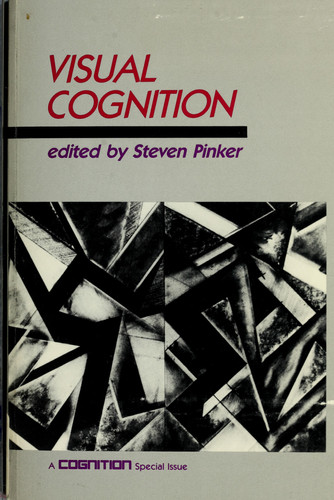
Visual cognition

Steven Pinker
These essays tackle some of the central issues in visual cognition, presentingexperimental techniques from cognitive psychology, new ways of modeling cognitive processes oncomputers from artificial intelligence, and new ways of studying brain organization fromneuropsychology, to address such questions as: How do we recognize objects in front of us? How do wereason about objects when they are absent and only in memory? How do we conceptualize the threedimensions of space? Do different people do these things in different ways? And where are theseabilities located in the brain?While this research, which appeared as a special issue of the journalCognition, is at the cutting edge of cognitive science, it does not assume a highly technicalbackground on the part of readers. The book begins with a tutorial introduction by the editor,making it suitable for specialists and nonspecialists alike.Steven Pinker is Associate Professor,Department of Psychology and Center for Cognitive Science at MIT.
MIT Press 1985 280 pages

My Adventures with God

Stephen Tobolowsky
A delightful collection from legendary character actor Stephen Tobolowsky—who currently appears on The Goldbergs , HBO’s Silicon Valley , and the serial podcast The Tobolowsky Files — “a series of true stories that wrestle with a big idea: how belief shapes our lives. Funny, smart, and moving, this is a wonderful account of our relationship with the unknowable” (Susan Orlean, New York Times bestselling author of The Orchid Thief and Rin Tin Tin ). In My Adventures with God , Stephen Tobolowsky explores the idea that most people’s lives seem to fit into the template of the Old Testament. We all have powerful creation myths: tales of our childhood and family, our first battles won and lost. It is our Genesis. Then, like in the Book of Exodus , we go into slavery. Rather than building pyramids, we lose ourselves in fear and ambition—in first loves, first jobs, too many dreams mixed with too much beer. We eventually become free, only to wander in the wilderness. At some point we stop and proclaim to the universe who we are. This is our Leviticus moment. We reconcile what we thought we would be with what we have become. We often attempt a mid-course correction. Then, as in the Book of Numbers, we are shaped by mortality as we bear the loss of family and friends. Finally, we retell our stories to our children hoping to make sense of the journey, like Moses did in Deuteronomy. Tobolowsky’s stories tell of a boy growing up in the wilds of Texas, finding and losing love, losing and finding himself—all told through the prism of the Torah and Talmud, mixed with insights from science, and refined through a child’s sense of wonder. My Adventures with God is a “fast-paced, precise, wide-ranging, and impressive book draws on the I Ching, Talmud, Einstein, Grimms’ Fairy Tales , and reruns of SportsCenter to create counterpoints when discussing his life of faith. This is a well-told, must-read…for anyone interested in a comedic adventure with the divine” ( Publishers Weekly ).
Simon & Schuster 2018-04-24 368 pages