2501 results for "American History"

Khe Sanh: siege in the clouds : an oral history

Hammel, Eric M.
In late 1967 as part of the Tet offensive, U.S. commanders hoped to lure the North Vietnamese Army into exposing large numbers of soldiers to their overwhelming air power. But in January 1968, a U.S. Marine Corps force found themselves surrounded by the enemy in their hilltop base at Khe Sanh. The siege lasted for nearly three months and caught the attention of the world; for many it came to epitomize the conflict. Eric Hammel's classic account is a vivid oral history, using the words of American fighting men caught up in the gruelling, deadly seventy-seven-day ordeal creates a harrowing tapestry of tragedy and triumph. As two North Vietnamese Army divisions move to surround them, the vastly outnumbered U.S. Marines rush to strengthen their defenses at the isolated base and several nearby hilltop positions. The Communist forces repeatedly attack, are repeatedly repelled, and then dig in to take the American base by siege-the makings of a classic, modern "set-piece" strategy in which the defenders become bait to tie the attackers to fixed positions in which they can be pummelled and pulverized by American artillery and air support. The gripping - and moving - narrative flows from the masterfully woven threads provided by nearly a hundred men who gallantly endured the wrenching all-out struggle to hold the combat base and its vulnerable outlying positions. Re-issued in the fiftieth anniversary year of the siege, with an updated photo section and maps, this is a ground-breaking and influential history of this crucial landmark battle.
Casemate 2018 376 pages

Gay essentials: facts for your queer brain

Bianco, David
TABLE OF CONTENTS: Who was Sappho? How gay was the Renaissance? When were the first sodomy laws passed in America? Were there any gay heroes in the American Revolution? Were "passing" women lesbians? Who was Walt Whitman? Who was Karl Heinrich Ulrichs? How did San Francisco become so gay? Was Susan B. Anthony a lesbian? Who were the "berdaches"? Who was Katharine Lee Bates? What was the Scientific-Humanitarian Committee? What were Oscar Wilde's trials about? What is the history of gay bathhouses? When did American gays, lesbians, and others first start calling themselves "queer"? Who was E.M. Forster? Who were Havelock Ellis and Edith Lees Ellis? How gay was the Harlem Renaissance? Who were Gertrude Stein and Alice B. Toklas? Who was Willa Cather? What was the Leopold and Loeb case? Who was Natalie Barney? What was the first gay rights organization in America? Who was Janet Flanner? What was the "Padlock" Bill? What was The Well of Loneliness? Who was Babe Didrikson Zaharias? Was Eleanor Roosevelt a lesbian? What was The Children's Hour? What happened to gays and lesbians during the Holocaust? Who were some of the lesbians in Hollywood's golden age? What is the origin of the phrase "a friend of Dorothy's"? Who were Ruth Benedict and Margaret Mead? What were the army drag shows during World War II? What were "blue discharges"? When did the American gay and lesbian press begin? How gay were Tennessee Williams's plays? What was the Kinsey Report? What were the lesbian pulp novels of the 1950s? What were physique magazines? Who was Christine Jorgensen? What was the Mattachine Society? How did McCarthyism affect gays and lesbians? Who were the Daughters of Bilitis? Who was Rudi Gernreich? Who was James Baldwin? What was the Boise Sex Scandal? What was Evelyn Hooker's research about? What was the Wolfenden Report? Who was Lorraine Hansberry? What was the Supreme Court's first pro-gay ruling? What have gays and lesbians experienced in revolutionary Cuba? Who was Bayard Rustin? What was NACHO? What is the origin of the annual gay and les
Alyson Books 1999 327 pages

The war on error: Israel, Islam, and the Middle East

Kramer, Martin S.
"In the War on Error, historian and political analyst Martin Kramer presents a series of case studies, some based on pathfinding research and others on provocative analysis, that correct misinformation clouding the public's understanding of the Middle East. He also offers a forensic exploration of how misinformation arises and becomes "fact". The book is divided into five theme: Orientalism and Middle Eastern studies, a prime casuality of the culture wars; Islamism, massively misrepresented by apologists; Arab politics, a generator of disappointing surprises; Israeli history, manipulated by reckless revisionists; and American Jews and Israel, the subject of irrational fantasies. Kramer shows how error permeates the debate over each of these themes, creating distorted images that cause policy failures. Kramer approaches questions in the spirit of a relentless fact-checker. Did Israeli troops massacre Palestinian Arabs in Lydda in July 1948? Was the bestseller Exodus hatched by an advertising executive? Did Martin Luther King, Jr., describe anti-Zionism as antisemitism? Did a major post-9/11 documentary film deliberately distort the history of Islam? Did Israel push the United States into the Iraq War? Kramer also questions paradigms - the "Arab Spring," the map of the Middle East, and linkage. Along the way, he amasses new evidence, exposes carelessness, and provides definitive answers." --
Transaction Publishers 2016 318 pages

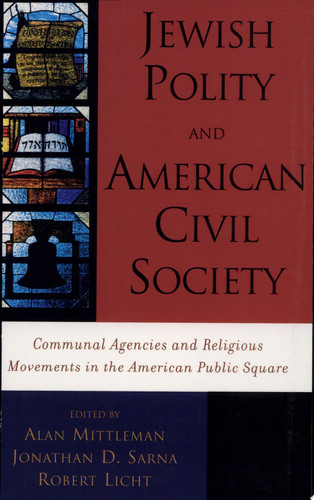
Jewish polity and American civil society: communal agencies and religious movements in the American public sphere

Alan Mittleman,Robert Licht,Jonathan D. Sarna
Jewish Polity and American Civil Society is a study of the civic and political engagements of American Jews as mediated by their communal and denominational institutions. The book explores how the various branches of the organized Jewish community seek to influence public affairs. Over the course of the last century, Jewish agencies and religious movements have tried to shape public debate and public policy on such issues as civil rights, church-state relations, and American foreign policy. The book sets the history of Jewish engagement in these areas into historical context; analyzes the motives, strategies, and tactics of various Jewish groups, and evaluates their successes and failures. The book also explores the underlying idea-the public philosophy-that informs American Jews' understanding of civic and political engagement.
Rowman & Littlefield 2002-07-23 420 pages

Cars for comrades: the life of the Soviet automobile

Siegelbaum, Lewis H.
The automobile and Soviet communism made an odd couple. The quintessential symbol of American economic might and consumerism never achieved iconic status as an engine of Communist progress, in part because it posed an awkward challenge to some basic assumptions of Soviet ideology and practice. In this rich and often witty book, Lewis H. Siegelbaum recounts the life of the Soviet automobile and in the process gives us a fresh perspective on the history and fate of the USSR itself. Based on sources ranging from official state archives to cartoons, car-enthusiast magazines, and popular films, Cars for Comrades takes us from the construction of the huge "Soviet Detroits," emblems of the utopian phase of Soviet planning, to present-day Togliatti, where the fate of Russia's last auto plant hangs in the balance. The large role played by American businessmen and engineers in the checkered history of Soviet automobile manufacture is one of the book's surprises, and the author points up the ironic parallels between the Soviet story and the decline of the American Detroit. In the interwar years, automobile clubs, car magazines, and the popularity of rally races were signs of a nascent Soviet car culture, its growth slowed by the policies of the Stalinist state and by Russia's intractable "roadlessness." In the postwar years cars appeared with greater frequency in songs, movies, novels, and in propaganda that promised to do better than car-crazy America. Ultimately, Siegelbaum shows, the automobile epitomized and exacerbated the contradictions between what Soviet communism encouraged and what it provided. To need a car was a mark of support for industrial goals; to want a car for its own sake was something else entirely. Because Soviet cars were both hard to get and chronically unreliable, and such items as gasoline and spare parts so scarce, owning and maintaining them enmeshed citizens in networks of private, semi-illegal, and ideologically heterodox practices that the state was helpless to combat. Deeply researched and engagingly told, this masterful and entertaining biography of the Soviet automobile provides a new perspective on one of the twentieth century's most iconic--and important--technologies and a novel approach to understanding the history of the Soviet Union itself.
Cornell University Press 2011 309 pages

Just Say Yes-Tenth Anniversary Edition

Catherine Hiller
Just Say Yes, perhaps the first marijuana memoir ever published, is a positive account of long-term cannabis use. With ruthless honesty and deadpan humor, the author observes the effect of weed upon every aspect of her life: marriage, motherhood, friendship, work, sport, sex. As John Updike wrote about Hiller's short story collection, Skin, this is "good, brave and joyful writing." Ten years after its first publication, the updated edition of Just Say Yes addresses the changing status of cannabis in America and includes a foreword by Steve DeAngelo. "This funny, wry and very candid memoir purports to be a Confession of an American Pot-Smoker but is really a cultural/personal history of the past fifty years. The narrative progresses backward, and not only the past but innocence itself is recaptured." -Phillip Lopate, Nonfiction Director, MFA Writing Program, Columbia University "Likely to loosen up fellow smokers, while adding a personal take to the public discussion of cannabis." -Kirkus Reviews "Brilliant, important, and beautifully written." -Betsy Prioleau, author of Seductress and Swoon
Heliotrope Books LLC 2025-04-20 222 pages

American Communism and Soviet Russia

Theodore Draper
This companion volume to The Roots of American Communism brings to completion what the author describes as the essence of the relationship of American Communism to Soviet Russia in the first decade after the Bolsheviks seized power. The outpouring of new archive materials makes it plain that Draper's premise is direct and to the point: The communist movement "was transformed from a new expression of American radicalism to the American appendage of a Russian revolutionary power." Each generation must find this out for itself, and no better guide exists than the work of master historian Theodore Draper. American Communism and Soviet Russia is acknowledged to be the classic, authoritative history of the critical formative period of the American Communist Party. Based on confidential minutes of the top party committees, interviews with party leaders, and public records, this book carefully documents the influence of the Soviet Union on the fundamental nature of American Communism. Draper's reflections on that period in this edition are a fitting capstone to this pioneering effort.
[distributor] Taylor & Francis, c/o Bookpoint 2017-07-14 596 pages

Between the lines: readings on Israel, the Palestinians, and the U.S. "war on terror"

Honig-Parnass, Tikva
This compilation of essays, edited by a Palestinian writer and an Israeli journalist, constitutes a challenge to critically rethink the Israeli-Palestinian conflict. Between the Lines presents a groundbreaking study that brings together insights from across the lines of conflict to put the latest chapter of Israeli apartheid and Palestinian resistance into context. Contributors include: Marwan Bargouti, Dr. Azmi Bishara, Dr. Sami Shalom Chetrit, Dr. Saleh Abdel Jawwad, Husam Khader, Eileen Kuttab, Dr. Yitzhak Laor, Dr. Adi Ophir, Dr. Ilan Pappe, Linda Tabar, Graham Usher and Dr. Jamal Zahalqa. "The destruction of a nation is not an everyday event in history. It is being carried out before our eyes, systematically and consciously, with cruelty and self-righteousness, and with the backing of the global superpower. These acute and informed essays develop a perspective on the background and unfolding of these events that is remote from anything likely to be heard in the West. They merit close attention and thoughtful consideration." --Noam Chomsky "This collection provides a lucid and critical analysis of the Israeli and American policies in the Middle East. The disastrous repercussions of this unholy alliance are presented in this collection through incisive and timely contributions. In the best tradition of [the journal] Between the Lines, readers will be rewarded by this collection that unmasks and exposes what the mainstream media refuses to report or admit." --Ilan Pappe, Israeli historian and author of A History of Modern Palestine Toufic Haddad is a Palestinian American activist who was formerly co-editor with Tikva Honig-Parnass of the Jerusalem-based magazine Between the Lines. Tikva Honig-Parnass is a Jewish Israeli active in radical anti-occupation movements.
Haymarket Books 2007 405 pages

Jumping the line: the adventures and misadventures of an American radical

Herrick, William
An eye-opening account of time served in the great battles of our century - for workers' rights, against Fascism, Communism, and racism - Jumping the Line is the life story of an American original. William Herrick relates his adventures and misadventures on the front lines of the Spanish Civil War, in (and very much out of) the Communist Party, driving a tractor on a communal farm in Michigan, jumping the line as a hobo, organizing African American sharecroppers in Georgia, at work with Orson Welles, and immersed in his own writing. When Paul Berman interviewed Herrick in the Village Voice in 1986, for the fiftieth anniversary of the Spanish Civil War, Herrick's remarks so incensed other veterans of the Abraham Lincoln battalion that they picketed the paper. What William Herrick has to say doesn't always go down easily. But for those who like the truth, with a dash of wit and a healthy dose of history, it can be exhilarating.
University of Wisconsin Press 1998 283 pages

The Hero in History

Sidney Hook
Considered by some the most controversial American philosopher of contemporary times, SIDNEY HOOK (1902-1989) was infamous for the wild swing in his political thought over the course of his career, starting out as a young Marxist before the Great Depression and ending up a vehement anti-Communist in his later years. Hook's conception of history and the individual's impact upon it is the subject of this intriguing work, first published in 1943. Subtitled A Study in Limitation and Possibility, it examines the concept of the "hero" as it relates to leadership in the modern world, the hero as a child of crisis, how the character of rulers affects society, how history swings on the contingent and the unforeseen, and much more. With sections on the Russian revolution and the influence of the hero on democracy, this unexpectedly entertaining book is an enthralling look at the theories that shaped Hook's thought and guided his changes in political alliance.
Cosimo, Inc. 2008-12-01 292 pages

Wounded titans: American presidents and the perils of power

Lerner, Max
Max Lerner taught generations of Americans about their government: who rules, why, and how. For almost half a century, the office of the presidency preoccupied his prodigious energies and unparalleled expertise. Lerner not only wrote about the men who inhabited the Oval Office during that time, he knew them personally, from Franklin D. Roosevelt to Bill Clinton - and he knew what made them tick. Here, collected for the first time, are Lerner's complete writings on the presidency and American presidents. Wounded Titans contains Lerner's classic essays on the presidency and its development. Here, too, are his most famous presidential portraits of Jefferson and Lincoln - the presidents he believed most significantly shaped both the office and our perception of it - as well as of the men who inherited the modern-day office created by Roosevelt. Each portrait combines a rigorous and unblinking analysis of its subject's place in history with a sympathetic appreciation of his humanity. Everything about the office of the presidency fascinated Lerner, including how someone ran for it. This volume also contains the best of Lerner's campaign journalism, written for his widely syndicated column, which appeared in the New York Post for over four decades.
Arcade Pub 1996 437 pages

The emergence of American Zionism

Raider, Mark A.
The images of Zionist pioneers in the late nineteenth and early twentieth centuries--hard working, brawny, and living off the land--sprang from the ascendent socialist Zionist movement in Palestine known as "Labor Zionism." The building of the Yishuv, a new Jewish society in Palestine, was accompanied by the rapid growth of Zionism worldwide. How did Zionism take shape in the United States? How did Labor Zionism and the Yishuv influence American Jews? Zionism and Labor Zionism had a much more substantial impact on the American Jewish scene than has been recognized. Drawing on meticulous research, Mark A. Raider describes Labor Zionism's dramatic transformation in the American context from a marginal immigrant party into a significant political force. The Emergence of American Zionism challenges many of the prevailing assumptions of Jewish and Zionist history that have held sway for a full generation. It shows how and why American Labor Zionism--"the voice of Labor Palestine on American soil"--played such an important role in formulating the program and outlook of American Zionism. It also examines more generally the impact of Zionism on American Jews, making the case that Zionism's cultural vitality, intellectual diversity, and unparalleled ability to rally public opinion in times of crisis were central to the American Jewish experience.
New York University Press 1998 296 pages

The surge: a military history

Kagan, Kimberly
"Kimberly Kagan ... [describes] the complete operational history of the surge from its inception to the end of 2007. Kagan's detailed analysis looks at the external players -- from al Qaeda in Iraq, and the Iranian-backed Special Groups, to the Jaysh al Mahdi -- and covers the day-to-day strategies, locations, tactics, organization, and responses to American actions" -- Jacket.
Encounter Books 2009 282 pages

The BreakBeat Poets New American Poetry in the Age of Hip-hop

Kevin Coval,Quraysh Ali Lansana,Nate Marshall (Poet)
Hip-Hop is the largest youth culture in the history of the planet rock. This is the first poetry anthology by and for the Hip-Hop generation. It has produced generations of artists who have revolutionized their genre(s) by applying the aesthetic innovations of the culture. The BreakBeat Poets features 78 poets, born somewhere between 1961-1999, All-City and Coast-to-Coast, who are creating the next and now movement(s) in American letters. The BreakBeat Poets is for people who love Hip-Hop, for fans of the culture, for people who've never read a poem, for people who thought poems were only something done by dead white dudes who got lost in a forest, and for poetry heads. This anthology is meant to expand the idea of who a poet is and what a poem is for. The BreakBeat Poets are the scribes recording and remixing a fuller spectrum of experience of what it means to be alive in this moment. The BreakBeat Poets are a break with the past and an honoring of the tradition(s), an undeniable body expanding the canon for the fresher.
Haymarket Books 2015 350 pages

The uses of history: understanding the Soviet Union and Russia

Dallin, Alexander
Exploring Soviet and Russian history, politics, and foreign policy, The Uses of History brings together the classic essays of renowned scholar Alexander Dallin. The author provides insightful analysis and nuanced interpretations of such key-and controversial-issues as the domestic sources of Soviet foreign policy, Stalin's leadership in World War II, Russian-American relations in the Reagan era, the causes of the collapse of the USSR, and the disappointments of Russia's post-Soviet evolution. With his incisive assessment of the biases and blunders in American interpretations, Dallin rejects single-factor explanations for Soviet and Russian domestic and foreign policies, instead examining the complex interplay of internal and external conditions, institutions, mindsets, and the role of individual leaders. All readers interested in Soviet and post-Soviet history will find this collection a stimulating and deeply knowledgeable resource.
Rowman & Littlefield Publishers 2009-10-16 271 pages

Insider/outsider: American Jews and multiculturalism

David Biale,Michael Galchinsky,Susannah Heschel
Twelve distinguished historians, political theorists, and literary critics present new perspectives on multiculturalism in this important collection. Central to the essays (all but one is appearing in print for the first time) is the question of how the Jewish experience can challenge the conventional polar opposition between a majority "white monoculture" and a marginalized "minorities of color multiculture." This book takes issue with such a dichotomy by showing how experiences of American Jews can undo conventional categories. Neither a complaint against multiculturalism by Jews who feel excluded from it, nor a celebration of multiculturalism as the solution to contemporary Jewish problems, Insider/Outsider explores how the Jews' anomalous status opens up multicultural history in different and interesting directions. The goal of the editors has been to transcend the notion of "comparative victimology" and to show the value of a narrative that does not rely on competing histories of persecution. Readers can discover in these essays arguments that will broaden their understanding of Jewish identity and multicultural theory and will enliven the contemporary debate about American culture generally. Twelve distinguished historians, political theorists, and literary critics present new perspectives on multiculturalism in this important collection. Central to the essays (all but one is appearing in print for the first time) is the question of how the Jewish experience can challenge the conventional polar opposition between a majority "white monoculture" and a marginalized "minorities of color multiculture." This book takes issue with such a dichotomy by showing how experiences of American Jews can undo conventional categories. Neither a complaint against multiculturalism by Jews who feel excluded from it, nor a celebration of multiculturalism as the solution to contemporary Jewish problems, Insider/Outsider explores how the Jews' anomalous status opens up multicultural history in different and interesting directions. The goal of the editors has been to transcend the notion of "comparative victimology" and to show the value of a narrative that does not rely on competing histories of persecution. Readers can discover in these essays arguments that will broaden their understanding of Jewish identity and multicultural theory and will enliven the contemporary debate about American culture generally.
University of California Press 1998 280 pages

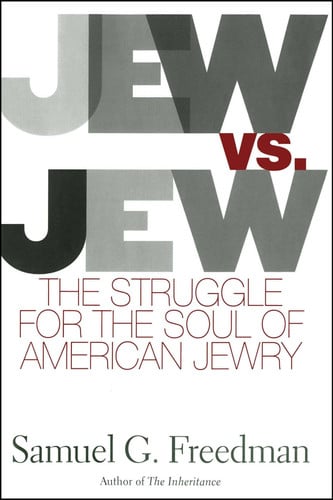
Jew Vs Jew The Struggle For The Soul Of American Jewry

Samuel G. Freedman
At a time when American Jews should feel more secure and cohesive than ever, civil war is tearing apart their community. Congregations, neighborhoods, even families are taking sides in battles about Jewish identity and Jewish authenticity. The conflict pits fundamentalist against secularist, denomination against denomination, even liberal against conservative within each branch of Jewry. Jew vs. Jew tells the story of how American Jewry has increasingly -- and perhaps terminally -- broken apart in the last forty years. Jew vs. Jew stretches in time from 1960 to 2000. It travels the country from Florida to New England, from Los Angeles to the Catskills in New York, from Cleveland to Denver, and it also crosses the ocean to Israel to show how tensions within the Jewish state inflame those among American Jews. The flash-points range from conversion standards to the role of women, from the peace process in Israel to the sexual climate on an Ivy League campus. But behind them all, as Samuel Freedman writes, lie common causes. First, far from unifying American Jews, Israel now divides them on both political and religious grounds. Second, neither America nor the larger world presents Jews with a single enemy against whom to coalesce. Third, and most important, nothing in the Jewish history of persecution, oppression, and exile prepared the Chosen People for the challenge posed by America, the challenge of being absorbed into a tolerant and diverse nation, being accepted so thoroughly that the intermarriage rate tops 50 percent. Jew vs. Jew introduces readers to memorable places and characters. Freedman describes one of the final summers at a Labor Zionist camp in the Catskills whose brand of secular Jewishness is becoming obsolete because Zionism succeeded in creating Israel. He tells the story of Orthodox and Reform Jews in a Cleveland suburb who are fighting about the construction of several synagogues -- and, on a deeper level, about whether unity or pluralism ought to be the goal of Jewish life. He portrays a Florida Jew so violently opposed to the Oslo peace accords that he planted a bomb in a synagogue where Shimon Peres was speaking. He tells about a Los Angeles congregation that spent three years debating whether or not to honor the Biblical matriarchs in its liturgy.We come to know the Long Island neighbors who cannot tolerate sharing even a property line because their versions of Jewish identity are so irreconcilably different. Jew vs. Jew is a work of vigorous reporting, lucid writing, and intellectual curiosity. And even as it chronicles an embittered and polarized community, it refuses to take sides or pass judgment. Instead, with compassion and acuity, Jew vs. Jew bears witness.
Simon & Schuster 2007-09-21 400 pages

Benedict Arnold: A Drama of the American Revolution in Five Acts

Zubrin, Robert
Benedict Arnold: A Drama of the American Revolution in Five Acts Benedict Arnold was the greatest combat soldier of the American Revolution. Yet, in September 1780, in collusion with the beautiful Tory agent Peggy Shippen and British spymaster John Andre, he attempted to betray George Washington, the Marquis de Lafayette, Alexander Hamilton, and the critical fortress of West Point into Royal hands. This devastating plot came within a hair's breath of succeeding, and the fragile infant American cause was only saved by the chance intervention of three of the humblest and most improbable heroes ever to grace the annals of history. Exciting and dramatic, the tale of the Arnold conspiracy recounts the most perilous moment in the birth of the new nation, and plumbs the depths and the heights of human nature. Now, in the historically accurate play, Benedict Arnold, noted scientist and author Robert Zubrin brings this incredible and still meaningful story back to life.
San Val 2005-06

West European communism and American foreign policy

Ledeen, Michael Arthur
The great vogue of Eurocommunism came to an end with the return of the French and Italian Communist Parties to positions of opposition to authority in the late 1970's, and the electoral confirmation that Spain's Communist Party would remain small. As the vogue of communism with a human face passed. The question of American policy toward Communists became far less pressing; yet the question will almost certainly require attention in the future. This is particularly true with respect to the Italian Communist Party, which remains powerful in numbers and flexible in policy. Michael Ledeen examines Communist Party participation in Western European governments since World War II, and the ambivalent American foreign policy toward it. He concentrates on the Italian Communist Party: its history and its relations with the Soviet Union. Togliatti, Secchia, Gramsci, Nenni are identified as the major players in Italian communist and socialist politics. The author explores in depth why the United States has been reluctant to become involved in internal Italian affairs, and how this policy posture has strongly influenced in the development of communism in Western Europe. Ledeen shows that the strategies of contemporary West European Communist Parties are now roughly similar to those of the immediate post-war period. He argues that American intellectuals are as uncritical of Eurocommunism as they were after the first flush of Allied victory in World War II, that the Carter administration's foreign policy was incoherent, and that the United States needs a consistent, ideological approach to communism--one that includes the capacity for action as well as reaction. Michael Ledeen is a senior associate of the Center for Strategic and International Studies at Georgetown University, and formerly taught history at Washington University. He was the founding editor of The Washington Quarterly , and is the author of, among other works, Grave New World; The First Duce: D'Annunzio at Fiume; and editor of U.S. Defense and Foreign Policy.
Transaction Books 1987 197 pages